


Geopolitical dynamics in the Middle East and Eastern Europe underwent a profound transformation in March 2026 as intelligence confirmed a paradigm shift in the military relationship between the Russian Federation and the Islamic Republic of Iran. While the initial years of the conflict in Ukraine saw Tehran serving as the primary supplier of loitering munitions to Moscow, a strategic reversal emerged during the opening months of 2026. Evidence substantiated by Ukrainian, American, and independent intelligence services indicates that Russia now functions as a high-volume supplier of modified, Russian-manufactured Shahed drones to Iran. These systems, produced at scale within the Alabuga Special Economic Zone, have transitioned from being tools of Russian aggression in Europe to instruments of Iranian retaliation against United States and Israeli targets in the Middle East. The disclosure of this hardware transfer coincided with the high-intensity kinetic environment of Operation Epic Fury, a joint U.S.-Israeli campaign launched on February 28, 2026, which targeted the Iranian regime’s core leadership and nuclear infrastructure.
—-
Zelenskyy informed the international community that Ukrainian intelligence services possessed “100 percent certain evidence” that the Iranian regime had utilized Russian-manufactured Shahed drones in strikes against United States military.
—-
The maturation of the Russian-Iranian defense industrial loop represents a critical development for global security planners. Intelligence data suggests that the Alabuga manufacturing facility in Tatarstan has reached a production capacity of approximately 5,500 units per month, allowing Moscow to fulfill its own requirements while exporting advanced variants back to its strategic partner. These Russian-made drones incorporate significant technical improvements over the original Iranian designs, including enhanced satellite navigation resilience, increased warhead payloads, and jet-propulsion systems. The deployment of these Russian-origin platforms against American bases in the Persian Gulf highlights a sophisticated level of tactical coordination, as Moscow provides not only the hardware but also the intelligence and targeting strategies necessary to overwhelm Western air defenses.
Zelenskyy’s Disclosures and the Proof of Hardware Reciprocity
Ukrainian President Volodymyr Zelenskyy provided the most definitive public accounting of this hardware transfer during an extensive interview with CNN’s Fareed Zakaria on March 14, 2026. Zelenskyy informed the international community that Ukrainian intelligence services possessed “100 percent certain evidence” that the Iranian regime had utilized Russian-manufactured Shahed drones in strikes against United States military installations. These aircraft, while based on the Iranian Shahed-136 design, were produced within Russian borders under a license agreement that had effectively industrialised the platform. The Ukrainian leader noted that his intelligence teams had identified Russian-made components within the wreckage of drones recovered from targets in the Middle East, confirming that the flow of weaponry had become a two-way street.
The motivation behind this Russian support appears rooted in a desire for geopolitical leverage. Zelenskyy explained that Moscow justifies the transfer of drones and intelligence as a direct response to Western assistance provided to Ukraine. Russian officials maintain that if the United States and Europe provide Kyiv with real-time intelligence and advanced weaponry, Russia reserves a reciprocal right to bolster the Iranian regime’s capabilities. This logic transforms the Middle Eastern theater into a secondary front of the broader confrontation between Russia and the West. Intelligence data shared with Kyiv further suggests that Russian officials are providing Tehran with precise locations of U.S. military assets, including warships and aircraft operating in the Middle East.
Public discourse within Russia reflected this shift through various social media channels and state-adjacent platforms. On VK, users discussed the arrival of “American-made retribution” in the form of Russian drones hitting U.S. bases, while military bloggers on LiveJournal detailed the technical superiority of the Russian-manufactured “Geran” variants over the original Iranian exports. These reports on VK and OK (Odnoklassniki) often emphasized the irony of the situation, celebrating the fact that the very technology Iran once shared with Russia was now returning to defend the Islamic Republic against Western intervention. Iranian news outlets and the video-sharing platform Aparat also showcased footage of Iranian missiles and drones, including fragments of Israeli hardware, to project an image of technological resilience.
Operation Epic Fury and the Kinetic Escalation in the Gulf
The geopolitical tension reached a breaking point on February 28, 2026, when the United States and Israel launched Operation Epic Fury. This massive joint strike campaign aimed to dismantle the Iranian regime’s security apparatus and prevent the acquisition of nuclear weapons. The opening phase of the operation included nearly 900 strikes within the first twelve hours, successfully targeting Supreme Leader Ali Khamenei and numerous senior commanders of the Islamic Revolutionary Guard Corps (IRGC). The assassination of Khamenei in his compound triggered an immediate and massive retaliatory response from Iran, characterized by the launch of hundreds of ballistic missiles and thousands of drones.
Retaliatory strikes from the Iranian side targeted U.S. bases throughout the region, with significant damage reported in Bahrain, Kuwait, and Iraq. The IRGC claimed responsibility for hitting the Ali al-Salem Air Base and Camp Arifjan in Kuwait, as well as the headquarters of the U.S. Fifth Fleet in Manama, Bahrain. These attacks demonstrated the efficacy of massed drone swarms in saturating even the most advanced air defense networks. While the U.S. and its partners successfully intercepted a large percentage of incoming threats, the sheer volume of the assault depleted interceptor stocks and caused significant infrastructure damage. Defense analysts observed that the use of Russian-manufactured Geran drones provided Iran with a more reliable and resilient strike platform than its previous domestic versions.
Economic consequences from the conflict manifested quickly as global oil prices surged toward $200 a barrel. Iran forced the closure of the Strait of Hormuz, an essential artery for global energy transit, and targeted oil facilities across the Gulf. Widespread disruptions in aviation and tourism occurred as major airports in Dubai and other regional hubs faced direct drone attacks. The disruption of oil flows through the Strait of Hormuz led to fuel rationing in parts of Asia, highlighting the global vulnerability to kinetic instability in the Persian Gulf. This economic pressure forms a core part of the Iranian strategy, aiming to sustain resistance until the conflict becomes too costly for the United States and its allies to maintain.
The Technical Evolution of the Geran Series-Russian Improvements
The drones Russia supplies to Iran represent a significant technological upgrade over the original Shahed-131 and Shahed-136 models. In Russian service, the Shahed-136 is known as the Geran-2, but the year 2026 saw the introduction of the Geran-3 and Geran-5 variants. These newer models incorporate lessons learned from the high-intensity combat environment in Ukraine, where Russia faced sophisticated electronic warfare and dense air defense arrays. One of the most critical upgrades involves the integration of the “Kometa” satellite navigation system, which utilizes a multi-channel antenna to resist jamming and spoofing. This enhancement ensures that the drones can maintain their flight path even when operating in GPS-denied environments, a capability that previously hampered the original Iranian versions.
Analysts have identified the Geran-5 as a particularly dangerous evolution of the platform. Unlike the propeller-driven Shahed-136, the Geran-5 utilizes a jet-propulsion system derived from the Iranian Karrar interceptor drone. This modification increases the drone’s cruise speed to approximately 450–600 km/h, making it nearly three times faster than its predecessors. The higher velocity makes the Geran-5 much harder for mobile fire groups and existing interceptor drones to track and destroy. Furthermore, the Geran-5 features a reinforced warhead of up to 90 kg, significantly greater than the 50 kg payload of the standard Shahed-136, allowing it to inflict more severe damage on hardened structures and naval assets.
The integration of consumer electronics and Western microchips remains a central feature of the Geran production line. Despite rigorous sanctions, investigators identified at least 75 foreign-made components in the Geran-2/Shahed-136 models, with a majority originating from American companies such as Texas Instruments, Analog Devices, and Xilinx. These components, including Raspberry Pi-based trackers and 3G/4G modems, are often dual-use items routed through intermediary countries like Turkey and the United Arab Emirates before reaching the Alabuga assembly lines. This systemic dependence on global supply chains illustrates the difficulty of completely isolating the Russian and Iranian defense industries from high-tech civilian electronics.
The Industrial Hub of Alabuga-Scaling the Adversary Entente
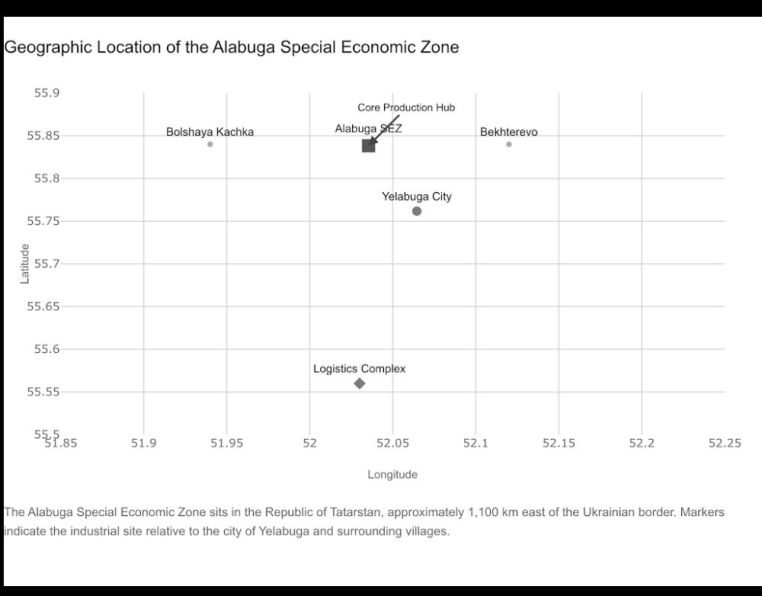
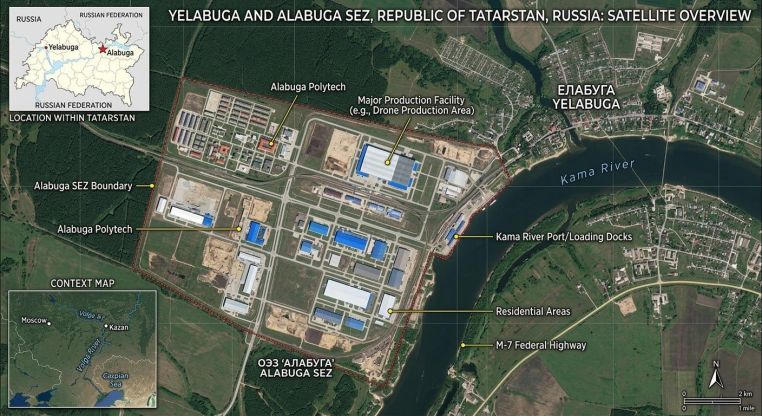
The primary manufacturing facility for these drones is located in the Alabuga Special Economic Zone (SEZ) in the Republic of Tatarstan, Russia. Since the signing of a bilateral agreement in February 2023, Russia and Iran have collaborated to turn this industrial park into the epicenter of their joint drone production efforts. Satellite imagery analyzed in early 2026 shows that the Yelabuga factory has expanded from two buildings under construction to a massive 17-facility complex encompassing over 2.8 million square meters. This industrial scaling allowed Russia to achieve production volumes of over 5,500 units per month, far exceeding the initial targets set during the project’s inception.
The Alabuga SEZ functions as more than just a Russian-Iranian project; it has evolved into a hub for the “Adversary Entente,” involving China and North Korea. China provides critical manufacturing equipment and logistical support, exemplified by the establishment of the Deng Xiaoping Logistics Complex at the SEZ in September 2024 to facilitate the flow of PRC-sourced components. Reports also suggest that North Korea provides labor to the facility, potentially allowing for even greater expansion of production lines. This four-way center of technological exchange allows these nations to share combat data and manufacturing expertise, creating a resilient defense industrial base that operates outside the reach of Western economic and military pressure.
To maintain this high output, the Alabuga SEZ established an international recruitment pipeline known as “Alabuga Start.” This program targets young women from Latin American and African countries, offering them airfare and housing under the guise of hospitality or catering work-study programs. Upon arrival, these recruits find themselves working in harsh conditions, assembling Geran drones in heavily monitored facilities where facial recognition and strict nondisclosure agreements limit their ability to communicate with the outside world. This labor model highlights the regime’s willingness to use unconventional methods to sustain the industrial-scale production of weaponry during a time of international isolation.
The Strategic Pivot-America’s Adoption of the LUCAS Drone
In an ironic development, the United States military adopted the very tactics used by its adversaries by deploying its own reverse-engineered version of the Shahed drone. The platform, designated as the Low-cost Unmanned Combat Attack System (LUCAS), is an American clone of the Iranian Shahed-136. Developed by the Arizona-based company SpektreWorks in less than eighteen months, the LUCAS drone provides the U.S. military with “affordable mass,” allowing for long-range strikes at a fraction of the cost of traditional cruise missiles. During Operation Epic Fury, Task Force Scorpion Strike (TFSS)—the U.S. military’s first dedicated squadron for one-way attack drones—utilized the LUCAS to strike Iranian command and control centers, naval vessels, and missile launch sites.
The LUCAS drone represents a paradigm shift in American military procurement. Traditionally focused on high-end, expensive platforms like the MQ-9 Reaper or Tomahawk missiles, the Department of Defense accelerated the development of LUCAS to counter the “asymmetric burden” imposed by Iranian drone swarms. Priced at approximately $35,000 per unit, the LUCAS allows U.S. forces to saturate enemy air defenses without exhausting limited stocks of million-dollar interceptors. Some LUCAS units incorporate advanced features such as Starlink terminals, enabling cooperative tactics and dynamic targeting while maintaining a human operator in the loop. This adoption of Iranian drone philosophy demonstrates that the flow of innovation in modern warfare is no longer a one-way street from technologically advanced states to their adversaries.
The debut of the LUCAS drone occurred on February 28, 2026, marking the first time the U.S. military utilized long-range kamikaze drones in active combat. Launches took place from ground-based catapults and the flight decks of Littoral Combat Ships like the USS Santa Barbara in the Arabian Gulf. Adm. Brad Cooper, commander of CENTCOM, praised the rapid innovation and deployment of these systems, noting that they provide “American-made retribution” against the very regime that pioneered the technology. The success of the LUCAS drone in the early stages of Operation Epic Fury has led to calls for the accelerated scaling of such “attritable” systems across the U.S. military to prepare for future conflicts with peer adversaries.
Intelligence Sharing and Tactical Advisory Roles
The military cooperation between Russia and Iran in March 2026 extended beyond hardware to include sensitive intelligence and tactical advisory roles. British Defense Secretary John Healey and other Western intelligence officials reported that Russia provides Iran with “specific advice” on drone targeting strategies. This tactical support includes recommendations on how to bypass Western air defense systems using flight paths and swarming patterns tested during the Russian invasion of Ukraine. By sharing these lessons, Moscow enables Tehran to maximize the impact of its drone arsenal against U.S. and Israeli targets with unprecedented precision.
Furthermore, reports from the Washington Post indicated that Russia has been providing Iran with the precise locations of U.S. warships and aircraft in the Middle East. This real-time intelligence sharing allows the Iranian military and its proxies to conduct more effective strikes and avoid detection by American surveillance platforms. While the Trump administration initially downplayed these reports, with special envoy Steve Witkoff stating that the Kremlin denied providing such data, President Zelenskyy insisted that his intelligence confirmed active cooperation. The sharing of intelligence is often framed by Moscow as a reciprocal act, responding to the intelligence assistance the United States provides to Ukraine.
The relationship between the two nations is also characterized by a “combat data loop.” Iran and its proxies provide Russia with valuable data on the performance of Iranian-designed systems against Western interceptors such as the Patriot and Iron Dome. This information allows Russian engineers at the Alabuga SEZ to iterate on their drone designs, leading to the development of the more resilient Geran-3 and Geran-5 variants. The result is a cycle of continuous improvement that outpaces traditional Western procurement cycles, giving the Adversary Entente a significant edge in the rapidly evolving field of autonomous warfare.
Regional Fallout and the Human Cost of Conflict
Operation Epic Fury and the subsequent Iranian retaliation have resulted in a staggering human and infrastructure cost across the Middle East. Reports indicated that over 2,000 people had been killed in Iran, Lebanon, and Israel, with hundreds of thousands more displaced by mid-March 2026. Casualty figures within Iran are particularly high, with human rights organizations like HRANA estimating over 3,000 total deaths, including at least 1,319 civilians. In addition to the leadership decapitation, the U.S. and Israeli strikes caused significant damage to schools, hospitals, and cultural heritage sites throughout Iran.
Neighboring countries also suffered from the spillover of the conflict. In Kuwait, strikes on U.S. bases resulted in several fatalities and dozens of injuries among both military personnel and civilians. The United Arab Emirates and Bahrain reported civilian and military casualties following Iranian drone and missile attacks on regional hubs. In Lebanon, the escalation between Israel and Hezbollah led to the 2026 Lebanon War, with hundreds of fatalities and widespread displacement as Israel expanded its strikes against Hezbollah infrastructure. The conflict has turned much of the Middle East into an active war zone, with the primary casualties being the civilian populations caught in the crossfire of this escalating drone and missile war.
The psychological burden on civilian populations in the Gulf has been immense. Video footage circulating on the Iranian platform Aparat and regional social media showed the persistent threat of Shahed drones penetrating air defenses, creating a constant sense of vulnerability. Unlike ballistic missiles, which are often intercepted at high altitudes, the low-flying and slow-moving drones can be seen and heard by civilians, amplifying the fear and disrupting daily life in cities like Dubai and Manama. This psychological impact is a deliberate part of the “asymmetric cost” strategy employed by Russia and Iran, aimed at undermining the morale of Western-allied populations and governments.
The DEPLETION of Defense Interceptor Stocks
A critical realization for Western military planners during the March 2026 conflict was the rapid depletion of missile defense interceptor stocks. Within the first ten days of Operation Epic Fury, the United States and its partners fired hundreds of interceptors to counter massed drone and missile attacks from Iran. Reports indicated that the U.S. military had consumed between 30 and 49 percent of its current THAAD deliveries and 20 percent of its SM-3 interceptors. This expenditure represents a dangerous drain on finite defensive resources designed to counter far more advanced threats, such as Chinese or Russian ballistic missiles.
The economic disparity between the incoming threats and the defensive response remains a fundamental challenge. Destroying a $20,000–$35,000 drone with a Patriot missile worth $4 million is an unsustainable strategy for any military. This “interceptor dilemma” has forced a reconsideration of air defense doctrine, with a renewed focus on low-cost solutions such as machine guns, electronic jamming, and interceptor drones. Ukraine has already shared its expertise in these areas, helping Gulf nations implement layered defenses that include truck-mounted miniguns and acoustic sensors to detect incoming Shahed-type targets. However, the sheer volume of drones produced at the Alabuga SEZ means that even with improved defensive tactics, some threats will inevitably saturate the network and reach their targets.
The vulnerability of regional infrastructure was further highlighted by the strike on the headquarters of the U.S. Fifth Fleet in Bahrain. Despite decades of preparedness and the presence of advanced Aegis-equipped warships, Iranian Shahed-136 drones successfully struck the facility during daylight hours. This incident served as a wake-up call for U.S. Central Command, demonstrating that traditional defensive arrays can be overwhelmed by “affordable mass” and coordinated swarm tactics. The combat debut of the LUCAS drone was a direct response to this vulnerability, as the U.S. military sought to impose its own asymmetric costs on the Iranian regime.
Geopolitical Implications: The Emergence of the Adversary Entente
The defense relationship between Russia and Iran in 2026 is the centerpiece of a broader realignment known as the “Adversary Entente.” This informal alliance between Russia, Iran, China, and North Korea has created a self-sustaining ecosystem of military production and intelligence sharing that operates outside the Western-led international order. By integrating Iranian drone designs, Russian manufacturing at Alabuga, Chinese microelectronics, and North Korean labor, these nations have developed a resilient defense industrial base that is largely immune to traditional sanctions. The expansion of this cooperation beyond bilateral agreements into a four-way technological exchange signifies a major shift in the global balance of power.
China’s role as the primary supplier of microelectronics to the Alabuga SEZ has been critical in sustaining production volumes. Between 2024 and 2025, Chinese companies surpassed all other exporters in providing drone components to Russia, despite the threat of secondary sanctions from the United States. The “Deng Xiaoping Logistics Complex” at the SEZ serves as a dedicated channel for these components, ensuring that the assembly lines for Geran drones remain operational even as Western supplies are restricted. The logistical support demonstrates China’s willingness to provide the material foundation for Russian and Iranian military capabilities, further cementing the bonds within the Adversary Entente.
The “strategic reversal” confirmed in March 2026—where Russia now supplies Iran with the very technology Tehran once provided to Moscow—highlights the dynamic and reciprocal nature of this alliance. The partnership is no longer just about the immediate requirements of the war in Ukraine or the conflict in the Middle East; it is about building a long-term, integrated defense infrastructure that can challenge Western military dominance across multiple theaters. The proliferation of Shahed-type technology, now industrialised and improved by Russian engineers, ensures that low-cost, high-impact autonomous weapons will remain a primary feature of modern warfare for the foreseeable future.
Future Outlook and Conclusion-The End of Asymmetric Advantage?
The events of March 2026 suggest that the era of asymmetric advantage for smaller, less technologically advanced militaries may be coming to an end, as major powers like the United States and Russia adopt and scale the same “low-cost mass” tactics. The debut of the American LUCAS drone and the expansion of the Russian Geran production line at Alabuga demonstrate that the major military powers have internalized the lessons of the drone wars in Ukraine and the Middle East. Warfare in the late 2020s will likely be characterized by massive swarms of “attritable” autonomous systems operating alongside traditional high-end platforms, creating a complex and highly saturated kinetic environment.
The proliferation of Shahed-type technology also poses a broader threat beyond state-on-state conflict. Intelligence officials have already noted the increasing use of similar drone technology by non-state actors, including Mexican drug cartels near the U.S. southern border. The accessibility and low cost of these systems mean that the “Shahed model” of warfare could soon be adopted by various terrorist organizations and criminal syndicates, presenting a global security challenge that traditional military forces are not currently equipped to handle. The focus on supply chain security and the control of dual-use electronics will become as critical as the development of kinetic defenses in the years ahead.
In conclusion, the March 2026 reports indicating that Russia is supplying Iran with Shahed drones mark a pivotal moment in the global security landscape. This hardware transfer, supported by intelligence sharing and tactical advisory roles, has fundamentally altered the dynamics of the conflict in the Middle East. The industrialization of drone production at the Alabuga SEZ and the emergence of the Adversary Entente have created a new reality for Western military planners, forcing them to adapt their own procurement and defensive strategies. As Operation Epic Fury continues to reshape the political and military structures of the Iranian regime, the lessons learned from this “war of the clones” will dictate the future of autonomous conflict for the next generation.
Geran-5
Based on information available as of early 2026, including detailed assessments from Ukrainian military intelligence (HUR/GUR) following the analysis of downed systems, the Russian Geran-5 (Герань-5) is a jet-powered, one-way attack (OWA) unmanned aerial vehicle (UAV).
It represents a significant technological and doctrinal shift from earlier piston-engine delta-wing drones in the “Geran” series (such as the Geran-2, based on the Iranian Shahed-136). The Geran-5 is often described by analysts as a “missile-drone” or a low-cost cruise missile, blurring the line between a traditional loitering munition and a long-range strike missile due to its high speed, conventional aerodynamic design, and turbojet propulsion.
Functions and Tactical Role
The Geran-5 is designed for long-range, high-speed precision strikes against fixed strategic targets deep within enemy territory. Its development and deployment are seen as an effort to complement Russia’s more expensive cruise and ballistic missile stockpiles with a mass-producible, less expensive alternative.
Primary Functions:
Deep Strike Munition: It serves as a one-way attack platform to destroy high-value infrastructure, such as power grid components, fuel depots, communication centers, and command posts.
Air Defense Saturation: Due to its relatively low cost compared to cruise missiles, it is used in mass “swarm” attacks to overwhelm and exhaust enemy surface-to-air missile (SAM) systems.
Atrition of Interceptor Stockpiles: It forces the adversary to use expensive, advanced air defense missiles (like Patriot or NASAMS) to intercept a much cheaper target, creating an unfavorable cost-exchange ratio.
Doctrinal Innovations:
High-Speed Penetration: The Geran-5’s turbojet engine allows it to achieve speeds that make it uncatchable by helicopers, current anti-drone interceptor UAVs, and mobile fire groups (which rely on anti-aircraft guns), requiring advanced SAMs for interception.
Air-Launch Capability: Intelligence reports indicate that Russia is exploring launching the Geran-5 from modified tactical aircraft, specifically the Sukhoi Su-25SM attack jet. This would extend the drone’s strike range by allowing release closer to the front line without risking the carrier aircraft in heavily defended airspace. It also restores operational relevance to older aircraft platforms.
Capabilities
The capabilities of the Geran-5 are optimized for a high-speed strike profile, contrasting sharply with the low, slow, and loitering nature of the Geran-2.
Performance:
Strike Profile: It flies a direct path to its target at much higher speeds than previous Gerans. While it maintains a “one-way” attack function, its aerodynamic design is built for sustained, efficient flight rather than prolonged loitering.
Speed Advantage: The key distinguishing feature is its flight speed, which allows it to decrease the warning time for defenders and complicates interception efforts.
Payload and Damage: The 90 kg warhead is significantly larger than that of many tactical drones, providing enough destructive power to cause severe damage to hardened or large-scale infrastructure.
Guidance and Navigation:
The Geran-5 utilizes a multi-layered, resilient navigation suite to ensure arrival at the target despite heavy electronic warfare (EW) environments.
Anti-Jam Satellite Navigation: It is equipped with Russia’s Kometa-M satellite navigation system, which features a multi-element (reported 12-channel) Controlled Reception Pattern Antenna (CRPA). This system is designed to reject jamming and spoofing signals.
Inertial Navigation Backup: For phases of flight where satellite signals might be completely lost, it relies on a backup inertial navigation system (often cited as Sadra/Minsoo), ensuring it continues on its heading, albeit with accumulating error.
Cellular Network Integration: Perhaps the most innovative and controversial feature is the inclusion of a telemetry and data transmission system based on 3G/LTE modems (such as Xingkai Tech Mesh Network modems). This system can use the adversary’s own civilian mobile phone networks for real-time telemetry and potentially for an additional layer of location-based service (LBS) navigation, which relies on cell tower triangulation.
Survivability:
Materials: The fuselage skin, wings, and tail assembly are constructed of carbon fiber and composites to potentially reduce its radar signature and weight, while the internal load-bearing frame uses aluminum and steel.
Detection Profile: While its jet exhaust provides a stronger infrared (IR) signature than a piston engine, its higher speed reduces the time window for IR-guided MANPADS to lock on.
Specifications
The following specifications are based on data compiled from multiple credible sources, including analysis of debris by the Ukrainian Main Directorate of Intelligence (HUR) and Western think tanks.
Physical Dimensions:
Design: A conventional aerodynamic “missile-like” configuration with a slender, cylindrical fuselage and large, un-swept (straight) main wings. It features dorsal (top-mounted) air intakes for the engine and endplate rudders on the tail assembly.
Length: Approximately 6 meters (~20 feet).
Wingspan: Approximately 5.5 meters (~18 feet).
Maximum Takeoff Weight (MTOW): Approximately 850 kg (~1,870 lb).
Propulsion:
Engine Type: Turbojet engine.
Engine Model: Identified as the Telefly TF-TJ2000A (originating from China).
Thrust: Reported at 200 kilogram-force (kgf), or approximately 1,960 newtons.
Performance Data:
Maximum Strike Range: 950 km to 1,000 km (~590 to 620 miles).
Cruising Speed: 450 to 600 km/h (~280 to 370 mph).
Maximum Flight Duration: Approximately 2 hours.
Operational Ceiling: Recorded use shows a practical effective range of 200 meters to 3,000 meters (650 to 9,800 feet), although the theoretical maximum ceiling is reported to be 6,000 meters (19,700 feet).
Warhead and Electronics:
Warhead Weight: Approximately 90 kg (~198 lb) high-explosive.
Guidance Suite: Kometa-M12 (or similar) anti-jam GNSS/GLONASS with 12-element CRPA antenna, combined with a Sadra/Minsoo inertial navigation unit.
Data Link/Telemetry: Tracker V3 telemetry system based on a Raspberry microcomputer, integrated with 3G/LTE modems and Xingkai Tech XK-F358 MESH networking modems.
Component Origin: Intelligence analysis reveals the reliance on widespread commercial off-the-shelf (COTS) and restricted microelectronics from countries including China, the United States, and Germany. Specific components from U.S. companies like Texas Instruments, CTS Corporation, and Monolithic Power Systems have been identified in downed units, highlighting Russia’s ability to circumvent international sanctions.


You must be logged in to post a comment.