

Prague Will Not Be Discussing Yesterday’s Threats at IS2 2026
Cybersecurity conferences often promise urgency. Very few actually earn it.
IS2 2026 in Prague looks different.
Set against the theme “No Time to Hesitate,” the upcoming Information Security Summit arrives at a moment when hesitation has become a liability. Attackers move faster. Signals arrive in fragments. AI speeds up offense, noise, and deception at the same time. Security teams still face pressure to decide quickly, yet many still rely on methods built for a slower fight.
Rather than offering another tour through familiar security slogans, the session goes straight at a harder question: How do defenders make better decisions before visible damage begins?
Why this talk stands out
Most people in the room will already know Zero Trust as an architecture model. Segmentation, identity control, least privilege, verification. Necessary, yes. Sufficient, no.
Real incidents rarely fail because a slide deck lacked the right vocabulary. Teams fail when they misread intent, trust weak signals, chase the wrong anomaly, or react in ways that help the attacker.
That is where this session gets interesting.
The talk pushes Zero Trust beyond infrastructure and into analyst judgment. It connects technical controls with structured analytic thinking, showing why security teams need more than rules, dashboards, and static indicators. It argues for a sharper operating model, one built around verification, competing hypotheses, adaptive risk ranking, and action taken before the breach reaches full force.
For an audience of Czech security professionals, that is not theory. That is operational reality.
Prague is the right place for this discussion
Prague is not a neutral backdrop for a talk like this.
Czech institutions, operators, and security leaders understand the cost of delay better than most. They have seen how cyber risk spills into public trust, critical services, and national resilience. They know that response time is now measured in minutes, not days. They know that compliance language alone does not stop an adaptive adversary.
A strong Prague audience will also appreciate that the talk does not float above the real world. It stays anchored in the pressures facing critical infrastructure, regulated environments, and teams working under NIS2-era expectations.
That makes the session timely. It also makes it practical.
What the audience will get
Expect a session that connects strategy to operations without losing pace.
Topics include:
- why reactive security breaks down against adaptive attacks
- why valid credentials and normal-looking activity still hide hostile intent
- how structured analytic techniques cut through noise and bias
- how dynamic threat ranking changes staffing and hunt priorities
- how predictive intelligence helps teams move left of exploit
- why AI should act as a junior analyst, not the final decision-maker
The appeal of the session lies in the mix. It speaks to executives who need stronger decision models, analysts who need clearer tradecraft, and defenders who are tired of being told to “be proactive” without being shown what that actually looks like.
Expect more than a technical talk
A memorable conference talk does more than explain a method. It changes how the audience looks at familiar problems.
That is the real pull here.
The session challenges a comfortable habit inside security culture: the belief that more telemetry automatically creates more clarity. In practice, raw signal often creates confusion. Better outcomes come from better judgment, better structure, and better sequencing.
That message is likely to land hard at IS2 2026.
Professionals in the room will hear ideas they can argue with, question, test, and bring back to their teams. That is exactly what a strong summit talk should do.
Why you should be in the room
Some talks confirm what people already think. Some talks open a live debate that continues in the hallway, over coffee, and long after the conference ends.
Expect the latter.
If your work touches critical infrastructure, security operations, cyber defense, risk governance, or incident response, this session deserves a place on your list. If you care about how teams think under pressure, not only how they deploy controls, it deserves even more.
Prague will host many conversations at IS2 2026.
Few are likely to feel more immediate than one built around a simple idea with uncomfortable force behind it:
Security teams can no longer wait for certainty before they act.
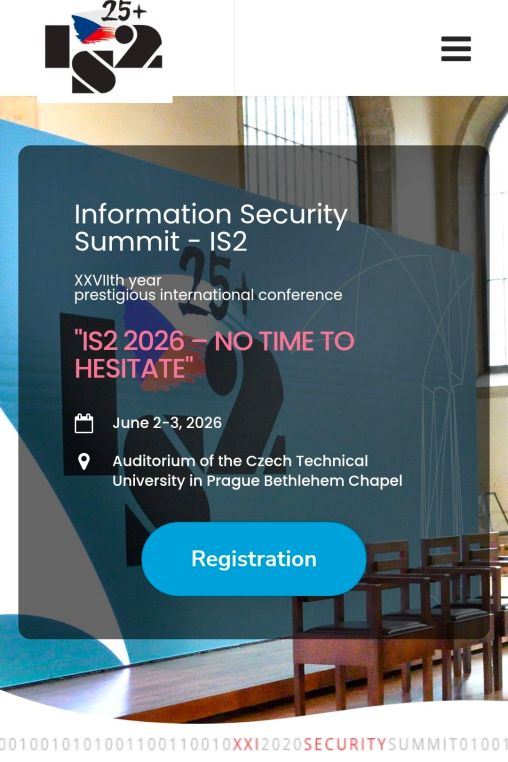
IS2 2026 – Prague
Information Security Summit – IS2
June 2-3, 2026
Auditorium of the Czech Technical University in Prague, Bethlehem Chapel
For anyone serious about where cyber defense is heading next, Prague looks like the right place to be.