

Operation Epic Fury marks a tectonic shift in American power projection as the Low-cost Uncrewed Combat Attack System (LUCAS) moves from rapid prototyping to combat validation. The United States now prioritizes “affordable mass” over “exquisite platforms,” adopting a doctrine of attritable precision that undermines traditional integrated air defense systems through numerical saturation and economic asymmetry.
- The Department of Defense (DoD): Transitioned acquisition models under Secretary Pete Hegseth’s “Drone Dominance” mandate.
- SpektreWorks: The Arizona-based lead contractor that reverse-engineered and improved the Shahed-136 architecture.
- Task Force Scorpion Strike (TFSS): The SOCCENT-led unit responsible for the operational deployment of LUCAS units.
- Iranian Leadership: Targeted and decapitated during the opening phases, including Supreme Leader Ali Khamenei and Defense Minister Aziz Nasirzadeh.
LUCAS represents a high-fidelity, American-refined version of the Iranian Shahed-136 loitering munition. The system integrates hardened GPS/INS navigation, Starshield satellite connectivity, and a reduced acoustic signature through the DA-215 engine. Unlike traditional aircraft, the DoD classifies LUCAS as “consumable material,” allowing for massive procurement at approximately $35,000 per unit.
Numerical superiority now rivals technical sophistication as the primary driver of air dominance. By deploying swarms of inexpensive drones, the U.S. forces adversaries into a “ruinous exchange ratio,” where multi-million-dollar interceptors must be expended against platforms costing less than a mid-sized sedan. This transformation effectively ends the era of absolute air superiority maintained by a small number of high-cost, manned assets.
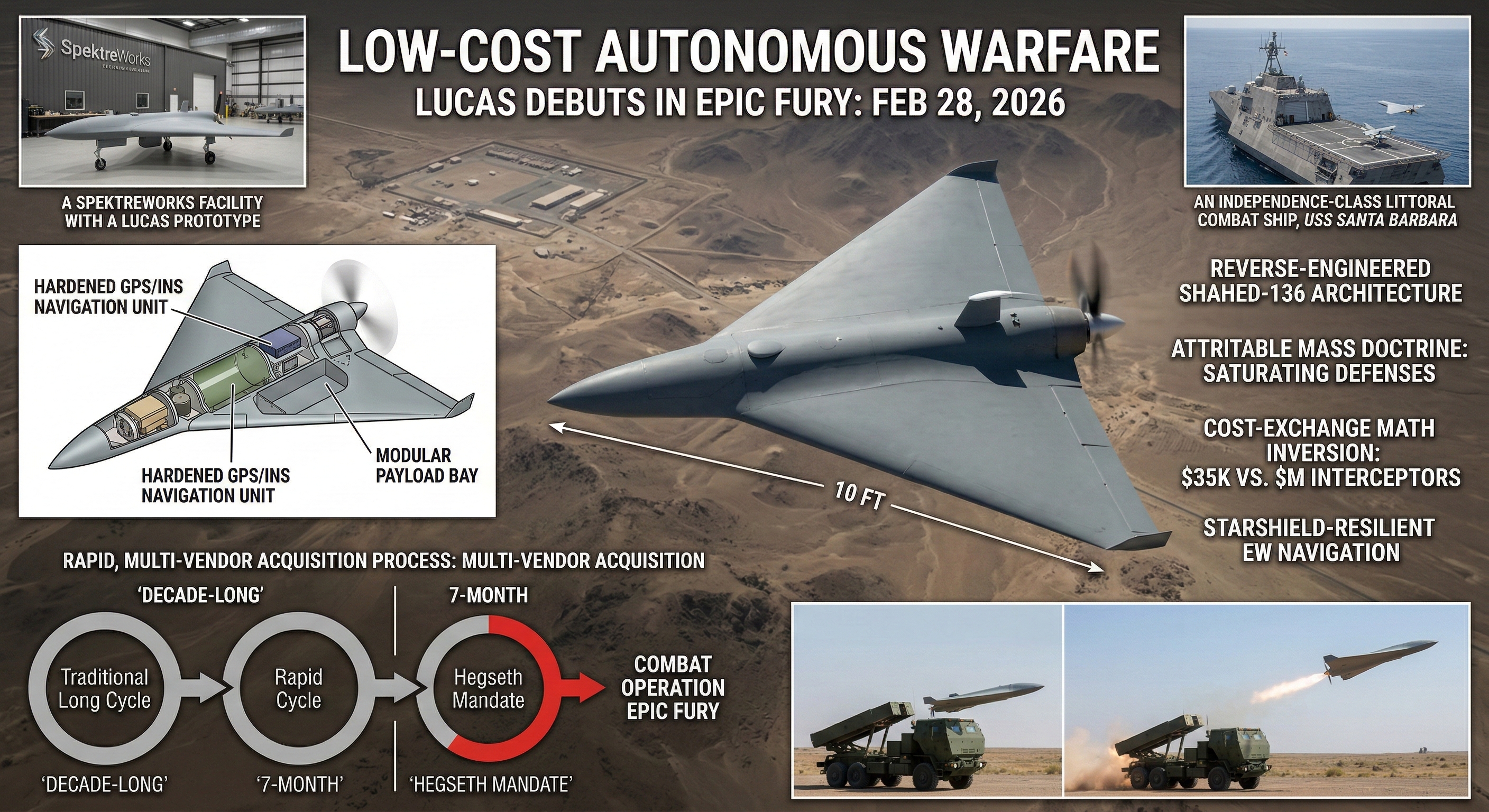
The 2024-2025 conflicts in Ukraine exposed the rapid depletion of precision-guided munition (PGM) stockpiles, proving that Western “exquisite” inventories cannot sustain high-intensity, peer-level warfare. Capture of Iranian hardware provided the technical blueprint, while the collapse of Geneva nuclear negotiations and imminent Iranian strike indicators triggered the immediate operationalization of the “Drone Dominance” policy.
- Tactical Efficacy: LUCAS units saturated Iranian air defenses during Epic Fury, enabling follow-on strikes by B-2 and F-35 aircraft.
- Leadership Decapitation: Coordinated strikes killed the Supreme Leader and the core IRGC command structure within hours.
- Strategic Procurement: The DoD compressed the standard decade-long acquisition cycle into 43 weeks, utilizing APFIT and TREX funding vehicles.
- Adversary Response: Iran launched multi-vector retaliatory strikes against 27 U.S. installations, demonstrating that even a decapitated command can project asymmetric power across the region.
The successful debut of LUCAS signals a permanent adoption of the “unmanned hellscape” strategy, moving beyond the Middle East to serve as a primary deterrent in the Indo-Pacific. Future trajectories suggest:
- Standardization of Attritability: The Department of War will likely institutionalize “Gauntlet” style elimination trials to maintain a multi-vendor ecosystem, targeting a production goal of 200,000 units by 2027.
- Technological Decoupling: Integration of MUSIC mesh networks and LEO satellite datalinks will render regional electronic warfare (EW) systems obsolete, creating a permanent advantage in “black zone” operations.
- Global Arms Proliferation: A secondary arms race will emerge as nations seek to counter affordable mass, potentially leading to the rapid development of directed-energy weapons and high-volume kinetic interceptors to stabilize the economic exchange math of defense.
| Feature | LUCAS (USA) | Shahed-136 (Iran) |
| Unit Cost | ~$35,000 | ~$20,000–$50,000 |
| Navigation | Hardened GPS/INS + Starshield | Civilian GPS/INS + 4G |
| Acoustic Profile | Low (DA-215 2-cylinder) | High (Mado MD-550) |
| Communication | BLOS via Starshield / MUSIC Mesh | Limited Line-of-Sight |
| Payload | Modular (Strike/ISR/Relay) | Fixed Kinetic |
The combat debut of the Low-cost Uncrewed Combat Attack System (LUCAS) on February 28, 2026, during the opening salvos of Operation Epic Fury, represents a fundamental rupture in the established paradigms of Western military intervention. The event signifies more than the introduction of a new weapon system; it marks the official adoption by the United States of an “attritable mass” doctrine that has redefined land and sea warfare since 2022. By reverse-engineering the Iranian-designed Shahed-136, a platform that had previously humiliated Western air defense systems through sheer numerical saturation and economic asymmetry, the United States military has effectively inverted the strategic equation. The transition of the LUCAS drone from a damaged, captured airframe to a combat-proven precision asset in just seven months represents a radical departure from traditional defense acquisition cycles, which typically span decades and prioritize individual platform perfection over numerical dominance. The pivot, orchestrated under the aggressive policy mandates of “Drone Dominance,” suggests a permanent change in how the Department of Defense (DoD) intends to project power in contested environments, particularly in the Middle East and the Indo-Pacific.
The Crucible of Innovation- Ukraine and the Crisis of Exquisite Systems
The intellectual and strategic lineage of the LUCAS drone is inextricably linked to the tactical realities observed on the battlefields of Ukraine during late 2024 and 2025. In that theater, the proliferation of low-cost, one-way attack (OWA) drones created an environment in which multi-million-dollar armored vehicles and hardened infrastructure were routinely neutralized by systems costing less than $400. The Russian Federation’s deployment of the Geran-2—a localized version of the Iranian Shahed-136—demonstrated that a persistent volume of “good enough” precision could overwhelm sophisticated integrated air defense systems (IADS) designed to counter a smaller number of high-end cruise missiles.
Before the operationalization of the LUCAS, Western defense philosophy prioritized “exquisite” platforms- stealthy, manned, and prohibitively expensive systems like the F-35 and the Gerald R. Ford-class carriers. While these systems remain unmatched in individual capability, the conflict in Eastern Europe highlighted a critical vulnerability in the American arsenal- the finite depth of precision-guided munition (PGM) stockpiles. Institutional assessments revealed that in a high-intensity conflict with a peer adversary, the US would deplete its primary PGM inventories in as little as seven to ten days. The requirement for a low-cost, mass-producible alternative became a strategic imperative to avoid a “capability inversion,” in which an adversary could dictate the tempo of conflict through sheer numerical superiority.
The capture of damaged Shahed specimens during operations against Iranian-backed militias in Iraq and Syria between 2021 and 2023 served as the technical catalyst. Analysis by US technicians revealed that the Shahed incorporated significant Western components, including U.S.-made GPS modules and microchips, which paradoxically facilitated its disassembly and adaptation by American firms. Rather than treating the specimen solely as an intelligence object for defensive countermeasures, the DoD tasked the Arizona-based startup SpektreWorks with creating an improved version that could be produced rapidly at a price point that changed the cost-exchange math of precision-strike operations.
Technical Anatomy and Evolutionary Refinement of the LUCAS Platform
The LUCAS drone is not a direct 1-1 copy of the Shahed-136 but rather a high-fidelity reconstruction that integrates American advances in autonomous navigation, material science, and modular design. While maintaining the signature 10-foot triangular delta-wing configuration for aerodynamic stability and long-range loitering, SpektreWorks introduced several key engineering improvements that distinguish the LUCAS from its Iranian predecessor.
Propulsion Systems and Acoustic Masking
A primary vulnerability of the original Shahed-136 was its loud acoustic signature, caused by its four-cylinder Mado MD-550 engine (a reverse-engineered German Limbach L550E). The “moped-like” sound often gave frontline troops and air defense crews several minutes’ warning before impact. The LUCAS addresses this by using a two-cylinder DA-215 (215 cc) carbureted internal combustion engine. The engine provides enhanced fuel efficiency and a significantly reduced acoustic profile, making the drone harder to detect via acoustic sensors.
Furthermore, the LUCAS family of systems includes variants incorporating electric propulsion for ultra-quiet operations and a minimized thermal signature during the terminal phase of flight. The diversification of propulsion ensures the platform can be tailored to the target’s specific defensive environment, using piston engines for long-range ferry missions and electric motors for stealthy infiltration into high-threat zones.
Navigation and Resilience in Jammed Environments
One of the most significant technological leaps in the LUCAS design is its resilience against electronic warfare (EW). While the baseline Shahed relies on civilian-grade GPS and rudimentary inertial guidance systems susceptible to spoofing and jamming, the LUCAS uses a hardened GPS/Inertial Navigation System (INS) architecture. Analysis of combat footage from Operation Epic Fury and subsequent Russian military commentary indicates that operational LUCAS units are equipped with miniature satellite datalinks, allowing for beyond-line-of-sight (BLOS) control and real-time target reassignment.
A particularly alarming development for Russian and Iranian military observers was the identification of Starlink-compatible receiving antennas integrated into the LUCAS airframe. Russian analysts have argued that the use of high-bandwidth, narrow-beam communication from Low Earth Orbit (LEO) constellations like SpaceX’s Starshield makes the LUCAS nearly impossible to jam with conventional regional EW systems. The capability allows the drone to maintain precision guidance and provide a continuous data stream to operators until impact, effectively transforming a “fire and forget” kamikaze drone into a dynamic loitering munition.
Modular Payload and Multi-Role Capability
The LUCAS was designed with an open architecture to support a variety of mission sets beyond one-way kinetic strikes. The system features interchangeable nose sections and auxiliary bays, allowing it to be reconfigured in the field by non-specialized personnel.
| Performance Category | LUCAS Specification | Comparison to Shahed-136 |
| Length | ~10 feet (3 meters) | Nearly Identical |
| Wingspan | ~8 feet (2.4 meters) | Nearly Identical |
| Unit Cost | ~$35,000 | ~$20,000–$50,000 |
| Max Range | 1,000–2,000 km | 2,500 km (Iranian claim) |
| Payload Capacity | 18–50 kg (40–110 lbs) | 45–50 kg |
| Cruise Speed | 93–115 mph (150–185 km/h) | 185 km/h |
| Engine Type | 215cc 2-cylinder DA-215 | 550cc 4-cylinder Mado MD-550 |
| Guidance | Hardened GPS/INS + Starshield | Civilian GPS/INS + 4G Modem |
The modularity permits the LUCAS to serve in intelligence, surveillance, and reconnaissance (ISR) roles when equipped with nose-mounted gimbaled cameras and EO/IR sensors. Furthermore, its integration with the Multi-Domain Unmanned Systems Communications (MUSIC) mesh network allows a single LUCAS unit to function as a communication relay node. The capability enables a swarm of drones to extend the reach of uncrewed systems in environments where traditional long-range communications are degraded or jammed, effectively creating an ad hoc, airborne data network over the target area.
The Transformation of Procurement- Speed, Economics, and the Hegseth Mandate
The development of the LUCAS is a case study in the successful execution of the DoD’s Acquisition Transformation Strategy. The program’s movement from a public unveiling on July 16, 2025, to active combat use by February 28, 2026—a duration of approximately 43 weeks—is unprecedented for a Group 3 UAS. In contrast, a typical Major Defense Acquisition Program (MDAP) often takes seven years or more to reach the development stage known as “Milestone B”.
Institutional Support and Funding Vehicles
The rapid fielding of the LUCAS was facilitated by several key institutional reforms and funding vehicles designed to bypass traditional bureaucratic friction-
APFIT (Accelerate the Procurement and Fielding of Innovative Technologies)- The program was instrumental in securing a $30 million initial production contract for SpektreWorks. APFIT was designed specifically to bridge the “Valley of Death” between prototype validation and large-scale manufacturing, enabling successful startups to scale without waiting for the standard 2-year Congressional budget cycle.
TREX (Technology Readiness Experimentation)- Participation in the TREX 2025 evaluations under the Office of the Under Secretary of Defense for Research and Engineering (OUSD R&E) enabled rapid validation of LUCAS’s technological maturity.
REJTF (Rapid Employment Joint Task Force)- Formed by CENTCOM in September 2025, this task force focused on three pillars- capabilities, software, and technological diplomacy. The REJTF created the operational conditions for the drone’s deployment within weeks of its formation.
The Hegseth Doctrine and “Consumable” Assets
The strategic shift was catalyzed by Secretary of Defense Pete Hegseth’s July 2025 initiative, “Unleashing U.S. Military Drone Dominance”. Hegseth’s memorandum and the subsequent Executive Order 14307 fundamentally reclassified Class 1 and Class 2 drones as “consumable materials”. By viewing these platforms as munitions—essentially “grenades with wings”—rather than “prized aircraft,” the DoD removed the requirement for lengthy certification processes and high-end NATO standards that are unnecessary for single-use expendable systems.
A critical component of this doctrine is the delegation of procurement authority. Under the new policy, unit commanders at the colonel level were granted the authority to independently acquire, test, and operate small UAS platforms, fostering a culture of battlefield innovation and rapid iteration. The shift was supported by a $1 billion commitment to equip combat units with low-cost, domestically produced drones, with the goal of manufacturing 200,000 units by 2027.
Multi-Vendor Strategy and Elimination Trials
To prevent the “vendor lock-in” that often plagues high-tech defense programs, the LUCAS design was specifically engineered for mass production by multiple suppliers. The DoD deliberately avoided dependency on SpektreWorks as the sole manufacturer, encouraging competition from firms such as Griffon Aerospace, which developed the MQM-172 Arrowhead as a competing derivative of the Shahed/LUCAS concept.
The procurement model has shifted toward “elimination trials” or “Gauntlet” phases, in which vendors must demonstrate performance in realistic strike scenarios before receiving fixed-price production contracts. The approach prioritizes operational efficacy and manufacturing scalability over traditional paper-based source selection. In early 2026, the first of these trials, Gauntlet 1, invited 25 vendors to demonstrate their capabilities, with the Department of War intending to select 12 to deliver 30,000 drones.
Operation Epic Fury- The Crucible of Combat Deployment
The LUCAS’s combat debut occurred on February 28, 2026, as part of Operation Epic Fury, a massive, coordinated strike campaign against the Islamic Republic of Iran. The operation was initiated following the collapse of nuclear negotiations in Geneva and intelligence indicators that Iran was planning preemptive strikes against US and allied targets in the region.
The Opening Phase- Decapitation and Saturation
Operation Epic Fury commenced at 1-15 a.m. EST (9-45 a.m. Tehran local time) with a sophisticated layering of kinetic and non-kinetic effects. US Cyber Command and US Space Command initiated the campaign by degrading Iranian communications and blinding its integrated air defense networks, followed by a synchronized wave of more than 100 aircraft, including B-2 bombers, F-35s, and F-22s.
The primary objective was a “strategic decapitation” of the Iranian leadership and the destruction of its offensive missile capabilities. Initial strikes targeted the Pasteur Street district in Tehran, destroying the compound of Supreme Leader Ayatollah Ali Khamenei. Subsequent reports confirmed the deaths of Khamenei and several other high-ranking officials, including Defense Minister Aziz Nasirzadeh and IRGC Ground Forces Commander Mohammad Pakpour.
| IRGC/Iranian Official | Role / Command | Status |
| Ali Khamenei | Supreme Leader of Iran | Killed in Initial Strike |
| Masoud Pezeshkian | President of Iran | Reported Target (Status Disputed) |
| Aziz Nasirzadeh | Minister of Defence | Confirmed Killed |
| Mohammad Pakpour | IRGC Commander-in-Chief | Confirmed Killed |
| Ali Shamkhani | Secretary of the National Security Council | Confirmed Killed |
| Abdolrahim Mousavi | Chief of Staff, Armed Forces | Confirmed Killed |
| Mohammad Shirazi | Head of Military Bureau | Confirmed Killed |
Task Force Scorpion Strike- The New Face of Regional Power
The kinetic portion of the drone campaign was managed by Task Force Scorpion Strike (TFSS), an elite one-way attack drone squadron led by personnel from US Special Operations Command Central (SOCCENT). TFSS had been stood up in December 2025 and deployed to undisclosed bases in the Middle East with approximately 50 LUCAS units.
During the first 12 hours of the operation, the US and its partners carried out nearly 900 strikes across nine cities, including Isfahan, Qom, and Karaj. The LUCAS drones were used to saturate and suppress Iranian air defenses, forcing radar systems into a state of saturation and clearing the path for more expensive precision assets like Tomahawk missiles. By deploying swarms of $35,000 drones, the US was able to strike IRGC command nodes and missile launch sites at a fraction of the cost of traditional weapons.
A notable aspect of the LUCAS deployment was its versatility in launch mechanisms. While the majority of units were ground-launched from mobile truck platforms, the system had demonstrated its capability to be deployed from naval vessels. On December 16, 2025, a LUCAS unit was successfully launched from the flight deck of the Independence-class littoral combat ship USS Santa Barbara in the Persian Gulf, marking the first shipboard employment of the platform.
Adversary Response- The Multi-Domain Iranian Counter-Strike
Iran’s response to Operation Epic Fury followed a pre-planned, multi-vector doctrine intended to impose costs on the US and its regional partners. Despite the decapitation of its senior command structure, the IRGC implemented retaliatory waves using its remaining stockpiles of ballistic missiles and Shahed drones.
Targeting the US Basing Architecture
The IRGC confirmed targeting at least 27 US installations across the region, viewing the US basing network as a unified operational system rather than discrete sites. Impact occurred at several key locations-
- Al Udeid Air Base (Qatar)- Targeted by missile and drone barrages.
- Al Dhafra Air Base (UAE)- Encountered multiple incoming threats; UAE authorities reported intercepting 137 missiles and 209 drones in the first 24 hours.
- Ali Al Salem Air Base (Kuwait)- An Iranian Shahed drone successfully struck the base.
- Naval Support Activity (Bahrain)- The headquarters of the US Fifth Fleet was hit by several drones, resulting in minimal damage to an empty warehouse and a radar installation.
- In a significant expansion of the conflict’s geographic scope, an Iranian drone successfully reached the British sovereign base of RAF Akrotiri in Cyprus, striking a runway and demonstrating Iran’s ability to project power into the Eastern Mediterranean.
Casualties and Operational Attrition
As of March 2, 2026, US Central Command confirmed that six service members had been killed in action during the operation. The casualties occurred when an enemy weapon bypassed layered air defenses and struck a tactical operations center during the initial phase of Epic Fury.
The fog of war also led to tragic friendly fire incidents. On March 1, three US F-15E Strike Eagles were mistakenly shot down by Kuwaiti air defenses while flying missions over Kuwait. During active combat that included attacks from Iranian aircraft, missiles, and drones, the Kuwaiti systems misidentified the American fighters; however, all six crew members ejected safely.
Iranian Asymmetric Tactics and the “Hormuz Codex”
Beyond kinetic strikes, Iran used its cyber capabilities and proxy networks to disrupt regional security. The IRGC Cyber-Electronic Command oversaw the deployment of wiper malware against energy sectors and banking networks in the Gulf. In the maritime domain, a Marshall Islands-flagged oil tanker became the first ship struck by an Iranian uncrewed surface vessel (USV), signaling the IRGC’s intent to close the Strait of Hormuz. While US officials disputed claims that the Strait had been closed, the threat of systemic maritime collapse led to immediate spikes in global energy prices and shipping insurance costs.
Second and Third-Order Insights- The Strategic Logic of Mass
The deployment of the LUCAS drone and the events of Operation Epic Fury signal a fundamental transformation in global military dynamics. The success of “affordable mass” indicates several emerging trends that will dictate future conflict.
The Erosion of Conventional Air Superiority
The success of the LUCAS drone in saturating sophisticated air defenses suggests that the era of absolute air superiority achieved through a small number of high-end platforms may be ending. Future conflicts are likely to be defined by prolonged, networked engagements driven by autonomous systems rather than traditional frontline armies. The ability to deploy thousands of $35,000 drones forces a defender into a ruinous economic exchange, where they must use interceptors costing millions (like the Patriot PAC-3) to stop platforms that cost less than a used car.
The Starlink/Starshield Decoupler
The integration of commercial and government LEO satellite constellations represents a genuine shift in the electronic warfare equation. By using narrow-beam, interference-resistant signals from constellations like Starshield, the US military has bypassed the regional jamming networks that Russia and Iran have refined over decades. The decoupling of precision strike from traditional GPS-based navigation allows for accurate targeting in “black zones” where electronic warfare was previously thought to provide sanctuary. Russian analysts have already identified this as a “wake-up call” that necessitates a complete overhaul of their own defensive doctrines.
Poetic Justice and Information Operations
The US decision to openly reverse-engineer the Iranian design—and then use it to strike the very factories where the original Shaheds were made—serves as a potent information operation. The “poetic justice” undermines Iranian claims of technological sovereignty and demonstrates that the US can master and improve upon an adversary’s most impactful weapons in less than a year. By utilizing a platform that the IRGC itself designed, the US has turned Iran’s own tactical playbook into an instrument of its leadership’s destruction.
The Global Drone Arms Race and Future Trajectories
The LUCAS project has sparked a renewed arms race in uncrewed systems, moving the focus from long-range surveillance to attritable strike capability.
The Indo-Pacific Deterrent- The “Hellscape” Strategy
While the LUCAS debuted in the Middle East, its ultimate strategic significance lies in the Indo-Pacific. In a potential conflict over the Taiwan Strait, the ability to deploy thousands of autonomous systems to create an “unmanned hellscape” is seen as a primary deterrent against Chinese military action. The low cost and ease of production of systems like the LUCAS enable distributed operations across island chains, reducing the vulnerability of centralized command structures and large surface assets such as aircraft carriers.
Emerging Projects and Next-Generation Platforms
The LUCAS is only the first of a broader portfolio of attritable assets being developed under the Drone Dominance mandate-
Project Artemis- A DIU-led initiative to prototype ground-launched, affordable one-way UAS platforms with ranges of 50-300 km+. The project focuses on operations in disrupted, disconnected, and low-bandwidth environments, with four companies currently under contract- Swan, Dragoon, AeroVironment, and Auterion.
MQM-172 Arrowhead- Developed by Griffon Aerospace, this multi-purpose drone is similar in concept to the Shahed/LUCAS but designed for even greater range (1,500 nautical miles) and a larger 100-pound payload.
Gauntlet Demonstration Trials- The DoD is institutionalizing a culture of continuous competition, in which vendors are evaluated on their ability to scale production and reduce unit costs to as low as $2,300 per drone.
The Permanent Shift to Attritable Precision
The combat deployment of the LUCAS drone during Operation Epic Fury validates the radical acquisition reforms initiated by Secretary Hegseth and the Trump administration. By breaking the bureaucratic mold of the 20th-century defense industrial complex, the US military has successfully transitioned to a model that prioritizes speed, economic discipline, and numerical mass. The seven-month development cycle of the LUCAS proves that the DoD can keep pace with the rapid evolution of modern threats when given the authority to treat uncrewed systems as consumable munitions rather than permanent aircraft.
However, the events in Iran also highlight the inherent risks of this new era. The democratization of long-range strike capabilities allowed even a decapitated regime to project power as far as Cyprus and strike Fifth Fleet headquarters. The friendly fire incidents and the successful Iranian impacts on US installations underscore that defending against “affordable mass” remains an unsolved problem, even for the world’s most advanced military. As the US military moves to integrate Starshield navigation and MUSIC mesh networking across its entire uncrewed fleet, the global landscape will increasingly move toward distributed lethality. The legacy of the LUCAS drone will not merely be its performance over Tehran, but its role in ushering in a future where mass matters, cost is decisive, and autonomy is the primary engine of victory in the 21st-century theater of war.
- Works cited
- After first combat appearance, LUCAS drones ‘remain ready’ for future Epic Fury strikes against Iran | DefenseScoop, https-//defensescoop.com/2026/03/02/lucas-drones-operation-epic-fury-iran-strikes/ 2. THE HORMUZ CODEX- KINETIC ESCALATION, LEADERSHIP DECAPITATION AND MARITIME SYSTEMIC COLLAPSE – https-//debuglies.com, https-//debuglies.com/2026/03/02/the-hormuz-codex-kinetic-escalation-leadership-decapitation-and-maritime-systemic-collapse/ 3. US Unveils LUCAS Drone- Reverse-Engineered Shahed-136 Weapon Designed to Flip the Script on Iran – Defence Security Asia, https-//defencesecurityasia.com/en/us-lucas-drone-reverse-engineered-shahed-136-iran-counter/ 4. US Military Has Used Long-Range Kamikaze Drones In Combat For The First Time, https-//www.twz.com/news-features/u-s-military-has-used-long-range-kamikaze-drones-in-combat-for-the-first-time 5. LUCAS Attack Drone Sees First Combat In Operation Epic Fury, Turning Iran’s Own Shahed Design Against Tehran, https-//dronexl.co/2026/02/28/lucas-attack-drone-epic-fury-iran-shahed-design/ 6. Unleashing US Military Drone Dominance – Department of War, https-//media.defense.gov/2025/Jul/10/2003752117/-1/-1/1/UNLEASHING-U.S.-MILITARY-DRONE-DOMINANCE.PDF 7. White House and DoD Unleash New Directives on Drones | Paul Hastings LLP, https-//www.paulhastings.com/insights/client-alerts/white-house-and-dod-unleash-new-directives-on-drones 8. Department of Defense Accelerates Drone Procurement- A Game-Changer for Military Operations – Dronelife, https-//dronelife.com/2025/07/15/department-defense-accelerates-drone-procurement-military-operations/ 9. US deploys LUCAS kamikaze drones against Iran ‘for first time in combat’, https-//kyivindependent.com/us-deploys-one-way-drones-against-iran-following-ukraines-battlefield-experience/ 10. The War in Ukraine and Drone Terrorism, https-//ctc.westpoint.edu/wp-content/uploads/2025/07/CTC-SENTINEL-072025.pdf 11. After Russia, China & US “Clone” UAV That Wreaked Havoc On Ukraine’s Defenses & Pockets; What Makes It Special? – EurAsian Times, https-//www.eurasiantimes.com/after-russia-china-what-makes-it-special/ 12. Iran-Israel War Latest Update- USS Gerald R. Ford World’s Largest Aircraft Carrier Now to Lead Operation Fury Against Iran – The Sunday Guardian, https-//sundayguardianlive.com/world/iran-israel-war-latest-update-uss-gerald-r-ford-worlds-largest-aircraft-carrier-now-to-lead-operation-fury-against-iran-173539/ 13. US Adoption of Low-Cost Long-Range Expendable Drones- Strategic Imperatives from Ukraine’s Battlefield Innovations in the Indo-Pacific Era, 2025 – https-//debuglies.com, https-//debuglies.com/2025/10/18/us-adoption-of-low-cost-long-range-expendable-drones-strategic-imperatives-from-ukraines-battlefield-innovations-in-the-indo-pacific-era-2025/ 14. Low-cost Uncrewed Combat Attack System – Wikipedia, https-//en.wikipedia.org/wiki/Low-cost_Uncrewed_Combat_Attack_System 15. US Bombs Iran With Shahed-136 Clones- CENTCOM Confirms LUCAS Drone Debut in Operation Epic Fury – EurAsian Times, https-//www.eurasiantimes.com/u-s-bombs-iran-with-shahed-136-clones-centcom-confirms-lucas-drone-debut-in-operation-epic-fury/ 16. The LUCAS poetic justice- US uses Iran’s own ‘Shahed’ drone tech in combat against Tehran, https-//www.theweek.in/news/defence/2026/03/02/the-lucas-poetic-justice-us-uses-irans-own-shahed-drone-tech-in-combat-against-tehran.html 17. The US is using Iran’s own ‘one-way’ suicide drone against Iran – We Are The Mighty, https-//www.wearethemighty.com/tactical/lucas-drone-iran-shahed/ 18. HESA Shahed 136 – Wikipedia, https-//en.wikipedia.org/wiki/HESA_Shahed_136 19. “Shocking Replica” Of Iranian UAV, Is US’ Low-Cost, High-Impact LUCAS Derived From Shahed-136 Drone? – EurAsian Times, https-//www.eurasiantimes.com/cost-high-impact-lucas-shahed-136-drone/ 20. Littoral Combat Ship Launches Shahed-136 Kamikaze Drone Clone – The War Zone, https-//www.twz.com/air/american-shahed-136-clone-fired-from-navy-littoral-combat-ship 21. American-Made Shahed-136 Kamikaze Drone Clones Being Tested By Marines, https-//www.twz.com/air/american-made-shahed-136-kamikaze-drone-clones-being-tested-by-marines 22. LUCAS Drone’s Starlink Terminal Alarms Russian Military Analysts — Musk Says It Violates Terms Of Service, https-//dronexl.co/2026/03/02/lucas-drone-starlink-alarms-russian-military/ 23. US develops its own version of Iranian kamikaze drone – Defence Blog, https-//defence-blog.com/pentagon-showcases-u-s-made-shahed-style-drone/ 24. ‘One-way attack drone’ used by US for first time in Iran strikes- What LUCAS is and how it works, https-//timesofindia.indiatimes.com/defence/international/one-way-attack-drone-used-by-us-for-first-time-in-iran-strikes-what-lucas-is-and-how-it-works/articleshow/128904438.cms 25. Pentagon’s DOGE Unit Seizes Control Of Drone Program After Replicator Failures, Targets 30,000-Unit Buy – Drones, https-//dronexl.co/2025/10/31/pentagon-doge-unit-seizes-control-of-drone-program/ 26. Next big arms race- Who can build the most drones nobody minds losing, America, Russia or China? – The Economic Times, https-//m.economictimes.com/news/defence/next-big-arms-race-who-can-build-the-most-drones-nobody-minds-losing-america-russia-or-china/articleshow/122509729.cms 27. Leading with Lethality- Hegseth’s Drone Strategy & What’s Next | Independent Women, https-//www.independentwomen.com/2025/09/22/leading-with-lethality-hegseths-drone-strategy-whats-next/ 28. Drone Dominance Program – Carahsoft, https-//static.carahsoft.com/concrete/files/9617/6702/7829/Drone_Dominance_Program_1.pdf 29. ‘Another democratic Shahed’- US Introduces MQM-172 Arrowhead Drone, https-//militarnyi.com/en/news/another-democratic-shahed-u-s-introduces-mqm-172-arrowhead-drone/ 30. ‘Operation Epic Fury’- How US, Israel encircled Iran before joint strikes, https-//timesofindia.indiatimes.com/defence/international/operation-epic-fury-how-us-israel-encircled-iran-before-joint-strikes/articleshow/128881852.cms 31. Experts React- What the Epic Fury Iran Strikes Signal to the World – Stimson Center, https-//www.stimson.org/2026/experts-react-what-the-epic-fury-iran-strikes-signal-to-the-world/ 32. Weapons of ‘Epic Fury’- Fighters, Missiles, and ‘Special Capabilities’, https-//www.airandspaceforces.com/weapons-of-epic-fury-fighters-missiles-and-special-capabilities/ 33. In surprise daytime attack, U.S., Israel take out Iranian leadership, https-//www.washingtonpost.com/national-security/2026/02/28/us-israel-military-operation-epic-fury-iran/ 34. IRAN IN TRANSITION- STRATEGIC INTELLIGENCE ASSESSMENT – Post-Khamenei Succession Crisis, Retaliatory Doctrine & Regional Escalation Calculus – https-//debuglies.com, https-//debuglies.com/2026/03/01/iran-in-transition-strategic-intelligence-assessment-post-khamenei-succession-crisis-retaliatory-doctrine-regional-escalation-calculus/ 35. US uses ‘low-cost one-way attack drones’ for first time in combat during Iran strikes, https-//www.washingtonexaminer.com/policy/defense/4475813/us-attack-drones-first-combat-iran-strikes/ 36. The Aircraft Behind the US Strikes on Iran – Flying, https-//www.flyingmag.com/the-aircraft-behind-the-u-s-strikes-on-iran/ 37. US military uses ‘kamikaze’ drones against Iran, improved clones of Shahed-136, https-//gulfnews.com/world/mena/us-military-uses-kamikaze-drones-against-iran-improved-clones-of-shahed-136-1.500459182 38. PERSPECTIVE- Operation Epic Fury Ends Negotiating Deadlock, Targets Iran’s 47-Year “Death to America” Campaign – HSToday, https-//www.hstoday.us/perspective/perspective-operation-epic-fury-ends-negotiating-deadlock-targets-irans-47-year-death-to-america-campaign/ 39. Hegseth Says ‘Epic Fury’ Goals in Iran Are ‘Laser-Focused’ – Department of War, https-//www.war.gov/News/News-Stories/Article/Article/4418826/hegseth-says-epic-fury-goals-in-iran-are-laser-focused/ 40. 2026 Israeli–United States strikes on Iran – Wikipedia, https-//en.wikipedia.org/wiki/2026_Israeli%E2%80%93United_States_strikes_on_Iran 41. Operation Epic Fury commences as US and Israel attack Iran | Liberty Champion, https-//www.liberty.edu/champion/2026/03/02/operation-epic-fury-commences-as-u-s-and-israel-attack-iran/ 42. Return To Sender? America’s ‘Shahed Clone’ Included In Military Buildup Around Iran, https-//www.rferl.org/a/shahed-copy-drone-iran-america-lucas-conflict/33689700.html 43. US And Israel At War With Iran (Updated), https-//www.twz.com/news-features/iran-is-under-attack 44. US Deploys Reverse-Engineered Shahed Clones Against Iran in Combat Debut, https-//www.sofx.com/u-s-deploys-reverse-engineered-shahed-clones-against-iran-in-combat-debut/ 45. From Kamikaze drones to Tomahawk missiles- What capabilities did US and Israel use in historic joint strikes on Iran?, https-//www.hindustantimes.com/world-news/us-news/from-kamikaze-drones-to-tomahawk-missiles-what-capabilities-did-us-and-israel-use-in-historic-joint-strikes-on-iran-101772343069529.html 46. Operation Epic Fury – Details of Attack – SOF News, https-//sof.news/middle-east/details-on-operation-epic-fury/ 47. US confirms first combat use of LUCAS one-way attack drone in Iran strikes, https-//www.militarytimes.com/news/your-military/2026/02/28/us-confirms-first-combat-use-of-lucas-one-way-attack-drone-in-iran-strikes/ 48. Operation Epic Fury – laststandonzombieisland, https-//laststandonzombieisland.com/tag/operation-epic-fury/ 49. Iran Responds to Operation Epic Fury with Layered Military, Cyber, and Proxy Strategy Amid Escalation Constraints, https-//www.hstoday.us/subject-matter-areas/counterterrorism/iran-responds-to-operation-epic-fury-with-layered-military-cyber-and-proxy-strategy-amid-escalation-constraints/ 50. US, Israel launch Operation Epic Fury against Iran; Tehran strikes back, https-//www.indiatoday.in/world/story/explosions-rock-tehran-as-israel-launches-preventive-attack-on-iran-defence-minister-says-2875809-2026-02-28 51. Iran Supreme Leader Ayatollah Ali Khamenei is dead, White House confirms – Military Times, https-//www.militarytimes.com/news/pentagon-congress/2026/02/28/iran-supreme-leader-ayatollah-ali-khamenei-is-dead-white-house-confirms/ 52. Escalation in the Middle East- Tracking “Operation Epic Fury” Across Military and Cyber Domains | Flashpoint, https-//flashpoint.io/blog/escalation-in-the-middle-east-operation-epic-fury/ 53. Iran’s Shahed drone hits RAF Akrotiri runway as UK Typhoon scores first Iranian drone kill over Qatar, https-//dronexl.co/2026/03/02/iran-shahed-drone-hits-raf-akrotiri-runway/ 54. US CENTCOM confirms first combat use of LUCAS drones – Air Force Technology, https-//www.airforce-technology.com/news/us-centcom-lucas-drone-iran/ 55. Latest Posts | The War Zone, https-//www.twz.com/latest 56. What They’re Saying About Operation Epic Fury—March 2, 2026, https-//www.unitedagainstnucleariran.com/press-releases/what-theyre-saying-about-operation-epic-fury-march-2-2026 57. Iranian Kamikaze Drone Boat Makes First Successful Strike Of War, https-//www.twz.com/news-features/iranian-kamikaze-drone-boat-makes-first-successful-strike-of-war 58. Iran‑Israel War- What is LUCAS ‘One‑Way Attack’ Drone Used for the First Time in Operation Epic Fury to Hit Iran? – The Sunday Guardian, https-//sundayguardianlive.com/world/iranisrael-war-what-is-lucas-one-way-attack-drone-used-for-the-first-time-in-operation-epic-fury-to-hit-iran-173453/ 59. What We Know About Drone Use in the Iran War, https-//carnegieendowment.org/emissary/2026/03/iran-drones-shahed-us-lessons 60. Report- US Imitates Iran’s Shahed Drone Technology under LUCAS Project – ABNA English, https-//en.abna24.com/news/1765089/Report-US-Imitates-Iran-s-Shahed-Drone-Technology-under-LUCAS 61. US Presents Low-Cost LUCAS Strike Drone Inspired by Shahed, https-//militarnyi.com/en/news/u-s-presents-low-cost-lucas-strike-drone-inspired-by-shahed/ 62. News – DIU selects four companies to provide long-range, one-way unmanned platforms prototypes for evaluation – SAE Media, https-//www.smgconferences.com/editors-corner/5822-news–diu-selects-four-companies-to-provide-longrange-oneway-unmanned-platforms-prototypes-for-evaluation 63. 4 Companies Selected To Prototype Long-Range, One-Way Unmanned Platforms, https-//www.diu.mil/latest/four-companies-selected-to-provide-long-range-one-way-unmanned-platforms
