


The Fragmentation of the Jalisco New Generation Cartel
The security landscape of North America underwent a seismic shift on February 22, 2026, when a coordinated military strike in the western state of Jalisco resulted in the death of Nemesio Rubén Oseguera Cervantes, who was widely known as El Mencho. This event was not merely a localized law enforcement success but rather the culmination of immense geopolitical pressure exerted by the administration of United States President Donald Trump upon the Mexican government led by President Claudia Sheinbaum. The operation represents a critical juncture at which the concepts of national sovereignty and security cooperation collide within a subordinate relationship that many critics argue strips Mexico of its independent authority. As the Jalisco New Generation Cartel, or CJNG, faces an unprecedented power vacuum, the broader implications for regional stability, the global financial system, and the upcoming 2026 FIFA World Cup have become the focal point of international concern.
The Strategic Context of the February 2026 Raid
A marked escalation in tension between the White House and the National Palace in Mexico City defined the geopolitical environment leading up to the death of Oseguera Cervantes.
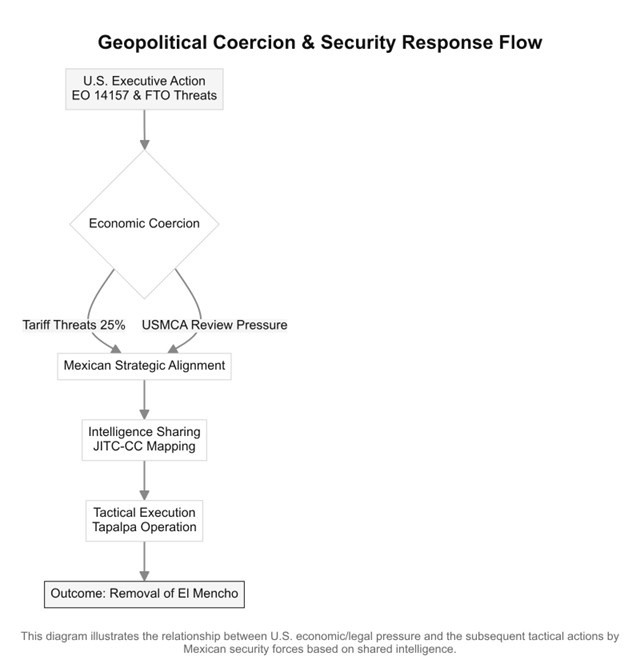
Since the inauguration of President Trump in January 2025, the United States has employed a combination of economic threats and national security declarations to pressure the Mexican government into adopting a more aggressive posture, culminating in Executive Order 14157, which declared transnational drug cartels a national security threat and laid the groundwork for designating organizations like the CJNG as Foreign Terrorist Organizations. This designation triggers immediate blocking obligations and provides the legal basis for the “material support” felony that has historically anchored US counterterrorism enforcement.
President Claudia Sheinbaum, who took office in October 2024 as Mexico’s first female president, has found herself in a precarious position. While she is a close ally of former President Andrés Manuel López Obrador and initially sought to continue his focus on the social roots of crime, the reality of US pressure has necessitated a strategic pivot. The Trump administration has frequently threatened to impose a 25 percent tariff on all Mexican goods under the International Emergency Economic Powers Act (IEEPA in response to what it characterizes as a fentanyl and migration emergency. Although the US Supreme Court ruled in February 2026 that IEEPA cannot be used to impose tariffs, the constant threat has served as a powerful lever to spur Mexican military action.
| Strategic Lever | Impact on Mexican Policy | US Legal Basis |
| FTO Designation | Freezes assets and allows for “material support” prosecutions | Anti-Terrorism and Effective Death Penalty Act |
| Tariff Threats | Compels border militarization and high-value targeting raids | IEEPA and Section 232 of the Trade Expansion Act |
| Military Intervention | Forces Mexico to demonstrate independent capability to avoid invasion | Commander-in-Chief authorities and National Emergency declarations |
| USMCA Joint Review | Negotiates security cooperation as a condition for trade pact survival | Trilateral trade agreement provisions for 2026 |
Technical Execution and the Intelligence Paradox
The Mexican Army carried out the operation that led to the death of El Mencho with the support of the National Guard and the Mexican Air Force, but it relied entirely on US technical and intelligence guidance. Specifically, the US Joint Interagency Task Force Counter Cartel (JITC-CC) provided mapping of cartel presence and movements. Intelligence personnel tracked a trusted associate connected to Oseguera Cervantes’s romantic partner, which eventually led them to the Tapalpa Country Club, an upscale gated residential development. On February 22, federal troops initiated a raid that quickly devolved into a fierce firefight as cartel gunmen used high-caliber firearms and rocket launchers to defend their leader.
The details of the confrontation reveal the extent of the cartel’s paramilitary capabilities. A military helicopter providing aerial support was struck by gunfire and forced to make an emergency landing in Sayula while cartel members established over 250 roadblocks across 20 states to disrupt the military’s movements. Oseguera Cervantes was eventually located in the surrounding forest undergrowth, where he was critically wounded during a pursuit by Special Forces. He died during an emergency medical transfer to Mexico City after officials diverted the flight away from Guadalajara due to security concerns.
The tactical victory has been framed by US officials, such as Deputy Secretary of State Christopher Landau, as a “great development,” but it also underscores the subordinate nature of Mexico’s security apparatus. By acting on US intelligence and responding to White House directives, the Mexican government effectively operates as a proxy in a conflict that many analysts argue is an ideological tool for regional dominance. The deployment of drones and extensive networks of local informants by US agencies in Mexico is a clear demonstration of this relationship, which often strips the country of its national sovereignty.
| Operation Detail | Metric or Outcome | Significant Location |
| Date and Time | February 22, 2026, at dawn | Tapalpa Country Club, Jalisco |
| Cartel Casualties | 8 killed, including Oseguera Cervantes | Tapalpa and the surrounding woods |
| Security Force Casualties | 25 soldiers and 34 gunmen killed in retaliatory wave | National Guard bases in Jalisco |
| Captured Equipment | Armored vehicles 7, long firearms 2, rocket launchers | Sayula and Tapalpa |
| Aerial Support Incident | Emergency landing after being hit by heavy weaponry | Sayula Jalisco |
Sovereignty as a Proxy
The Political Economy of Tariffs and Coercion
The pressure on the Sheinbaum administration extends beyond mere security cooperation into full economic alignment. In early 2026, President Trump signed an executive order targeting countries that provide oil to Cuba, which directly impacted Mexico, as it had become the top supplier of fuel to the island. Sheinbaum was forced to pause these shipments and declare it a “sovereign decision” while simultaneously dealing with threats of unilateral military strikes against drug-trafficking cartels. This environment creates a paradox in which Mexico must sacrifice its foreign policy independence to preserve the U.S.-Mexico-Canada trade agreement (USMCA), which is vital to its economy.
Critics suggest that the war on drugs is being used as a justification for a new phase of contemporary imperialism. The “putinization” of US foreign policy, as described by some academics, involves using unchecked war powers and spectacles of violence to mask political failures at home. By framing drug cartels as an existential threat, the US government justifies the militarization of territories for political intervention and economic exploitation, including the use of weaponized drones and the cultivation of informants, which serve to tighten control over the populations of both nations while disenfranchising marginalized communities.
| Policy Instrument | Economic Leverage | Target of Intervention |
| Plan Mexico | Attracting 277 billion in investment | Industrial and renewable energy sectors |
| Cuba Oil Embargo | Threatened tariffs on oil suppliers | Mexican state oil company Pemex |
| USMCA Review | Potential withdrawal or revision of trade terms | Trilateral manufacturing and agriculture |
| China Tariffs | Alignment with US trade policy | Mexican imports of Chinese goods |
Financial Engines and Global Banking Complicity in Trade-Based Money Laundering
One of the most persistent aspects of the cartel dilemma is the integration of illicit proceeds into the legitimate economy through sophisticated money-laundering techniques.
Cartels have moved beyond simple drug trafficking to become sophisticated financial engines that utilize trade invoice manipulation, shell companies, and informal payment systems. This trade-based money laundering, or TBML, allows them to move billions of dollars through the manipulation of invoices for fungible commodities like electronics, furniture, and heavy equipment.

Major global banks have been accused of disregarding the origins of this money, preferring to accumulate vast cash reserves and invest in financial derivatives and real estate speculation. In a landmark 2024 case, an international bank pled guilty to conspiracy to commit money laundering and paid over 3 billion dollars in penalties for allowing Chinese money laundering networks to deposit hundreds of millions in cartel cash. These networks provide a corrupt symbiotic relationship where drug proceeds are used to bypass currency conversion caps in countries like China while integrating dirty money into the global financial system.
In 2025, the Mexican government implemented significant reforms to its Anti-Money Laundering Law to raise standards for identifying beneficial owners and tracing funds in high-risk sectors such as real estate and precious metals. However, the scale of the problem remains staggering as approximately 80 percent of global drug trafficking profits are believed to be laundered in the banks of consuming countries rather than in producing nations, leaving countries like Mexico to deal with the bodies and destruction while the financial centers of the world profit from the liquidity.
| Laundering Sector | Regulation or Penalty | Mechanism of Evasion |
| Real Estate | Mexican AML Law Fraction V reform | Construction and development intermediation |
| Banking | 3 billion dollar settlement in 2024 | Chinese money laundering networks or CMLNs |
| High-Value Goods | Fractions VI and VII of Mexican law | Precious metals and works of art |
| Timeshare Fraud | OFAC sanctions on Kovay Gardens | Defrauding older US citizens via wire transfers |
| Crypto Exchanges | Over 1 billion in penalties in 2025 | Lack of KYC and transaction monitoring |
The 2026 FIFA World Cup Security Risks and the Guadalajara Vacuum
The death of Oseguera Cervantes represents a significant strategic risk for President Sheinbaum as it coincides with the final preparations for the 2026 FIFA World Cup. Guadalajara, the heart of Jalisco state and a primary stronghold of the CJNG, is set to host crucial matches and qualifying mini-tournaments in March 2026. The outbreak of violence following the raid, including the torching of vehicles and the closure of airports in Guadalajara and Puerto Vallarta, has raised serious concerns about the safety of international delegations and fans.
President Sheinbaum has insisted that there is “no risk” for visitors and that all guarantees for the tournament remain in place. FIFA President Gianni Infantino has also expressed confidence in the security measures being implemented by the Mexican authorities. However, the instability in Jalisco is undeniable as the cartel’s retaliatory wave led to a state of high alert and the postponement of multiple domestic soccer matches. Success in organizing this global event is seen as a golden opportunity to attract foreign direct investment and create jobs for Mexican youth, but unchecked violence threatens to squander these hopes.
The intercontinental play-offs scheduled for late March 2026 in Guadalajara and Monterrey will serve as a critical test of the government’s ability to regain full control of security. These matches involve teams from across the globe, including representatives from Africa, Oceania, and South America, and any further disruptions could lead to calls to move the games to other host cities in the United States or Canada.
| Match Type | Participating Teams | Location |
| Intercontinental Semi-final | New Caledonia vs Jamaica | Guadalajara |
| Intercontinental Semi-final | Bolivia vs Suriname | Monterrey |
| World Cup Group A | Mexico and South Africa | Mexico City opening game |
| World Cup Group H | Spain and Uruguay | Guadalajara marquee match |
| UEFA Play-off Potential | Ukraine vs Iceland or Azerbaijan | Scheduled for March 2026 |
Retaliation and Fragmentation
The Future of the Jalisco Cartel
The immediate response to the killing of El Mencho was a “rampage of revenge” that paralyzed parts of western Mexico.
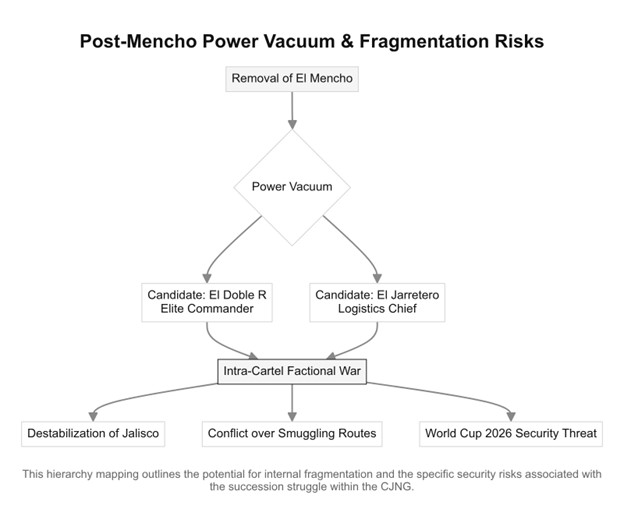
Cartel henchmen set fire to pharmacies and convenience stores, and over 1000 people were forced to shelter overnight inside the Guadalajara zoo to avoid the chaos. Experts predict that the organization will now face a period of intense internal fragmentation as prominent field commanders like “El Doble R” and “El Jarretero” vie for succession. This competition threatens to spark bloody factional wars for territorial control and strategic smuggling routes, which will further burden Mexican government agencies.
Historically, the targeting of cartel leaders has led to an increase in localized violence without dismantling the diversified economic structures of criminal organizations. The rudimentary nature of clandestine fentanyl laboratories allows cartels to rebuild rapidly, often within days of a military raid. Furthermore, the diversification of the CJNG into industries like energy and transportation means that the death of a single leader is unlikely to significantly reduce the volume of narcotics being trafficked into the United States.
If the cartel feels truly cornered, it may resort to even more extreme modes of retaliation, including the intentional increase of drug potency through the substitution of fentanyl with carfentanil to create a mass casualty overdose crisis. They may also target US citizens within Mexico or sabotage infrastructure belonging to international businesses as a form of economic warfare. This potential for escalation underscores the limits of tactical victories in the absence of a long-term strategic presence.
| Cartel Leader Influence | Succession Candidate | Strategic Territory |
| Nemesio Oseguera Cervantes | Post-death power vacuum | Jalisco and Michoacán |
| El Doble R | Elite field commander | Guanajuato and Western Jalisco |
| El Jarretero | High-level logistics chief | Strategic smuggling routes |
| The Chapitos | Rival Sinaloa faction | Sinaloa and Sonora border zones |
Structural Failures and the Need for a Comprehensive Social Strategy
While the Mexican military has demonstrated its ability to impose state authority through force of arms, these temporary security solutions remain insufficient to address the historical dilemma of organized crime. A sustainable solution requires a comprehensive national strategy aimed at addressing the deep social and economic roots of violence. Remote rural areas serve as the main recruiting pool for cartels because they lack real development alternatives and basic government services.
The Sheinbaum administration has articulated a desire to move away from the “war on drugs” rhetoric, stating that permission to kill without a trial is outside the law. However, the capacity of the current Mexican authorities to implement a strategy based on intelligence-led policing and socio-economic investment is limited by both external pressure and internal corruption. Without a sustained state presence that provides education and employment for Mexican youth, the cycle of recruitment and violence will likely continue unabated.
Furthermore, the role of the United States in enabling the cartels through high demand for illicit drugs and the constant flow of firearms into Mexico cannot be ignored. A more effective strategy would prioritize strengthening judicial systems and reducing demand, rather than relying on militarized tactics that often exacerbate the very problems they seek to solve. The path forward requires a rethinking of the bilateral relationship, moving away from a model of subordination toward one of genuine collaboration aimed at the welfare of both nations.
| Policy Aim | Tactical Method | Desired Structural Outcome |
| Reduce Violence | Intelligence-led policing | Lower homicide rates and stable governance |
| Dismantle Finance | Targeting political patrons | Disruption of the middle operational layer |
| Economic Stability | USMCA compliance and FDI | Job creation for marginalized youth |
| Border Security | Technology and joint operations | Interdiction of fentanyl and precursors |
The killing of Nemesio Oseguera Cervantes on February 22, 2026, represents a landmark event in the ongoing struggle against transnational criminal organizations in North America. While it offers a momentary tactical victory for the Mexican military and a political win for the Trump administration, it also exposes the deep-seated vulnerabilities of the Mexican state. The subordination of Mexico’s security policy to US directives, the pervasive influence of illicit capital in the global banking system, and the looming shadow of the 2026 World Cup all point to a complex and volatile future. As the Jalisco cartel fragments and new leaders emerge, the need for a structural shift toward social development and judicial reform is more urgent than ever. The success of the North American region in the coming years will depend not on the deaths of individual kingpins but on the collective ability to address the root causes of a crisis that has, for too long, defined the lives of millions on both sides of the border.


You must be logged in to post a comment.