


The security dynamic surrounding Japan shifted fundamentally in late 2025 as Chinese and Russian forces transitioned from routine airspace probing to high intensity combat rehearsals and direct threat simulation targeting the Japan Self Defense Forces.
The People’s Liberation Army of China and the Russian Armed Forces engaged in coordinated aggressive maneuvers against the Japan Air Self Defense Force and the United States Japan security alliance.
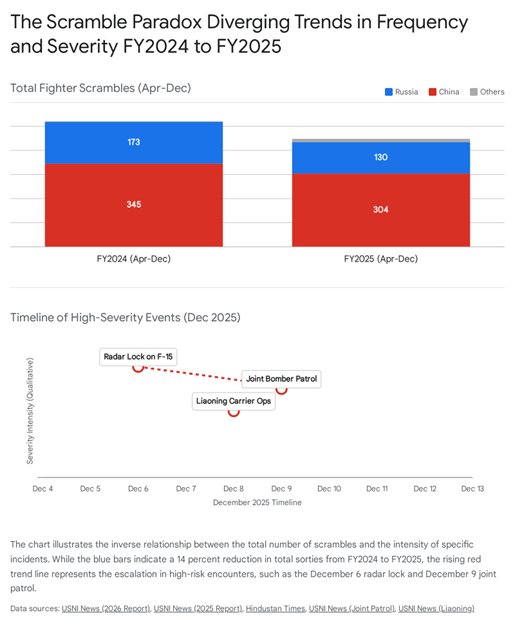
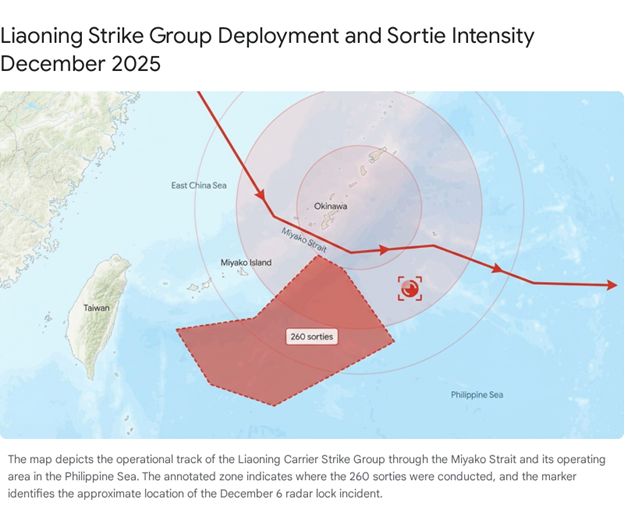
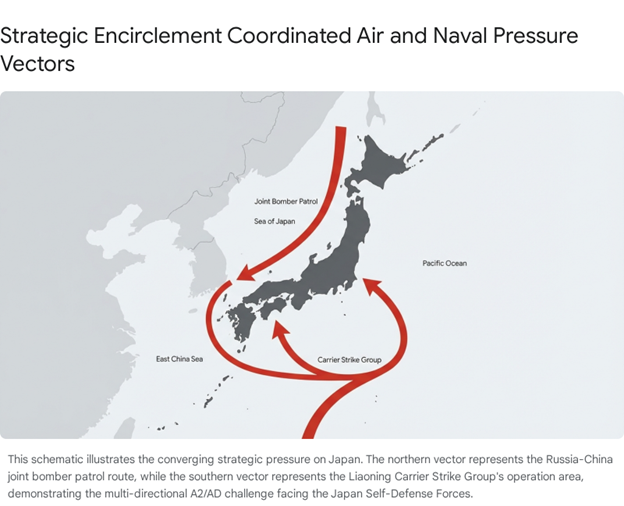
The Japan Joint Staff Office reported 448 fighter scrambles between April and December 2025 which represents a fourteen percent decrease from the previous year yet operational severity spiked dramatically. Chinese J 15 fighters executed a fire control radar lock on a Japanese F 15 for thirty minutes on December 6 while the Liaoning carrier group conducted 260 sorties in the Philippine Sea. Russian and Chinese bombers subsequently performed their tenth joint strategic patrol with fighter escorts on December 9 to encircle the Japanese archipelago.
The escalation proves that Beijing and Moscow now possess the interoperability to challenge Japan on multiple fronts simultaneously and the intent to use lethal targeting protocols in peacetime. The Liaoning deployment to the Pacific forces Tokyo to divide its air defense attention between the traditional western front and the exposed eastern flank. These actions normalize dangerous tactical behavior and significantly increase the probability of a fatal miscalculation or accidental kinetic engagement in international airspace.
Adversaries intensified their pressure campaign to punish Prime Minister Sanae Takaichi for explicitly linking Taiwan’s defense to Japanese national survival in November 2025. Beijing seeks to degrade the political resolve of the US Japan alliance and demonstrate the high cost of intervention in a Taiwan crisis before the 2026 strategic planning cycle begins.
The Japanese government lodged severe diplomatic protests and the United States State Department formally criticized China for the radar incident which marked a rare direct condemnation of tactical conduct. Operational fatigue within the Japan Air Self Defense Force continues to accumulate as pilots face complex integrated strike packages rather than simple navigational incursions. The security environment has deteriorated to a point where routine patrols now carry the psychological and technical weight of active combat missions.
The Indo Pacific theater will likely experience a permanent state of gray zone crisis throughout 2026 as China regularizes carrier operations east of Okinawa. Japan must accelerate the deployment of standoff counter strike capabilities and harden its electronic warfare defenses to survive this new operational reality. We anticipate adversaries will increasingly employ unmanned systems and cyber warfare alongside conventional bomber patrols to saturate Japanese sensor networks and force a political concession regarding Taiwan.
The security architecture of East Asia has undergone a fundamental transformation during the first nine months of Fiscal Year 2025. This period is defined not by a linear increase in the volume of airspace incursions but by a marked escalation in the tactical complexity and political aggression of the intercept events that have occurred. Data released by the Joint Staff Office of the Ministry of Defense indicates that the Japan Air Self-Defense Force conducted 448 scrambles between April 1 and December 31, 2025. This figure represents a fourteen percent quantitative decline compared to the 521 scrambles recorded during the same timeframe in the previous fiscal year. However, a purely statistical interpretation of this decline invites a dangerous complacency. The operational reality on the ground and in the air reveals a security environment that has deteriorated significantly in qualitative terms.
Adversary forces, specifically the People’s Liberation Army of China and the Armed Forces of the Russian Federation, have shifted their operational focus. They have moved away from frequent, low-intensity probing flights that characterized previous years. Instead, they now prioritize complex, high-intensity integrated operations that directly challenge the static defense perimeter of the First Island Chain and the established rules of engagement. This transition manifests in the execution of large-scale carrier strike group deployments, joint strategic bomber patrols with fighter escorts, and the utilization of fire-control radar against Japanese assets. These actions signal a departure from surveillance-based operations toward active combat rehearsals and coercive signaling.
Three critical developments define this new phase in Indo-Pacific security dynamics. First, the December 6 incident involving the illumination of a Japan Air Self-Defense Force F-15 fighter by a Chinese J-15 carrier-based aircraft using fire-control radar constitutes a significant breach of normative military conduct. This act moves beyond passive presence into the realm of direct threat simulation and electronic warfare targeting. Second, the deployment of the aircraft carrier Liaoning into the Philippine Sea, conducting approximately 260 sorties over a brief window, demonstrates a maturing capability for sustained power projection beyond the cover of land-based air defense systems. Third, the execution of the tenth joint strategic air patrol by Chinese and Russian bombers indicates a deepening level of operational interoperability between Beijing and Moscow that complicates Japanese defensive planning.
This report provides an exhaustive analysis of these trends. It examines the quantitative data to understand the changing operational tempo of adversary air forces. It dissects the tactical mechanics and strategic implications of the fire-control radar incident. It evaluates the growing proficiency of Chinese carrier aviation through sortie generation analysis. Finally, it assesses the geopolitical ramifications of the deepening Sino-Russian military alignment and its impact on the United States-Japan security alliance.
Operational Analysis of Scramble Statistics
The Joint Staff Office of the Ministry of Defense provides the empirical foundation for assessing the airspace security of Japan. The data for the first three quarters of FY2025 offers a compelling contradiction that requires deep analytical parsing. The reduction in total scrambles from 521 in the previous year to 448 in the current period suggests a superficial easing of tensions. However, defense analysts must resist the temptation to equate lower frequency with lower risk. The composition and character of these 448 events reveal a persistent and evolving threat landscape.
National Origin and Operational Focus
The breakdown of intercepts by national origin confirms that the People’s Republic of China remains the primary challenger to Japan’s airspace integrity. Chinese aircraft accounted for approximately 68 percent of all intercepts, or roughly 304 instances. This dominance in the scramble statistics aligns with the long-term strategic objective of the People’s Liberation Army to normalize its presence within the First Island Chain and contest the airspace over the East China Sea. While the absolute number of Chinese intercepts decreased from 345 in the previous year, the proportion of Chinese activity relative to the total remains consistent. This indicates that the East China Sea continues to function as the primary theater of friction between the Japan Self-Defense Forces and the People’s Liberation Army.
Russian aircraft accounted for 29 percent of the total scrambles, representing approximately 130 instances. This figure marks a slight increase in the proportion of Russian activity compared to previous years, although the absolute numbers have fluctuated. The remaining 3 percent of scrambles involved aircraft from other nations, including Taiwan. The geographical bifurcation of these threats is distinct. Chinese operations concentrate heavily around the southwestern islands, specifically the airspace between Okinawa and Miyakojima. This corridor serves as the critical maritime and aerial gateway for Chinese forces seeking access to the deeper waters of the Philippine Sea. Conversely, Russian flight paths remain concentrated to the north and west of Hokkaido and over the Sea of Japan.
Strategic Interpretation of Declining Numbers
The decrease in raw scramble numbers likely reflects a shift in adversary doctrine rather than a reduction in intent. Several factors contribute to this trend.
First, the People’s Liberation Army Air Force and the Russian Aerospace Forces appear to be consolidating their training and patrol activities into larger, more complex force packages. In the past, single aircraft or small flights of two might have conducted probing missions to test reaction times. Today, these forces are increasingly conducting joint patrols or large-scale exercises that involve multiple bombers, fighters, and support aircraft launching simultaneously. A single scramble event against a large formation represents a much higher threat level than multiple scrambles against individual intruders, yet it may appear as a single statistical data point or a cluster of points on a single day.
Second, the increasing use of unmanned aerial vehicles affects the scramble data. While drones do trigger scrambles, their long endurance allows them to maintain a presence for extended periods without the need for the repetitive sorties required by manned aircraft. The persistent surveillance capability of high-altitude drones means that the adversary can achieve its intelligence goals with fewer distinct airframe intrusions.
Third, resource management plays a role. The high operational tempo of previous years placed immense strain on the F-15J Eagle fleet of the Air Self-Defense Force. The decrease in total launches offers a necessary reprieve for airframe life and pilot fatigue management. However, the intensity of the remaining missions has increased. Pilots now face more complex tactical scenarios, including electronic jamming and aggressive maneuvering by adversary aircraft, as evidenced by the events of December 2025.
The Liaoning Carrier Strike Group Deployment
The third quarter of FY2025 witnessed a significant deployment of the Chinese aircraft carrier Liaoning. This operation provides a clear window into the maturing naval aviation capabilities of the People’s Liberation Army Navy and its ability to project power beyond the immediate protection of land-based defenses.
Operational Timeline and Geography
The Liaoning carrier strike group transited the Miyako Strait in early December, moving from the East China Sea into the Philippine Sea. This passage is strategically vital. The Miyako Strait represents one of the few international waterways that allow the Chinese Navy to break out of the First Island Chain. By transiting this strait and establishing an operating box in the Pacific Ocean southeast of Okinawa, the Liaoning effectively flanked the Japanese archipelago.
Japanese defense planners have historically oriented their air defense architecture to the west, anticipating threats emanating from the Asian continent. The presence of a carrier strike group in the Pacific Ocean to the east forces the Air Self-Defense Force to split its attention. It creates a “two-front” air threat that complicates the allocation of interceptors and early warning aircraft. The carrier’s position also places it astride the sea lines of communication that connect Japan to the United States and Australia, simulating an interdiction capability that would be critical in any regional conflict.
Sortie Generation and Combat Capability
The Joint Staff Office reported that the Liaoning conducted approximately 260 takeoffs and landings over a period of roughly six days. This figure includes both J-15 “Flying Shark” fighter jets and various helicopter platforms such as the Z-18. This level of activity translates to a daily sortie generation rate of over 40 sorties.
While this rate remains lower than that of a United States Navy Nimitz-class carrier, which can sustain 120 sorties per day in a surge capacity, it represents a substantial improvement for the People’s Liberation Army Navy. Early deployments of the Liaoning often featured single-digit daily sortie counts, reflecting its initial role as a training vessel. The ability to sustain over 40 sorties per day indicates that Chinese deck crews have mastered the complex choreography of fueling, arming, launching, and recovering aircraft. It suggests that the carrier can now maintain a continuous combat air patrol to defend the fleet while simultaneously generating strike packages for offensive missions.
The composition of these sorties is also significant. The presence of J-15 fighters carrying live munitions and electronic warfare pods suggests that these were not merely flight training evolutions. The air wing practiced complex intercepts, maritime strikes, and air defense scenarios. The sheer volume of 260 sorties in the Pacific theater stresses the monitoring capacity of the Japan Self-Defense Forces. Each takeoff requires tracking and potential response, rapidly depleting the endurance of Japanese assets shadowing the fleet.
The December 6 Fire-Control Radar Incident
The most alarming event of the third quarter occurred on December 6, when a Chinese J-15 fighter jet locked its fire-control radar onto a Japan Air Self-Defense Force F-15 fighter. This incident represents a dangerous escalation in the tactical behavior of Chinese pilots and marks a departure from professional airmanship toward aggressive coercion.
The Mechanics of Radar Lock
To understand the severity of this incident, one must distinguish between the two primary modes of fighter radar operation.
The first mode is “Search” or “Track While Scan” (TWS). In this mode, the radar sweeps a volume of airspace to detect contacts. It provides the pilot with situational awareness of where other aircraft are located. When a radar in search mode sweeps across a target, the target’s Radar Warning Receiver (RWR) registers a periodic “ping” or symbol. This is a standard, non-threatening state of affairs in international airspace. Military aircraft routinely scan each other without implying immediate hostile intent.
The second mode is “Single Target Track” (STT), colloquially known as a “lock.” In this mode, the radar stops scanning the volume of space and focuses its energy entirely on a specific target. This continuous stream of radar energy provides the high-precision data on range, azimuth, elevation, and velocity required to guide a semi-active radar-homing missile or to cue an active radar-homing missile. When a target aircraft is locked, its RWR detects the continuous illumination and the specific waveform associated with weapons guidance. The cockpit systems typically generate an urgent audio and visual warning, alerting the pilot that they are being targeted for an imminent attack.
Operational Narrative of December 6
The Ministry of Defense reported two distinct instances of radar illumination on December 6. The first occurred in the late afternoon and lasted for approximately three minutes. The second took place in the evening and persisted for roughly thirty minutes.
The duration of these locks is particularly egregious. A momentary lock can sometimes happen accidentally if a pilot is switching modes or if the radar auto-acquires a target. However, a three-minute lock is a deliberate, sustained act. A thirty-minute lock is an extreme form of harassment that borders on psychological warfare. For half an hour, the Japanese F-15 pilot had to fly with continuous cockpit warnings indicating that a Chinese missile launch could be seconds away. This forces the pilot to remain in a state of supreme defensive readiness, potentially preparing countermeasures such as chaff and flares or evasive maneuvers. It degrades the pilot’s ability to perform other mission tasks and increases the risk of a miscalculation that could lead to a shoot-down.
Strategic Intent and Electronic Intelligence
The decision to use fire-control radar serves a dual purpose for the Chinese forces.
First, it is a tool of intimidation. By escalating the risk of the encounter, the Chinese pilot—or the commanders on the Liaoning—attempted to deter the Japanese aircraft from closing the distance. It sends a message that the People’s Liberation Army is willing to threaten lethal force to maintain the sanctity of its training areas, even in international airspace.
Second, the incident likely had an electronic intelligence (ELINT) dimension. When a fighter is locked by radar, its defensive systems often react automatically or the pilot may manually activate jamming pods. If the Japanese F-15 activated its Electronic Countermeasures (ECM) to break the lock, Chinese sensors would have been recording the specific frequencies and jamming techniques used. This data is invaluable for Chinese engineers, who use it to update their radar algorithms to be more resistant to Japanese jamming in a future conflict. By provoking the Japanese defenses, the Chinese forces attempt to map the electronic order of battle of the Air Self-Defense Force.
Diplomatic Response and Fallout
The Japanese government reacted swiftly to this provocation. Defense Minister Shinjiro Koizumi lodged a severe protest through diplomatic channels, characterizing the act as “dangerous” and “extremely regrettable.” He emphasized that the action violated the Code for Unplanned Encounters at Sea (CUES), a non-binding agreement that also applies to naval aircraft, which specifically discourages the use of fire-control radar simulation against ships and aircraft encountered in peacetime.
The United States State Department issued a statement supporting Japan, labeling the Chinese actions as “not conducive to regional peace and stability.” This diplomatic signaling reinforces the cohesion of the US-Japan alliance. However, the incident also underscores the fragility of crisis management mechanisms between Tokyo and Beijing. Despite the existence of a direct communication hotline, the tactical behavior of frontline units suggests that political restraint is not always filtering down to the operational level, or conversely, that the political level is directing these aggressive actions as a form of “wolf warrior” diplomacy.
The Joint Strategic Bomber Patrol and Encirclement
On December 9, 2025, just three days after the radar lock incident, the security situation intensified further with the execution of the tenth joint strategic air patrol by China and Russia. This operation involved Chinese H-6 bombers and Russian Tu-95 “Bear” bombers flying a coordinated long-distance route that spanned the Sea of Japan, the East China Sea, and the Western Pacific.
Integration of Fighter Escorts
A distinguishing feature of this tenth patrol was the extensive integration of fighter escorts. Russian Su-35 and Su-30 fighters, along with Chinese J-16 fighters, accompanied the bomber formation for significant portions of the route. This represents a leap in operational interoperability. Escorting long-range bombers requires precise logistical planning, as fighters have much shorter ranges and endurance than strategic bombers. The successful coordination of fighter hand-offs and the presence of mixed-nationality formations indicate that the Chinese and Russian air forces have moved beyond symbolic fly-pasts to practicing functional combined-arms operations.
The presence of fighters such as the Su-35 fundamentally changes the threat profile of the patrol. A formation of unescorted bombers is vulnerable to interception. A formation protected by advanced air superiority fighters creates a contested airspace environment. It forces the intercepting Air Self-Defense Force jets to contend not only with the bombers but also with high-performance adversaries capable of engaging in air-to-air combat. This complicates the intercept geometry and increases the number of Japanese assets required to monitor the patrol safely.
The Encirclement Strategy
The flight path of the joint patrol, when viewed in conjunction with the Liaoning carrier deployment, reveals a coordinated strategy of encirclement. The bombers transited the Tsushima Strait to enter the East China Sea from the north, while the carrier strike group operated in the Pacific to the south and east. Simultaneously, flight activities were recorded passing through the Miyako Strait.
This geometry creates a “pincer” effect around the Japanese archipelago. It demonstrates the capability of the Sino-Russian axis to strike Japan from multiple directions simultaneously. The northern vector through the Sea of Japan threatens the western coast of Honshu. The southern vector from the carrier group threatens the Pacific coast and the Ryukyu Islands. This multi-axis threat compels Japanese defense planners to distribute their resources across the entire perimeter of the nation, diluting the concentration of force available for any single sector.
Russian Activity in the Northern Theater
While the joint patrol represents the most visible aspect of Russian activity, the broader data indicates that Russia continues to maintain a distinct operational tempo in the north. Roughly 29 percent of all scrambles in FY2025 targeted Russian aircraft. These incidents primarily involve surveillance flights along the coasts of Hokkaido and the Sea of Japan. The Russian operational pattern remains focused on probing the northern air defenses of Japan and monitoring US naval activity in the region. The continued flight of Tu-95 bombers and Il-20 surveillance aircraft serves to remind Tokyo that it shares a maritime border with Russia and that the northern flank remains a zone of active military friction.
Geopolitical Context and Future Implications
The military escalation observed in the third quarter of FY2025 unfolds against a backdrop of deteriorating diplomatic relations and shifting defense policies. The actions of China and Russia appear to be calibrated responses to the hardening of Japan’s security posture.
The Taiwan-Japan Security Linkage
A primary driver of tension is the increasing clarity with which Japanese political leadership has linked the security of Taiwan to the security of Japan. In November 2025, Prime Minister Sanae Takaichi stated that a Chinese attack on Taiwan could constitute an “existential crisis” for Japan. This statement explicitly invokes the legal framework that allows the Self-Defense Forces to exercise the right of collective self-defense. Beijing interprets such statements as a direct challenge to its sovereignty claims over Taiwan and a violation of the “One China” policy foundation of Sino-Japanese relations.
The subsequent military activities—the radar lock and the encirclement drills—serve as kinetic diplomacy. They are designed to demonstrate the cost of Japan’s alignment with Taiwan. By simulating attacks on Japanese aircraft and surrounding the islands, China signals that any intervention in a Taiwan scenario would result in immediate and overwhelming strikes against the Japanese homeland. The “2025-2026 China-Japan Diplomatic Crisis” referenced in regional reports is fueled by this cycle of political statement and military counter-signaling.
The Erosion of Deterrence
The events of late 2025 suggest that the traditional deterrence mechanisms in the region are under severe stress. The willingness of Chinese pilots to use fire-control radar implies a higher risk tolerance for accidental conflict. The increasing capability of the People’s Liberation Army to project power deep into the Pacific challenges the assumption of US naval supremacy. The 260 sorties generated by the Liaoning indicate that China is rapidly closing the gap in carrier aviation, a domain that was once the exclusive preserve of the US Navy.
For the Japan Air Self-Defense Force, the future outlook is demanding. The reduction in scramble numbers offers little comfort when the remaining sorties involve high-stakes encounters with integrated strike packages. The burden of defense is shifting from simple airspace policing to complex counter-air operations. Japan must prepare for a security environment where “gray zone” coercion routinely blurs the line between peace and war, and where the airspace over the East China Sea is permanently contested.
The analysis of the first three quarters of FY2025 reveals a paradox. The total number of scrambles has declined, yet the security threat to Japan has undoubtedly increased. The statistical decrease masks a fundamental shift in adversary tactics toward consolidated, high-intensity operations that maximize strategic impact. The December 6 fire-control radar incident serves as a stark warning that the rules of engagement are fraying. The sustained operations of the Liaoning carrier strike group and the coordinated bomber patrols demonstrate that China and Russia possess the capability and the intent to encircle Japan and challenge the established order in the Indo-Pacific. As the region moves into 2026, the risk of miscalculation remains acute, requiring constant vigilance and a robust strengthening of the US-Japan alliance to maintain stability in an increasingly volatile theater.
The strategic landscape of East Asia has darkened considerably. While the raw number of scrambles fell, the tactical aggression of Chinese and Russian forces surged. The use of fire control radar and the execution of encirclement drills signal that adversaries have moved beyond surveillance. They are now actively rehearsing the mechanics of regional war.