


Estimates cover a 14–45 day horizon and express analytic judgment under uncertainty, not prediction. Actors include Iran, the United States, Israel, and the Islamic Revolutionary Guard Corps.
Sustained regime containment with prolonged repression remains the most likely outcome at roughly forty to fifty percent. Iranian leadership shows a demonstrated willingness to absorb economic damage in exchange for social control. Airspace closure reduces ambiguity during high-alert air defense operations and limits elite movement during crisis conditions.
Assessment below isolates US airstrikes as a distinct scenario and evaluates likelihood, triggers, scope, and consequences under current conditions involving Iran, the United States, Israel, and the Islamic Revolutionary Guard Corps. Judgments reflect a 7–30 day horizon.
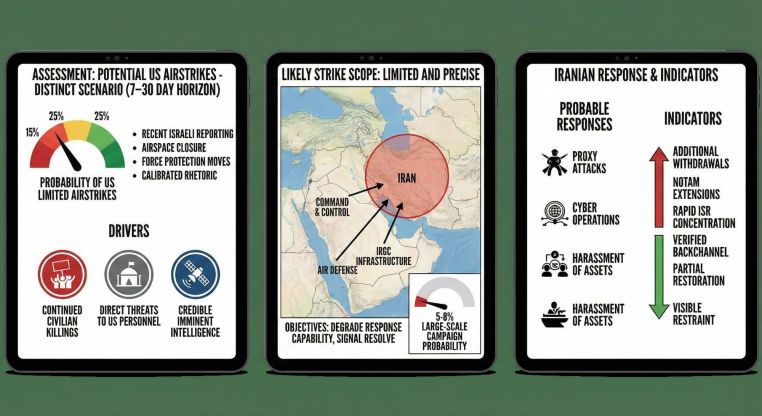
Probability of US limited airstrikes sits in the fifteen to twenty-five percent range. Recent Israeli reporting citing Western military officials who describe indicators as “imminent” raises the ceiling above background noise. Airspace closure, regional force protection moves, evacuation advisories, and calibrated US rhetoric together signal readiness rather than bluff. Decision-makers appear to treat a narrow strike package as a coercive tool rather than an opening move toward war.
Drivers pushing toward US airstrikes concentrate around three conditions. Continued mass civilian killings tied to protests create political justification framed as deterrence or protection. Direct threats to US personnel, bases, or maritime traffic raise red-line pressure rapidly. Credible intelligence showing imminent Iranian action against US or Israeli targets compresses timelines and favors preemption.
Likely strike scope remains limited and precise rather than expansive. Planners favor targets tied to command, control, intelligence, air defense, or IRGC expeditionary infrastructure rather than population centers. Objectives focus on degrading response capability, signaling resolve, and restoring deterrence without triggering regime collapse dynamics that Washington does not control. Duration likely spans hours to days, not weeks.
Probability of a large-scale US air campaign remains low at five to eight percent. Domestic unrest inside Iran increases escalation risk rather than reducing it, which restrains US planners. Leadership avoids actions that unify Iranian elites or shift protest narratives from internal legitimacy failure to external aggression. War termination uncertainty also weighs heavily against broader campaigns.
Iranian response options shape US calculus. Tehran almost certainly avoids symmetrical retaliation against the US homeland. More probable responses include proxy attacks, cyber operations, harassment of regional assets, or symbolic strikes calibrated to avoid all-out war. That expectation raises US confidence that limited strikes stay contained, yet miscalculation risk persists.
Airspace closure inside Iran aligns strongly with preparation for either receiving or responding to airstrikes. Closure removes civilian ambiguity, frees air defense bandwidth, and shortens engagement decisions. Such a move historically correlates with high-alert phases rather than routine protest control, which supports a non-trivial strike probability.
Indicators that sharply increase likelihood include additional US personnel withdrawals from exposed bases, public or leaked NOTAM extensions aligned with strike windows, rapid ISR concentration, and synchronized allied diplomatic warnings. Indicators that reduce likelihood include verified backchannel engagement, partial restoration of Iranian connectivity paired with de-escalatory messaging, or visible restraint following provocative events.
Extended telecommunications denial fragments protest coordination and suppresses external narrative amplification. Security cohesion inside the IRGC supports endurance rather than rapid compromise. Probability rises further if blackouts persist beyond another week and arrest tempo increases.
Managed normalization with selective restoration follows at roughly twenty to twenty-five percent.
Leadership historically reopens limited connectivity and civilian aviation once protest tempo drops enough to stabilize commerce and elite interests. Partial restoration allows authorities to claim order while preserving surveillance and legal pressure. Probability increases if domestic flights resume under permission regimes and mobile data returns in throttled segments alongside heavy policing.
Escalatory internal crackdown with higher lethality carries an estimated fifteen to twenty percent likelihood. Rising security force casualties, symbolic attacks on regime institutions, or mass funerals often trigger harsher measures. Prolonged isolation creates operational cover for raids and rapid adjudication. Probability increases if authorities impose curfews, accelerate executions, or expand shoot-to-kill reporting.
Limited external kinetic action against Iranian targets stands at roughly ten to fifteen percent, higher than baseline due to Israeli and Western signaling that frames attack timing as near-term. Airspace closure, regional base posture adjustments, and public red-line rhetoric suggest contingency readiness.
Decision-makers still prefer narrow strike packages over sustained campaigns. Probability increases if allied evacuations expand, ISR activity concentrates, or repeated short-notice airspace closures align with suspected strike windows.
Regional retaliation through proxies and indirect pressure carries a five to ten percent likelihood. Iran often favors deniable responses to avoid direct war during internal unrest. Proxy activation against regional targets or maritime harassment remains plausible but constrained by escalation risk. Probability rises if limited strikes occur and leadership seeks external diversion without inviting regime-threatening retaliation.
Broader regional escalation into sustained interstate conflict remains unlikely at roughly three to six percent. Leadership incentives strongly favor avoiding a multi-front war while domestic legitimacy erodes. Only a cascade of miscalculation following a strike-counterstrike cycle would push events toward this path.
Rapid regime fracture or loss of central control remains low at two to five percent. Security institutions retain cohesion, payroll continuity, and command unity. Absence of unified opposition leadership and limited elite defection suppress near-term collapse scenarios. Probability increases only with visible senior defections, provincial broadcast seizures, or a nationwide general strike that halts logistics.
Information miscalculation and accidental escalation deserves explicit mention at roughly five to eight percent across all scenarios. Communications shutdowns degrade signaling clarity and raise the risk of misinterpreting military movements, drone activity, or proxy actions. Airspace closure mitigates some risks while increasing others by compressing decision timelines.
The assessment favors a drawn-out containment strategy with intermittent repression, while external military action remains a meaningful but not dominant risk. Airspace shutdowns and blackouts function as preparatory control measures rather than definitive indicators of imminent full-scale war.


You must be logged in to post a comment.