

The author accuses the #Mexican State, along with its political, economic, and religious elites, of being directly responsible for the disappearance of over 125,000 people. The text provided (below) frames this crisis not as a failure of policy but as a deliberate, genocidal “divine crime” against the Mexican people, orchestrated by a corrupt system and characterized by a 98% impunity rate.
✝️❤️🕊🇲🇽🌹 A las Madres de los 125 mil desaparecidos en México 🌹🇲🇽🕊❤️✝️
✝️🕊 Desde lo más profundo de mi corazón les dedico estas flores. Ustedes han sido víctimas del abandono intencional del Estado Mexicano, de todas sus instituciones y de quienes hoy ostentan el poder.
✝️🕊 Nombro con toda claridad a Claudia Sheinbaum, como presidenta de México; al expresidente Andrés Manuel López Obrador, Carlos Salinas de Gortari y otros ex presidentes; al nuevo Presidente de la Suprema Corte de Justicia; al Secretario de Marina; al Secretario de la Defensa; al Secretario de Seguridad Pública; Senadores; Diputados; al Fiscal de la Nación; y a los Gobernadores y todo persona que haya participado en este crimen divino. Todos ellos son responsables de esta tragedia que carga con un índice de 98% de impunidad.
✝️🕊 La operación para desaparecer a más de 125 mil personas no podría existir sin el amparo de estas instituciones. Para el Estado, las madres buscadoras forman parte del horrible y diabólico sufrimiento intencional, porque son el mismo crimen- las ignoran, las amenazan, se burlan de su dolor y hasta las matan por intentar encontrar a sus hijas e hijos.
Y detrás de esos desaparecidos también se ocultan la mayoría de los feminicidios en México, porque a muchas mujeres asesinadas las hacen pasar como desaparecidas.
✝️🕊Esto no merece otro nombre que odio racial y genocidio al pueblo de
México. No solo matan a los desaparecidos, también asesinan en vida a sus madres, negándoles apoyo y tratándolas como si no fueran seres humanos. Ese es el punto- los deshumanizaron.
✝️🕊 La élite empresarial —escondida detrás de la Bolsa de Valores, Slim, Salinas, banqueros, etc.—, la Iglesia con sus líderes mexicanos y el Papa León XIV, junto con sus cardenales caídos en México, y toda la élite privilegiada del país con poder, que nadie ha dado la cara, ni siquiera los medios de comunicación mexicanos- todos ellos son responsables. Todos los que hoy viven del privilegio que le arrancan al pueblo son parte de este crimen.
✝️🕊 Este es el crimen más profundo y evidente del Estado Mexicano y sus aliados contra los Mexicanos.
✝️🕊Y todos ustedes, poderes del Estado y élites, han cometido sin réplica ni justificación una Blasfemia contra el Espíritu Santo y ya se saben lo que eso significa.
🔱Honor, Deber, Lealtad y Patriotismo🕊
🕊🇲🇽⚘️Todo por México⚘️🇲🇽🕊
✝️❤️🕊⚘️Pablo y Espíritu Santo⚘️🕊❤️✝️
Who, What, and So What
- The author is an anonymous individual or group (“Pablo y Espíritu Santo”) adopting a prophetic and righteous persona. The message is dedicated to the “Mothers of the 125,000 disappeared” in Mexico and accuses a comprehensive list of actors, including President Claudia Sheinbaum, former presidents, the judiciary, military leaders, legislators, business magnates like Carlos Slim, and even the Catholic Church.
- This document is a public condemnation. Its author uses highly emotional and religious language to articulate a narrative of intentional abandonment and violence by the state against its citizens. The text alleges the state’s complicity is an “operation” that dehumanizes victims and their families, hides feminicides under the guise of disappearances, and constitutes a “Blasphemy against the Holy Spirit.”
- The document’s significance lies in its raw reflection of absolute disillusionment with all formal institutions in Mexico. It signals a complete breakdown of trust between a segment of the population and the state. The author’s choice to label the crisis as “genocide” and a “divine crime” elevates the rhetoric beyond political dissent into a moral and spiritual indictment. This represents a dangerous level of societal fracture, where official authority is seen not just as incompetent but as fundamentally evil and illegitimate.
Analysis of the Strategic Environment
The timing of this message appears directly linked to Mexico’s recent political transition. Naming Claudia Sheinbaum as president places the text squarely in the present, serving as an immediate warning and challenge to her new administration. The author preemptively holds her accountable, linking her government to the perceived failures of her predecessor, Andrés Manuel López Obrador. Decades of accumulated frustration over the escalating number of disappearances have reached a boiling point, and the change in leadership provides a catalyst for expressing this pent-up rage.
As an anonymous text, its primary impact is within the digital information sphere, circulating on social media and messaging platforms. It serves as a potent piece of anti-government propaganda and a data point for measuring the social temperature. For those who share the author’s grievances, it validates their anger and feelings of abandonment. For the institutions it attacks, the text represents the challenge of governing a populace with deep-seated and justified grievances. The message contributes to an environment of extreme polarization and delegitimizes official channels for seeking justice.
Foresight
- Short-Term (0-1 Year)- Expect the proliferation of similar messages using even more extreme rhetoric. The government will likely employ a strategy of strategic silence to avoid amplifying the author’s voice. However, if the narrative gains significant traction, it could fuel more organized and potentially disruptive protests.
- Mid-Term (1-3 Years)- The trajectory depends entirely on the Sheinbaum administration’s ability to meaningfully address impunity. Should the government fail to make significant progress in investigating disappearances and prosecuting those responsible, the worldview presented in this text—that of a malevolent “deep state”—will gain greater currency. This erosion of legitimacy could hamper governance and lead to the growth of radicalized activist groups.
- Long-Term (3+ Years)- A persistent failure to dismantle the structures that enable mass disappearances and impunity will corrode the Mexican social contract beyond repair. The belief in a hopelessly corrupt narco-state will cease to be a fringe conspiracy theory and become a mainstream conviction for a large portion of the population. This scenario points toward a future of endemic social conflict, deepening political instability, and a nation where faith in democratic institutions has effectively collapsed.
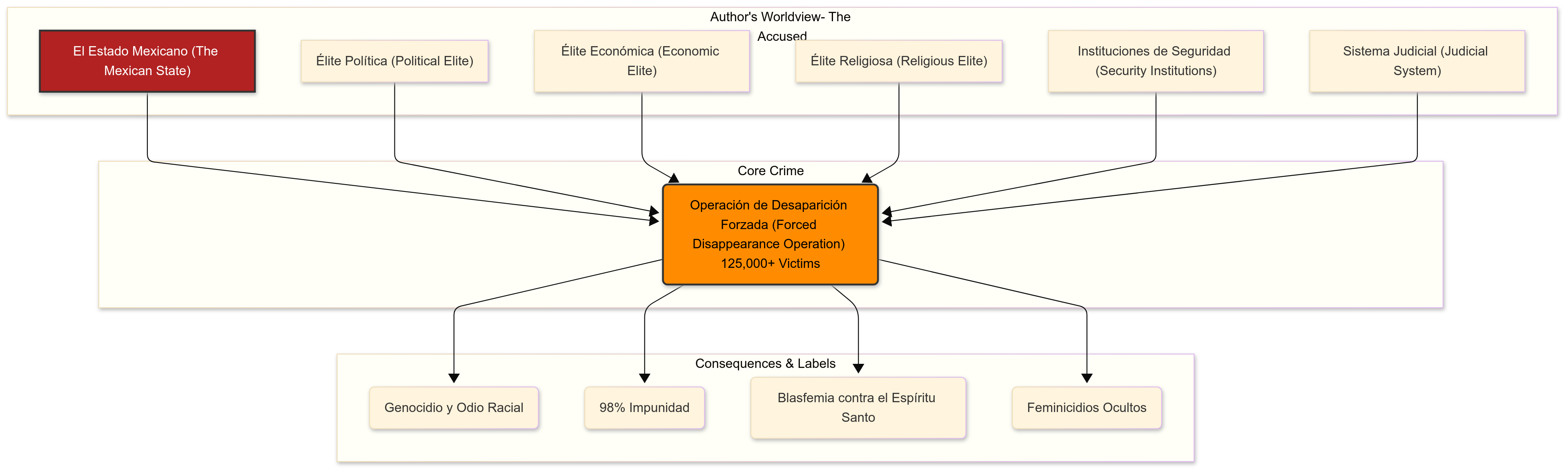
Cognitive Bias, Fallacy, and Intelligence Analysis
A critical analysis of the text reveals several cognitive biases and logical fallacies that, while diminishing its credibility as an objective argument, amplify its emotional power.
- Confirmation Bias- The author interprets all state inaction and silence as proof of intentional, malicious complicity, fitting a preconceived narrative of a diabolical government.
- Fundamental Attribution Error- The crisis is attributed to the inherent evil and “racial hatred” of the individuals named, rather than to a more complex interplay of systemic corruption, institutional weakness, policy failure, and the overwhelming power of transnational criminal organizations.
- Sweeping Generalization- The text commits a fallacy by assigning universal guilt to vast, diverse groups. Statements like “Todos ellos son responsables” (All of them are responsible) unfairly condemn every individual within the government, business elite, and church, which is factually improbable.
- Appeal to Emotion- The document relies almost exclusively on appeals to pity, righteous anger, and religious fear. Words like “diabólico,” “asesinan en vida,” and “blasfemia” are used to provoke an emotional response rather than to present verifiable evidence.
- Factual Error- A significant error is the reference to “Papa León XIV.” Pope Leo XIII was the last of that name, dying in 1903. This inaccuracy could be a simple mistake, undermining the author’s credibility, or a deliberate choice to symbolize a corrupt or illegitimate church leadership.
Intelligence Analysis Application
Applying an ACH to the content helps to assess the author’s intent.
- Hypothesis 1- Authentic Expression of Grief. The author is a person directly or indirectly affected by the crisis, and the text is a raw, albeit hyperbolic, expression of their pain and anger. The extreme language reflects the extreme reality of their suffering.
- Hypothesis 2- Political Disinformation. A political adversary of the current government may have crafted the message to weaponize public anger, sow chaos, and delegitimize the new administration from its inception. The broad, somewhat clumsy list of targets supports this possibility.
- Hypothesis 3- Messianic Ideation. The pseudonym “Pablo y Espíritu Santo” and the claim of a “divine crime” could suggest the author possesses a messianic or prophetic self-concept, using a real-world tragedy as a vehicle for their unique worldview.
The most probable assessment is a combination of Hypotheses 1 and 3. The author is likely expressing a genuine and widespread sentiment of outrage, but is filtering it through a highly personalized, religious, and conspiratorial lens. The message is a symptom of a real disease, even if the diagnosis it presents is flawed.
Corroborating Sources and Context
The central claims of the text, while presented in an extreme manner, are rooted in documented facts.
- Number of Disappeared- Mexico’s own National Search Commission (CNB) has reported figures exceeding 110,000 disappeared and unidentified persons. The number 125,000 is a figure often cited by activists and is tragically plausible given the ongoing crisis.
- Impunity Rate- Multiple studies, including those from organizations like México Evalúa and the World Justice Project, consistently place Mexico’s general impunity rate for crimes, especially homicides, at well over 90%. The 98% figure cited is a commonly accepted statistic in human rights reports for specific high-impact crimes.
- Violence Against Searching Mothers- Human rights organizations like Amnesty International and the UN Office of the High Commissioner for Human Rights have repeatedly documented and condemned the threats, attacks, and murders of the “madres buscadoras” (searching mothers) in Mexico.
- Connection Between Disappearances and Feminicide- Activists and researchers have long pointed out that official feminicide statistics are likely undercounted because many women who are murdered are first reported as missing. Their bodies are often disposed of in clandestine graves, making it difficult to ever classify their deaths properly.
The text blends grief, faith, and fury to accuse the Mexican state and its elites of running a deliberate campaign of disappearance with near total impunity. The rhetoric is absolutist and theological—”crimen divino,” “blasfemia”—and it names a full roster of power centers: the presidency, the armed forces, Congress, business magnates, and the Catholic hierarchy. The author equates the ongoing crisis with genocide and asserts a 98% impunity rate. That voice resonates because the underlying tragedy is real, large, and persistent. Official data and independent monitoring confirm a six‑figure caseload of disappeared persons, a surge in new disappearance reports since 2023–2024, systematic risks for the “madres buscadoras,” and chronic failure to investigate and prosecute. The message, however, overreaches in two ways. First, the charge of genocide does not align with the legal definition that requires intent to destroy a protected group “in whole or in part” on national, ethnic, racial, or religious grounds. Patterns in México—disappearances tied to territorial control, forced recruitment, and profit—fit crimes against humanity, including enforced disappearance, rather than genocide. References: UN Genocide Convention; Rome Statute Article 7 on crimes against humanity and enforced disappearance.
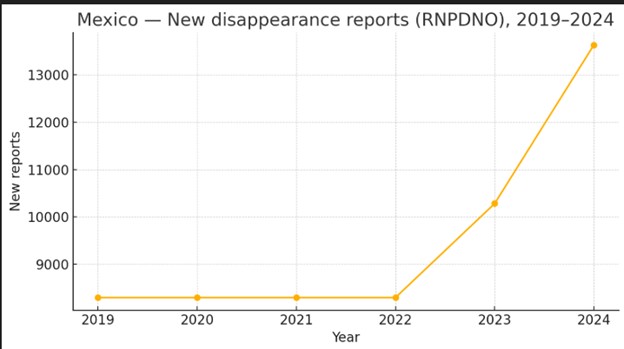
Evidence against the author’s strongest claims remains substantial. México’s official registry and independent reconstructions show a total above 120,000 disappeared and non-located persons, with 2024 setting a new annual high in incoming reports. Amnesty International’s July 2025 report cites 128,059 disappeared and non‑located as of end‑March 2025, alongside a forensic backlog exceeding 72,100 unidentified bodies and 5,696 clandestine graves. The investigative platform A dónde van los Desaparecidos, drawing on RNPDNO data, reports 10,283 new disappearances in 2023 and 13,627 in 2024, after several years near the 8,000–8,600 range. An NGO consortium tracking the crisis (IMDHD/Red Lupa) also reports an upward trend through 2025. Those figures place the author’s “125,000” within the range of reputable tallies.
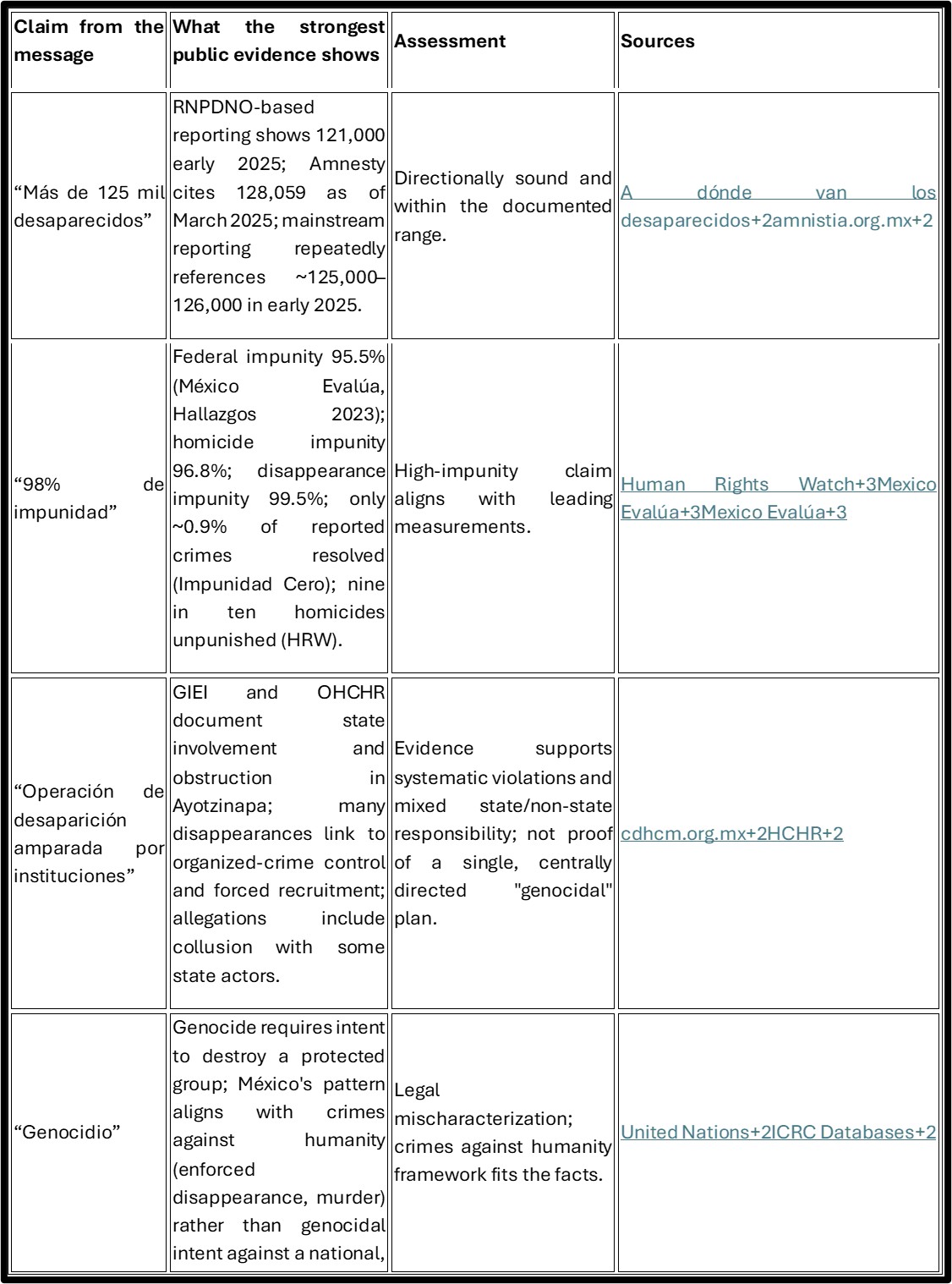
Impunity remains the core reality. México Evalúa’s Hallazgos 2023 places federal impunity at 95.5% and shows impunity near 96.8% for homicide; its 2025 analysis reports impunity at 99.5% for disappearance. Impunidad Cero estimates that 92.9%–93.2% of crimes go unreported, and that only about 0.9% of those reported end in resolution, which aligns with the author’s “98% impunity” claim for many serious crimes. Human Rights Watch describes chronic failure to investigate and sanction violent crime, with roughly nine in ten homicides unpunished.
Violence against search collectives is documented and ongoing. The UN human‑rights office in México condemned the 2023 murder of searcher Teresa Magueyal; independent tracking counts at least 27 murdered searchers by April 2025; Amnesty’s 2025 study finds that 97% of women searchers interviewed faced threats, attacks, or other harms.
Narrative risk and factual corrections
A faith-infused, maximalist indictment—state, business, and church in one “operation”—channels authentic pain yet simplifies a complex conflict landscape into an all-powerful conspiracy. Cartel control over territory, forced recruitment of youth, and collusion with some local and state agents help drive the disappearances; those dynamics appear across multiple independent investigations. México’s GIEI reports on the Ayotzinapa case detail state involvement and obstruction, including military non‑cooperation, while recent reporting on the Izaguirre and La Vega ranches in Jalisco describes forced recruitment and extermination sites linked to CJNG. El País, Reuters, and other outlets, along with statements from the OHCHR, document these patterns. That record describes a widespread and systematic attack against civilians—language that fits crimes against humanity standards—without the protected‑group intent that genocide requires.
One point in the original analytic notes needs an update. The text’s mention of “Papa León XIV” no longer constitutes an error. Cardinal Robert Prevost was elected Pope Leo XIV in May 2025; the Vatican’s pages and major newswires record his first appointments and messages.
Comparative fact table
Trend picture
The plot below visualizes new disappearance reports per year, 2019–2024, based on RNPDNO‑derived reporting. Values for 2019–2022 use the midpoint of the 8,000–8,600 band reported by A dónde van los Desaparecidos; 2023 and 2024 reflect the exact figures 10,283 and 13,627 from the same source.
Strategic meaning
Public speech that merges spiritual judgment with hard numbers amplifies social anger and deepens distrust. Messages like the one analyzed here validate the grief of families and press leaders to act; they also frame every institution as malevolent, which narrows the space for cooperation and makes reform harder to sustain. An information environment saturated with absolutist claims invites further radicalization, conspiracy growth, and opportunistic use by political entrepreneurs. Governance will hinge on two visible outputs: measurable reductions in impunity and visible protection for those who search. The Sheinbaum administration has announced steps to strengthen the national search system and modernize processes following the Teuchitlán revelations. Monitoring should track whether these steps increase identification rates, improve case workflow, and prevent any manipulation of registries.
Additional credible sources for continued monitoring and analysis
Official data and dashboards. México’s National Search Commission public dashboard (RNPDNO) and CNB website provide the baseline registry and protocols; INEGI’s ENVIPE quantifies unreported crime and victimization exposure.
Independent research and watchdogs. México Evalúa’s Hallazgos series tracks impunity and prosecutorial capacity; Impunidad Cero measures the “cifra negra” and case resolution; Data Cívica’s “Volver a desaparecer” reconstructs changes in the registry to prevent statistical “disappearance” of cases; Human Rights Watch World Reports and the February 2025 “Double Injustice” report trace investigative failure.
UN and Inter‑American system documentation. OHCHR’s national office statements address attacks on searchers and institutional obligations. The UN Committee on Enforced Disappearances and the Working Group issue findings and session reports. Inter-American Court judgments in Radilla Pacheco and Alvarado Espinoza establish state responsibility and required remedies.
Major journalism and academic work. El País, Reuters, the Los Angeles Times, The Guardian, and CBS have produced sustained coverage of the Izaguirre and La Vega ranches, forced recruitment, and identification backlogs; A dónde van los Desaparecidos analyzes RNPDNO patterns. Spanish‑language academic and civil‑society reports from IMDHD/Red Lupa and IDHEAS document forensic collapse and case growth.
Cross-language context. Al Jazeera (English and Arabic) has reported on the scale of enforced disappearances and the politics of Mexico’s search institutions; Chinese-language OHCHR pages have summarized the crisis and recent discoveries tied to cartel sites; regional Chinese outlets have echoed the 130,000-plus figure and referenced BBC coverage of nationwide marches.
Short legal primer for framing
Genocide under the 1948 Convention requires specific intent to destroy a protected group “in whole or in part.” Crimes against humanity under Rome Statute Article 7 require a widespread or systematic attack directed against a civilian population, which includes enforced disappearance where the state or a political organization commits or acquiesces to detentions followed by refusal to acknowledge the fate of the victim. México’s record and jurisprudence in Radilla Pacheco and Alvarado Espinoza confirm that enforced disappearance and impunity engage international responsibility. Analysts should frame public debate with those standards to ensure language is precise and align remedies with the appropriate legal tools.
What to watch across 2025–2026
Reported disappearances surged in 2024; Jalisco’s forced‑recruitment cases against teens and young adults remain a bellwether. Monitor identification throughput and protection outcomes for search collectives following the March 2025 policy announcements. Watch for registry methodology changes and independent replication by Data Cívica or academic partners. Track whether new Ayotzinapa cooperation with outside experts materializes and whether the armed forces open their archives.
Notes on the chart
Values for 2019–2022 reflect the midpoint (8,300) of the 8,000–8,600 annual band reported by A dónde van los Desaparecidos; the 2023 value is 10,283 and the 2024 value is 13,627 from the same source. The plot is a visual cue, not a substitute for the RNPDNO’s live series.
Selected primary links for rapid reference
RNPDNO public dashboard (CNB); CNB homepage and protocols; México Evalúa Hallazgos 2023 executive summary; Impunidad Cero “Percepciones de Impunidad 2024”; Amnesty International “Desaparecer otra vez” (2025); HRW “Double Injustice” (2025); OHCHR México communications; UN CED/WGEID pages; Inter‑American Court judgments in Radilla Pacheco and Alvarado Espinoza; Reuters on March 2025 policy steps after Teuchitlán; El País coverage of the 125,000 figure and the Jalisco ranch cases.
The author’s lament names far more than personal grief. Numbers and case studies back the scale of loss and the depth of impunity; murders and threats against those who search for the dead and the living are not rhetorical flourishes. The “genocide” label misdirects the legal frame, which points instead to crimes against humanity. A credible response rests on independent measurement, protection for searchers, access to military and prosecutorial records, and consistent case work that moves families from uncertainty to truth.
References
Amnistía Internacional. (2025, julio 8). Desaparecer otra vez: Violencias y afectaciones a las mujeres buscadoras en México. Amnistía Internacional. https://amnistia.org.mx/contenido/wp-content/uploads/2025/07/Informe_Desaparecer-Otra_Vez_Mujeres_Buscadoras_Amnistia_Internacional_Mexico.pdf
Amnesty International. (2025, July 8). Disappearing again: Violence and harms faced by women searchers in Mexico. Amnesty International. https://www.amnesty.org/en/wp-content/uploads/2025/07/AMR4193742025ENGLISH.pdf
A dónde van los Desaparecidos (Martínez, C.). (2025, enero 14). Sheinbaum, 100 días y 4,000 desapariciones. https://adondevanlosdesaparecidos.org/2025/01/14/sheinbaum-100-dias-y-4000-desapariciones/
Comisión Nacional de Búsqueda. (n.d.). Versión estadística del Registro Nacional de Personas Desaparecidas y No Localizadas (RNPDNO) [tablero]. Secretaría de Gobernación. https://versionpublicarnpdno.segob.gob.mx/
Comisión Nacional de Búsqueda. (n.d.). Consulta pública del RNPDNO. Secretaría de Gobernación. https://consultapublicarnpdno.segob.gob.mx/
Data Cívica. (2024–2025). Volver a desaparecer [sitio web y bases de datos]. https://volveradesaparecer.datacivica.org/
Human Rights Watch. (2025, February 19). Double injustice: How Mexico’s criminal justice system fails victims and the accused. https://www.hrw.org/report/2025/02/19/double-injustice/how-mexicos-criminal-justice-system-fails-victims-and-accused
Human Rights Watch. (2025). World Report 2025: Mexico. https://www.hrw.org/world-report/2025/country-chapters/mexico
Instituto Mexicano de Derechos Humanos y Democracia (IMDHD) & Red Lupa. (2025, mayo 16). Informe nacional de personas desaparecidas 2025. https://imdhd.org/redlupa/informes-y-analisis/informes-nacionales/informe-nacional-de-personas-desaparecidas-2025/
Instituto Nacional de Estadística y Geografía. (2024, septiembre 19). Encuesta Nacional de Victimización y Percepción sobre Seguridad Pública (ENVIPE) 2024. https://www.inegi.org.mx/contenidos/saladeprensa/boletines/2024/ENVIPE/ENVIPE_24.pdf
Inter-American Court of Human Rights. (2009, November 23). Case of Radilla‑Pacheco v. Mexico (Merits, reparations and costs) [Judgment]. https://www.corteidh.or.cr/docs/casos/articulos/seriec_209_ing.pdf
Inter-American Court of Human Rights. (2018, November 28). Case of Alvarado Espinoza et al. v. Mexico (Merits, reparations and costs) [Judgment]. https://www.corteidh.or.cr/docs/casos/articulos/seriec_370_ing.pdf
México Evalúa. (2024, octubre). Hallazgos 2023: Seguimiento y evaluación del sistema de justicia penal. México Evalúa, Centro de Análisis de Políticas Públicas. https://www.mexicoevalua.org/wp-content/uploads/2024/10/HALLAZGOS2023.pdf
México Evalúa (Hernández, A.). (2024, noviembre 1). La impunidad en México permanece por encima del 90%: Hallazgos 2023. https://www.mexicoevalua.org/la-impunidad-en-mexico-permanece-por-encima-del-90-hallazgos-2023/
Office of the United Nations High Commissioner for Human Rights (OHCHR), Mexico Office. (2023, May 3). ONU‑DH condena enérgicamente el asesinato de Teresa Magueyal, madre buscadora de Guanajuato. https://hchr.org.mx/comunicados/onu-dh-condena-energicamente-el-asesinato-de-teresa-magueyal-madre-buscadora-de-guanajuato/
Office of the United Nations High Commissioner for Human Rights (OHCHR). (2023, August 30). Mexico: UN experts outraged at attacks and killings targeting women human rights defenders. https://www.ohchr.org/es/press-releases/2023/08/mexico-un-experts-outraged-attacks-and-killings-targeting-women-human-rights
Oficina del Alto Comisionado de las Naciones Unidas para los Derechos Humanos. (2022, abril 25). Report: We must join forces to combat enforced disappearances in Mexico. https://www.ohchr.org/en/stories/2022/04/report-we-must-join-forces-combat-enforced-disappearances-mexico
Reuters. (2025, March 20). At Mexico’s “ranch of horror,” families of the missing hope for answers. https://www.reuters.com/world/americas/mexicos-ranch-horror-families-missing-hope-answers-2025-03-20/
The Guardian (Graham, T.). (2025, March 7). Mexico: 200 pairs of shoes found at clandestine crematorium. https://www.theguardian.com/world/2025/mar/07/mexico-crematorium-jalisco-cartel
U.S. Department of State. (2025, August 13). Mexico 2024 Human Rights Report. Bureau of Democracy, Human Rights, and Labor. https://mx.usembassy.gov/mexico-2024-human-rights-report/
United Nations. (1948, December 9). Convention on the Prevention and Punishment of the Crime of Genocide. United Nations Treaty Series, 78, 277. https://treaties.un.org/doc/publication/unts/volume%2078/volume-78-i-1021-english.pdf
Vatican News. (2025, May 8). Leo XIV is the new Pope. Dicastery for Communication. https://www.vaticannews.va/en/pope/news/2025-05/cardinal-elected-pope-papal-name.html
International Criminal Court. (2024). Rome Statute of the International Criminal Court (as amended), Article 7: Crimes against humanity. https://www.icc-cpi.int/sites/default/files/2024-05/Rome-Statute-eng.pdf
A dónde van los Desaparecidos (Nuño, A., & Ayala Martínez, A.). (2025, abril 4). 27 personas buscadoras han sido asesinadas y tres más desaparecidas en México. https://adondevanlosdesaparecidos.org/2025/04/04/27-personas-buscadoras-han-sido-asesinadas-y-una-mas-desaparecida-en-mexico/
El País. (2025, marzo 11). Cientos de zapatillas y huesos: un nuevo campo de exterminio devuelve el horror al centro de México. https://elpais.com/mexico/2025-03-11/cientos-de-zapatillas-y-huesos-un-nuevo-campo-de-exterminio-devuelve-el-horror-al-centro-de-mexico.html
El País. (2025, marzo 28). “Altas concentraciones de ceniza” y humo de gasolina: los indicios que apuntan a que en el rancho de Teuchitlán hubo crematorios clandestinos. https://elpais.com/mexico/2025-03-28/altas-concentraciones-de-ceniza-y-humo-de-gasolina-los-indicios-que-apuntan-a-que-en-el-rancho-de-teuchitlan-hubo-crematorios-clandestinos.html
Institute for Economics & Peace. (2025, May 16). Mexico Peace Index 2025. https://www.visionofhumanity.org/wp-content/uploads/2025/05/MPI-ENG-2025-web.pdf
Grupo Interdisciplinario de Expertas y Expertos Independientes (GIEI). (2023, julio 14). Informe Ayotzinapa VI: Hallazgos, avances, obstáculos y pendientes. https://comisionayotzinapa.segob.gob.mx/work/models/Comision_para_la_Verdad/Documentos/pdf/Informe_Ayotzinapa_VI.pdf
Impunidad Cero. (n.d.). Impunidad en México. https://www.impunidadcero.org/impunidad-en-mexico/
You must be logged in to post a comment.