


The Trump administration reached a bilateral accord with the Taliban on 29 February 2020 in Doha. Trump offered a dated withdrawal of all foreign forces, closure of five U.S. bases within 135 days, an expedited mass prisoner release, an administrative review of U.S. sanctions with a target removal date, a push at the U.N. to delist Taliban names, and a pledge of non‑intervention. The Taliban pledged counterterrorism guarantees against al‑Qaida and similar groups, public messaging against such groups, constraints on recruiting, training, fundraising, refusal to host them, denial of travel documents to threat actors, and participation in intra‑Afghan talks toward a ceasefire as well as no attacks against US troops on Afghan soil.
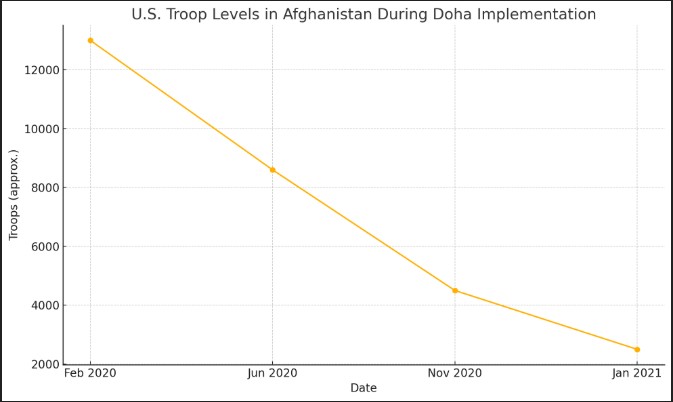
From trumps agreement to Biden’s takeover – US Troop Strength
What Washington signed, in exact terms. Part One bound the United States to reduce forces to 8,600 within 135 days and close five bases, then complete withdrawal of all U.S., allied, and Coalition forces (including contractors and non‑diplomatic civilians) within 14 months, contingent on Taliban compliance. The same section directed immediate work with “all relevant sides” to release “up to five thousand (5,000)” Taliban prisoners in exchange for “up to one thousand (1,000)” prisoners from the other side by 10 March 2020, with a goal to finish remaining releases within three months;
Taliban‑released prisoners must commit not to threaten U.S. or allied security. The public text tasked the Taliban to prevent any group or individual from using Afghan soil to threaten U.S. and allied security, to issue public statements against such actors, to cut cooperation, recruiting, training, and fundraising, to refuse sanctuary, and to withhold visas and travel documents from threat actors.
That section also ordered an administrative review of U.S. sanctions and rewards lists against Taliban members, with a goal of removal by 27 August 2020, and diplomatic engagement at the U.N. to delist Taliban names by 29 May 2020. Part Two set the Taliban’s counterterrorism duties: block use of Afghan soil by any group or individual against U.S. or allied security; send a public message that such actors have no place in Afghanistan; prevent recruiting, training, and fundraising; refuse to host them; and deny visas, passports, and travel permits to threat actors. Clause F pledged that the United States and its allies “will refrain from the threat or the use of force” against Afghanistan’s territorial integrity or political independence and will not intervene in domestic affairs. Part Three tasked Washington to seek U.N. Security Council endorsement and spoke to positive relations and economic cooperation with a post‑settlement Afghan Islamic government.
ISIS‑K executed the Abbey Gate suicide bombing on August 26, 2021, which killed 13 U.S. service members and about 170 Afghans. U.S. investigators identified the bomber as Abdul Rahman al‑Logari, an ISIS‑K operative released from an Afghan prison during the Taliban takeover. The Pentagon’s supplemental review in April 2024 reaffirmed that identification and found no evidence that U.S. troops had a viable shot to stop him. U.S. prosecutors later charged Mohammad Sharifullah (a.k.a. “Jafar”) as an ISIS‑K planner for the attack.
Taliban control of Kabul’s outer‑perimeter checkpoints—run by figures from the Haqqani network—failed to prevent ISIS‑K’s bomber from reaching Abbey Gate, and credible reporting documented Taliban harassment and violence at checkpoints during the evacuation.
The six men transferred to Doha under Qatari monitoring as Hekmatullah, Sayed Rasul, Gul Ali, Mohammad Daud, Allah Mohammad, and Naqibullah. Hekmatullah murdered three Australian soldiers in a 2012 insider attack; Australian and French officials opposed releasing this group because of killings of their nationals, including the 2008 Sarobi ambush of French troops that Afghan sources link to two of the six.
Kabul paid a heavy political price through the mass release of Taliban prisoners, including 400 high risk detainees. The Taliban gained international legitimacy and manpower returns from releases, while avoiding an explicit bar on attacking Afghan forces, which is why violence against government targets surged after signing. The Taliban ringed Hamid Karzai International Airport. Contemporary reporting and later rights documentation recorded harassment and beatings at Taliban checkpoints, including incidents affecting Americans and U.N. personnel, while the group publicly promised order. That perimeter control did not stop ISIS‑K from mounting attacks, including the Abbey Gate bombing.
You must be logged in to post a comment.