


The Islamic Revolutionary Guard Corps (IRGC) stands as a foundational pillar of Iranian power, a force conceived to preserve the 1979 Revolution and expand Iran’s influence. The IRGC Aerospace Force (IRGC-ASF), a premier component, spearheads Iran’s strategic capabilities, particularly its extensive missile and drone programs. Ashura Aerospace University, identified as a Defense Command Headquarters, serves as a central hub for advanced military research and development, a place where Iran showcases its cutting-edge weaponry. Recent Israeli strikes have removed several high-ranking IRGC-ASF commanders, including Amir Ali Hajizadeh, directly impacting the force’s leadership and operational coherence. These external pressures coincide with growing internal dissent against the regime, creating a volatile environment that presents opportunities for change and risks of unpredictable escalation.
The Islamic Revolutionary Guard Corps→A Pillar of Iranian Power
The Islamic Revolutionary Guard Corps emerged on May 5, 1979, following the Iranian Revolution. Its establishment consolidated various paramilitary forces into a single entity loyal to the new government, counterbalancing the traditional Iranian military, Artesh. The Constitution of the Islamic Republic entrusted the Artesh with defending Iran’s territorial integrity, while the Pasdaran, the IRGC, received the responsibility of preserving the Revolution itself. This dual military structure positioned the IRGC as the ideological guardian of the new Islamic government.
The IRGC functions as a combined arms force, possessing its own ground forces, navy, air force, intelligence, and special forces, including the formidable Quds Force. It also controls the Basij militia, a volunteer force numbering 90,000 regular soldiers and 300,000 reservists, with the potential to mobilize an additional 500,000 to 1 million in wartime. The IRGC’s main role encompasses national security, internal and border security, law enforcement, and command of Iran’s missile forces. Its operations focus on asymmetric warfare and less traditional duties, including smuggling control, managing the Strait of Hormuz, and conducting resistance operations.
Beyond military functions, the IRGC has metastasized into one of the most dominant political, security, economic, and ideological actors in Iran. The organization reports directly to Supreme Leader Ali Khamenei. The United States government designated the IRGC, including the Quds Force, as a Foreign Terrorist Organization (FTO) in April 2020, citing its “continued support to and engagement in terrorist activity around the world”. The IRGC’s personnel extend beyond traditional military roles, encompassing intelligence and security personnel, special operators, prison guards, interrogators, morality police, cyberwarriors, university professors, and business operators.
The IRGC’s foundational purpose creates inherent tension with traditional military forces and embeds it deeply within the regime’s survival strategy. The IRGC formed after the 1979 revolution to consolidate loyal paramilitary forces and counter the Artesh, which leaders viewed as potentially disloyal. Its constitutional mandate to “preserve the Revolution itself” contrasts sharply with the Artesh’s role in territorial defense. This dual structure establishes the IRGC not merely as a military branch but as the ideological guardian of the Islamic Republic. Consequently, any threat to the IRGC directly threatens the regime’s ideological core and its internal stability, making the IRGC indispensable to the Supreme Leader’s control. This explains its pervasive influence across political, security, economic, and ideological spheres.
The IRGC’s extensive internal security and intelligence apparatus underpins the regime’s authoritarian control. The IRGC handles internal security, law enforcement, and controls the Basij militia , a volunteer force numbering hundreds of thousands. The Basij mobilizes voters, but also suppresses social unrest. The IRGC also functions as intelligence and security personnel, morality police, cyberwarriors, and interrogators. This broad internal mandate, combined with its decentralized ground forces structured to counter internal threats , indicates a sophisticated and pervasive system of domestic control. The regime relies on this apparatus to suppress dissent, as evidenced by protests met with deadly force. The IRGC’s internal power makes it the primary instrument for maintaining the clergy’s grip on power.
The IRGC Aerospace Force→Strategic Capabilities and Global Reach
The IRGC Aerospace Force, initially established as the IRGC Air Force in September 1985 and renamed in 2009, has significantly expanded its capabilities and tasks over time. The IRGC-ASF stands as the principal operator of Iran’s missile and drone arsenals, holding responsibility for the nation’s surface-to-surface missile systems.
Iran possesses the largest missile inventory in the Middle East. The Shahab-3/3B, with a range of up to 2,100 kilometers, forms the mainstay of Iran’s strategic deterrent, placing NATO members such as Turkey, Greece, Bulgaria, and Romania within striking range if fired from Western Iran. The IRGC-ASF has also developed lethal drone capabilities, extending Iran’s military reach into previously inaccessible territories, including Ukraine.
The IRGC-ASF operates five main operational branches→
Missile Command, Space Program, Air Defense, Aircraft and Helicopters, and UAVs (drones) command. The force constitutes a primary means of projecting force and threatening adversaries. It conducted Iran’s first missile strike abroad in decades in 2017 and has since carried out repeated strikes into Iraq, Syria, and Israel. The IRGC-ASF also fired missiles into Saudi Arabia in 2019 and Pakistan in 2024.
Should Iran produce nuclear weapons, those weapons fall under the direct supervision of the IRGC-ASF. Evidence from a stolen Iranian laptop obtained by U.S. intelligence in 2004 indicated calculations, simulations, and modifications required to enable the Shahab-3 nose cone to carry a nuclear warhead. Iran’s continuous lack of transparency regarding its nuclear program fuels suspicion about its intentions.
Beyond its direct operational roles, the IRGC-ASF exports weaponry to various nations globally, including Venezuela, Russia, North Korea, and Sudan. The force also uses the aircraft fleet of civil airlines, such as Iran Air, Mahan Air, and Kashm Fars Air, to smuggle missiles, UAVs, defense systems, and critical components for missile precision projects, providing civilian cover for its activities. The IRGC also maintains a cyber command, which conducts military and commercial espionage and distributes propaganda. The pervasive nature of the IRGC’s influence extends to social media, where it attempts to control information and counter anti-regime sentiment.
The IRGC-ASF is the vanguard of Iran’s asymmetric warfare strategy, enabling power projection and deterrence without direct conventional military confrontation. The IRGC’s overall operations focus on asymmetric warfare. The IRGC-ASF, as the primary operator of missiles and drones , directly contributes to this by providing long-range strike capabilities (Shahab-3) and extending military reach into previously inaccessible territories (drones). This allows Iran to conduct strikes abroad and support proxies without engaging its conventional Artesh, which military analysts describe as “badly dated”. The indigenous development of these systems also reduces reliance on foreign supplies , enhancing strategic autonomy. This strategy minimizes direct, costly conventional conflict while maximizing regional influence and deterring adversaries.
The IRGC-ASF’s control over Iran’s strategic missile and potential nuclear programs presents a significant proliferation risk and complicates international security efforts. The IRGC-ASF controls Iran’s ballistic missile program. If nuclear weapons develop, they fall under its direct supervision. Evidence suggests Iranian efforts to modify missiles for nuclear warheads. This indicates a direct link between the IRGC-ASF’s technological advancements and Iran’s potential nuclear ambitions. Furthermore, the export of weaponry to various nations demonstrates a willingness to proliferate advanced military technology, increasing instability in other regions. The lack of transparency regarding Iran’s nuclear program exacerbates international suspicion, making the IRGC-ASF a central actor in global non-proliferation concerns.
Ashura Aerospace University→A Nexus of Advanced Military Development
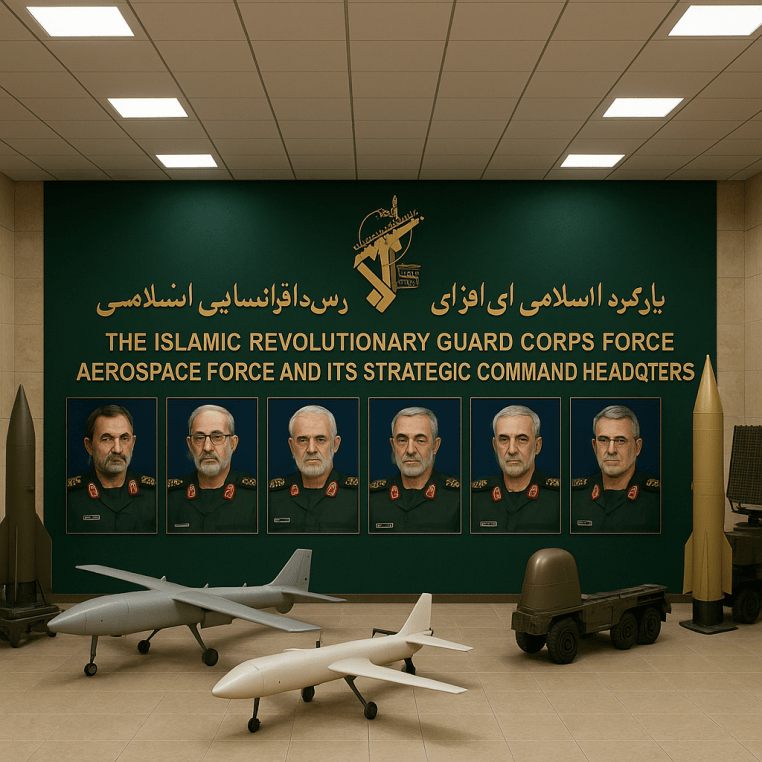
The user’s query places the photo inside the Defense Command Headquarters at the IRGC’s Ashura Aerospace University. This location gained prominence as a site where Iran unveiled its “Fattah” hypersonic ballistic missile and long-range drones in early June 2023. Amir Ali Hajizadeh, Commander of the IRGC Aerospace Force, toured an exhibition showcasing the latest achievements of the IRGC-ASF at the Ashura Aerospace University of Science & Technology in November 2023.
The IRGC operates an independent research and development organization named the Research and Self-Sufficient Jihad Organization (IRGC RSSJO). This organization holds responsibility for the research, development, production, and procurement of weapon systems and components required for IRGC activity. Its scope ranges from simple products such as helmets to complex systems like military vehicles, communications systems, ballistic missiles, and radar systems.
While the snippets do not explicitly detail “Ashura Aerospace University” as a distinct academic institution, the broader Iranian military-academic complex includes institutions like Imam Hossein University (IHU). IHU is affiliated with the IRGC and features an Aerospace Engineering Department and an Aerospace Research Center. IHU has been considered a center for Iran’s secret nuclear programs, with the IAEA stating the IRGC has co-opted its nuclear research facilities and experts to conceal the military aspect of the Iranian nuclear program. Another relevant entity, the Aerospace Research Institute (ARI) in Tehran, affiliated with Iran’s Ministry of Science, Research and Technology, develops space launch vehicle technologies similar to those used in ballistic missiles.
Ashura Aerospace University serves as a critical hub for the IRGC-ASF’s indigenous military-technological advancement, indicating a self-sufficiency drive in strategic weapon systems. The revelation of hypersonic missiles and long-range drones at Ashura Aerospace University directly links the institution to cutting-edge military development. The IRGC’s Research and Self-Sufficient Jihad Organization further confirms a concerted effort toward indigenous production of complex systems, including missiles and radar. This emphasis on self-sufficiency reduces Iran’s reliance on external suppliers and strengthens its strategic autonomy, making the university a symbol of Iran’s military-industrial complex and its commitment to developing advanced, domestically produced weaponry.
The university’s connection to high-level IRGC-ASF leadership and its potential links to broader military-academic networks suggest a deeply integrated system for strategic research and personnel development. Commander Hajizadeh’s visit to Ashura Aerospace University demonstrates the institution’s importance to the IRGC-ASF’s top leadership. While a direct, explicit link between Ashura and Imam Hossein University (IHU) is not provided, IHU’s affiliation with the IRGC, its aerospace engineering department, and its alleged role in secret nuclear programs suggest a broader network of military-academic institutions. The Aerospace Research Institute also contributes to this ecosystem. This integration ensures a steady pipeline of skilled personnel and research capabilities, reinforcing the IRGC-ASF’s long-term strategic development goals and its ability to conceal sensitive programs within academic structures.
The “Martyr of Honesty” Headquarters→A Symbol of Operational Significance
The photo caption identifies the location as “Martyr of Honesty,” also called “Minus 3,” within the Defense Command Headquarters at the IRGC’s Ashura Aerospace University. This naming convention holds significant cultural and ideological weight within Iran.
The concept of martyrdom (šahidân) carries profound significance in Iran, particularly within the Shia Islamic context, where it expands beyond merely giving one’s life for religious beliefs to encompass those who died in the revolution and soldiers from the Iran-Iraq War. Martyrs receive great respect, with special burial rites, well-maintained graves, and their names memorialized on street signs and schools. Martyr museums exist in major Iranian cities, and themes of martyrdom permeate children’s textbooks. The term “Martyr of Honesty” thus imbues the headquarters with ideological sanctity and legitimizes its activities within the Iranian narrative.
The designation “Minus 3” remains undefined in the provided research material related to Iranian military intelligence. Iranian military intelligence figures often maintain a low profile, suggesting a preference for secrecy. Commander Amir Ali Hajizadeh’s statement, “executioners have reached the point of understanding, and their names will be recorded as the greatest criminals in history,” spoken from this location, implies a site associated with sensitive, possibly coercive or punitive, intelligence operations.
The designation “Martyr of Honesty” for a military headquarters, especially one linked to intelligence operations, signifies the IRGC’s deep ideological grounding and its use of martyrdom narratives to legitimize actions. The term “Martyr of Honesty” invokes the powerful concept of martyrdom in Iranian Shia Islam, where individuals give their lives for beliefs. This naming convention for a command center, particularly one where “executioners have reached the point of understanding” suggests an attempt to imbue intelligence and potentially coercive activities with religious and ideological legitimacy. By associating the site with “honesty” and “martyrdom,” the IRGC reinforces its self-perception as guardians of the revolution , framing even harsh actions as righteous sacrifices. This ideological framing helps to maintain internal cohesion and public support for the regime’s security apparatus.
The “Minus 3” designation, combined with the context of “executioners” and the location within a sensitive military university, indicates a highly classified and potentially clandestine intelligence or command-and-control facility. The phrase “Minus 3” lacks an explicit public definition in the provided intelligence snippets. This obscurity, coupled with the location inside a Defense Command Headquarters at a specialized aerospace university, strongly suggests a classified designation. Commander Hajizadeh’s statement about “executioners” and “greatest criminals” further implies a site where sensitive intelligence gathering, interrogation, or strategic planning with coercive implications takes place. The low profile of Iranian military intelligence figures reinforces the notion of secrecy. Such a designation could refer to a deep underground facility, a specific operational level, or a highly compartmentalized intelligence unit, all pointing to a clandestine and strategically important function within the IRGC’s security architecture.
Leadership Dynamics→Impact of Recent Losses on IRGC-ASF Command
The user’s query lists several high-ranking IRGC-ASF commanders whose names appear in the photo’s context. Recent Israeli airstrikes have reportedly killed these individuals, significantly impacting the IRGC-ASF’s leadership structure.
Amir Ali Hajizadeh, Commander of the IRGC Aerospace Force, held his position from October 2009 until his assassination in June 2025. He played a central role in the development, proliferation, and use of Iran’s drone and missile programs. His long tenure reflected Supreme Leader Ali Khamenei’s confidence in his abilities. Hajizadeh led and executed the April 2024 and October 2024 Iranian strikes against Israel.
Other commanders reportedly killed alongside Hajizadeh include→
- Gholamreza Mehrabi, Deputy Chief of Staff for Intelligence of the Armed Forces. He served as the deputy intelligence chief for the general staff since at least 2013 and maintained a low profile.
- Mahmoud Bagheri Kazemabad, Commander of Al-Ghadir Command. This command is identified as part of the IRGC Aerospace Forces Al-Ghadir Missile Command.
- Mohammad Baqer Taherpour, Commander of the IRGC Aerospace Drone Command.
- Davud Sheikhian, Commander of the IRGC Aerospace Defense Command.
- Mansour Safarpour, Deputy Commander of the IRGC Aerospace Defense.
- Khosrow Hassani, Deputy Deputy Commander of IRGC Aerospace Intelligence.
Iran reported that the strikes “seriously disrupt[ed] its command”. The Israeli Defense Forces (IDF) claimed a strike on an underground command center killed most of the IRGC Aerospace Force’s leadership after they convened for a meeting, including Hajizadeh and the leaders of the IRGC’s air defense and drone units.
The concentrated loss of senior IRGC-ASF commanders, particularly those involved in missile, drone, and intelligence operations, represents a significant decapitation strike against Iran’s strategic capabilities. The list of killed commanders includes the IRGC-ASF Commander (Hajizadeh), commanders of drone and air defense units, and intelligence deputies. Hajizadeh, in particular, was central to Iran’s drone and missile programs and a trusted figure of Khamenei. The simultaneous elimination of multiple high-ranking officers responsible for distinct but interconnected strategic domains (missiles, drones, air defense, intelligence) creates a vacuum at the operational and strategic levels. Iran’s own reports of “seriously disrupting its command” corroborate the severity of these losses. This indicates a deliberate targeting strategy designed to degrade the IRGC-ASF’s ability to plan, execute, and innovate its most potent asymmetric warfare instruments.
The targeting of intelligence and specialized command personnel suggests a sophisticated intelligence operation aimed at weakening the IRGC’s internal cohesion and operational secrecy. The casualties include Gholamreza Mehrabi, Deputy Chief of Staff for Intelligence, and Khosrow Hassani, Deputy Deputy Commander of IRGC Aerospace Intelligence. Intelligence figures often maintain a low profile , making their identification and targeting indicative of precise intelligence gathering. The strikes on command centers and the specific targeting of intelligence and specialized unit commanders (drone, air defense, missile command) point to an effort to not just degrade hardware but to disrupt the human networks, command-and-control structures, and institutional memory that underpin the IRGC-ASF’s operations. This could lead to internal distrust, operational paralysis, and a loss of secrecy, further compounding the impact of personnel losses.
Key IRGC-ASF Commanders and Their Status
Name-Position (as per User Query)-Confirmed Status (June 2025)-Relevant Source ID(s)
Amir Ali Hajizadeh
Commander of the IRGC Aerospace Force
Killed
Gholamreza Mehrabi
Deputy Chief of Staff for Intelligence of the Armed Forces
Killed
Mahmoud Bagheri Kazemabad
Commander of Al-Ghadir Command
Killed
Mohammad Baqer Taherpour
Commander of the IRGC Aerospace Drone Command
Killed
Davud Sheikhian
Commander of the IRGC Aerospace Defense Command
Killed
Mansour Safarpour
Deputy Commander of the IRGC Aerospace Defense
Killed
Khosrow Hassani
Deputy Deputy Commander of IRGC Aerospace Intelligence
Killed
Internal Dissension and External Pressures→The Regime’s Vulnerabilities
The Iranian regime faces deep unpopularity among many of its citizens, a sentiment manifested in mass protests, including those against forced Islamic dress codes and other restrictions on women. These demonstrations have been met with deadly force. Exiled Iranians claim the regime’s grip on power weakens daily, expressing readiness to build a new future. Some view the recent Israeli strikes as the beginning of the regime’s collapse.
Videos circulating on social media show Iranians chanting “Death to Khamenei” and “Death to the Islamic Republic,” with some even calling for the restoration of the Pahlavi monarchy. The Iranian Ministry of Communications imposes restrictions on internet access, hindering citizens’ access to information. Despite this censorship, anti-regime sentiment persists. Dissidents suggest the ongoing conflict and the losses within IRGC leadership weaken the regime’s ability to suppress its population, potentially leading to renewed street protests.
The Iranian authorities actively attempt to boost public support through disinformation and propaganda. Iran’s state-owned IRIB TV1, itself targeted in an Israeli strike, broadcast footage from a pro-regime rally where attendees chanted “Death to Israel!” and “Death to America!”.
External pressures compound the internal vulnerabilities. Israeli Prime Minister Benjamin Netanyahu has appealed to Iranians to rise up against their government, stating the regime is at its weakest. The IRGC’s Quds Force, its expeditionary arm, actively participates in malign proxy activity, supporting non-state actors such as Hezbollah in Lebanon, Hamas and Islamic Jihad in the Palestinian territories, Houthis in Yemen, and Shia militias in Iraq, Syria, and Afghanistan. The IRGC pursues regional dominance and the export of the revolution as primary foreign policy goals.
The recent strikes on IRGC leadership, particularly within the Aerospace Force, exacerbate existing internal vulnerabilities by degrading the regime’s primary instrument of domestic control. The IRGC, with its Basij militia and internal security functions, acts as the regime’s praetorian guard, violently suppressing dissent. The loss of senior IRGC-ASF commanders , including those in intelligence , directly impacts the operational capacity of this suppressive apparatus. Dissident voices explicitly link these losses to a weakening of the regime’s “power of suppression” , potentially creating openings for renewed mass protests. This indicates a direct causal link: external military pressure on the IRGC’s leadership weakens the regime’s internal grip, creating a feedback loop where external actions amplify internal discontent.
The regime’s reliance on censorship and propaganda, coupled with the public’s access to external information and anti-regime sentiment, indicates a struggle for narrative control that could further fuel popular unrest. The Iranian regime actively restricts internet access and broadcasts pro-regime propaganda. Despite this, videos of anti-regime chants circulate on social media , and exiled Iranians communicate with sources inside the country. This suggests the regime’s attempts at information control are imperfect. The public’s awareness of the IRGC’s losses and the regime’s unpopularity creates a disconnect between state-controlled narratives and popular perception. The IRGC’s cyber command contributes to propaganda distribution, but the widespread anti-regime sentiment demonstrates its limited effectiveness against a populace craving freedom. This struggle for narrative control, particularly in the wake of significant military setbacks, represents a psychological vulnerability that external actors can exploit to encourage internal challenges to the regime.
Implications and Outlook
The Islamic Revolutionary Guard Corps remains central to Iran’s defense, security, and foreign policy. The Quds Force, as the IRGC’s expeditionary arm, continues its support for non-state actors across the Middle East, projecting power and deterring aggression from Western countries and Israel. The IRGC-ASF’s ongoing development and export of advanced weaponry, particularly missiles and drones, solidifies Iran’s asymmetric capabilities. The potential for the IRGC-ASF to supervise nuclear weapons, supported by evidence of related research, introduces a grave proliferation concern.
The recent strikes, which eliminated several commanders, including the IRGC-ASF chief , represent a significant blow to the organization’s operational capacity and command structure. These external pressures coincide with deep internal unpopularity and calls for change within Iran.
The recent targeted strikes represent a strategic effort to degrade Iran’s asymmetric capabilities and disrupt its regional influence, forcing a re-evaluation of its foreign policy calculus. The IRGC-ASF, through its missile and drone programs, constitutes Iran’s primary instrument for projecting power and supporting proxies. The elimination of commanders responsible for these specific capabilities directly impacts Iran’s ability to execute its “axis of resistance” strategy. This suggests that external actors move beyond deterrence to actively degrade Iran’s capacity for malign activity. The forced re-evaluation of foreign policy could manifest as a temporary reduction in proxy support or a more cautious approach to regional interventions, as the IRGC prioritizes rebuilding its command structure and strategic assets.
The confluence of external military pressure and internal dissent creates a volatile environment, presenting opportunities for regime change and risks of unpredictable escalation. The regime’s weakening grip on power due to internal unpopularity and the perceived effectiveness of external strikes creates a precarious situation. While external actors like Israel encourage popular uprising , Iranian dissidents express a desire for self-determined change. The regime, in turn, intensifies propaganda and censorship , indicating its awareness of internal fragility. This dynamic suggests a potential for intensified internal unrest, but also a risk that the regime, feeling cornered, could resort to more aggressive external actions to consolidate power or distract from domestic issues. The future remains highly uncertain, with the possibility of either a popular uprising or a desperate, escalatory response from a beleaguered regime.
The Islamic Revolutionary Guard Corps stands as the ideological and operational core of the Iranian regime, deeply embedded in national security, internal control, and foreign policy. Its Aerospace Force, a highly specialized branch, spearheads Iran’s strategic missile and drone programs, serving as the primary instrument for asymmetric power projection and regional influence. The Ashura Aerospace University, functioning as a Defense Command Headquarters, plays a central role in the indigenous research and development of these advanced military technologies, reflecting Iran’s drive for self-sufficiency in strategic weaponry. The naming of this sensitive headquarters as “Martyr of Honesty” underscores the IRGC’s reliance on ideological narratives to legitimize its actions, even those involving coercive intelligence operations, as suggested by the cryptic “Minus 3” designation.
Recent targeted strikes, which eliminated several senior IRGC-ASF commanders, including its chief and leaders of its drone, air defense, and intelligence units, represent a significant blow to Iran’s strategic capabilities. These losses degrade the IRGC-ASF’s operational capacity and disrupt its command structures. The precision of these strikes, particularly against intelligence figures, indicates a sophisticated effort to weaken the IRGC’s internal cohesion and operational secrecy.
These external pressures intersect with profound internal dissent and unpopularity within Iran. The weakening of the IRGC’s leadership directly impacts the regime’s capacity for domestic suppression, potentially creating openings for renewed popular protests. The regime’s ongoing struggle for narrative control, marked by censorship and propaganda against a populace accessing external information and expressing anti-regime sentiment, further exacerbates its vulnerabilities. The current environment remains highly volatile, presenting a complex interplay of forces that could lead to intensified internal unrest or, conversely, unpredictable escalations from a regime facing unprecedented challenges. The situation demands continued vigilance and nuanced analysis to navigate the unfolding dynamics.


You must be logged in to post a comment.