


Today, April 15, China issued a nationwide directive requiring all Chinese airlines to immediately cease purchasing any aircraft, equipment, or aviation parts from American companies. The ban applies to new aircraft orders, maintenance contracts, onboard systems, avionics, engines, flight software, and associated technologies. This directive is already triggering profound financial losses across the U.S. aerospace sector, most notably for aircraft manufacturers, parts suppliers, and the extended logistics and MRO (maintenance, repair, and overhaul) ecosystem.
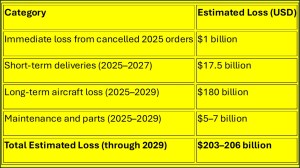
The immediate revenue loss for U.S. companies in 2025 stems from suspended aircraft deliveries. At the time of the ban, Chinese airlines were scheduled to take delivery of at least 10 U.S.-made commercial aircraft valued at roughly $100 million each. The abrupt halt erases at least $1 billion in projected near-term revenue.
In the short term, from 2025 through 2027, China’s largest state-owned airlines had scheduled receipt of over 175 new U.S. aircraft. At an average sale price of $100 million, the loss totals roughly $17.5 billion across this two-year window. The results do not include high-margin services such as post-sale parts supply, integrated software support, avionics servicing, or flight training—all of which are suspended under the current restrictions.
The long-term impact through the remainder of Trump’s presidency—January 2029—reaches a much larger scale. China historically accounted for approximately 20 percent of the total global demand for commercial aircraft. Based on current production forecasts and pre-ban procurement projections, U.S. manufacturers stood to deliver roughly 1,800 aircraft to China through 2029. Assuming a flat average value of $100 million per unit, the lost aircraft orders alone total $180 billion. That figure excludes embedded service contracts, retrofits, or derivative technology sales that often follow large fleet deployments.
Beyond aircraft sales, the loss of China’s growing demand for spare parts, software updates, turbine replacements, and lifecycle support services creates a secondary revenue collapse. U.S.-based MRO providers risk losing access to a market that had been forecasted to grow by tens of billions over the decade. Even under conservative estimates, lost MRO revenue between 2025 and 2029 may exceed $5 billion.
The overall quantified financial impact from now until the end of Trump’s term is outlined in the attached image.
The numbers reflect revenue that will not be recovered, jobs that will be eliminated or delayed, and market share that will be permanently lost. Suppliers will be forced to cut production lines, freeze hiring, and scale back capital investments. The entire U.S. aerospace sector—already strained by post-pandemic supply chain issues—faces contraction unless alternate buyers rapidly emerge.


You must be logged in to post a comment.