


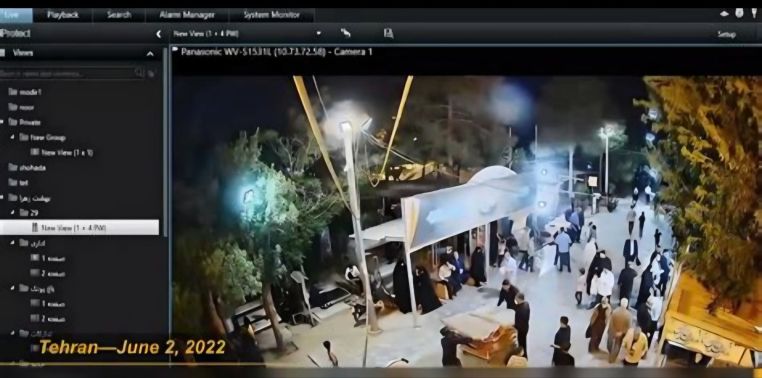
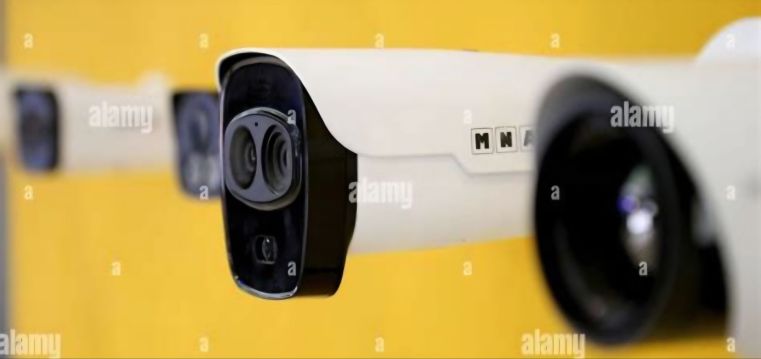
The image shows surveillance cameras installed under a pedestrian bridge in Tehran, part of an expanding surveillance network by the Iranian government. These cameras, reportedly sourced from China’s Hikvision, are designed to capture facial recognition data and track license plates, enabling real-time monitoring of pedestrian and vehicular movement.
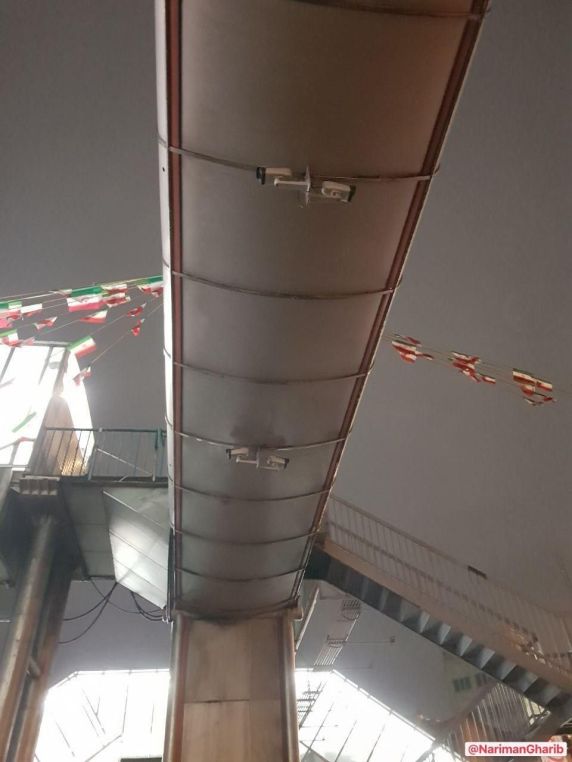
Sources from within Iran indicate that this surveillance infrastructure is being discreetly expanded, particularly along key routes such as the stretch from Enghelab Street to Azadi. This area is significant due to its history as a hotspot for protests and public gatherings. The project allegedly began with installations near the Imam Hussein Square metro station and has since extended across multiple pedestrian bridges.
The government deploys unmarked maintenance vehicles equipped with forklifts to service these cameras, particularly before major public events, ensuring their continuous operation without drawing attention. This heightened surveillance effort aligns with the regime’s broader strategy to suppress dissent and maintain control over public spaces, particularly in response to recent waves of protests and civil unrest.
Iran’s reliance on Chinese technology for surveillance mirrors tactics used in other authoritarian states, integrating AI-powered recognition systems with a growing digital monitoring apparatus. The implications of this expansion are significant for activists, dissidents, and ordinary citizens, further restricting privacy and movement in urban centers.
The installation of advanced surveillance cameras across Tehran is a clear manifestation of the Iranian government’s deep-seated paranoia and its recognition that it rules without genuine public consent. The regime’s reliance on mass surveillance, particularly with AI-powered facial recognition and license plate tracking, is not an assertion of strength but rather an admission of weakness. A government confident in its legitimacy does not need to monitor every street corner, bridge, and sidewalk for signs of dissent.
For years, the Islamic Republic has systematically suppressed free speech and silenced opposition, yet its need for constant surveillance reveals that it fears its own people more than any external enemy. The growing number of cameras, particularly along routes like Enghelab to Azadi—historically significant for protests—exposes a regime obsessed with preempting demonstrations before they even begin. The authorities know that every public gathering, no matter how small, carries the potential to spark larger unrest.
This paranoia is deeply ingrained in the state’s security apparatus. The use of unmarked vehicles to service these cameras, especially before key political events, underscores the government’s desperation to maintain control through secrecy and intimidation. But control through fear is not sustainable. The widespread implementation of Chinese-made surveillance technology mirrors tactics used by other authoritarian regimes, reinforcing Iran’s growing isolation and its dependence on foreign tools to subjugate its own population.
The relentless crackdown on speech, protests, and even online expression, coupled with the expansion of digital monitoring, highlights a leadership that understands it no longer represents the will of the people. If the regime had genuine support, it would not need an army of cameras watching every street and bridge. The surveillance network is not a show of power; it is a glaring admission that the government is fragile, illegitimate, and afraid.


You must be logged in to post a comment.