


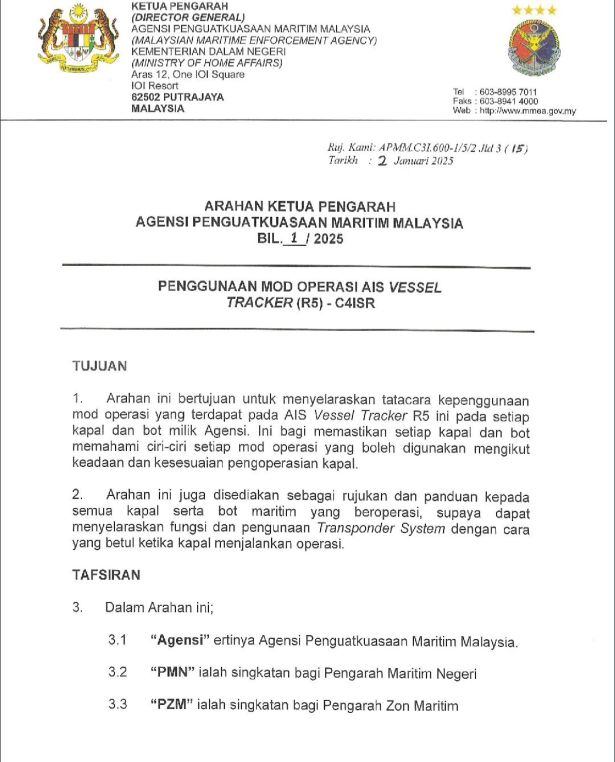
Analyzing the document revealed a detailed examination of AIS (Automatic Identification System) ship tracking, with a focus on its applications, vulnerabilities, and implications in maritime security, logistics, and geopolitical intelligence.
The content, written in Malay, breaks down the functionality of AIS, the ways ships transmit and receive data, and the risks associated with AIS manipulation, spoofing, and interference.
AIS plays a crucial role in maritime navigation, allowing vessels to broadcast their identification, position, course, and speed. Maritime authorities and commercial entities rely on AIS data for traffic management, collision avoidance, and fleet monitoring. The document explains how AIS enhances operational efficiency but also exposes ships to risks when bad actors exploit vulnerabilities in the system.
AIS spoofing emerges as a central concern. Ships engaged in illicit activities—such as smuggling, illegal fishing, and sanctions evasion—manipulate AIS data to conceal their true movements. Techniques such as GPS jamming, AIS signal suppression, and identity fraud enable vessels to disappear from tracking systems or masquerade as legitimate ships. Intelligence agencies and cybersecurity professionals recognize the broader implications, as adversarial states, private entities, and criminal networks use these tactics to bypass regulatory scrutiny.
The document also explores how AIS data intersects with satellite monitoring and open-source intelligence (OSINT). Correlating AIS signals with satellite imagery exposes discrepancies, such as ships broadcasting misleading locations while physically appearing elsewhere. This capability strengthens maritime situational awareness, allowing authorities to detect illicit activities with greater precision.
An assessment of AIS reliability highlights its dependence on signal integrity and real-time data processing. Unauthorized interference compromises safety, particularly in congested shipping lanes or conflict zones where hostile actors exploit AIS disruptions to mask military movements or stage false-flag operations. Cybersecurity risks also emerge, as hackers infiltrate AIS networks to manipulate maritime logistics, disrupt supply chains, or facilitate attacks.
The document concludes with discussions on countermeasures. Advanced encryption, satellite verification, and artificial intelligence enhance AIS resilience against spoofing and cyber threats. International cooperation remains essential, as maritime security demands a unified response to AIS exploitation. Intelligence-sharing frameworks between governments, private sector stakeholders, and cybersecurity firms help mitigate risks.
Analyzing AIS ship tracking through an intelligence lens reveals its dual nature as both an enabler of transparency and a tool for deception. The document offers a comprehensive view of AIS mechanics while exposing the geopolitical, technological, and security dimensions tied to its use and manipulation. Readers gain a deeper understanding of how maritime actors exploit AIS weaknesses, reinforcing the need for advanced monitoring and defensive strategies.
A deeper analysis of the document’s content reveals that while it does not contain highly classified material, its structured presentation of AIS vulnerabilities and countermeasures makes it a valuable resource for intelligence professionals, cybersecurity experts, and maritime security analysts. The implications extend beyond routine ship tracking, touching on areas that adversarial actors exploit for geopolitical and economic advantage.
The detailed breakdown of AIS spoofing, signal suppression, and identity fraud suggests an awareness of how illicit maritime activities circumvent regulatory oversight. Smugglers, arms traffickers, and sanction-evading fleets from countries like Iran, North Korea, and Russia rely on these tactics to operate undetected. The document explains how vessels change their AIS identifiers, create ghost signals, or engage in GPS jamming to mislead authorities. While such methods are not new, the report consolidates them in a way that facilitates both strategic analysis and counterintelligence efforts.
Beyond criminal activities, the document hints at how state actors manipulate AIS for military deception and hybrid warfare. The reference to conflict zones and contested waters suggests that AIS data is not just a commercial tool but a geopolitical chess piece. Chinese maritime militias, for instance, routinely switch off AIS to mask their presence in disputed territories like the South China Sea. Russia has deployed AIS manipulation techniques to obscure naval operations in the Black Sea. The document’s focus on such tactics indicates a sophisticated understanding of how maritime tracking intersects with intelligence-gathering and strategic deception.
The emphasis on satellite verification and artificial intelligence-driven analysis suggests an effort to counteract AIS vulnerabilities. The ability to cross-reference AIS data with satellite imagery exposes discrepancies, helping intelligence agencies and maritime security forces detect suspicious movements. The document discusses advancements in machine learning algorithms that flag anomalies in AIS transmissions, a concept already being explored by naval forces and private security firms. This reinforces the idea that while AIS remains a compromised system, integrating it with other technologies strengthens its reliability.
Cybersecurity concerns also feature prominently, particularly the risks of AIS data being hacked or manipulated. The document explains how malicious actors infiltrate AIS networks to alter ship positions, erase movement history, or inject false data into tracking systems. The risks extend beyond simple deception; coordinated cyberattacks on AIS could disrupt global shipping, cause collisions, or even be used as a tool in economic warfare. The emphasis on encryption and secure communication channels suggests an awareness of countermeasures needed to protect AIS from cyber threats.
The recommendations for enhanced maritime security cooperation align with global efforts to regulate AIS usage and enforce stricter monitoring standards. Intelligence-sharing networks between governments, commercial entities, and cybersecurity firms play a role in mitigating risks. The document acknowledges the limitations of unilateral enforcement, stressing the importance of multinational frameworks to address AIS-related threats. Given that countries like China, Russia, and Iran exploit AIS weaknesses for strategic purposes, collaborative monitoring efforts are necessary to prevent manipulation.
While the document does not reveal classified techniques, it organizes sensitive information in a way that intelligence agencies could use to refine monitoring operations. The in-depth analysis of AIS deception tactics, combined with discussions on satellite verification and cybersecurity, elevates its strategic relevance. Those engaged in maritime intelligence, cybersecurity, and national security policy would find the material valuable for understanding how AIS tracking fits into larger geopolitical and economic security frameworks.
A final assessment suggests that while the document is not highly secret, it contains information that could be restricted within certain professional circles. Intelligence and defense communities dealing with maritime security would treat it as a resource for operational awareness, particularly in countering adversarial AIS manipulation. The structured presentation of deception tactics, cyber risks, and countermeasures adds a layer of insight that, if placed in the wrong hands, could aid those seeking to exploit AIS vulnerabilities rather than mitigate them.


You must be logged in to post a comment.