

Satellite imagery of the laser fusion research facility in Mianyang shows a significant development in China’s high-energy physics and nuclear research programs. The facility’s architectural layout shows a focus on inertial confinement fusion (ICF), a technology with direct applications in advanced nuclear weapons development and potential civilian energy generation. The presence of a large target chamber building at the center, flanked by laser bays, are like designs seen in other fusion research facilities, including the National Ignition Facility (NIF) in the United States.
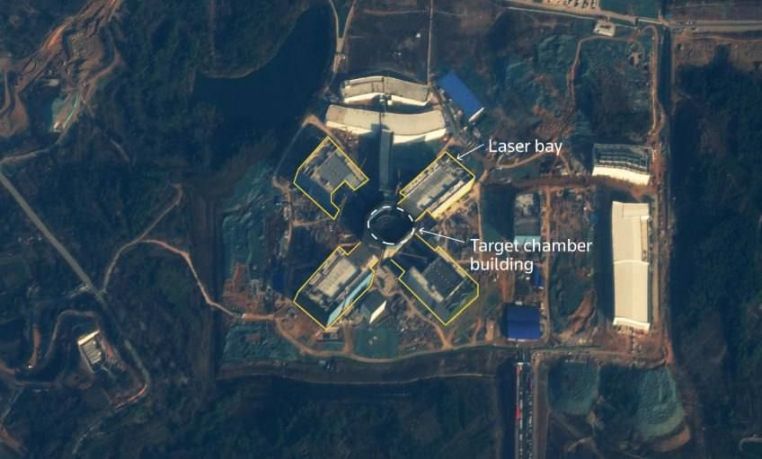
The laser fusion facility in Mianyang likely uses multiple high-powered laser beams directed toward a central target, where fuel pellets—potentially composed of deuterium and tritium—are compressed and heated to initiate nuclear fusion. Achieving ignition under controlled laboratory conditions represents a crucial milestone in weapons physics research. A successful fusion ignition experiment provides data necessary for modernizing thermonuclear weapons without conducting full-scale underground nuclear tests.
China’s nuclear weapons research institutions, particularly the China Academy of Engineering Physics (CAEP), have historically operated in Mianyang, supporting the likelihood that this facility supports weapons physics simulations. The ability to replicate extreme pressures and temperatures within the target chamber allows scientists to refine the understanding of secondary-stage nuclear detonation processes, ensuring the reliability of China’s warheads under varying conditions.
Achieved a breakthroughs in nuclear fusion ignition occurred in December 2022, where a laser-driven reaction produced more energy than the input required to trigger it. The Mianyang facility, given its scale and construction timeline, likely replicates and eventually will surpass these milestones.
China has aggressively expanded research in laser fusion, investing heavily in high-energy lasers and experimental reactors. Earlier laser facilities, like the Shenguang series, provided the foundation for this latest advancement. The transition from smaller-scale experiments to a full-scale ignition facility is an effort to bridge the gap between theoretical research and practical nuclear applications.
While nuclear weapons development remains a probable objective, inertial confinement fusion also holds promise for civilian energy applications. A successful ICF reactor could revolutionize power generation by providing a virtually limitless source of energy with minimal radioactive waste. China has actively pursued fusion energy solutions, including magnetic confinement systems like the EAST Tokamak, demonstrating a parallel interest in fusion as an energy source.
The geopolitical implications of this facility extend beyond energy. Fusion breakthroughs reduce dependency on uranium-based fission reactors, allowing China to mitigate the influence of uranium-exporting nations. Additionally, advancements in high-energy laser systems could enhance directed-energy weapon programs, further integrating fusion research into military applications.
Nuclear nonproliferation treaties prohibit full-scale nuclear testing, driving major powers toward simulation-based research. The Comprehensive Nuclear-Test-Ban Treaty (CTBT) restricts explosive tests, but laboratory-scale fusion experiments provide alternative means to refine warhead designs. The Mianyang facility enables China to improve its stockpile reliability while maintaining adherence to international test bans.
China’s investment in laser fusion will continue through expanded facilities, enhanced diagnostic instruments, and integration with artificial intelligence-driven simulations. The incorporation of machine learning into fusion physics accelerates the rate at which experimental results translate into practical applications. If successful, China could achieve self-sustaining fusion reactions, positioning itself at the forefront of next-generation energy and weapons technology.
The long-term consequences of this research extend beyond China’s borders. A breakthrough in inertial confinement fusion could trigger an arms race among nuclear states, forcing adversaries to reassess deterrence postures. Additionally, commercial applications of fusion power may challenge the existing global energy market, reducing dependence on fossil fuels and altering geopolitical dynamics.
China’s laser fusion research facility in Mianyang represents a major step in nuclear physics, with implications spanning military, energy, and geopolitical domains. The architectural design and technical capabilities align with known fusion ignition research, reinforcing suspicions of its role in warhead development. While civilian energy applications remain plausible, the strategic location and institutional affiliations suggest nuclear weapons research as a primary focus. Continued advancements in this field will shape global security policies, with nations closely monitoring China’s progress in laser-driven fusion technology.

You must be logged in to post a comment.