


The presentation (posted below) authored by the FSB officer Romachev titled “The Role of Network Structures in Information Confrontation Using the Example of ‘Independent’ Internet Investigators,” lays bare the methodology and ideology underpinning modern Russian information warfare. The short presenration represents a stark acknowledgment of the strategies used by Russia to disrupt adversaries and manipulate narratives.
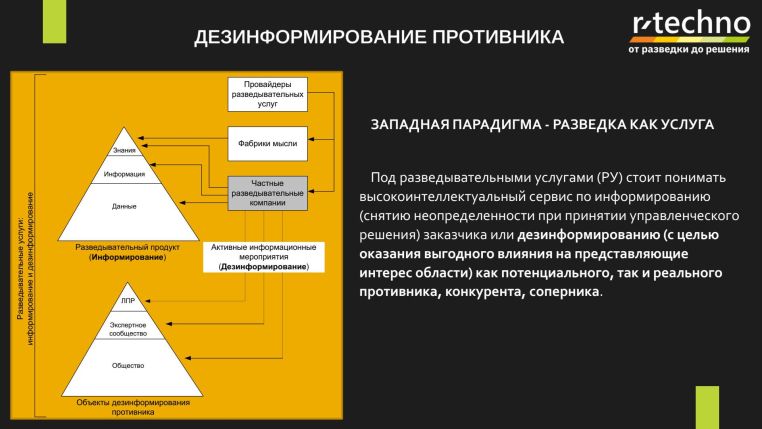
The first slide establishes the framework for understanding intelligence operations as a dual-pronged effort. On one side lies the goal of reducing uncertainty for decision-makers, allowing for more informed strategic choices. On the other side, disinformation targets opponents by shaping perceptions and decisions to an advantage. Romachev grounds this concept in a “Western paradigm,” arguing that intelligence and manipulation are two sides of the same coin. His rhetorical positioning preempts criticism of Russia’s disinformation activities by asserting that similar tactics have long been embraced by adversaries. The assertion of equivalency frames the discussion in a way that minimizes ethical scrutiny.
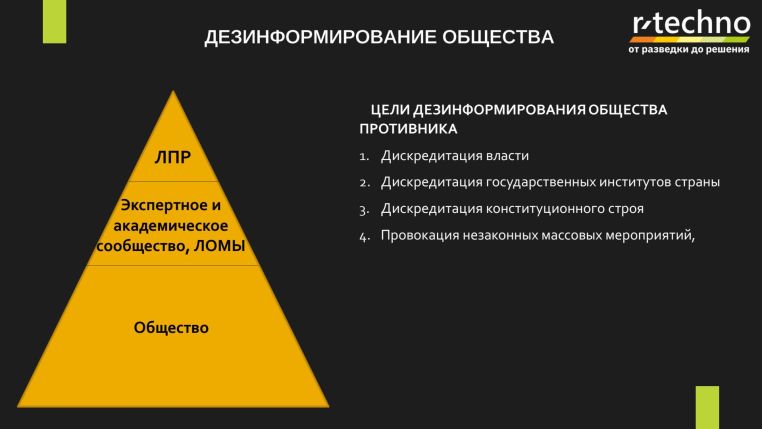
The objectives of societal disinformation, detailed in the second slide, focus on undermining cohesion and governance. Strategies to erode trust in leadership, discredit institutions, and provoke unrest are shown not as theoretical considerations but as actionable goals. The prioritization of these methods shows an acute understanding of societal vulnerabilities. The focus on discrediting constitutional order, for instance, shows a recognition of the foundational role of governance structures in maintaining societal stability. The disinformation strategy intends to sow chaos and reduce a target nation’s capacity for organized response by weakening these structures.
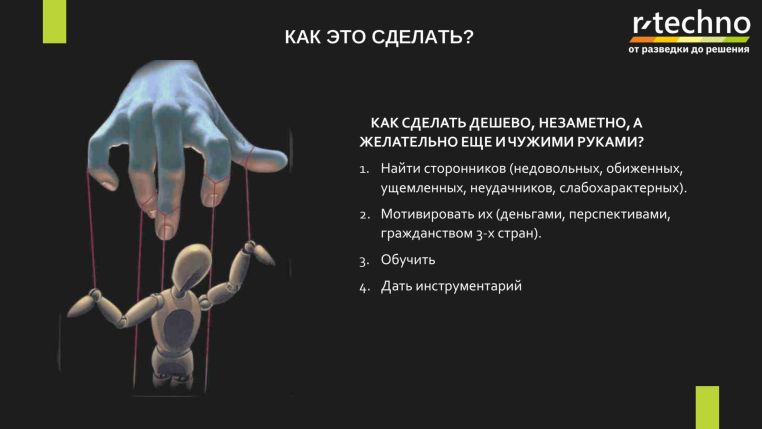
Methods for implementing these objectives reflect a calculated approach prioritizing efficiency and anonymity. The emphasis on recruiting dissatisfied individuals, whether motivated by personal grievances, material gain, or external opportunities, clarifies the pragmatism of the Russian approach. Operatives are identified, trained, and equipped to act as proxies, enabling deniability and reducing direct exposure for state actors. The methods maximize operational reach and obscure the source of manipulation, complicating attribution efforts.
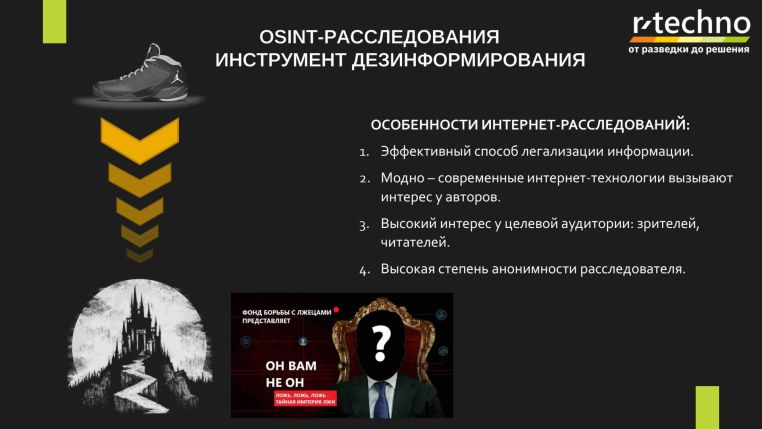
Open-source intelligence (OSINT) receives attention as a potent tool for advancing disinformation. The presentation describes OSINT investigations as a means of lending credibility to fabricated narratives. Public access and transparency, hallmarks of legitimate investigative journalism, are exploited to disguise propaganda as credible reporting. Modern technological platforms enhance the appeal of such content, ensuring engagement from targeted audiences. The use of anonymity to shield operatives further bolsters the effectiveness of this approach. The tactics demonstrate an intentional effort to diminish trust in independent journalism by appropriating its methods for state-driven purposes.
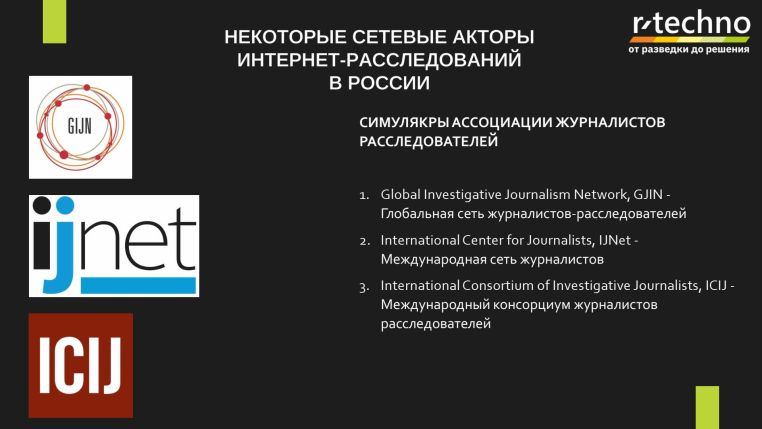
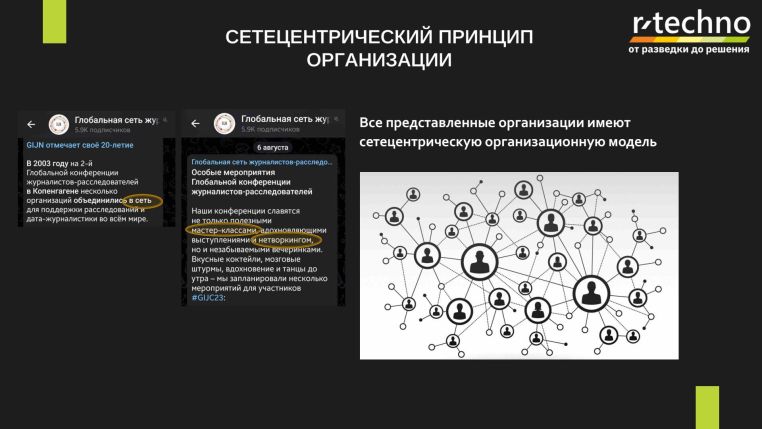
The discussion extends to actors involved in OSINT within Russia and internationally. The presentation casts suspicion on global journalism organizations, labeling them as potential fronts for adversarial activity, likely since this is a standard of zrussian globall disinformation. His mischaracterization is dual purpose: discrediting legitimate investigative efforts while positioning Russian operations as necessary countermeasures. The reference to network-centric organizational models indicates an aspiration to emulate the decentralized and adaptive structures of these groups. The adoption of these principles shows an acknowledgment of their efficacy in contemporary operations.
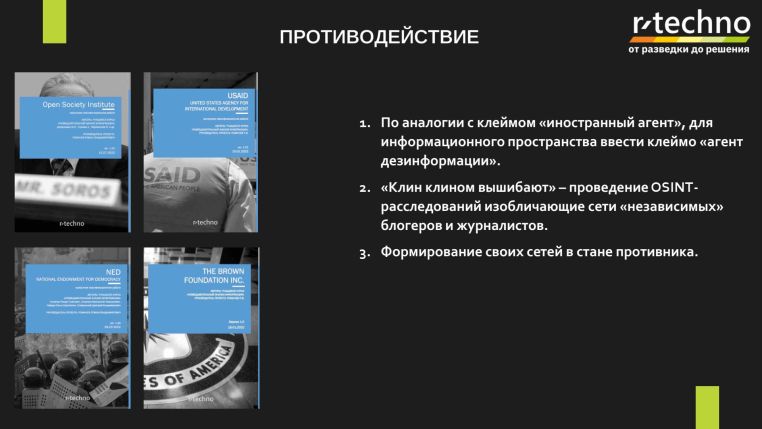
Countermeasures proposed in the presentation reveal a mix of defensive and offensive tactics. Labeling disinformation agents as “agents of influence” mirrors existing practices of branding organizations as foreign agents under Russian law. Conducting investigative efforts to expose adversarial networks reflects a commitment to turning opponents’ tools against them. Establishing networks within target nations demonstrates a proactive approach to infiltrating and disrupting adversaries from within. The measures define the cyclical nature of information confrontation, where tactics and strategies often mirror those of the opponent.
The closing slide reiterates the central theme of dominating the information space through intelligence and manipulation. His conclusion ties together the threads of the presentation, emphasizing the importance of systematic and strategic efforts to shape narratives and perceptions.
Russian information warfare strategies, as revealed in this document, reflect a sophisticated understanding of the dynamics of modern conflict. The dual nature of informing and manipulating shows an adaptability aligning with broader trends in hybrid warfare. The normalization of disinformation as a strategic tool raises significant ethical concerns targeting and challenging democratic institutions to develop robust countermeasures.
Romachev’s position, portraying the West as an “evil bearer of democracy,” underscores a glaring hypocrisy that reflects deep contradictions within his argument. His critique hinges on framing democracy as a destabilizing force, harmful to the stability of nations like Russia. His portrayal conveniently ignores the repressive nature of Russian governance, where dissent is systematically silenced, and democratic principles are dismissed as subversive tools of Western influence. By demonizing democracy, Romachev deflects from the failures of authoritarian control while vilifying a system that threatens the Kremlin’s grip on power.
The narrative that the West imposes democracy as a weapon against sovereign states is particularly disingenuous when juxtaposed with Russia’s aggressive efforts to undermine democratic institutions abroad. While Romachev accuses Western nations of destabilizing others under the guise of promoting freedom, his own strategies—outlined in his presentation—reveal a systematic approach to eroding trust in governance, manipulating public discourse, and inciting unrest within target countries. His approach mirrors the very tactics he attributes to the West, exposing a duplicity that discredits his claims of moral superiority.
Moreover, the characterization of democracy as inherently antithetical to Russian stability ignores the aspirations of Russian citizens who seek greater freedoms and transparency. He alignment of democracy with chaos perpetuates the false narrative that Russian society must choose between repression and disorder. His binary positioning supports the interests of an authoritarian regime rekying on control and fear to maintain power. He dismisses the possibility that democracy fosters resilience and prosperity within Russia, as it has in numerous other nations.
Romachev’s stance exemplifies a broader pattern of projection often employed in Kremlin rhetoric. While criticizing the West for its supposed export of values, Russian operatives actively intervene in the political systems of other nations, spreading disinformation and fostering division. His clear hypocrisy shows a fundamental insecurity about the appeal of democratic governance and its potential to inspire change within Russia itself. Romachev’s attack on democracy reflects old Soviet positions intent on discrediting an ideological rival while shielding their own system from scrutiny and reform.
In essence, Romachev’s condemnation of the West’s democratic ideals reflects a fear of the transformative power of those ideals and his inability to handle normal dissent and differences of valid opinions. uh His position relies on the false premise that repression is synonymous with stability, ignoring the universal human desire for freedom, justice, and accountability. The hypocrisy inherent in his arguments weakens his critique and highlights the fragility of the system he seeks to defend.



You must be logged in to post a comment.