


The Eastern War Front of the National Liberation Army (ELN), led by Manuel Vásquez Castaño, has claimed responsibility for the execution of two individuals accused of narco-paramilitary activities. The ELN alleges these individuals, in coordination with local police and military, were involved in criminal acts against civilians, including arson and murder of local leaders. The organization positions itself as the protector of the people, issuing warnings to deter youths from involvement with mercenary groups.
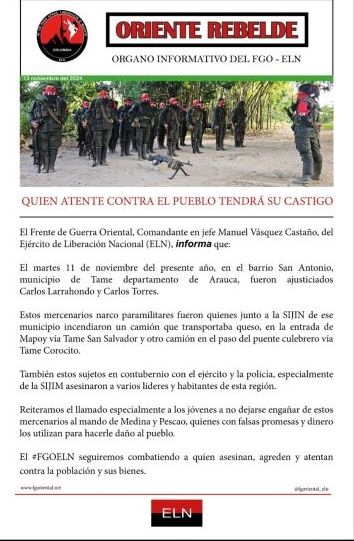
The ELN’s message asserts a retaliatory stance against perceived threats to the local populace, identifying itself as a defender of community justice. The messaging aligns with historical guerrilla narratives where the group acts in opposition to government-aligned paramilitary activities. The statement emphasizes a protective role for disenfranchised populations, positioning itself against “narco-paramilitary mercenaries.”
San Antonio, Tame, Arauca.
November 11.
Execution of Carlos Larrahondo and Carlos Torres, alleged to be working with SIJIN (Judicial Police) and local armed forces. Their actions include arson on transportation assets, presumably to disrupt economic activities that the ELN claims were carried out by state-supported mercenaries.
Involvement of the executed individuals in assassinating local leaders and collaborating with state forces to terrorize the population. The details frame the ELN’s actions as a “response” to civilian endangerment as opposed to criminal violence.
The theme of the comms cautions younger populations against joining mercenary groups led by individuals known as “Medina” and “Pescao,” who purportedly manipulate youths with financial incentives. Their intent pushes the psychological dimensions of influence to deter enlistment through moral appeals, a classic tactic in guerrilla messaging designed to consolidate community support.
The phrase “Anyone who attacks the people will be punished” underscores a deterrent aimed at paramilitary and military collaborators, presenting the ELN as an enforcer of local justice and implicitly aligning with sentiments against state corruption and impunity.
The ELN publicized the names of the deceased detailing alleged crimes influencing local perceptions, portraying their actions as justified measures of local defense. They drive fear among adversaries and weaken recruitment into state-aligned forces.
The post targets the credibility of state actors (e.g., SIJIN) involved in counter-insurgency, framing them as criminal groups that weaken local trust in official security forces promoting community alignment with the ELN.
The actions and public statements by the ELN spark government or paramilitary responses, escalating violence in the Arauca region. Given the explicit naming and accusations, the risk of reciprocal targeting against ELN forces and civilians.
The ELN’s focus on narrative control shows the group’s awareness of the cognitive dimension in asymmetric warfare, likely a deliberate effort to manipulate perceptions and frame the group as a community shield rather than a destabilizing force.
The targeting of youth in the message hints at an ongoing struggle for influence over future recruits. State and guerrilla forces may intensify efforts to sway local sentiments.
There is a lack of independent verification of the collusion between paramilitary forces and local police introduces uncertainty in assessing the ELN’s claims.
Understanding the local population’s response to ELN actions would refine assessments of ELN’s influence
You must be logged in to post a comment.