


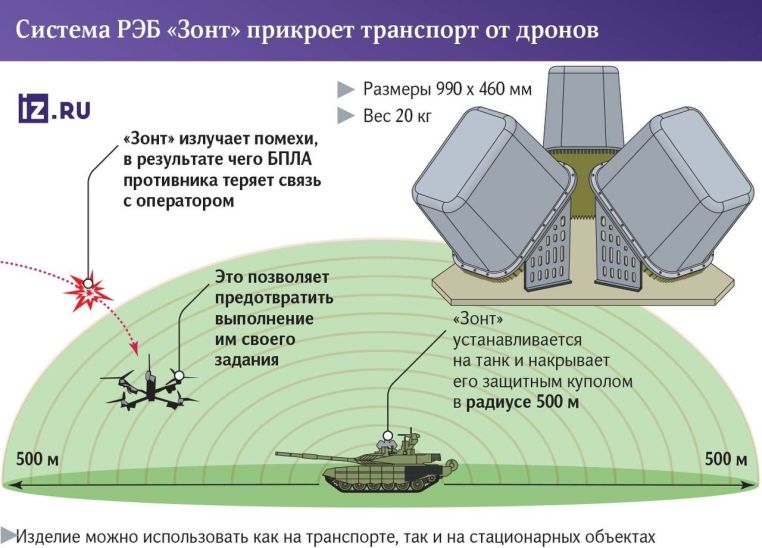
Russia has created a dome-type electronic warfare system called Zont, which is capable of jamming enemy FPV drones within a radius of up to 500 meters. The development was initiated at the request of Russian servicemen in the combat zone.
The system is designed to protect equipment from FPV drones. It can be used both on transport and on stationary objects.
The equipment is already being used on the combat contact line.
Protective dome
The sector-type product “Zont” is an electronic warfare (EW) system that allows military and civilian facilities to be covered with a protective dome within a radius of up to 500 meters. The development is mainly focused on protecting equipment from FPV drones. It can be used both on transport and on stationary objects.
— At the moment, none of the FPV drones used during testing have been able to fly up to the Umbrella, — the chief designer of the product from the company ELIARS told Izvestia. — Depending on what kind of UAV it is, the picture or the control channel is lost, and sometimes both. We tested the Umbrella with fighters in Donetsk, simulating the situation by taking a three-liter bottle of water, loading it onto an FPV drone and trying to drop it on a car. As a result, none of the drones we used were able to complete the task.
According to the developer, the product also passed tests on the combat contact line in April 2024. Now one system has been sent to fighters in the SVO zone, after positive feedback the company decided to launch the Zont product into serial production.
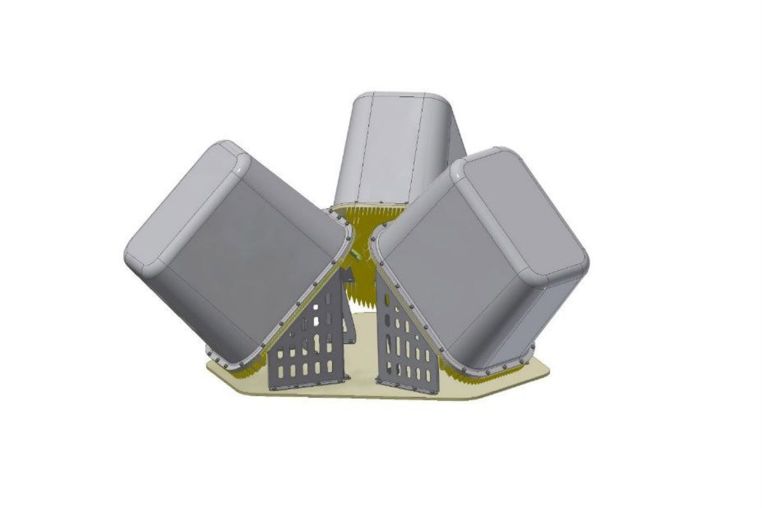
The development turned out to be large, its weight is about 20 kg. The work is carried out on frequency ranges – from 0.4 GHz to 5.8 GHz.
Turns off all signals
As military expert Yuri Lyamin explained to Izvestia, in the context of the active use of FPV drones, they are now trying to install dome-type systems on heavy equipment – tanks, armored vehicles.
— When a tank goes on the attack, our soldiers need to extinguish as many UAVs approaching it as possible. And there is no time to choose a direction, as you need to do with narrow-beam EW systems, — he emphasized. — A dome-type electronic warfare system extinguishes all signals in its range, and a narrow-beam type selectively hits a particular direction. Sometimes the military puts a dome-type product on a separate vehicle that accompanies a tank or other armored vehicle in an attack.
Klim Dmitriev, a veteran of the electronic warfare troops of the Russian Armed Forces, also says the same thing. According to him, in the case of dugouts and shelters, there is a rough idea of where the FPV drone is flying from, so there is no point in irradiating your rear areas and creating interference for your drones with dome-type electronic warfare.

This system is also not relevant for civilian stationary objects, since the power for their protection must be higher. “Zont” is most suitable for moving objects that can maneuver, turn, approach the enemy with their front, back, side. That is, for those objects that expect an attack from everywhere, – he noted. – In addition, EW should imply an additional reconnaissance system, because the enemy is constantly rebuilding, switching to other frequencies. And for further effective development and parrying of attacks, the electronic warfare system must be block. So that some blocks can be optionally replaced with antenna modifications. Because if everything is done stationary, strictly in a certain range, then by the time it all reaches the front, it will become irrelevant. Manufacturers should pay attention to this, in my opinion.
The development of the product began in early 2024. According to the chief designer, the company then began receiving requests from Russian military personnel from the special military operation zone about the need to create an electronic warfare system to protect vehicles.
“Many vehicles come to the front lines, but according to military personnel, without protection from drones, they crash within a week,” the company representative explained.
ELIARS LLC has already independently developed several different types of electronic warfare products – guns, individual protection systems, drone detectors, etc., but the main focus of the organization is radar.
A unique Airspace Control System (ASCS) has begun operating in the Moscow region, which is capable of detecting not only airplanes or helicopters, but also mini- and micro-drones at extremely low altitudes and directing air defense systems or electronic warfare systems at them.
— Making a radar station (RLS) see a fighter or a bomber is something any manufacturer in the world can do. We can detect such types of aerial targets as copter-type drones the size of a sheet of paper. We are guaranteed to detect a copter that carries a maximum of a video camera, such as the Mavic 2, at ranges of up to 4 km, — noted the deputy chief engineer of the developer company, the Central Design Bureau of Apparatus Manufacturing from Tula.
SKVP is a network of radar stations with a fixed phased antenna array. They can be installed on tripods, on vehicles and on the roofs of high-rise buildings, cell towers and even on the balconies of ordinary residential buildings. The radiation of such a radar is so small that it does not require a sanitary passport. Initially, it was developed as a civil system for air traffic control, but the SVO made its own adjustments


You must be logged in to post a comment.