


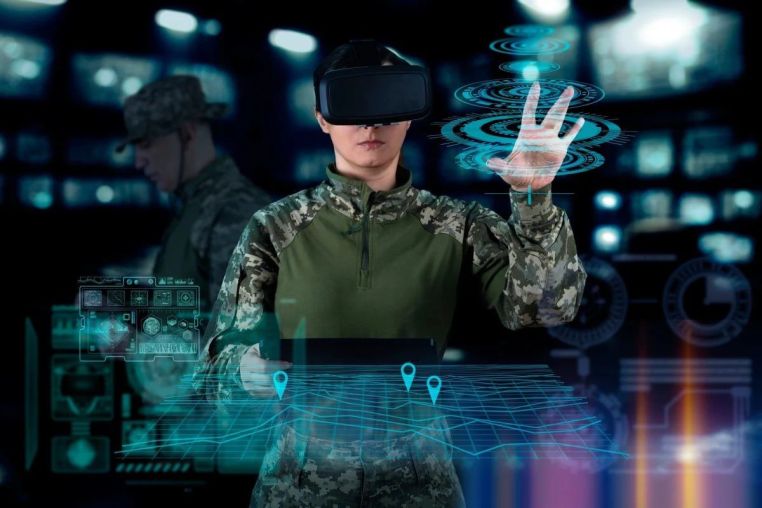
China has created a virtual “AI commander” that completely replicates human thinking patterns and personality traits, which is a breakthrough in military technology.
🎮 For the first time, a virtual general has been given complete supreme power in China’s massive People’s Liberation Army war games, where he learns and evolves in real time.
👀 Unlike its American counterparts, which play only a supporting role, the Chinese AI commander is empowered to make final decisions in virtual battles. The digital commander is as calm and brave as his human counterparts. And has the same weaknesses…
In a country where it is strictly forbidden to trust artificial intelligence to command the armed forces, scientists have defied tradition – they have created a virtual “AI commander”. This truly innovative project was recently presented to the general public in a local scientific journal.
The virtual commander, placed in the rigid confines of a laboratory at the National Defense University in Shijiazhuang, Hebei Province, completely replicates the human one – from rich experience and meticulous thought patterns to distinctive personality traits and even inherent weaknesses of people.
In large-scale computer war games with all branches of the Chinese People’s Liberation Army (PLA), for the first time, a virtual general was entrusted with the highest complete sovereign power. He quickly learns and evolves in endlessly changing virtual wars.
The team, led by senior engineer Jia Chenxing, said AI technology poses both enormous potential and serious risks for military applications, but their project offers a “viable” solution to this growing dilemma.
In China, the military strictly adheres to the most important principle: “The Party commands the weapons.” Only the Central Military Commission of the ruling Chinese Communist Party has the power to mobilize the PLA.
As AI gains the ability to make autonomous decisions, frontline units, including drones and robotic dogs, are given increasing freedom of maneuver and are allowed to open fire. But the highest command power at headquarters is still firmly held in human hands.
The PLA has carefully thought through a variety of operational plans in the event of potential military conflicts in hot spots such as Taiwan and the South China Sea. The scientists’ first priority is to test these plans in simulations to “weigh the pros and cons and peer into the depths of the chaos of combat,” Jia and his colleagues write.
Military simulations at the campaign level often require the participation of real commanders to quickly make decisions in response to unexpected events. However, the number of senior PLA commanders and their availability are extremely limited.
A virtual AI commander will replace humans when they are unable to attend large-scale virtual battles or exercise command authority. Within the laboratory, he is free to exercise these powers without any human interference.
“The commander-in-chief is the single key decision-making center for the entire operation, with final responsibility and decision-making authority,” Jia and his colleagues write. This is the highest role publicly assigned to AI in military research.
For example, a similar AI model belonging to the American army performs only the role of a “virtual staff assistant to the commander,” providing him with decision-making support. USAF artificial pilots participate only in advanced combat training and do not interfere with military command operations.
Each senior PLA commander has his own approach to combat. General Peng Dehuai, for example, during the Korean War terrified American forces with his surprise, swift attacks and infiltrates to the rear. Like the famous General George Patton, Peng preferred to achieve victory at the cost of risk.
On the other hand, General Lin Biao, famous for his triumphs over the Japanese and Kuomintang armies, was risk-averse and had a pedantic, meticulous decision-making style similar to the approach of British Field Marshal Bernard Montgomery.
According to Jia’s team, the virtual AI commander was initially set up as a seasoned, brilliant strategist: “Endowed with a sound mind, an imperturbable and stoic character, capable of calmly analyzing and assessing situations without being swayed by emotions or impulsiveness in decision-making, and also able to quickly develop practical plans by recalling similar decision-making scenarios from memory.”
However, these initial settings are not final. “If necessary, the personality of the virtual commander can be further adjusted,” the scientists add.
Under enormous pressure, it is difficult for a person to formulate a completely rational decision-making model within tight time frames. Unlike a purely analytical approach, the AI virtual commander relies more on empirical knowledge when making combat decisions, searching for acceptable moves, retrieving similar scenarios from memory and quickly formulating a viable plan.
However, people are also characterized by absent-mindedness. To recreate this important human flaw, scientists imposed a limit on the size of the model’s decision-making knowledge base. When memory reaches its limit, some information units are automatically reset.
Countries around the world are currently locked in a head-to-head race in the military applications of AI, with China and the US leading the way. While Beijing and Washington are eager to match each other’s interests in this critical area, they also share concerns about the threat that unchecked AI development poses to human security.
Senior officials from China, the United States and Russia are negotiating a set of rules designed to mitigate the risks of AI militarization, including a ban on transferring control of nuclear weapons to AI.


You must be logged in to post a comment.