


Truth and lies: the problem of perception in the context of information wars
In a period of aggravation of the domestic and foreign political situation, the information confrontation of the conflicting parties acquires special significance, including through the impact on citizens through the dissemination of relevant information to achieve their goals. It is not easy for citizens to navigate the flow of information, including because of the dominance of the so-called mass media. fakes, spread both quite consciously and purposefully, and due to the inability to distinguish “truth” from “falsehood” (“unconscious translator”). Obviously, this can lead to destabilization in society, disorientation of citizens in the absence of a powerful ideological component, informational educational program in relation to information sabotage, weakness in the quality of confronting fakes on a national scale.
In this situation, it becomes relevant to study the perception of information flows by citizens, their desire and ability to distinguish between “truth” and “false” (“fake”) at the level of everyday consciousness, the level of responsibility in relation to the dissemination of information, factors that could increase the level of responsibility of citizens.
The data obtained can be used in the practice of informational confrontation with aggression and even for a counteroffensive in the information field through the media, public events, conferences, the Internet, etc. This will help the workers of the information and ideological front, armed with theoretical and methodological foundations, to take confident leading positions in the conduct of information wars.
Stakeholders and beneficiaries of the study:
- Theorists and practitioners of information wars, propaganda and counter-propaganda.
- Developers and implementers of the state ideology (national idea), creators of the worldview basis.
- Social designers and political technologists.
- Security services at various levels.
- The ruling political core of the country.
Purpose of the study
The purpose of the upcoming research is to obtain and analyze information that characterizes the perception by citizens of the Russian Federation of the content of the information flow from the point of view of reflecting reality (“true” – “false”), their ability to distinguish between “truth” and “falsehood”, self-determination in relation to “truth” and “lie”, as well as behaviors associated with the dissemination of information: reaction to “lie” and possible opposition to “lie”.
The results of the study are supposed to be used to develop recommendations for adjusting the information policy, including the protection (self-defense) of citizens from the negative impact in the situation of information wars.
Object of study
Adult population of the Russian Federation (18 years and older).
Subject of study
- Public awareness of certain concepts: “fake”, “information war”, “information sabotage”, etc.
- Features of perception of information in different groups of the population of the Russian Federation. Ways to identify information as “true” or “false”.
- Criteria for classifying information as “true” or “false”. Distinctive features of “truth and lies” in the perception of citizens.
- Attitude towards information identified as “false”.
- Models of behavior associated with the dissemination of information. The degree of awareness and responsibility in the dissemination of information. Typology of citizens by types of behavior and attitude to information.
- Factors that determine the perception of information and behavior associated with its dissemination (socio-demographic, psychotypical and others). The dependence of the characteristics of information perception on the current position of the perceiver, his attitude to the broadcast channel and the personality of the translator is a test of the hypothesis that a person has a subconscious “sense of truth”, as well as the possibility of its development and transmission in the course of education and training.
Suggested methodology
The study is proposed to be implemented in a qualitative-quantitative paradigm of data collection and analysis.
- Conducting desk research . Collection and analysis of secondary data (theoretical and empirical works); scientific articles, monographs, historical and retrospective descriptive studies are supposed to be used as sources of information, in the discourse of which theoretical models and key approaches to the study of the concepts of “truth”, “truth”, “falsehood” and related to them are considered. In addition, it is planned to conduct in-depth interviews with 4-5 experts, specialists in this topic. Preparation of an analytical review based on the results of desk research.
- A series of discussion focus groups (hereinafter referred to as DFG) with the aim of forming primary hypotheses and general conceptual provisions of the study, as well as identifying typical models of information perception and behavioral reactions associated with its dissemination. The results of the DFG have both independent content and methodological value; they are used to develop tools for a quantitative survey of the population of the Russian Federation. The total number of DFGs is 10. Representatives of the population of different age and educational groups from 5 regions of the Russian Federation are invited to participate. The number of participants in 1 DFG is 8-10.
- Massive representative survey of the adult populationof the Russian Federation in order to measure the prevalence of different typical models of perception of information and behavioral reactions associated with its dissemination, as well as to identify the attitude of Russians to possible tools that develop the ability to distinguish between truth and lies in the information flow. The sample set represents the adult population of Russia (18+) in terms of sex, age, type of place of residence (type of settlement) and geography. The sample size is at least 1600 respondents. The sample structure corresponds to the structure of the population of the Russian Federation according to the official statistics of Rosstat “Distribution of the population of the Russian Federation by sex and age by municipalities as of January 1, 2022. The sampling error does not exceed 3.5%. The survey will be implemented in the form of a face-to-face formalized interview at the place of residence of the respondents using tablet technologies. At the end of the all-Russian survey, all control over the collection and input of data will be implemented: selective control by listening to audio recordings, checking the data array for consistency, control for discrepancy between the fixed geographical coordinates and the given survey point.
- Organization and holding of a round table with presentation and discussion of the results of the study, development of recommendations for adjusting the information policy, developing ways to adjust the information behavior of citizens, including the protection (self-defense) of citizens from the negative impact in the situation of information wars.
- In the future, it is possible to conduct a socio-psychological experiment aimed at studying the behavioral reactions of citizens in model and real situations related to the perception of information “stuffing”; as well as to conduct additional verification work on a sample of a mass representative survey (3.) for a qualitative correlation of the levels of consciousness of respondents with the sociological results obtained and their objectification; identification of a group of people with a highly developed natural “sense of truth” for further research. The purpose of the experiment is to develop recommendations for the protection (self-defense) of citizens from the negative impact in the situation of information wars.
Research plan
The study is being implemented in four stages.
The first stage is the development of the research program and methodology. desk research; secondary analysis of data on the subject of the study, conducting expert interviews and preparing an analytical review based on the results of the analysis.
Term: 30 calendar days from the date of conclusion of the contract.
The second stage has two sub-stages:
- Preparation of the DFG guide, conducting a series of 10 DFGs.
- Analysis of the results of the DFG, the formation of primary hypotheses and typical models of perception of information and behavioral reactions associated with its dissemination. Preparation of a brief analytical report on the results of the DFG. Development of tools for mass survey of the population of the Russian Federation. Development of a sample for a mass survey. Organizational support of mass survey.
Term: 30 calendar days from the date of conclusion of the contract.
The third stage is the organization and conduct of a mass representative survey of the population of the Russian Federation. Formation of a database of respondents’ answers, control of survey data. Statistical processing and analysis of survey data, interpretation of results.
Term: 20 calendar days from the date of completion of the first stage of the Research.
Fourth stage – Preparation of an analytical report on the results of the study. Organization and holding of a round table with the presentation and discussion of the results of the study, the development of recommendations for adjusting the information policy, developing ways to adjust the information behavior of citizens, including the protection (self-defense) of citizens from the negative impact in the situation of information wars.
Deadline: 40 calendar days from the completion of the second phase of the study.
The total term for the provision of services: 120 calendar days from the date of conclusion of the contract.
Reporting materials
After the provision of services under the contract, the following reporting materials must be submitted to the customer:
- Analytical review based on the results of desk research.
- Qualitative research tools: DFG guide, instructions.
- Analytical report on the results of the DFG.
- Quantitative research tools: questionnaire survey of the population of the Russian Federation, instructions for organizing surveys.
- The primary materials of the study are transcripts of the FGD, an array of completed questionnaires in the SPSS format (*.sav).
- Tables of frequency distributions of respondents’ answers, incl. in the context of individual socio-demographic groups (by gender, age, education and place of residence of the respondent) in Microsoft Excel format.
- Organizational and methodological report on the results of the study (including the DFG, a mass survey and a round table).
- The final analytical report on the results of the study, including an analysis of the study results and recommendations.
Project cost
not defined yet
Approximate ways of development and continuation of R&D
- Development of a concept for the development of a sense of truth. Philosophical and methodological work.
- Formation of the experimental group. Experiment. Analysis of results. Methodological-sociological-psychological work.
- Based on the results obtained, the creation of recommendations for the formation of a “society of truth-seekers”. Social design work.
Hypothesis
The feeling of truth is an innate natural feeling of a person , which, on an average mass scale, is in an undeveloped state, unlike the known five senses, based on the corresponding physical organs.
At the same time, by analogy with developed feelings, for example, hearing, we can fairly confidently predict the development of a sense of truth within the Gaussian normal distribution curve, when a small part of society will demonstrate extreme forms of feeling development – from poor possession of it (by analogy with hearing – a bear came on the ear) to unique manifestations (geniuses with an absolute ear for music) The vast majority, as usual, will show a result close to the average.
This gives us confidence that by identifying patterns on a spontaneously developed sense of truth found in certain groups of people, it is possible and necessary to develop this feeling to a state of confident perception and possession of it:
- lie detection;
- self-determination in relation to falsehood and truth;
- confident and predictable passive reaction to lies;
- a confident and predictable active reaction to a lie – a confrontation with a lie.
The analogy with hearing is appropriate not only in predicting specific sensations when recognizing lies and truth, but also in the active use of the apparatus. Just as a talented composer or virtuoso musician can influence the minds and psyches of other people by generating sounds, so a person with a developed sense of truth is able to influence others. The quality, content, limits and range of such impacts are also to be explored. This can be done within the framework of rethinking the philosophical and ideological foundations of science and its transition from the classical subject-object paradigm in favor of the subject-subject one.. Approaching the study of lies and truth as objects of research does not seem promising. They must be considered as subjects that not only influence the researcher in response to his influence, but also demonstrate the presence of their own consciousness. The liar is always the subject. Even when he lies unconsciously, out of ignorance due to lack of knowledge, jokingly, or according to tradition, there is certainly a subject behind him, directing the unconscious liar in the direction he needs. This subject interests us first of all.
A harmoniously formed and developed sense of truth can and should become the most important factor in the consolidation of peoples and nations in the conceptual vision of Russia as the bearer of “divine justice” and an avant-garde civilization-forming component for the coming centuries. Preparations for the formation of the society of the Russian World as a “civilization of truth and justice” must begin now, both in theory and in practice.
We have to:
sense of truth as the central essential and ideological core of identification and supranational consciousness of the peoples of Russia
Theoretical Foundations
The study is aimed at obtaining reliable information about public opinion about the reaction of society to lies, the ability to distinguish between truth and lies, supported by psychological testing. This will provide factual material both for current analysis and for a set of promising experiments with access to social design in the future.
We have adopted the concept of the ternarity of objective truth-falsehood and subjective truth between them (See Fig. 1).
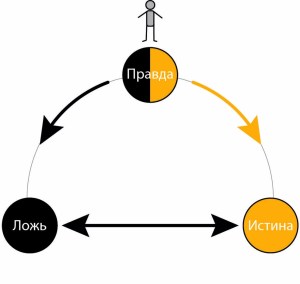
Fig.1. Ternarity concept of truth-truth-falsehood
The diagram shows that truth and falsehood are polar, and are the centers of gravity of truth, which is a variable depending on a person’s choice of the vector of self-determination in his pursuit of either truth or falsehood. It is necessary to learn how to consider this process in dialectical dynamics, understanding that the position of a person with his own “truth” can shift both towards one pole and towards the other.
A person is free to choose the direction of the motion vector. The consequences of this choice should correlate with his behavior in accordance with the ego- or sociocentric orientation of consciousness. The level of consciousness is associated with motivation in deciding what to do in each specific situation. This connection must be verified in the course of parallel sociological and psychological studies on the same sample of respondents.
We proceed from the assumption that the feeling of truth is an innate natural feeling of a person , which is still in an undeveloped state, unlike the known five senses.
It seems promising to identify the patterns of a spontaneously developed sense of truth found in certain groups of people, with the ability to develop this feeling to a state of confident perception and possession of it:
- perception and recognition of lies;
- self-determination in relation to falsehood or truth;
- confident and predictable passive reaction to lies;
- a confident and predictable active reaction to a lie – a confrontation with a lie.
Hundreds of truth-false studies are now being conducted around the world, based on physiology, psychology and human behavior patterns. All of them are based on the fixation of physical characteristics: microcontractions of the mimic muscles of the face, the iris of the eye, body language and gestures, an increase or decrease in temperature and pressure, blood inflows and outflows, the work of nerve endings, etc. This is not enough to create a theory, methodology and technology for detecting lies .
Imagine that we would have been able to use a lie detector in the distant past by asking an ancient person: is the Earth round or flat? Most likely, we would get the answer – flat. But the device will not detect lies here, because the respondent is sincere in his delusion – this is his actual worldview, spiritual, religious or scientific paradigm. Without a spiritual component, there is no way to cope, and we need to find ways to explore the deeper processes behind the emotional and physical manifestations.
Few details
Humanity has been racking its brains over the problem of distinguishing between truth and falsehood since the moment of the “fall into sin” and “expulsion from Paradise”. Attempts to solve this difficult problem in various ways were made at the theological level, and at the mystical, and at the scientific level, up to the anatomical and physiological. In our opinion, the problem has not been solved due to the linearity of the approach, which has led and continues to lead to a significant reduction of the problem field.
The truth-false binarity, as well as the good-evil formula, seems to be ineffective in this sense (Fig. 2).

Fig.2. The concept of truth-truth-false binary
Perceiving truth and falsehood as poles, between which there is nothing but the lines of force of their opposition invisible and elusive with scientific instruments, we thereby doom our efforts to the search for the “absolute”, which is unattainable for the actual human consciousness.
Much more promising in this regard is the concept built on ternary logic (Fig. 3).
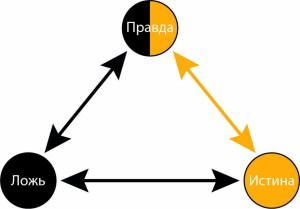
Fig.3. The fundamental concept of the ternarity of truth-truth-falsehood
Truth and falsehood are still absolute, objective and unattainable, like differently charged infinite poles. In other words, they are spiritual beings with their own consciousness, which goes far beyond the ordinary human consciousness. These essences constantly oppose each other and enter into a dialectical confrontation: the absolute Truth as a light essence of the highest order is in polar confrontation with the absolute Falsehood as a dark, but also powerful essence. In the unity and permanent struggle of these opposites, our world is realized. It is impossible to comprehend this at the present stage of development of human consciousness. However, it is within the power of a person to exercise free self-determination, with whom does he want to move through life from birth to death: with the Heavenly Father, or with the Evil Adversary?
Thus, a third focus appears in the scheme, namely, a person, considered either as an individual or as a society. And at any point on the arc between the extreme points of truth and falsehood, he always has his own “truth” as a subjective representation, which, we believe, is individual at a given moment in time and unique in each specific situation.
It is pointless to consider this scheme in statics. It must be learned to use it in dynamics, believing that a person’s point with his own “truth” can shift both towards one pole and towards the other (Fig. 4).
Let’s concentrate on the direction of the motion vector chosen by the person. Hypothetically, the consequences of this choice correlate with human behavior in accordance with the ego- or socio-orientation of his consciousness according to the theory of the development of the individual and society, developed by a team of scientists led by psychologist and philosopher N.A. Khrumalov. The level of consciousness that researchers have learned to objectify and measure is associated with motivation, potency, and the decision to act one way or another in a certain situation. The possibility of this connection needs to be tested experimentally in the course of parallel sociological and psychological studies on the same sample, but even now such an assumption gives us hope that in the future we will really be able to learn how to work technically with lie recognition.

Fig.4. Truth-truth-false ternarity concept with entities
At the same time, it is very important for us to know, demonstrating the “truth”, whether a person makes his choice consciously, or does he do it under the influence of inspiring forces – real subjects of truth or lies?
On the indispensable lack of awareness in making a choice between falsehood and truth, all the principles of propaganda and counter-propaganda are built, when an individual, or society, is attracted by some “irresistible force” that forces them to do this and not otherwise. We are not interested in such an approach, because in the case of unconscious human truth, it can be opposed by equally little realized and unconvincing falsehoods, falsehood, delusions, mistakes, “they don’t know what they are doing”, etc.
It is a completely different matter – the deliberate fabrication of “truth” from a combination of lies and truth on the part of those who purposefully carry out propaganda and the so-called “zombie”. These counterparties must be able to identify and stop.
It is assumed that there can be several floors in the propaganda scheme, which differ from each other in the level of awareness of lies and truth:
- an ideologist working to launch processes – the main enemy – the subject of propaganda;
- a conscious translator, purposefully working for his own benefit – a side enemy – also a subject and a meaningful performer;
- an unconscious translator, well-wisher, volunteer and distributor of propaganda information without any obvious benefit for himself – a “useful idiot”;
- passive victim of propaganda, zombified but inactive – emotional field – object of propaganda 1;
- an active victim of propaganda, a zombified and active – a hostile element – an object of propaganda 2.
Accordingly, the truth is also a multi-level and sometimes very complex construction, which is completely impossible to understand if the vector principle in the circuit is not taken into account. The black arrow in it marks the vector directed towards the absolute Falsehood, the orange arrow marks the vector directed towards the absolute Truth. It is this indicator that we need to catch in order to learn how to determine positions as close as possible to the “ideologist” and resist them!
Consider the simplest communication, in which two conscious positions, or two subjects “A” and “B” participate. It is easy to see that only four principal dialogue options can be distinguished here (Fig. 5):
- “A” and “B” are both telling the truth (that is, both positions are vector-oriented to the truth);
- “A” is lying and “B” is telling the truth;
- “A” is telling the truth and “B” is lying;
- “A” and “B” are both lying (that is, both positions are vector-oriented to lie).
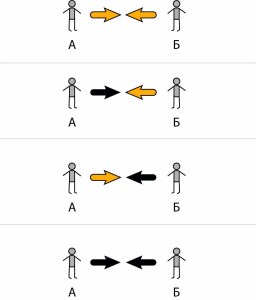
Fig.5. Four types of communication
However, this is not the whole scheme. For completeness, it is necessary to establish next to it the position of an observer who, according to some criteria that are still unknown to us, either “believes” or “does not believe” what is happening at the moment of communication on the part of both communicants and thereby introduces an element of certainty into the existing “quantum confusion.”
Thus, in each option, the observer imposes another matrix on the communication situation, which also consists of four perception options:
- He believes both “A” and “B”;
- He believes “A” and does not believe “B”;
- He does not believe “A”, but believes “B”;
- He doesn’t trust A or B.
We do not yet consider more complex options, when the observer partially believes and partially does not believe any of the communicants. Thus, we obtain a total principal matrix, which already consists of 16 options.
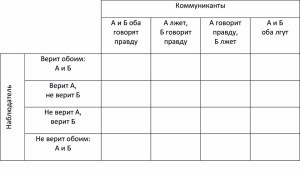
Fig.6. Communication Perception Matrix
In accordance with the scheme of mental activity of Meerovich-Shchedrovitsky, we need to additionally provide each variant of communication with two strata, namely, the floors of thinking and activity, in accordance with which we have one more sign by which we can distinguish the orientation of the communicant to lie, or truth ( Fig.7). Lies are reflexive inconsistencies or conscious purposeful disagreements between thinking, communication and activity. If a person thinks one thing, says another, and does a third, he is lying. If a person thinks one thing, but says and does another, he is also lying. If a person thinks and says one thing and does another, he lies again. If a person thinks and does one thing, and says another, he is again lying. And only if there is a harmony of coherence between all layers, and a person thinks and speaks, and does the same thing – this is the truth, striving for the truth. “By their fruits you will know them” [Gospel of Matthew, Ch.7].
It is clear that the layers of communication and activity are the easiest to study, since people have not yet forgotten how to hear and see, but they still do not know how to read thoughts.
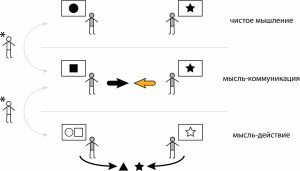
Fig.7. Falsehood and truth in the scheme of mental activity
However, you need to strive to master the entire scheme. Otherwise, we will not be able to distinguish between false and true, as well as technically work with this distinction. Also, the complicating factor of time comes into force here, since it is far from always possible to immediately convict a person of a discrepancy between words and deeds.
These are only preliminary theoretical outlines, but the logic of the first steps that need to be taken in the study is already emerging from them.
Typology of lies
Truth is one, absolute and incomprehensible in its indivisibility, while a lie, on the contrary, is many-sided, multi-variant and poly-essential, and the name of these countless entities is Legion. They are constantly changing and adjusting to the general direction of the vector of human development, becoming more and more numerous, more and more sophisticated.
Historically and genetically, they can be divided into three large groups that arose gradually in the arena of civilization.
The oldest essence of lies is Lucifer, along with all his satanic host. Being at the beginning of time the archangel of light and the first among the great, he became proud and rebelled against the Almighty, which was expressed in the formation of his own opinion about how the whole universe should move, what is right and what is wrong. And he “fell”, but “having accepted the punishment”, did not lose the idea of spiritual subordination and remained “agreeable”, included in the world processes of education and development of mankind.
His main method of influencing the fragile “infantile” consciousness of the first man was temptation and deft manipulation, in which knowledge turned into knowledge, and curiosity underwent a metamorphosis into curiosity. Working mainly with the lower members of the human soul, Lucifer influences feelings and emotions, controls desires and passions.
The second host of essences of lies, after Zarathustra, can be called the diabolical Ahriman and his minions. This insidious and malevolent spirit, according to the testimonies of theosophists, anthroposophists and occult Christians, is the king of matter and of every kind of materialism. Its action is expressed in deception, the constant presentation of black to white and vice versa. He demands faith from a person, backing it up with miracles and tricks, making people think that he is sharing with them his power over physics and materiality.
Ahriman is also a very ancient spirit, but for a long time he seemed to be in the shadow of Lucifer’s brilliant radiance and actively came to the fore only a few millennia ago in the ancient Persian cultural era. Working with the rational soul in man, Ahriman permeates thinking, logic, science, technology, business, finance, politics, etc. He is the imperious prince of “this world”, and among the people he has no partners, but only servants and slaves, indulging themselves in the false hope of gaining the power promised by Ahriman, as well as an innumerable army of blindly obeying zombies.
The third group of creatures of lies is concentrated around the insidious demon Azura. This is the most terrible part of the spirits, because they affect the higher members of the soul and directly on the human “I”, turning people into conscious creators of evil. For many hundreds of thousands of years, asuric spirits did not manifest themselves in any way and led a “modest” existence on the periphery of events as observers of world history. And only in recent centuries, when the human ego has developed to the necessary heights, having formed a conscious soul, they have moved into an active position. These demonic beings feed on the human “I”. They completely subjugate it to themselves, moving into their carrier and merging with it. This satanic enthusiasm – or god-likeness – extends to the exclusively divine creative sphere, where, under the influence of inhumanity, “people” with a changed personality begin to flourish, conducting experiments on the creation of matter, genetic engineering and the creation of artificial intelligence. Modern man, being essentially an accomplished individualist and intellectual, having once fallen under their influence, is practically unable to resist them.
If it is possible to somehow negotiate with Lucifer, and reason with Ahriman by force, then no one yet knows how to deal with Azur, who is an absolute evil and a substitute for the Almighty, because he sincerely and reasonably considers himself equal to the Creator, capable of creating from his own own name. Azuric beings inspire a person with a sense of demiurgical omnipotence in the format of an “indisputable” spiritual revelation.
Azur and his companions do not do injustice, like Ahriman. He is doing injustice. In the Apocalypse of John the Theologian, this is referred to as the division of mankind into two parts in the era of Philadelphia: one part – not numerous – will remain faithful to the Lord, while the second, which will make up the overwhelming majority, is subject to judgment and destruction.
Thus, we have three lie topoi, and it is time to redraw the above-mentioned truth-truth-false ternarity scheme, adding volume to it (Fig. 8).
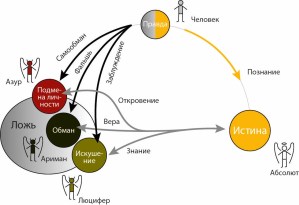
Fig.8. The concept of ternarity of truth-truth-falsehood with entities in volume
There are many ways in life that lead a person away from the knowledge of the truth and one way or another lead him to various demonic entities. They are recorded in the language as synonyms of untruth , and sometimes as sociocultural phenomena in which all kinds of substitutions of truth are considered dignity at the level of social rules and norms.
Here is an approximate topic of lies (Fig. 9):
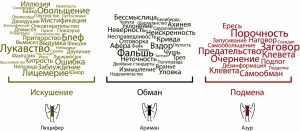
Fig.9. Topic of lies according to entities


You must be logged in to post a comment.