


FUNCTIONAL DESCRIPTION OF BRAWLER 2.1 OVERVIEW
BRAWLER is designed to simulate air-to-air combat between multiple flights of aircraft in both the visual and beyond-visual-range (BVR) arenas. Special emphasis has been placed on simulating cooperative tactics and on capturing the importance of situation awareness in this environment. Accurate modeling of hardware is also emphasized; BRAWLER currently models aircraft aerodynamics, missiles, radars, communications, IRST, IFF, NCID, RWR, missile launch warning devices, missile approach warning radars, etc. ECM effects on radars, communications, and missiles are played.
BRAWLER 's current configuration supports the simulation of engagements within the following numeric limitations:
• Twenty total aircraft maximum
• Ten flights maximum
• Eight aircraft maximum per flight.
Extensions to larger numbers are straightforward. BRAWLER is structured as an event- store simulation with most real-world stochastic features operating on Monte Carlo principles. It is normally operated with the computer controlling all players, but an interactive mode is also available to allow human operator control of one or more aircraft.
> The total size of pages = 400 pages
> Date : Feburary 2022
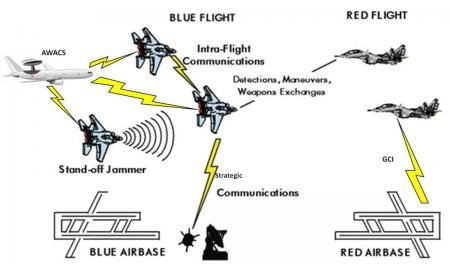
BRAWLER models the aircraft’s aerodynamics and signature, fuel, missiles, directed energy weapons, radar, communications, infrared search and track (IRST), identification, friend or foe (IFF), non-cooperative identification (NCID), radar warning receiver (RWR), Electronic Support Measures (ESM), heads-up display (HUD), health management system (HMS), electronic warfare (EW) systems (including
Digital Radio Frequency Memory (DRFM) Jamming), data link devices, sensor fusion systems, missile warning, and laser warning devices. Components can be modeled natively within BRAWLER, or a federate (such as Threat Modeling Analysis Program (TMAP) missile modules from the Intel Community (IC)), running in parallel. Ground Controlled Intercept (GCI), Airborne Warning and Control Systems (AWACS), Surface-to-Air Missile (SAM) sites, Surface-to-Surface Missiles (SSM), and stand-off jammers (SOF) are also modeled. BRAWLER is structured as an event-store simulation with a heavy use of stochastic models for most real-world systems. BRAWLER provides for effects-based electronic countermeasure (ECM) models and expendables.
Input
BRAWLER inputs consist of component-level system capabilities, which include aircraft performance, weapons performance, and sensor systems performance. The simulated scenario consists of number and types of aircraft, their command and control hierarchy, their disposition and bases, as well as GCI, AWACS, SAM Sites, SSMs, and SOJ support. Additionally, the set of rules representing doctrine and mission-specific tactics for both sides and all missions represented in the scenario must be specified. BRAWLER’s current default configuration is capable of handling a total of 20 different aircraft in as many as 10 independent flights with up to eight aircraft per flight, but can be run with well over 20 aircraft. Not surprisingly, setting up a study takes considerable time to simulate realistic combat, especially if it requires matching known tactics, techniques, and procedures (TTP).

You must be logged in to post a comment.