

04 JULY 2023 15:18READ 15 MINUTES
The Ministry of Defense wants to recover billions from the “daughter” of Roskosmos for disrupting the development of the upper stage
The Energia Rocket and Space Corporation failed to develop an upper stage for the Angara-A5 launch vehicle on time. Now the Ministry of Defense is trying to recover 3.23 billion rubles from the company. Boosters are a long-standing problem in Russian rocket science.
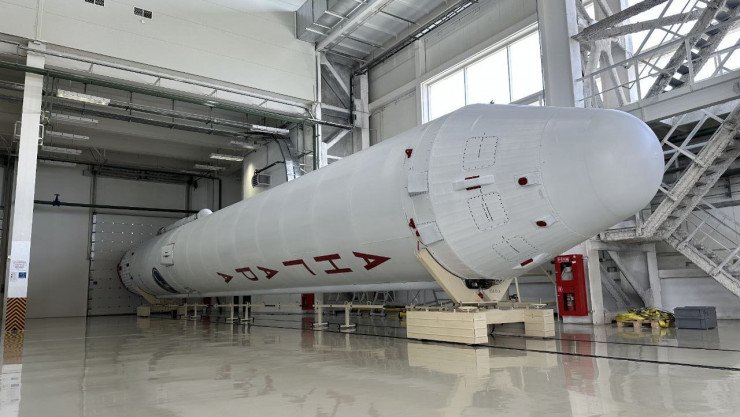
Photo: Roscosmos
Space Mess
The Ministry of Defense of the Russian Federation requires PJSC Rocket and Space Corporation Energia (RKK) to pay a penalty for the failure of contract No. 1621187308601452246000311 dated September 26, 2016.
This contract is part of a large project to carry out development work (R & D) “Persey-KV” for the needs of the Ministry of Defense, it can be seen from the materials of court proceedings between Energia and the Ministry of Defense of the Russian Federation.
The price of the entire work is 18.11 billion rubles, the share of Energia, judging by the information from the order of the Government of the Russian Federation of November 19, 2016 No. 2460-r, is 3 billion rubles.
RSC Energia was to upgrade the DM-03 upper stage for the Angara-A5 rocket as part of the Perseus-KV R&D. However, the contractor did not meet the schedule: according to the decision of the Moscow Arbitration Court dated January 16, 2023, the delay in 16 stages of the R&D implementation ranged from 158 to 1192 days, that is, more than three years and three months.
The Ministry of Defense calculated that the penalty for delay should be more than 3.23 billion rubles. But the defendant in the courts recalled that he had already sued the ministry for several stages of this contract, 211.9 million rubles and 94.9 million rubles were recovered from Energia . Moreover, in both disputes ( first and second ), the parties signed settlement agreements, agreeing that RKK would pay the debt by the end of 2049.
Taking this into account, the court accepted the counter-calculation presented by the defendant for a total amount of about 1.15 billion rubles and noted that “the penalty is clearly disproportionate to the consequences of the violation of the obligation.” As a result, the volume of claims of the Ministry of Defense was reduced to 574 million rubles.
The Ministry of Defense did not like this decision, and in the appeal on June 28, 2023, the ministry achieved a review of the case . The full text of the decision of the cassation has not yet been published.
Sergei Bakeshin, Head of Dispute Resolution and Bankruptcy at Maxima Legal, notes that in a new case, the court can either fully satisfy the claim or completely reject it. In addition, the plaintiff may increase the amount of claims if the delay in the performance of work continues.
MASHNEWS REFERENCE:
RSC Energia (29% owned by Roskosmos, 33% by JSC United Rocket and Space Corporation) is a manufacturer of launch vehicles, satellites, automatic interplanetary stations and other rocket and space technology. Established on June 6, 1994 on the basis of NII-88, formed in 1946 to develop long-range ballistic missiles.
RKK designed and built Salyut orbital stations, Soyuz manned spacecraft, Progress cargo spacecraft, the Energia-Buran reusable space system with the world’s largest Energia launch vehicle, etc.
The last time RKK disclosed financial results was in 2020. Revenue then amounted to 43.5 billion rubles, a net loss of 5.37 billion. The value of Energia’s net assets at the end of March 2023 is minus 3.3 billion rubles.
“Perseus” fell off schedule

Photo: Roscosmos
The upper stage (RB) is necessary to launch the rocket into the planned space orbit. The Perseus rocket launcher was developed by Energia on the order of Roskosmos for use with launch vehicles of the Angara family.
The basis for the “Perseus” was the RB of the previous type 11S861-03, aka DM-03. Initially, it was assumed that the new Perseus would be used with Proton-M missiles, and then it would be upgraded to Angara-A5. But then they decided to decommission the Proton-M, and the upper stage immediately began to be designed for the Angara-A5. For this, in 2014, the Perseus-KV project was launched, but the customer was no longer Roscosmos, but the Ministry of Defense.
It was this replacement that Energia explained the delays in fulfilling the contract, when in December 2018 it received a lawsuit from Roskosmos demanding to pay a penalty of 28.55 million rubles for failure to meet deadlines. Energia was supposed to hand over the work to Roskosmos by September 30, 2018, and the first rocket launch using the new upper stage was scheduled for 2019.
But Energia did not deliver the object either in 2018 or 2019, the launch was constantly postponed, as a result, it took place from the Plesetsk cosmodrome only at the end of December 2021. True, the Perseus-KV did not cope with the task: due to improper operation of the engines, it got stuck in near-Earth orbit, and then fell into the Pacific Ocean, NASA reported .
In 2019, the court denied Roskosmos the recovery of a penalty from Energia, deciding that two state departments, the Ministry of Defense and Roscosmos, were to blame for the delays in fulfilling the contact. They were unable to resolve organizational problems – to resolve issues with borrowing RNTD (results of scientific and technical activities – ed. ), created under government contracts concluded with the Ministry of Defense.
With a new customer, RSC Energia again delayed the delivery of work, and already the Ministry of Defense in court demanded that the company pay a penalty. Only this time it amounted to 5 billion rubles. The court approved 100 times less – 51.9 million rubles, in November 2021 the parties signed an amicable agreement that RKK will pay the penalty before the end of 2049.
As the media wrote, 5 billion rubles is only a small part of the total debt of the RKK to the Ministry of Defense in the amount of 36 billion. It was formed not only as a result of problems with the contract for Perseus-KV, but also due to the disruption of the program for the mass production of satellites of the type “ Tundra”, included in the Unified Space Detection and Combat Control System.
It was assumed that by 2020 the Space Forces would launch ten satellites into orbit to replace the old devices designed to warn of a missile attack. But by October 2019, only three Tundras had been launched.
Energy of criminal cases

Photo: Roscosmos
“Upper stages are the Achilles’ heel of Russian cosmonautics,” says Denis Yushin , author of the Zen channel Science & Future . So, two weeks before the unsuccessful experience of Angara-A5 with Perseus-KV, on December 13, 2021, Proton-M was launched from Baikonur on the Breeze-M upper stage. During the launch, a premature shutdown of the RB engines occurred, and the two Express communication devices being launched ended up in an off-design orbit.
The predecessors of the Perseus, upper stages DM-03, had two launches as part of the Proton-M launch vehicle in the 2010s , both of which were accidental. As a result, six navigation satellites “Glonass-M” were lost.
Among the reasons for the failures, experts cite a shortage of personnel in RSC Energia and shortcomings in the management of the company, which led to criminal cases and arrests of top managers.
In 2018, the Department of the Federal Treasury for the Moscow Region revealed violations of 27.5 billion rubles in the activities of RSC in 2017 alone. Thus, Energia was unreasonably included in the list of recipients of advances under state contracts for 906.4 million rubles, which it did not conclude. RKK provided false information about the execution of state contracts for 7.26 billion rubles, did not include in the reporting the facilities it created worth 19.3 billion rubles, etc. After that, the investigating authorities became seriously interested in the work of the corporation.
In 2019, Alexei Beloborodov, former Deputy General Director of RSC Energia, received a three-year suspended sentence for attempted bribery and commercial bribery in the amount of 31 million rubles. About 0.5 million marked rubles were found in Beloborodov’s safe – they were handed over to him by applicants for state contracts.
In May 2023, court hearings began on the case of the former president of Energia Vladimir Solntsev, his deputy Stepan Prokhorov and the director of CJSC NPP Magratep Oleg Morozov. sentenced to six years for incitement to abuse of power.


You must be logged in to post a comment.