


A broad, multi-axis Ukrainian long-range strike overnight into 2 July hit the Kstovo/NORSI refinery in Nizhny Novgorod and probed a new northern corridor toward St. Petersburg, while Russian air defense claimed 300–460+ drones downed across ~30 regions. The event sits inside Ukraine’s formal 40-day “long-range sanctions” campaign and — coming days after a suspected first FP-9 ballistic-missile launch at Moscow Oblast — represents cumulative denial, attrition, and cognitive pressure on Russia, not a decisive blow. The artifact you uploaded is itself a Russian denial/reassurance product whose existence paradoxically confirms the campaign’s depth.
Ukraine is very likely executing a deliberate cost-imposition and cognitive-erosion strategy — degrading refining capacity, stretching air-defense magazines across the entire western half of Russia, opening new geographic axes to force redeployment, and signaling strategic-depth reach via the FP-9 — with the explicit secondary objective of breaking the Kremlin’s domestic “sanctuary” narrative. Confidence: high on the physical facts (multiple independent corroborations), moderate on intent characterization, low-to-moderate on the milblogger’s specific tallies (327/460) and its FP-9 claim, which run ahead of confirmed reporting.
Source & provenance note (tradecraft)
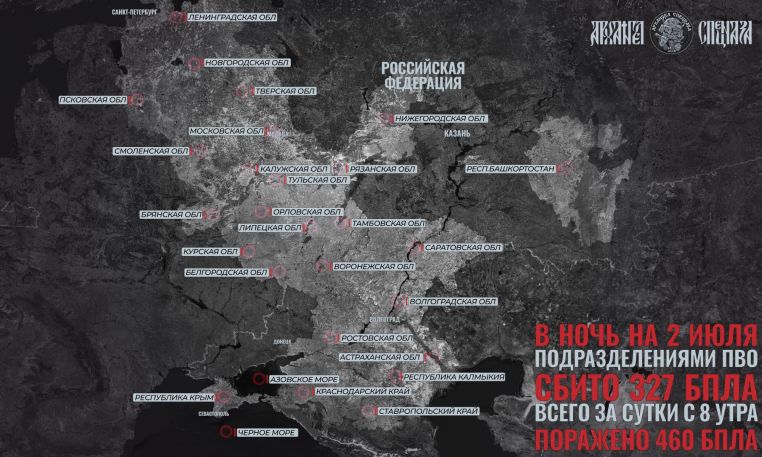
The image is a branded Архангел Спецназа (Arkhangel Spetsnaza) infographic — a hardline pro-war Russian Z-channel. Read it as an information product, not neutral BDA:
Framing tell. Leading with “460 destroyed” and a 30-region shootdown map is a competence-projection / reassurance move for the domestic audience. Yet publishing a map that stretches from Leningrad Oblast to Bashkortostan advertises the reach of the threat it claims to defeat — a self-defeating denial artifact.
Number discipline. The 327 overnight / 460 per-day figures are the channel’s aggregation. Russia’s own MoD briefing for the adjacent window cited a different figure (~602 UAVs plus one “long-range operational-tactical missile”). The ministry reported air defenses shot down seven guided aerial bombs, one long-range operational-tactical missile, and 602 fixed-wing UAVs in its daily briefing. (South Front) Round, source-dependent, non-reconcilable tallies → treat as order-of-magnitude (hundreds/day), not precise BDA.
The “звоночек” tell. The post’s own author flags the FP-9 intercept as an alarm bell and pressures the MoD for “systematic” reciprocal strikes on Ukraine’s defense-industrial base. That is an indicator of intra-camp anxiety, not confidence.
Attacker: Ukrainian Defense Forces / SBU long-range strike apparatus, operating under Zelensky’s formally-approved 40-day pressure operation. On 25 June 2026 Zelensky approved a 40-day SBU operation of sustained long-range strikes on energy, logistics, and military-industrial targets to pressure Russia toward ending the war. (Tech Times)
Target set: LUKOIL-
Nizhegorodnefteorgsintez (NORSI) at Kstovo; air-defense/early-warning belts across ~30 oblasts; the Moscow and (probing) St. Petersburg defensive rings; the missile supply chain (recent Penza sensor institute, Voronezh semiconductor plant).
The narrator: a pro-Russian milblogger performing morale management and MoD-pressure signaling for a Russian domestic audience.
Overnight 1→2 July, a geographically dispersed drone wave struck across western Russia. Confirmed hard points:
Kstovo/NORSI hit again. Ukrainian drones struck the LUKOIL-Nizhegorodnefteorgsintez refinery at Kstovo early on 2 July, with eyewitness footage showing flames and heavy black smoke. (Militarnyi) NORSI is Russia’s fourth-largest refinery and second-largest gasoline producer, with ~17 million tonnes/year capacity. (The Kyiv Independent)
Northern probing. Leningrad region — Putin’s home region, with major export and oil-refining facilities — reported seven drones brought down. (The Jerusalem Post) The milblogger assesses (plausibly) an intent to “cut a corridor” toward St. Petersburg.
Casualties/adjacent damage. In Nizhny Novgorod region one person was killed, four wounded, and an industrial facility damaged. (The Jerusalem Post)
Preceding capability signal. A 30 June high-altitude S-300/S-400 engagement over Moscow Oblast, with a large crater near Yudanovka ~800 km from the border, prompted OSINT assessments of a possible first FP-9 heavy ballistic-missile launch at the capital region. (The Defense News) The milblogger’s claim of “two FP-9s” downed runs ahead of the single, still-unconfirmed intercept in mainstream OSINT.
Individually, none of these is decisive — Russia can restart units, reroute cargo, and reinforce a defensive ring. In aggregate they change the problem structure. Damage to a single reservoir, refinery unit, or local power node is manageable in isolation; repeated strikes across multiple nodes of the same system are far harder to absorb. (Defence Matters) The strategic center of gravity is not any one refinery — it is the cumulative erosion of refining throughput, air-defense magazine depth, and the political fiction of a home-front sanctuary.
Three converging drivers:
Campaign tempo. The 40-day SBU operation is mid-stride; 2 July is a scheduled beat, not an anomaly.
Reciprocity/retaliation cycle. Russia’s own massive 2 July strike on Kyiv, which killed at least 10, was cast by Moscow as retaliation for Ukrainian strikes on its infrastructure — a tit-for-tat escalation now running in both directions. (The Jerusalem Post)
Capability maturation window. Fire Point’s chief designer publicly tied the FP-9’s schedule to a June engine test, stating that after a successful test flight the next launch should be directed at Moscow, and naming Moscow energy infrastructure — with St. Petersburg also in range. (Global Defense Corp) The timing of the suspected 30 June launch fits that telegraphed window.
Refining/energy (the main effort). By early June, analysts estimated roughly one-third of Russia’s national refining capacity — about 2.14 million bpd — was offline from cumulative strike damage. (Tech Times) The June Moscow refinery strikes reportedly shut a plant supplying ~40% of the capital region’s fuel until at least 2027, and more than 25 regions imposed gasoline sales restrictions. (Tech Times)
Fuel economy / daily life. Russia is importing gasoline from as far as India, with rationing at St. Petersburg stations and a worsening crisis reaching regions thousands of kilometers east. (CNBC) (Pravda) Ukrainian deep strikes are dampening ordinary Russians’ mood more visibly than at any point since the war began 4½ years ago. (CSMonitor.com)
Air-defense strain. The forced dispersal across ~30 regions plus a possible ballistic threat compels Russia to shift scarce high-end interceptors toward cities and energy nodes — the FP-9’s real utility even before it is operational. Ballistic missiles compress warning time, reduce engagement opportunities, and demand high-end interceptors, giving them weight beyond their payload. (Army Recognition)
Information/political. ISW assesses the rising frequency, size, and depth of the campaign against Moscow and St. Petersburg reveal growing Russian air-defense vulnerabilities and dilemmas for the Kremlin in managing the domestic costs of its war. (CNBC)
Strategic value of Ukrainian action — Deny / Degrade / Deceive / Cognitive
Mapping the campaign to a D5-style effects frame, with STEMPLES Plus factors woven in:
DENY (resource & revenue). The refinery focus is a “long-range sanctions” strategy — denying Russia refined-product output and export revenue that funds operations (Economic + Military factors). Second-order denial: forcing Moscow to spend million-dollar-class interceptors against sub-$100k drones and to lock scarce S-300/400/Pantsir batteries onto rear cities rather than the front.
DEGRADE/ERODE (attrition of systems, not just stocks). The intent is magazine-depth erosion and throughput erosion over time. Refining at a multi-year low, ports (Primorsk/Ust-Luga) degraded, and the missile supply chain (Penza, Voronezh) targeted at the inputs to Russian strike capacity — attacking the adversary’s ability to regenerate, not merely its current inventory (Technical + Military).
DECEIVE/DISRUPT (this is the sharpest tradecraft layer).
Saturation + geographic misdirection. A 30-region footprint stretches sensors and interceptor allocation thin and complicates the air-picture — you cannot mass defense everywhere. Cheap decoy drones mixed with strike drones is a classic magazine-exhaustion play that forces defenders to expend on low-value tracks.
Axis-opening as a probe. The Leningrad/St. Petersburg push is very likely reconnaissance-by-fire to map gaps and force redeployment northward, thinning defenses elsewhere — a reflexive-control move that makes Russia move its own assets to Ukraine’s advantage.
Ambiguity/capability signaling. The unconfirmed FP-9 event functions as test-as-message: whether it was a success, a failed test, or an intercept, the ambiguity itself imposes planning costs and psychological effect. Neither government confirming it keeps Moscow’s analysts guessing — deception through withheld attribution.
COGNITIVE (effect on the Russian population and elite). This is where the campaign’s designed payoff is clearest, and where your uploaded artifact is direct evidence:
Sanctuary-myth demolition. For years the Kremlin promised the war would not reach home. Fuel queues, resort-beach intercepts, and refinery fires are lived, repeated contradictions of that promise (Social + Psychological + Demographics).
Adversary confirmation of intent. Putin has publicly characterized the deep strikes as having largely psychological aims — to shake Russian self-confidence, foster societal division, and create conditions for negotiations. When the target leadership names your cognitive objective aloud, that is itself an indicator the effect is landing and a management attempt.
Information-space fracture. The reassurance-vs-alarm split — official “air defense is coping” messaging versus milbloggers calling it an alarm bell — is a visible crack in narrative cohesion. Your artifact performs both functions at once (project competence via the “460 downed” banner; demand escalation via the “звоночек” line), which is the signature of a stressed information environment.
Key Assumptions Check (compact)
That the 327/460 figures reflect actual attack volume — caution. They are single-source and unreconciled with MoD; use as scale, not truth.
That the Kstovo strike materially reduces output — likely but unquantified; repeat strikes have caused shutdowns before, but same-day operational effect is not yet independently confirmed. Russian officials acknowledge fires and damage, but the full extent of disruption at such sites is typically not independently quantified in the immediate aftermath. (Defence Matters)
That the FP-9 is operational — unproven. The FP-9 remains non-operational pending engine, guidance, and production validation. (Army Recognition) Treat a single suspected launch as a threshold event, not fielded capability.
That a St. Petersburg corridor is intended — plausible inference, consistent with the northern probing, but the milblogger is a motivated source; corroborate before adopting.
Outlook — strategic foresight (Cone of Plausibility, 6–12 months)
Baseline / most likely (~55–70%): grinding attrition. Sustained refinery/energy/logistics strikes keep ~25–35% of refining stressed; fuel rationing and imports persist; air-defense erosion is incremental; no regime break. Cost accrues to Moscow’s economy and legitimacy without a decisive military inflection. Watch: refinery restart timelines, gasoline import volumes, ruble/budget stress signals. RUSI framing: Ukraine is demonstrating the war’s cost is only rising, for the regime and ordinary Russians alike. (CNBC)
Escalation branch (~20–30%): strategic-depth ballistic phase. FP-9 reaches codification and modest production; Moscow/St. Petersburg energy nodes come under ballistic threat that compresses warning time and forces further high-end interceptor concentration. Russia responds with sharper retaliation against Ukrainian cities and possibly against Western logistics, plus harder domestic censorship. Watch: confirmed FP-9 impacts, MoD language shifts, air-defense redeployments, censorship tightening.
Negotiation-leverage branch (~10–20%): economic pain → talks. Cumulative energy/budget strain plus the domestic-morale slide creates conditions for negotiations on terms less favorable to Moscow than a year ago — Kyiv’s stated theory of victory. Watch: back-channel signaling, Kremlin messaging pivots, any pause in the tit-for-tat.
Discontinuity / wildcard (<10%): step-change. A single catastrophic loss (a major refinery rendered non-restartable; an FP-9 through the Moscow ring), a sudden Russian counter-UAS breakthrough, or an external supply shock resets the curve. Watch: one-off “black swan” strike outcomes, new Russian EW/interceptor fielding, changes in Western munitions flow.
Intelligence gaps / collection priorities
Prioritize: independent BDA on NORSI CDU/AVT unit status and restart timeline; confirmation and technical characterization of the 30 June object (FP-9 vs. other); evidence of northward air-defense redeployment consistent with a Leningrad corridor; refined-product export throughput at Primorsk/Ust-Luga; and quantitative morale/economic indicators (fuel-price dispersion, regional rationing spread, milblogger sentiment trend as an elite-anxiety proxy).
Confidence statement (ICD 203): High confidence in the occurrence and general pattern (multi-source, independent). Moderate confidence in the intent/effects characterization. Low-to-moderate confidence in the artifact’s specific quantitative claims and its FP-9 assertion, which exceed currently confirmed reporting.
Sensitive-source caveat: the driving artifact is adversary information messaging; I’ve flagged where its numbers and the FP-9 claim outrun independent corroboration so they aren’t laundered into “fact.”


You must be logged in to post a comment.