


Summary
Russia maintains a formal blacklist, the “undesirable organizations” register, which the Ministry of Justice administers following decisions by the Prosecutor General, in coordination with the Foreign Ministry. Federal Law No. 129‑FZ (2015) defines the trigger as an alleged threat to the constitutional order, defense capability, or state security, and then attaches sweeping prohibitions that cover offices, projects, and the distribution of materials, including online distribution.
Download the full list below
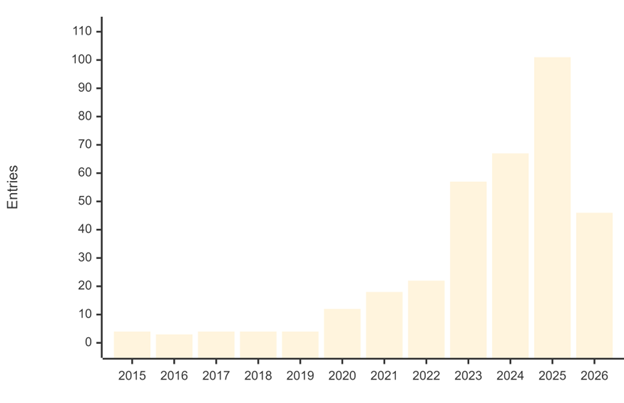
Attached data covers 342 entries from July 29, 2015, through March 26, 2026. Pace averaged about 32 designations per year over 10.7 years, yet the mean masks a sharp wartime surge: 49 additions from 2015–2021 versus 293 from 2022–March 2026, with 101 entries in 2025 alone.
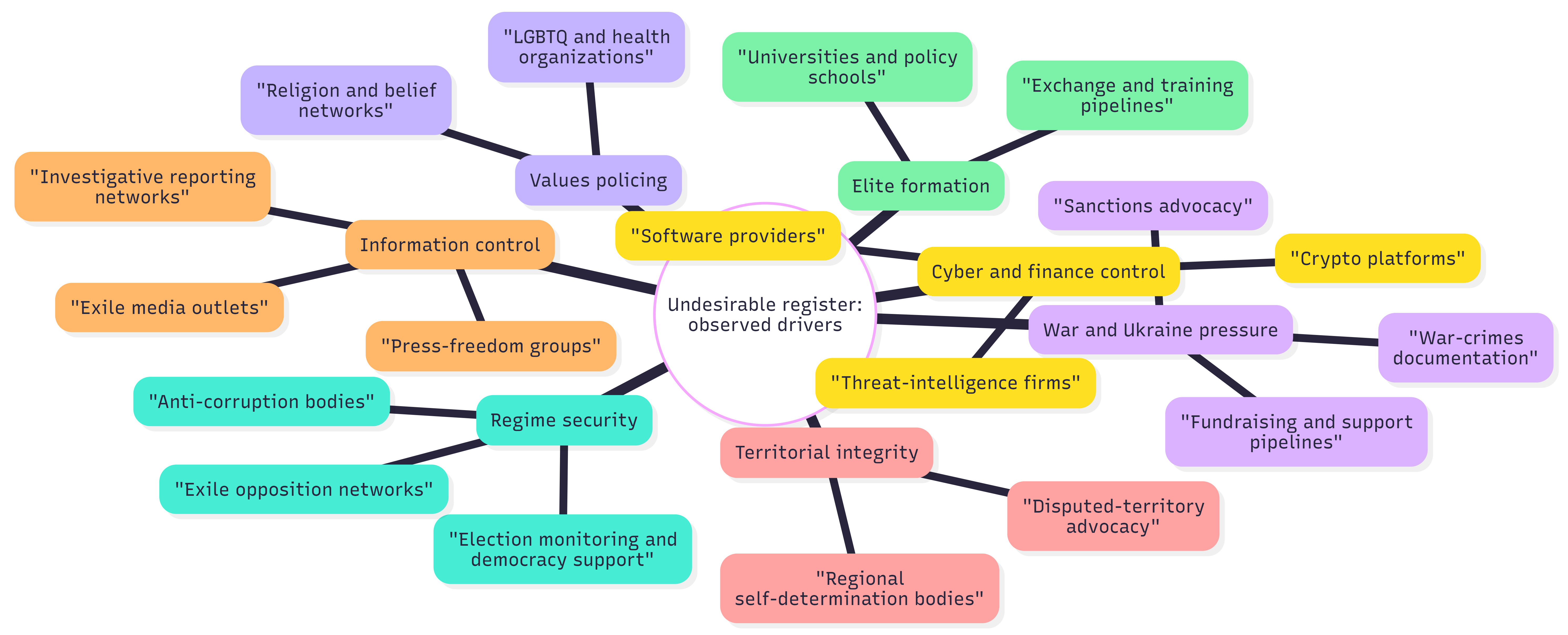
Russian officials frame the register as a defense against foreign interference. Public evidence points to a broader function: repression, isolation, and agenda control. A large share of targets fit five recurring buckets: regime security, information control, war and Ukraine accountability, elite formation, and values policing. A smaller yet telling bucket targets cyber, finance rails, and tech entities when prosecutors link them to Ukraine, intelligence collection, sanctions pressure, or information operations.
Enforcement pressure is real. Engagement with an “undesirable organization” exposes people to administrative penalties and criminal liability, with reported prison exposure of up to 6 years for organizing activity under Article 284.1 and administrative exposure under Article 20.33. Russian civil-society monitors tracked at least 32 criminal cases under Article 284.1 during 2025 alone, and United Nations reporting describes ongoing convictions and expanding criminalization. [2]
Strategic judgment: the register very likely functions as a coercive filter that raises the cost of contact with outside institutions, narrows channels for independent facts, and signals “allowed” loyalty lines. The register performs poorly as a neutral “foreign interference map,” since target selection is uneven and strongly correlated with criticism, war narratives, and civic capacity rather than with covert influence risk alone. [3]
Data and scope in the attached register
The attached roster is not a company-only blacklist. Attached roster includes NGOs, universities, media outlets, advocacy networks, grantmakers, churches, exile groups, tech firms, a cryptocurrency exchange, a game developer, and a small set of other commercial bodies. Prosecutors, with the Foreign Ministry’s approval, place foreign or international organizations on the register based on the statutory threat test; the Ministry of Justice then adds them to the published list.
User framing in the prompt treats the list as “persona non grata.” International law reserves the status of persona non grata for diplomats and individuals under the Vienna Convention framework, while Russian law uses “undesirable organization” for institutional blacklisting. Federal Law No. 129‑FZ and Venice Commission materials outline the formal term and the legal effects associated with prohibition, publication, and enforcement. [4]
The attached dataset supports two time stories at once. A slow early phase ran from 2015 through 2021, adding 49 entries, or about 7 per year. A fast wartime phase began in 2022 and added 293 entries through March 2026, or roughly 62 per year when counting 2022–2025 full years. A simple “31 per year” average misses the tempo shift in the regime.
Country distribution is not balanced across the outside system. The United States leads with 73 entries, followed by Germany with 53, Ukraine with 26, and the United Kingdom with 24. The pattern points toward Western foundations, policy groups, universities, media, exile networks, and Ukraine-linked bodies rather than a neutral sweep across all foreign actors with influence.
Cluster coding in the attached analysis identifies dominant target types. Education and research bodies form the largest bloc (74). Opposition, democracy promotion, elections, and anti‑corruption bodies follow closely (70). Media entities form a third bloc (40). Ukraine support, war accountability, sanctions, and military-aid-linked bodies add up to 36. Human rights and legal accountability groups add 33. Funding and civil‑society infrastructure groups add 23. Religion and belief networks add 18. Regional and anti‑separatism-linked bodies add 16. Gender, LGBTQ, health, and harm-reduction groups add 11. Tech, cyber, and commercial entities add 10.
The chart below captures annual additions in the attached register through March 2026.
Legal architecture and enforcement mechanics
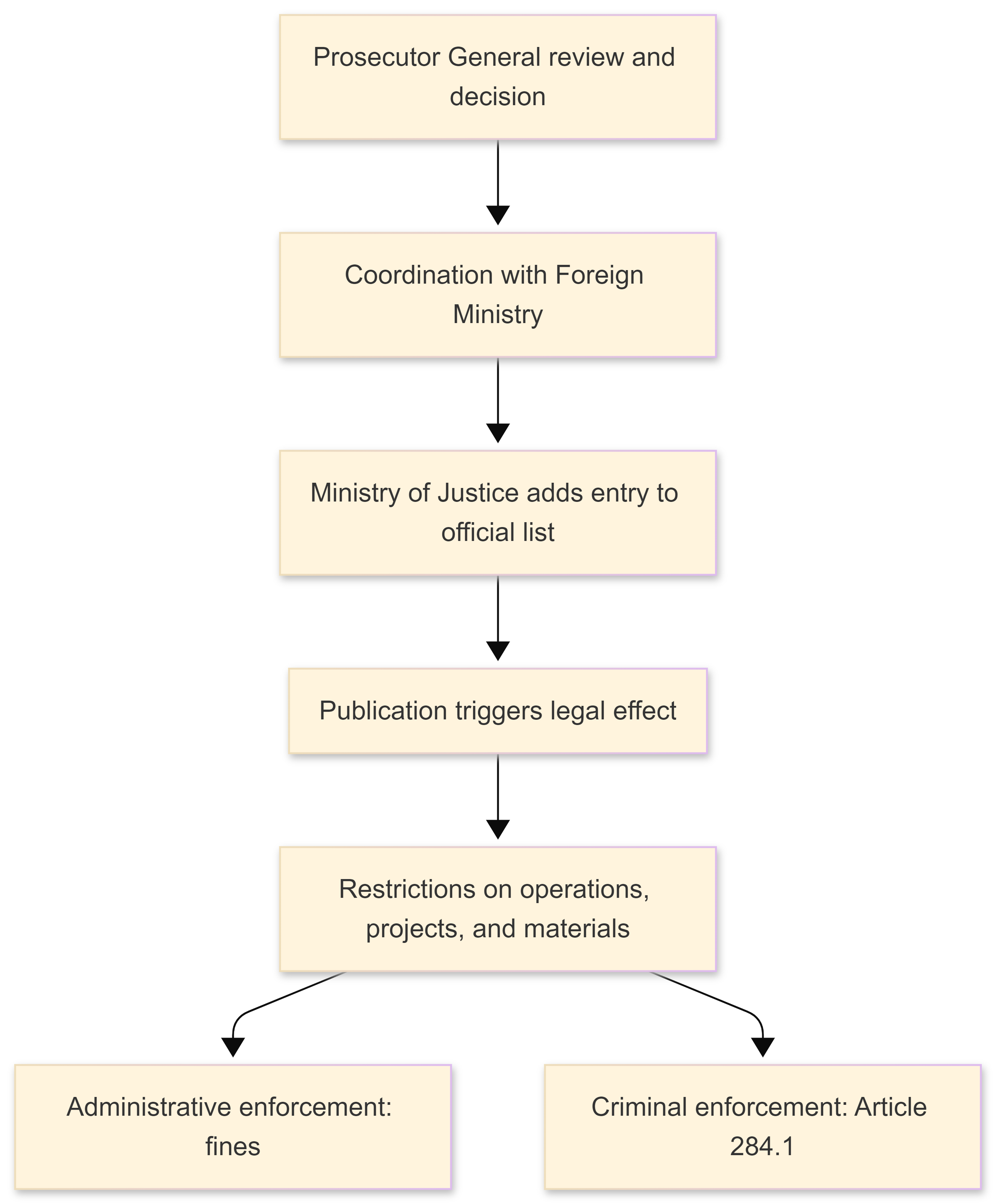
Federal Law No. 129‑FZ entered into force in 2015 and amended multiple codes and laws, including the Criminal Code and administrative liability provisions. The Venice Commission material describes the structure: prosecutors decide the “undesirable” status, the Ministry of Justice maintains the list, and publication triggers legal effect. [5]
Decision authority sits with the Prosecutor General or deputies, with mandatory coordination through the foreign-policy authority. Regional prosecutor explanations repeat the same chain and present the designation threshold as a threat to constitutional order, defense capability, or state security. [6]
Consequences are broad. Federal Law No. 129‑FZ lists prohibitions, including shutting down structural units, banning the distribution of materials (including online), and banning projects inside Russia. Publication on the official list is part of the legal trigger for effect. [7]
Liability operates on two tracks: administrative penalties for participation (Article 20.33 of the administrative code) and criminal liability under Criminal Code Article 284.1 for repeated participation, organizing, or financing. Amnesty International’s report spells out “up to six years” exposure under Article 284.1(3) for organizing activity, and United Nations statements describe criminalization risk tied to engagement with listed entities. [8]
Law expansion tightened its reach outside Russia. A United Nations communication describes 2021 amendments that restricted participation “extraterritorially,” meaning Russian nationals and legal entities faced prohibition on involvement even beyond Russia’s borders. A 2024 law change then widened the designation pool from foreign and international NGOs to any foreign or international organization, according to reporting and civil-society monitoring. [9]
Economic pressure tools expanded alongside the blacklist. Russia enacted a ban on advertising through resources tied to “undesirable” or “extremist” entities, with reporting tying the change to risk-management behavior among advertisers and distributors. Policy tracking sources frame enforcement exposure as fines and a broad scope across online platforms and other restricted resources. [10]
Evidence grading below separates binding sources from analysis and narrative tracking.
| Grade | Source family | Examples used here | Reliability note |
| A | Statute, official prosecutor releases, Russian presidential legal notices, Venice Commission texts | Federal Law No. 129‑FZ; prosecutor announcements for individual entities; Venice Commission opinion and law text | Strong on legal structure and official accusations |
| B | UN human-rights documentation, EUAA COI reporting, ICNL legal monitors | UN communication and UN Special Rapporteur statement; EUAA COI | Strong synthesis, still indirect on internal decision records |
| C | Reputable journalism and structured watchdog reporting | AP, Reuters, RBC; RSF statements; OVD‑Info reporting | Strong chronology and effects, weaker on internal intent |
| D | State media commentary and partisan amplification | TASS framing and domestic polemics | Useful for narrative tracking, weak for independent verification |
The flowchart code below models the formal pipeline.
Targeting patterns and state rationales in open publications
The attached analysis identified five main drivers for most entries. Regime security dominates one bloc: democracy-promotion bodies, election observers, anti‑corruption groups, exile opposition networks, and anti-war groups. Early entries listed in the attached write‑up include NED, OSF, NDI, and IRI, followed later by exile and antiwar networks. Russian framing treats such activity as hostile political influence; outside reviews treat the same pattern as repression of peaceful civic and political activity.
Information control anchors another bloc: media and investigative outlets registered outside Russia that still reach Russian audiences. Attached write‑up lists Project Media, IStories, Bellingcat, The Insider, Meduza, TV Rain, Novaya Gazeta Europe, SOTA, RFE/RL, The Moscow Times, Dekoder, Radio Echo, Deutsche Welle, OCCRP, and press-freedom support bodies as a coherent target set. Official releases often accuse media bodies of discrediting the armed forces or destabilizing the country; external reporting and watchdog statements interpret the same moves as part of a wider crackdown after February 2022.
War and Ukraine-related pressure from the third bloc. Post‑2022 additions include support for Ukraine, documentation of war crimes, sanctions and accountability advocacy, fundraising, and diaspora antiwar organizing. United Nations documentation ties “undesirable” enforcement to criminal cases and convictions for engagement with such bodies, and civil-society monitoring describes expansion toward Ukraine-support and antiwar initiatives.
Elite formation and foreign soft‑power form the fourth driver. Prosecutor announcements repeatedly target universities, policy schools, exchange bodies, and leadership pipelines, framing them as training grounds for hostile elites and agenda work. Prosecutor releases on Canada-linked policy schools provide an example of security framing around academic units, and affected organizations often warn that public association and online mentions increase legal risk for travel and personal exposure.
Values policing forms the fifth driver. Religious groups, belief movements, LGBTQ rights bodies, and health or harm‑reduction organizations appear in the register. Civil society monitors and rights bodies describe a link between “undesirable” enforcement, stigma campaigns, and broader repression of social groups and rights defenders.
A smaller strand focuses on territorial integrity and anti‑separatism. Attached is a write‑up listing Free Idel‑Ural, Free Buryatia, and Japan-linked Northern Territories organizations as examples. The prosecutor’s release shows “destabilization” logic around disputed territories and diaspora fractures, reinforcing the pattern that regional self‑determination narratives receive zero tolerance.
Commercial and tech cases deserve separate attention because they mark a real shift. Older waves focused on liberal foundations, rights groups, and election bodies. Newer waves include software companies, threat‑intelligence firms, cryptocurrency platforms, and entertainment studios when prosecutors tie them to Ukraine support, intelligence collection, or wartime targeting. Prosecutor releases provide direct examples: WhiteBit and W Group were labeled “undesirable” with a financing-Ukraine frame; a Canada-linked software entity was linked to Micro Focus services for Ukrainian security bodies; Recorded Future was framed as intelligence support for Ukraine and information operations; a Ukraine-linked game studio was framed as fundraising support and anti‑Russia messaging.
Mindmap code below summarizes the attached drivers without collapsing differences among legal, media, and wartime cases.
Effects, effectiveness, and measurement limits
Effectiveness depends on the yardstick. Kremlin-facing effectiveness looks strong: the register creates immediate stigma, forces exile branding changes, chills partnerships, and exposes supporters to the risk of prosecution. United Nations reporting underscores the chilling effect of logic by linking the system to criminalization and fear of accountability, while rights organizations describe “undesirable” status as a tool designed to silence independent voices.
Neutral counter‑interference effectiveness looks weak. The target set is not a balanced map of covert influence risks across all foreign actors, lobbies, or covert networks. The attached dataset is heavily weighted toward liberal-democratic institutions, rights groups, media, academic bodies, Ukraine-support networks, and exile opposition, rather than toward hostile-intelligence tradecraft alone. The Venice Commission’s opinion on Federal Law No. 129‑FZ warned of vagueness and weak safeguards, reinforcing the view that political elasticity is built into the mechanism.
Enforcement trends show real operational pressure. OVD‑Info reported at least 32 criminal cases under Article 284.1 during 2025, with parts tied to participation, organizing, and financing. United Nations reporting adds detail on convictions and ongoing criminal cases tied to “undesirable organizations,” framing the pattern as dismantling civil society rather than counter‑espionage.
Secondary pressure has widened into business risk. Advertising law changes signed in April 2025 and entering force in September 2025 broadened commercial exposure for publishers and advertisers associated with “undesirable” resources. Legal and policy tracking sources describe fines and compliance burdens that push private firms away from association, even when the material is news reporting rather than direct participation. [20]
Measurement limits constrain certainty on a stronger societal effect. Open sources rarely provide full decision dossiers, evidence packages, or internal threat assessments for each designation. The prosecutor releases a list of accusations, yet independent verification is often partial or impossible without court discovery. Confidence is high on formal designations, open enforcement actions, and chilling effects, while confidence is moderate on many case‑specific motive details beyond what prosecutors publish. [21]
The table below separates verified elements from government claims and grades evidence.
| Topic | Verified record | Government claim pattern | Evidence grade | Confidence |
| Decision pipeline | Prosecutor decides with Foreign Ministry coordination; Ministry of Justice maintains list; publication triggers effect. | State frames the process as a defense against threats | A | High |
| Legal consequences | Prohibitions on offices, projects, and materials; administrative and criminal liability frameworks | State frames liability as a necessary counter‑interference | A | High |
| Extraterritorial reach | UN documentation describes the 2021 amendments that added extraterritorial constraints. | State frames extraterritorial reach as a defense of national interests | B | Moderate‑High |
| War-linked tech and finance cases | Prosecutor releases accuse crypto, software, and threat‑intel entities of supporting Ukraine or enabling information operations. | State frames as war defense and security | A for accusation; C for motive detail | Moderate |
| “Foreign interference” coverage | Target set overlaps heavily with critics, journalists, rights groups, and education pipelines. | State frames the target set as a hostile foreign influence | B for pattern; D for sweeping claims | Moderate |
Outlook and indicators
Near-term expansion is likely. A 2024 legal change widened the pool from NGOs to any foreign or international organization, lowering barriers to list commercial entities, universities, professional associations, and business networks. Prosecutor releases from 2024–2026 already show movement into software, threat‑intelligence, crypto rails, and entertainment sectors. [23]
Enforcement tempo is likely to remain high relative to the 2015–2021 phase. UN and watchdog reporting describe rapid list growth and rising criminalization pressure, while civil-society monitoring tracks steady prosecutions under Article 284.1. Fewer structural incentives exist for de‑escalation while war framing remains dominant in official rhetoric. [24]
The most probable strategic function is coercive isolation rather than interference mapping. Register punishes linkages that support rival facts, rival loyalties, rival money flows, rival social norms, or rival political futures. The attached write‑up argues that the register changed function: early years targeted a narrow band of democracy-promotion bodies; later years turned the mechanism into a broad blacklist for war-related pressure, exile politics, hostile media, Western education, values conflict, and selected tech or finance entities.
Indicators worth tracking include annual additions, the share of commercial and educational entities, advertising enforcement cases, prosecutions under Article 284.1, and the ratio of “undesirable” entries to “foreign agent” designations. UN reporting notes more than 1,100 “foreign agents” and over 280 “undesirable organizations” by late 2025, signaling a broad “hostile registries” system that increasingly shapes civic risk and business risk inside Russia. [25]
The Full List – Russian and English
russia_undesirable_organizations_analysis
[4] [7] [11] [12] [21] [22] https://www.venice.coe.int/webforms/documents/default.aspx?pdffile=CDL-REF%282016%29037-e
https://www.venice.coe.int/webforms/documents/default.aspx?pdffile=CDL-REF%282016%29037-e
[2] [19] https://reports.ovd.info/en/repression-russia-2025-overview-ovd-info
https://reports.ovd.info/en/repression-russia-2025-overview-ovd-info
[3] [18] [24] [25] https://www.ohchr.org/en/press-releases/2025/12/russias-repression-policy-dismantle-civil-society-exposes-fear
[5] https://www.venice.coe.int/webforms/documents/default.aspx?pdffile=CDL-AD%282016%29020-e
https://www.venice.coe.int/webforms/documents/default.aspx?pdffile=CDL-AD%282016%29020-e
[6] https://epp.genproc.gov.ru/ru/proc_59/activity/legal-education/explain/e8409072/
https://epp.genproc.gov.ru/ru/proc_59/activity/legal-education/explain/e8409072/
[8] https://www.amnestyusa.org/press-releases/russia-prominent-human-rights-defenders-targeted-under-undesirable-organizations-legislation/
[9] https://spcommreports.ohchr.org/TMResultsBase/DownLoadPublicCommunicationFile?gId=29248
https://spcommreports.ohchr.org/TMResultsBase/DownLoadPublicCommunicationFile?gId=29248
[10] https://www.themoscowtimes.com/2025/04/07/putin-signs-law-banning-advertising-on-platforms-labeled-extremist-or-undesirable-a88641
[13] https://www.ohchr.org/sites/default/files/documents/hrbodies/hrcouncil/sessions-regular/session60/advance-version/a-hrc-60-59-aev.pdf
[14] https://epp.genproc.gov.ru/ru/gprf/mass-media/news/main/e470607/
https://epp.genproc.gov.ru/ru/gprf/mass-media/news/main/e470607/
[15] https://ilga.org/news/russia-ilga-world-undesirable/
https://ilga.org/news/russia-ilga-world-undesirable/
[16] https://epp.genproc.gov.ru/ru/gprf/mass-media/news/main/e8358714/
https://epp.genproc.gov.ru/ru/gprf/mass-media/news/main/e8358714/
[17] https://epp.genproc.gov.ru/ru/gprf/mass-media/news/?item=99765742
https://epp.genproc.gov.ru/ru/gprf/mass-media/news/?item=99765742
[20] https://digitalpolicyalert.org/event/28874-amendments-to-federal-law-banning-on-advertising-on-information-resources-whose-activities-are-recognised-as-undesirable-law-no-72-fz-enter-into-force
[23] https://www.rferl.org/a/putin-bill-law-undesirable-russia/33070753.html
https://www.rferl.org/a/putin-bill-law-undesirable-russia/33070753.html

