


In Russia, they created a “pager” for Telegram without cellular connection: the inventor explained how it works
A developer from the regions, faced with disruptions in mobile internet, created a device that allows you to read and send messages in Telegram without a cellular connection. The author of the Telegram channel “Techno Minimalist”, Igor Fedorov, explained the principle of operation to Business FM:
“I have a small computer at home that receives all messages in Telegram and transmits signals further via a classic radio frequency. People who support the Meshtastic network buy devices to communicate with each other. From their points, they can cover an entire city.”
The device connects to a smartphone via Bluetooth and works as an additional data transmission sensor. However, the technology is only designed for text messages – it “won’t handle” voice, video, and pictures.
Information security expert Alexey Gorelkin noted the potential of the development, but warned about the risks:
“For personal use, I see potential in this. For commercial and mass use, I’m starting to see difficulties in terms of security. The radio signal is either not encrypted, or it’s not encrypted strongly enough. It’s quite easy to hack it and read the message.”
While some are trying to revive Telegram, messengers like imo, BiP, and WeChat have already appeared in the top of social networks in the Russian App Store.
The creator of the Telegram channel “Techno Minimalist” connected the Telegram client to the mesh network via Meshtastic and the Telethon library, launching a build on a Raspberry Pi.
The solution works as a bridge: a request goes from a portable device → arrives at the home node → which pulls data from Telegram and sends it back. As a result, we get Telegram without a network: you can read channels and receive messages.
However, there are also drawbacks — the current build consumes a lot of battery. Messages from channels are delivered in transliteration, and large posts are broken into several small ones. This is due to the fact that Russian characters take up twice as much space in the communication packet. Photos, videos, and reactions cannot be sent.
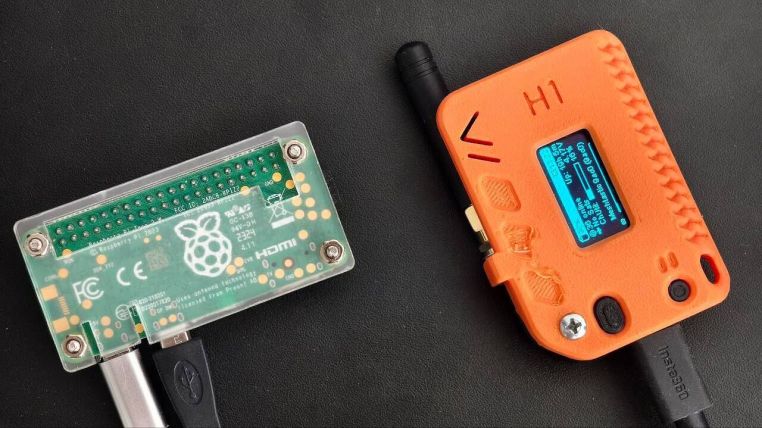
An enthusiast made a Telegram pager on a Raspberry Pi via mesh networks
Electronics enthusiast and creator of the Techno Minimalist Telegram channel connected the Telegram client to a mesh network via Meshtastic and the Telethon library, running a build on a Raspberry Pi. The solution works as a bridge: the request comes from a portable device → comes to the home node → it pulls data from Telegram and sends it back. As a result, we got Telegram without a network: you can read channels and receive messages. But there are also disadvantages – the current build still consumes a lot of battery during operation. Messages from channels are delivered in transliteration, and large posts are divided into several smaller ones. This is due to the fact that Russian characters take up twice as much space in the communication package. Photos, videos and reactions cannot be transferred.
Telegram via mesh networks.
Well, does telegram work? I haven’t had a cell phone in the center for a couple of months.
There was an idea to send telegram messages and reading channels through radio communication. Mesh networks are now gaining popularity, so I decided to give it a try.
I set up a servacy on the Raspberry Pi with a cart and processing requests through Meshtastic — one at home, the other with me.
I can read channels, download the latest posts, scroll through them. Of course, without videos and pictures, it’s just text.
I made a transliteration so that twice as many characters fit on the screen.
How the Telegram pager works.
Look, it’s not that complicated here. There’s an official Meshtastic library that allows you to connect your device and control it from any computer. And there is the Telethon library — through it we connect to the Telegram API. Not as a bot, but as a personal account – this is done for developers to create their own Telegram clients.
И вот эти две библиотеки я запустил на Raspberry Pi. Основная задача — написать скрипт-мост между Telegram и Meshtastic. Всё.
Дальше схема простая: команды идут с моего переносного Meshtastic, их получает Meshtastic который стоит дома, скрипт считывает команду и запрашивает данные из Telegram.
Сейчас реализовано так — я забиндил несколько каналов, они автоматически считываются через мой аккаунт, посты кэшируются и ждут запроса. Потом могу обновлять когда надо — можно по таймеру, можно вручную. Можно и личные сообщения получать автоматом. Короче, возможностей много.
Но здесь не про это. А про то, что на Meshtastic можно зацепить вообще всё что угодно. Любой сервер, любые данные. В чём плюс — mesh-сети в городах уже большие, и вы можете очень далеко получать любую информацию.
Например, серверное оборудование — по запросу получаете статус и метрики.
Или навороченный автомобиль — вешаете кучу датчиков и издалека опрашиваете, и даже управляете через mesh-сеть.
Для безопасности лучше создать зашифрованный канал, чтобы пакеты шли закрытыми. Конечно, лазейки всегда есть, это не супер-секретная тема — но зато получается рабочий инструмент, который можно адаптировать практически под всё что угодно.
P.s. жрёт конечно мештастик на esp дофига).
Earlier, Igor Bederov, an expert on information security (IS) and chairman of the Council for Combating Technological Offenses of the Coordination Council of the Non-State Security Sphere of the Russian Federation (CC NSS), said that he considers it possible that Telegram can bypass the blocking in the country by updating the messenger. If an update is released that adds the ability to work in a mesh network to the client, users will be able to exchange messages within a huge network via Bluetooth and Wi-Fi, bypassing providers and servers.
“If Telegram suddenly becomes a mesh messenger, with its audience of 90 million users in Russia, especially in large agglomerations like Moscow, the Moscow region and St. Petersburg, this will be a serious risk in terms of the distribution, for example, of fraudulent content,” Bederov said.
The expert stressed that the implementation of such a function in Telegram is technically difficult due to the large-scale ecosystem of the service. According to him, when implementing the mesh mode, it would probably be necessary to leave only basic communication functions, such as text and voice messages. “It will bypass all possible restrictions and blockages. The only way to counter a Mesh connection is to jam the radio signal in the Bluetooth and Wi-Fi ranges,” Bederov added.
One of the well-known Mesh messengers is Jack Dorsey’s Bitchat based on Bluetooth Low Energy.
The Bitchat app connects users to a decentralized network in which devices transmit messages to other participants. With the right number of devices, the network coverage is unlimited. Bitchat stores all messages in the smartphone’s memory. The messenger does not have authorization and data collection mechanisms. The information is encrypted with Curve25519 and AES-GCM. For emergencies, there is a Panic Mode – the user can tap on the logo three times, and the application will delete all data.

