


Source base and analytic discipline
A single thread ties the material together: a fast feedback loop between battlefield demand, regional production, and a social-media distribution layer that pushes tactics, parts, and morale at high tempo. The Telegram channel “Military hub | СВО, FPV, дроны, БПЛА” advertises itself as a broad aggregation feed for UAVs, FPV, electronic warfare, and communications, with more than 22,000 subscribers and a linked discussion group under @main_guide.
Local reporting and official pages identify concrete nodes behind that content: Rostec, its security holding SIBER, the Sakhalin scientific-production center Wings of Sakhalin, and the NewLink engineering group.
Formal registers and government guidance add hard edges around an otherwise fluid space. Rosaviatsia publishes a list of UAV operators and their aircraft, while Roskomnadzor and Gosuslugi publish mandatory registration rules for large social media pages.
Geography and physical infrastructure
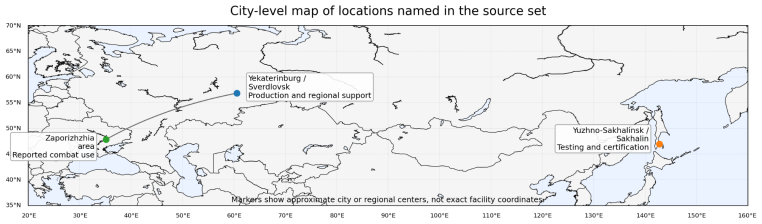
Wind and salt define Sakhalin Oblast. Corporate and media reporting place joint trials of drone-detection and drone-suppression equipment on the island, hosted at the Sakhalin center’s test range. Reporting describes radar stations that cover short defensive rings and long defensive rings, including coastal zones, and organizers frame the trials as a step toward selecting equipment for the Northern Sea Route security task.
A second pole sits in Yekaterinburg. Business reporting and a director interview describe a design bureau that began as a small engineering team in 2014 and shifted toward wartime UAV production after 2022.
A third pole runs along the front in Zaporizhzhia Oblast. Regional outlets report that deputies from Sverdlovsk Oblast delivered communications gear, construction materials, and UAVs to three regiments deployed on Zaporizhzhia directions.
Organizations, leadership, and roles
The security holding functions as a services umbrella and treats anti-drone engineering plus training as part of its mission set. AviaPort reporting describes integrated security work for the state corporation’s organizations, spanning physical protection, cargo protection, fire safety, and engineering security systems, and it lists subsidiaries that include RT-Okhrana and an engineering center, NITS TSO.
The corporation identifies Vladimir Kapysh as head of the holding and names him as curator of the Sakhalin branch of Union of Machine Builders of Russia. Official reporting also identifies Viktor Gritsaenko as director of the Sakhalin center and chair of the local Union branch.
https://www.treadstone71.com/deconstructing-true-cyber-intel
NITS TSO operates as the competence center that designs and integrates anti-UAV security systems inside the holding. The corporation’s 2025 interview material presents Aleksandr Samoylovich as a spokesman on layered defense and radio-electronic suppression, and industry event material describes the competence center role and training activity for security units.
Corporate registry summaries place the Sakhalin center in Yuzhno-Sakhalinsk, identify a regional ministry as the sole founder, and list the director from the organization’s registration date in March 2024.
A long director interview names Mikhail Pyannikov and describes a founding nucleus drawn from Ural Federal University, with early work focused on reverse engineering of foreign UAV control systems and later work focused on domestic autopilot hardware and software.
Regional political logistics channel hardware into the war zone under public cover. Reporting identifies Legislative Assembly of Sverdlovsk Oblast leadership and deputies who accompany deliveries, including Lyudmila Babushkina and deputies Vyacheslav Brozovsky, Taras Isakov, and Vyacheslav Vegner.
https://www.treadstone71.com/training/project-omega-in-person-training
Capabilities, skill sets, and operational function
Counter-drone work on the island centers on sensing plus coordinated suppression. Reporting on the joint tests describes radar stations that cover short and long rings and a plan to integrate multiple radars into a unified detection-and-suppression complex. Severe weather trials appear as a selling point, which signals focus on reliability under fog, precipitation, and coastal wind.
The corporation’s 2025 interview material outlines a blended toolset for site defense: radars; acoustic, optical, and radio-frequency sensors; thermal imagers; mechanical barriers; interceptor drones; and radio-electronic measures that include targeted jamming, barrage jamming, and coordinate spoofing. The same interview warns that frequency-hopping and autonomous drones complicate pure jamming solutions, so the competence center promotes layered defense that mixes sensors with intercept options.
Certification and civil operations sit beside war. The civil aviation operator list (as of 2 March 2026) includes an entry for the Sakhalin center, and the register lists a mixed fleet that includes DJI Matrice variants, DJI Mavic variants, and other systems.
TASS reporting describes an operator certificate that supports tasking for regional government and energy-sector missions, including monitoring, delivery to hard-to-reach areas, aerial survey, and mapping, while local policy pushes drones and artificial intelligence across priority sectors.
UAV production in the Urals links to short iteration cycles. The director interview describes a fixed-wing reconnaissance UAV with endurance around three hours, speed around 120 km/h, a radio link out to 60 km in combat conditions, and high-zoom optics. The same interview describes design updates within two to four weeks after combat-user feedback and describes local manufacture of flight controllers, power management, servo systems, composites, and metal parts.
A parallel FPV ecosystem runs through Telegram. “Military hub” forwards posts that discuss antenna placement to prevent link drop during turns and dives, along with posts that describe firmware modifications that remove Drone ID and no-fly-zone restrictions and enable additional radio bands. Such content signals practical tradecraft for adapting commercial drones to contested airspace and for evading identification.
A special narrative attaches to the FPV brand “Zanoza.” A dedicated Telegram channel markets a production team, recruits assemblers and developers, and advertises frontline feedback loops plus control behavior under jamming. The same channel markets fiber-optic FPV as a path around jamming on some sectors.
Range reporting for that brand varies widely. A pro-Russian Telegram outlet reports a deputy statement that operations reach 47 km, while URA.RU quotes the same deputy describing work out to 10 km and reaching the outskirts of Zaporizhzhia.
Ukrainian analysis of distance geometry argues that standard FPV launch positions tend to place operators 40–50 km from the city, which blocks city strikes under typical link constraints, except rare “mother drone” cases. The same analysis points to longer-range fixed-wing strike drones that cover 40–70 km.
Propeller-guard tradeoffs appear in the wider instruction culture. Peer-reviewed and conference material shows that shrouds and ducts sometimes raise static thrust in narrow regimes while adding drag at higher speeds, and added mass pushes endurance downward even when airflow improves in hover.
Production scale and supply chain realities
Domestic assembly stories often begin in the Urals. The director interview describes internal production of controllers, power electronics, and airframes, and regional outlets describe a push toward serial output for military orders starting in 2026.
Regional government messaging links the Yekaterinburg firm to a 300 million ruble grant for serial production of domestic servos for UAVs and links the effort to the national project “Unmanned Aviation Systems,” with job-creation targets and infrastructure buildout.
The civil aviation registry points to ongoing reliance on foreign commercial drones even inside state-linked programs. The registry lists DJI aircraft under the Sakhalin operator record, which signals a procurement reality where Chinese commercial airframes remain part of regional state operations.
Sanctions pressure and component realities cut against “full domestic cycle” narratives. Ukrainian investigative reporting in 2024 documented foreign components inside Russian UAV electronics, including boards tied to Western manufacturers.
Reuters reporting in 2024–2025 describes Russian UAV development and supply links tied to China, including a drone development-and-production project in China for a sanctioned Russian arms maker and covert shipment of Chinese engines disguised as other goods to a Russian state-owned drone maker. Chinese-language reporting in Zaobao echoes the China-based project and cites the same European-intelligence framing.
Chinese-language reporting that cites Ukraine’s military intelligence states that China-origin electronics comprise a majority share in some Russian loitering-munition variants.
Royal United Services Institute analysis of drone supply chains describes China’s dominance in global drone manufacturing and documents Russia’s sourcing of drones and components from China and from third-party routes, which complicates enforcement.
Logistics channels add redundancy. Regional reporting on Sverdlovsk deliveries describes “humanitarian” convoys that carry DJI platforms and domestic FPV platforms alongside building materials and communications gear, blending civil and combat supply chains in a way that resists disruption.
Lethality, targets, intent, and maliciousness indicators
War demands define the target sets. The director interview describes combat users requesting fixed-wing reconnaissance to cover a 40 km radius, and the firm built its platform in response. Such wording ties intent directly to battlefield reconnaissance and target acquisition.
FPV systems drive lethality through low cost, rapid iteration, and dense operator teams. Public statements from Sverdlovsk deputies portray imported DJI platforms as the reconnaissance workhorse and domestic FPV platforms as the strike element.
Counter-UAV work shows a defensive intent that still carries offensive enablers. Sakhalin trials focus on detection and suppression for perimeter security, with attention to coastal zones and to the Northern Sea Route security mission.
The Telegram aggregation layer adds a hostile-enablement signature. “Military hub” forwards technical instruction content on antennas, frequency management, and commercial-drone firmware modifications that remove identification and geofencing controls. Such material lowers barriers for drone misuse and accelerates tactical learning across units.
Russian regulation shapes channel behavior. Roskomnadzor and Gosuslugi pages state mandatory registration for social media pages and channels above 10,000 subscribers and describe enforcement that includes ad restrictions and possible platform actions.
The “Military hub” channel description lists an RKN short link and shows a subscriber count above the threshold. Yandex redirect controls blocked direct review of the government-services page behind the short link during collection, so the record entry remains unverified in the current snapshot.
State platform strategy intersects with control of wartime communications. Reuters reports a Russian push to steer users away from Telegram toward a state-backed messenger, MAX, and MAX’s website markets stable messaging and calls under low bandwidth.
Explosive hazards appear at the edge of the drone story through improvised mine reporting. Central Intelligence Agency declassified material on Warsaw Pact demolition devices notes MV-5 pressure fuzes in improvised mine contexts, and explosive-ordnance reference sources describe MV-5 as a Soviet-era mechanical pressure-operated mine fuze used with older anti-vehicle mines.
A coherent pattern emerges. Sakhalin supplies test ranges, certification, and integrated site defense development. The Urals supply rapid engineering iteration and local assembly. Telegram ecosystems distribute tradecraft, normalize modification of commercial drones for war, and connect logistics narratives to donors and officials.


