


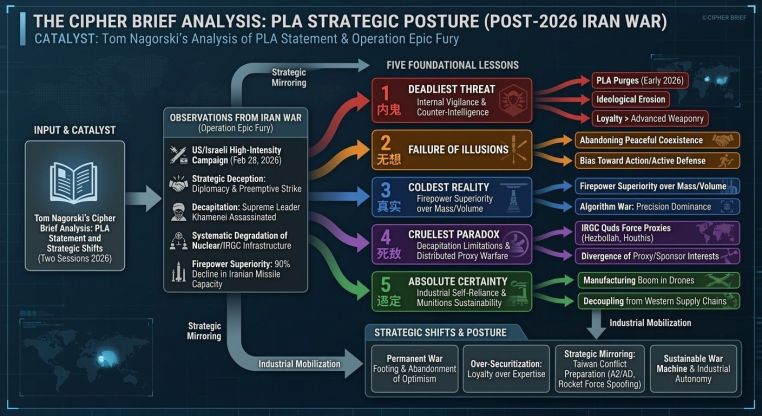
Tom Nagorski’s article in The Cipher Brief regarding foundational lessons from the Iran War acted as the primary catalyst for the current assessment. Nagorski’s analysis of the People’s Liberation Army social media statement revealed how China internalizes Western kinetic successes to prepare for future conflicts. Observations on the “deadliest threat” (内鬼, neigui) of internal traitors and the “coldest reality” of firepower superiority provided the necessary framework for investigating Chinese strategic shifts. Nagorski’s work illuminates the Chinese military’s intentional messaging during the 2026 Two Sessions. People’s Liberation Army (PLA) responses suggest a transition toward a permanent war footing, a finding Nagorski first identified.
Strategic shifts in the Middle East during early 2026 provided the People’s Liberation Army (PLA) an unprecedented laboratory for observing modern kinetic warfare. Operation Epic Fury, launched by joint United States and Israeli forces on February 28, 2026, altered the regional security architecture through a high-intensity campaign. Analysts within the Chinese military establishment viewed the decapitation of the Iranian leadership and the systematic degradation of nuclear infrastructure as a fundamental inflection point for global power dynamics. Beijing reacted with a calculated effort to internalize tactical takeaways that mirror Chinese anxieties regarding the Taiwan Strait and internal regime stability.
Rare public commentary from the People’s Liberation Army (PLA) identified foundational lessons that now shape the Chinese military’s approach to future large-scale conflicts. The lessons—centered on internal threats, the failure of peaceful illusions, the dominance of firepower, the complexity of proxy warfare, and the necessity of industrial self-reliance—guide Chinese defense planners. Scholars of intelligence analysis recognize the statements as sophisticated components of cognitive warfare, designed to project strength while simultaneously protecting domestic vulnerabilities. Understanding the lessons requires an investigation into the specific kinetic events of the Iran War and the psychological environment of the Chinese leadership during the 2026 Two Sessions.
Operational Architecture of Epic Fury and the Chinese Observation Post
Joint military operations against Iran began with an intensity that caught many regional observers off guard. The coalition used a dual-track strategy where diplomatic envoys remained engaged even as planners finalized the timing of a massive preemptive strike. Chinese observers noted the synchronization of diplomacy and kinetic preparation as a form of strategic deception.
Assassination of Supreme Leader Ali Khamenei and the simultaneous destruction of primary nuclear sites in Tehran and Isfahan demonstrated coordination and intelligence penetration. Kinetic strikes focused on the Islamic Revolutionary Guard Corps (IRGC) command structures and ballistic missile launch sites. United States Central Command (CENTCOM) reported a 90 percent decline in Iranian missile launch capacity within the first week.
Chinese analysts monitored developments from a position of economic and strategic discomfort. Protecting the Strait of Hormuz remains an essential interest for Beijing, given the reliance on Iranian oil. Suspension of operations by shipping giants like COSCO forced China to balance ideological support for Tehran with the practical necessity of maintaining stability for other regional partners. PLA accounts disseminated narratives that emphasized the logic of firepower over the illusion of peace.
Cognitive Warfare and the Narratives of the Five Lessons
Public dissemination of the Five Lessons via social media platforms represented a departure from traditional PLA opacity. Experts suggest the transparency achieved multiple psychological objectives, including reinforcing loyalty and preparing the Chinese public for potential conflict. Each lesson targets a specific cognitive domain.
The Deadliest Threat and the Architecture of Internal Vigilance
Designating the “enemy within” (内鬼, neigui) as the deadliest threat reflects an obsession with internal security and counter-intelligence within the Chinese Communist Party (CCP). Rapid decapitation of the Iranian leadership suggested to Chinese observers that intelligence breaches enabled the precision strikes on the Supreme Leader. Beijing views such penetrations as the byproduct of long-term ideological erosion.
Purges within the PLA leadership during early 2026 align with the fear of internal betrayal. Senior military planners in China recognize that advanced weaponry is unable to compensate for a compromised command structure. The “enemy within” narrative justifies continuous internal surveillance. Minority regions such as Iranian Kurdistan often function as geopolitical fault lines. Strategic planners in Beijing conclude that the regime’s survival depends more on the loyalty of provincial units than on the reach of intercontinental missiles.
The Most Expensive Miscalculation and the Failure of Deterrence
Condemning “blind faith in peace” as a catastrophic miscalculation underscores the transition toward a permanent war footing. Chinese strategic thought rejects the concept of a peaceful rise in favor of active defense and warfighting readiness. Failure of Iranian diplomatic efforts to prevent Operation Epic Fury functions as a cautionary tale.
Military planners in Beijing likely interpret the Iranian collapse as evidence that coercive diplomacy only succeeds when backed by an undeniable capacity for violence. The PLA’s emphasis on overcoming blind faith encourages a bias toward action and the abandonment of lingering optimism about international institutions like the United Nations. Deterrence fails when an adversary believes the cost of inaction exceeds the cost of conflict. Iranian planners assumed the threat of closing the Strait of Hormuz deterred a full-scale American strike, but the rapid degradation of missile assets proved the assumption false. Chinese analysts conclude that real deterrence requires the ability to impose unacceptable costs.
The Coldest Reality and the Reign of Kinetic Dominance
Admitting the logic of firepower superiority as the “coldest reality” acknowledges the persistent technological gap. Destruction of Iran’s air defenses and 90 percent of its missile launchers in days demonstrated that mass and volume remain secondary to precision. Chinese analysts observed “Interceptor Math” in action, where Iranian drone swarms momentarily strained US defenses but ultimately failed to prevent the destruction of high-value assets.
Recognition of the reality drives efforts to acquire advanced weaponry while flooding the battlefield with inexpensive drones to complicate the adversary’s targeting logic. Beijing is working to master the algorithm war. Technological disparity becomes pronounced when considering the speed of modern drone warfare. Western forces struggle to maintain production speeds that match the consumption rates of high-intensity conflict. China sees the massive manufacturing base as a potential equalizer.
The Cruelest Paradox and the Persistence of Distributed Warfare
Labeling the “illusion of victory” as the cruelest paradox emphasizes the gap between destroying a state and defeating its network. Operation Epic Fury decapitated the Iranian regime but failed to eliminate the distributed proxy architecture of the IRGC Quds Force. Hezbollah and the Houthis remained operational, launching retaliatory strikes on shipping even as Tehran burned.
Chinese strategists view the event as a lesson in the limitations of decapitation strikes. The PLA also recognizes that relying on proxies fails if the central state remains vulnerable to collapse. China’s strategy uses maritime militias and paramilitary forces in the South China Sea to create layers of deniable aggression. Proxy warfare requires a balance between control and autonomy. Sub-state actors in Iraq prioritized political survival over the defense of the Iranian nuclear program.
Absolute Certainty and the Mandate for Industrial Autonomy
Defining self-reliance as an “absolute certainty” reinforces the CCP’s economic objectives of decoupling from Western supply chains. The Iran War demonstrated that reliance on foreign technology leads to rapid munitions depletion. China views its manufacturing boom in drone weaponry as a strategic advantage.
Self-reliance extends beyond hardware to include cyber sovereignty and the ability to operate without Western-controlled satellite networks. PLA experiments with signal spoofing and false aircraft signals using aerial drones represent an attempt to create an autonomous information environment. Industrial capacity determines the winner of a protracted war. The PLA is creating a sustainable war machine that avoids reliance on global financial systems by focusing on mass-producible systems.
Information Warfare and Cognitive Biases in PLA Assessments
Analysis of rare public statements through the lens of intelligence analysis reveals sophisticated cognitive distortions. Planners demonstrate Substitution Bias by replacing the complex strategic challenge of United States deterrence with the simpler task of identifying internal traitors (内鬼, neigui). Such a mental switch permits the leadership to prioritize political purges over correcting the structural kinetic gaps revealed in the Iran War. The People’s Liberation Army (PLA) narrative regarding the deadliest threat relies on Ad Metum (Appeal to Fear) to justify absolute surveillance and political control. That fallacy frames dissent as a precursor to national collapse, creating an environment in which political loyalty trumps military expertise.
Valuation bias, specifically the Gerschenkron effect, likely distorts Chinese perceptions of Western power. PLA analysts potentially underestimate the United States military capacity by failing to account for “Military-PPP”—the relative cost and efficiency of different inputs like personnel and foundational technology. Official propaganda executes a moral equivalence fallacy by labeling the United States as the “Destroyer of Peace” (和平的破坏者) while omitting Iranian regional aggression. Foreign Minister Wang Yi reinforces such messaging with Argumentum ad Antiquitatem (Appeal to Ancient Wisdom), citing “Ancient Chinese wisdom” to grant an aura of objective truth to subjective political stances against the “law of the jungle” (丛林法则).
PLA planners commit a hasty generalization by treating a 30-hour air campaign in Iran as an immutable universal law for all future warfare. Such logic treats one specific tactical outcome as an absolute model for the Taiwan Strait, ignoring unique geographical and political differences between the theaters. The mandate for “absolute certainty” in cyber sovereignty hides the paradox of techno-cyber vulnerability. While planners believe self-reliant systems eliminate risk, such complexity likely increases susceptibility to strategic surprise as the network grows. Defining internal loyalty as the essential factor represents over-securitisation, a fallacy that subordinates defense logic to ideological paranoia.
Chinese military analysts also exhibit hindsight bias by treating the Iranian leadership decapitation as an inevitable result of internal failure rather than a probabilistic outcome of sophisticated intelligence operations. Wang Yi projects Chinese historical anxieties onto the United States strategy by emphasizing “rejecting the abuse of force” and avoiding “color revolution,” which represents a mirror-imaging fallacy. The PLA also demonstrates circular reasoning by defining self-reliance as an “absolute certainty” based on the unreliability of external systems, then citing that unreliability as proof for the certainty of self-reliance. Finally, analysts show the availability heuristic by over-relying on the vivid Iranian decapitation as the primary model for future conflict, potentially ignoring scenarios of long-term economic blockade or non-kinetic attrition.
Strategic Mirroring and the Taiwan Conflict
Chinese military leaders frequently expressed intense interest in past conflicts like Desert Storm to learn how to engage Taiwan. The 2026 Iran War functions as a modern update to the data. Beijing sees the US focus on Iranian missile launchers as a mirror of how Washington targets PLA Rocket Force assets. Consequently, the PLA emphasizes signal spoofing and mobile launch platforms to counter exquisite surveillance capabilities.
Confirmation bias plays a role as the PLA uses the Iranian failure to confirm existing theories on A2/AD (Anti-Access/Area Denial) networks. PLA commentators focus on how the logic of firepower justifies investment in domestic missile programs. PLA planners assume the United States uses decapitation and infrastructure-destruction strategies against China. Intelligence failures stem from leaders relying on simplified representations that fail to account for the adversary’s adaptability.
Propaganda as a Tool of Compellence
Cartoons and videos criticize US military operations against Iran to delegitimize American power. The narrative positions China as a sincere friend and strategic partner. Cognitive warfare tactics extend to the physical battlefield. Transmitting false aircraft signals to confuse adversaries mirrors spoofing tactics used around Taiwan. PLA media outlets used the Iran conflict to paint the United States as the biggest source of uncertainty for the international nuclear order.
Proxy Dynamics and the Redistribution of Risk
Reflecting on the Iranian experience, the PLA must grapple with the cruelest paradox of proxy warfare. Iran’s investment in its Axis of Resistance provided resilience that a traditional state lacks. The conflict showed that proxies act on local interests, which are likely to diverge from a sponsor’s needs. Sub-state actors in Iraq prioritize their political survival over Tehran’s interests.
For China, the lesson is one of convergence of interests rather than total control. Using third-party actors to achieve objectives while minimizing costs remains an attractive option, but the PLA sees the risk that groups will escalate conflicts beyond a sponsor’s comfort zone. The potential for proxy interference in energy trade poses a risk that China must manage. Strategic repositioning replaces de-escalation. PLA planners view irregular forces as a means to tie down American naval assets, preventing redeployment to the Pacific.
Industrial Mobilization and the Logistics of Modern War
Industrial mobilization requires an industrial base capable of sustaining high-intensity combat. Chinese planners watched the United States struggle with the speed of the drone war. China’s manufacturing boom in drone weapons exploits Western production bottlenecks.
Supply chain security is a necessity for national survival. Export controls incentivized China to build an autonomous cyber infrastructure. Industrial autonomy ensures China outlasts opponents. Warship production remains an area where China believes it gained an advantage. PLAN continues to commission vessels at a rapid pace, providing a strategic depth that the Iranian navy lacked.
The Two Sessions Backdrop and Domestic Political Signaling
The timing of the PLA statement coincided with the closing of the 2026 Two Sessions. Military leadership signals to the party faithful that it remains vigilant against threats that toppled the Iranian regime. Messages foster a sense of national urgency. Warning against the “enemy within” provides a framework justifying social control and high defense spending. Chinese citizens receive a clear message: only the strong and unified survive. Wang Yi elaborated on China’s position, emphasizing national sovereignty. CCP maintains its image as a global leader while preparing its population for the possibility of a similar struggle.
Conclusions on the People’s Liberation Army Strategic Posture
People’s Liberation Army responses to the 2026 Iran-United States War reveal a military committed to resilient strength. The Five Lessons represent a shift in Beijing’s view of the nature of modern conflict. The PLA prepares for a future in which direct conflict is inevitable by prioritizing internal security and rejecting the illusion of peace.
Strategic planners must account for cognitive warfare. PLA statements signal that the lessons of Iran have been learned. Persistent cognitive biases suggest the PLA’s assessments contain blind spots. Future stability in the Pacific depends on how effectively Western powers counter Chinese narratives. The 2026 Iran War demonstrated the power of modern firepower. Beijing actively builds the capacity to define that logic. Strategic resilience requires continuity of leadership and cyber sovereignty. PLA responses show that China is attempting to master these elements. Strategic absorption ensures that resolve and industrial power determine the outcome.
References
- Çelik, E. (2026, March). US cognitive warfare: How AI and Big Tech shaped the Iran strikes. Yeni Safak.
- Embassy of the People’s Republic of China in the United States of America. (2026, March 8). Wang Yi on the Iran situation: Stop fighting, end the war, and restore peace to the Middle East and the rest of the globe.
- Institute for the Study of War. (2026, March 6). China & Taiwan update, March 6, 2026.
- McKay, H. (2026, March 8). Interceptor math: How Iran’s drone swarms strain US defenses. The Cipher Brief.
- Nagorski, T. (2026, March 13). China’s military: Five lessons from the Iran war. The Cipher Brief.
- Nagorski, T. (2026, January 28). China’s stunning military purge – and what it means for Taiwan. The Cipher Brief.
- Robertson, P. (2024). Military purchasing power parity: Index number techniques to quantify China’s real defense spending. Defence and Peace Economics.
- Rubin, M. (2026, March 13). Iran’s blockade of the Strait of Hormuz is destined to fail. 19FortyFive.
- UNN. (2026, March 3). China identifies “five lessons” after US and Israeli strikes on Iran.
- Vision Times. (2026, March 10). Xi Jinping’s Achilles’ heel: Why loyalty in China’s military has become his biggest fear.
Works cited
1. The Cipher Brief – Daily National Security Brief, https://www.thecipherbrief.com/ 2. China’s Military: Five Lessons from the Iran War – The Cipher Brief, https://www.thecipherbrief.com/chinas-military-lessons-iran-war 3. China identifies “five lessons” after US and Israeli strikes on Iran | УНН, https://unn.ua/en/news/china-identifies-five-lessons-after-us-and-israeli-strikes-on-iran 4. The Three Stages of the US-Israeli War Against Iran: From Diplomacy to Covert Ground Operations – Rudaw Research Center, https://rudawrc.net/en/article/the-three-stages-of-the-us-israeli-war-against-iran-from-diplomacy-to-covert-ground-operations-2026-03-06 5. Iran Update Evening Special Report, March 6, 2026 | ISW, https://understandingwar.org/research/middle-east/iran-update-evening-special-report-march-6-2026/ 6. Wang Yi on the Iran situation: Stop fighting, end the war, and restore peace to the Middle East and the rest of the world_Embassy of the People’s Republic of China in the United States of America, https://us.china-embassy.gov.cn/eng/zmgx/zxxx/202603/t20260308_11870570.htm 7. We Bombed the Wrong Target Iran’s Proxy Network Strategy – Irregular Warfare Initiative, https://irregularwarfare.org/articles/iran-proxy-network-strategy/ 8. The Strategy We Are Not Prosecuting: Options for Senior Leaders in the Iran War, https://smallwarsjournal.com/2026/03/13/the-strategy-we-are-not-prosecuting-options-for-senior-leaders-in-the-iran-war/ 9. China & Taiwan Update, March 6, 2026 | ISW, https://understandingwar.org/research/china-taiwan/china-taiwan-update-march-6-2026/ 10. China – The Cipher Brief, https://www.thecipherbrief.com/asia/china 11. U.S.-Iran Proxy Competition in Iraq – New America, https://www.newamerica.org/insights/us-iran-proxy-competition-iraq/ 12. Rethinking Proxy Warfare – New America, https://www.newamerica.org/insights/twenty-first-century-proxy-warfare-confronting-strategic-innovation-multipolar-world/rethinking-proxy-warfare/ 13. Right Sizing the People’s Liberation Army: Exploring the Contours of China’s Military – USAWC Press, https://press.armywarcollege.edu/cgi/viewcontent.cgi?article=1021&context=monographs 14. Right Sizing the People’s Liberation Army: Exploring the Contours of China’s Military, https://www.files.ethz.ch/isn/48426/Right%20Sizing%20the%20People’s_full.pdf 15. National Security | RAND, https://www.rand.org/content/rand/topics/national-security.html?start=5628 16. 正常发挥- 维基百科,自由的百科全书, https://zh.wikipedia.org/zh-cn/%E6%AD%A3%E5%B8%B8%E7%99%BC%E6%8F%AE 17. China’s Response to the Iran-United States War Aftermath – The …, https://chinaglobalsouth.com/analysis/china-response-iran-united-states-war-khamenei-death/ 18. The Escalating Stakes of Proxy Wars – Army University Press, https://www.armyupress.army.mil/Journals/Military-Review/English-Edition-Archives/November-December-2025/Proxy-Wars/ 19. Tom Nagorski | Author – The Cipher Brief, https://www.thecipherbrief.com/author/tomnagorski 20. Resilience of Democratic – Pam – | Parliamentary Assembly of the Mediterranean, https://pam.int/wp-content/uploads/2025/12/PAM-Democracy.-After-Peer-Review.-23-October-2025.pdf 21. Chris Kremidas – Centrul Euro-Atlantic pentru Reziliență – E-ARC, https://e-arc.ro/en/category/authors/chris-kremidas-en/ 22. Iran’s Blockade of the Strait of Hormuz Is Destined to Fail – 19FortyFive, https://www.19fortyfive.com/2026/03/irans-blockade-of-the-strait-of-hormuz-is-destined-to-fail/


