
Reporting from major market outlets indicates that Chinese authorities have instructed refiners to pause new export contracts for refined fuels and to seek cancellation of some already-committed cargoes, with practical volume effects more likely from April onward than in March. Guidance reportedly exempted jet fuel refueling for international flights, bonded bunkering, and supplies to Hong Kong and Macau, which means a full export shutdown did not occur under the reported terms. [1]
Chinese official public messaging did not confirm a fuel-export order. A question at a regular press briefing asked about a Bloomberg report on an export pause for gasoline and diesel; Mao Ning[2] replied, “I do not know the situation you mentioned” (我不了解你提到的情况). [3]
Maritime security and ship-movement data indicate a severe operational shock in the Strait of Hormuz and adjacent waters beginning on February 28, 2026. A Joint Maritime Information Center advisory described ongoing missile and drone attacks, emphasized a hazardous operating environment without a declared legal closure, and reported steep reductions in AIS-observed transits, including a reported drop toward ~28 vessels versus a ~138-vessel historical daily average (about an 80% reduction) in one advisory. [4] An Argus report, citing JMIC, described tanker transits falling from 50 on February 28 to three on March 1 and also cited sharply lower cargo ship transits. [5]
Market indicators already reflect the shock. Charter costs for very large crude carriers from the Middle East to China jumped sharply in early March, and marine war-risk costs rose as shipowners held vessels at anchor. [6] Refining margins and middle-distillate cracks in Asia climbed to multi-year highs, consistent with tighter regional product balances. [7]
Near-term domestic fuel scarcity in China does not automatically follow from an export pause, because an export pause increases domestic availability of finished products, while a crude import disruption decreases refinery feedstock. Net outcome depends on the duration and depth of the shipping freeze, the ability to replace Middle East crude, and drawdowns from crude and product stocks. Evidence already shows that some refinery run cuts are tied to crude supply disruptions and price spikes. [8]
Scenario-weighted outlook (subjective analytic probabilities, grounded in open-source signals): short disruption with partial normalization within ~1–2 weeks (45%); disruption lasting ~2–4 weeks with sustained traffic suppression and wider run cuts (35%); disruption beyond a month with broader infrastructure damage and binding storage constraints for Gulf exporters (20%). Those probabilities reflect the observed intensity of attacks and the scale of insurance and operational pullback, plus analyst commentary about sharply rising impacts after week three. [9]
Research design, sources, and confidence
STEMPLES Plus method: Social, Technical, Economic, Military, Political, Legal, Environmental, Systems, plus an added layer for information environment and supply-chain resilience. Evidence collection prioritized public Chinese government and state-firm releases, maritime security advisories, and independent shipping or market analytics reporting. [10]
| STEMPLES Plus lens | Main observables in the current episode | Practical watch items for early warning |
| Social | Fuel-buying behavior shifts in wholesale channels; public concern spikes during visible shortages. | Local “stock low” notices; station-level queues; local rumor-control or enforcement notices [1] |
| Technical | AIS anomalies and GNSS interference; port disruptions and vessel clustering | JMIC updates on navigation interference; sustained “dark” transit patterns [11] |
| Economic | Refining margins, freight rates, war-risk premia, crude differentials | Crack spreads and freight staying elevated after de-escalation messaging [12] |
| Military | Missile/drone attacks on vessels and energy infrastructure; escort proposals | Expansion of strike geography; repeated hits on terminals and refineries [13] |
| Political | Diplomatic pressure for de-escalation; domestic stability signaling | Policy signals on stock releases, export quotas, and emergency logistics [14] |
| Legal | No declared legal closure in maritime advisories, yet high-risk operating conditions. | Formal closure declarations; insurance exclusions tightening [15] |
| Environmental | Spill or fire risks rise with strikes and congestion; refinery fires affect local air quality. | Incident reports near anchorage clusters and terminals [13] |
| Systems | Coupling between crude inflows, refinery runs, product exports, and domestic price controls | Observable run cuts at coastal refineries; domestic price-control escalation [16] |
| Plus: information | High-volume rumor propagation on social platforms | Divergence between official transcripts and viral claims [17] |
| Plus: supply-chain resilience | Alternative crude routes and diversification capacity | Pipeline spare capacity outside the Strait; rerouting data [18] |
Confidence grading used three tiers: higher confidence when multiple independent sources converge (maritime traffic collapse, freight spike); moderate confidence when credible outlets cite unnamed sources without publication of documents (Chinese export guidance); lower confidence when social media asserts specifics without primary confirmation (claims of blanket closure or universal targeting). [19]
Methodology notes on translation: translations below follow a literal-first style, then a short interpretation line, with citations to the Chinese original pages or PDFs. [20]
Event timeline and operational picture
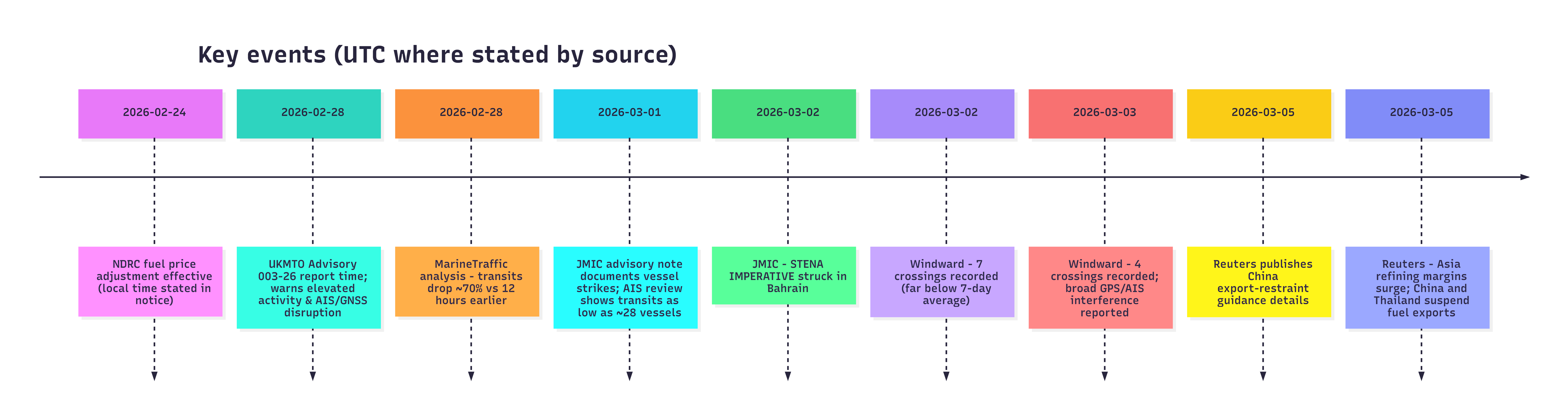
Narrative anchors: maritime security advisories report missile and drone attacks plus an abrupt collapse in transits; major outlets report vessel damage and large anchorage queues; policy reporting links Chinese export guidance to tightened crude supply risk and refinery run constraints. [21]
Key dates and events table
| Date (2026) | Event | Evidence type | Source alignment |
| February 28 | Missile/drone attacks reported against commercial vessels; regional maritime posture shifts upward. | Maritime security advisory | JMIC advisory details attacks and notes no declared legal closure alongside active kinetic hazards [22] |
| March 1 | AIS-observed transits plunge; tanker movements approach near-standstill | AIS-based assessment | JMIC reports historical ~138 vessels/day and a drop toward ~28 in one assessment; Argus cites only three tankers on March 1 [23] |
| Mar 2–3 | “Dark” transit behavior and U-turn behavior signal risk avoidance | Vessel-level anecdotes | Argus describes a VLCC U-turn and “dark” transit examples; Reuters describes AIS shutoff during transit in a “rare voyage” [24] |
| March 3 | Refinery run cuts begin at Hormuz-exposed refineries | Industrial operations | Reuters reports shutdown/maintenance shifts at Zhejiang Petrochemical and an 80 kb/d unit at the Fujian site [8] |
| March 4 | Stranded tankers and vessel damage continue; war-risk pricing jumps | Operational + insurance | Reuters reports ~200 ships at anchor and multiple damaged vessels; insurers report higher premiums [25] |
| March 5 | Reported Chinese guidance to pause new fuel export contracts; official denial of knowledge at press briefing | Policy reporting + official transcript | Reuters describes guidance and exemptions; MOFA spokesperson denies knowledge of reported export pause [26] |
Official statements and translations
Foreign ministry messaging on energy-route security and export-pause question
Chinese-language transcript (March 5) includes a direct question about the export pause. Original: “法新社记者:据彭博社报道…暂停柴油和汽油出口…能否证实?” Reply: “我不了解你提到的情况。” Translation: AFP asked for confirmation of a reported pause in diesel and gasoline exports; spokesperson replied: “I do not know the situation you mentioned.” [3]
Chinese-language transcript (March 3) links energy security to de-escalation and navigational security. Original: “能源安全对世界经济非常重要…维护霍尔木兹海峡航道安全…中方将采取必要措施,保障自身能源安全。” Translation: “Energy security matters greatly for the global economy… parties bear responsibility to keep energy supply stable and smooth… China urges de-escalation and protection of navigation safety in the Strait of Hormuz… China will take necessary measures to safeguard national energy security.” [27]
The English-language transcript (March 4) calls the Strait an important trade route and states that there is a lack of knowledge about reports of an Iranian blockade, with exceptions for certain flags. English official text: spokesperson said she was not familiar with claims about a blockade notification and reiterated China’s stance, urging an end to military operations and avoiding escalation. [28]
Price-control and supply-stability directive inside the domestic fuel pricing mechanism
A National Development and Reform Commission notice on February 24 raised retail benchmark prices and instructed major state oil firms and other processors to organize production and distribution to ensure stable supply, while also ordering strict adherence to price policy and enforcement against violations, including reporting via the 12315 platform. NDRC raised gasoline and diesel prices by 175 yuan/ton and 170 yuan/ton, respectively, and directed production and logistics to maintain market stability. [29]
https://kh.china-embassy.gov.cn/chn/fyrth/index_1.htm
State-firm public messaging on supply assurance
A China Energy News article, citing Sinopec Group as the source, emphasizes safety and supply assurance for the “Two Sessions” period in Beijing, including “ensuring stable supply” of refined products and hydrogen, as well as increased monitoring and logistics coordination. Translation summary: Sinopec-affiliated Beijing-area units treated supply assurance as a major political task, emphasizing stable refined product supply and strengthening risk controls. [30]
Publicly accessible CNPC/PetroChina-origin text proved less consistent in tool retrieval across CNPC domains during collection. However, third-party reproductions and CNPC search excerpts describe “Two Sessions” fuel supply actions, including planned emergency supply mechanisms and refinery coordination for Beijing-standard fuels. Evidence remains directional rather than document-grade for export policy, but it supports a broader pattern: state firms publicly emphasize domestic supply assurance during sensitive periods. [31]
Official statistics for refining throughput
The National Bureau of Statistics’ December 2025 report lists crude processing of 62.46 million tons and an average daily crude processing rate of 2.015 million tons/day. Translation summary: NBS reported faster crude processing growth in December and published the daily average crude-processing output. [32]
https://www.ndrc.gov.cn/xwdt/xwfb/202602/t20260224_1403852.html
Independent confirmations from shipping data and market signals
Shipping traffic collapse and vessel-incident confirmation
JMIC advisories provide detailed incident lists (named vessels and locations) and state that missile and drone attacks occurred against multiple commercial vessels across the Gulf of Oman waters, the Musandam approaches, and UAE coastal waters. JMIC also notes GNSS interference and AIS anomalies, creating navigation risk multipliers during congestion. [33]
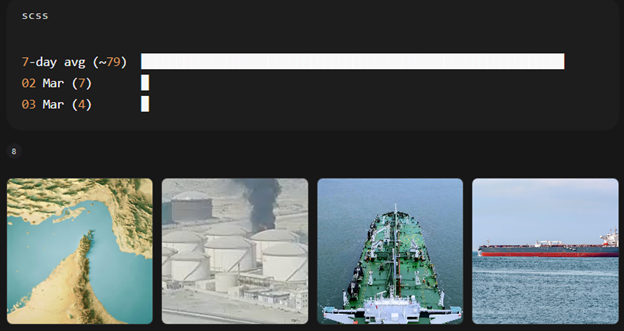
A specific JMIC traffic assessment reports a historical average of ~138 vessels per 24 hours, and an AIS review suggests transits fell to ~28 vessels in one observation window (roughly 80% down). Another table segment in the advisory shows tanker transits dropping sharply between February 28 and March 1. [34]
Argus, referencing JMIC and Kpler, reports only three tankers transited on March 1 versus 50 on February 28, plus an example VLCC U-turn and an example “dark” transit where a vessel stopped broadcasting AIS around the Strait and later reappeared. Argus also notes that “dark” passages imply that actual traffic may exceed broadcast capacity, yet overall movements still fell sharply. [5]
Reuters reporting adds incident confirmation and wider operational context: multiple vessels sustained projectile damage near the Strait and the Gulf of Oman; around 200 ships sat at anchor off Gulf producers; and at least one tanker transit included AIS shutoff behavior, consistent with elevated threat perceptions. [25]
Market-based corroboration: freight, insurance, and refining margins
A Reuters data-based review reports a jump in VLCC charter costs from around $120,000/day to more than $450,000/day for Middle East–to–China routes after hostilities escalated, supporting a severe disruption in tanker availability and routing. [35]
Reuters reports war-risk premia rising sharply while insurance remained available, and cites ship-tracking-based estimates of extensive vessel queuing at anchor off Gulf producers. [36]
Reuters reports Asian refining margins rising to multi-year highs, with jet and diesel cracks leading the way, consistent with tighter supply and rerouting. [7]
Non-English media and social platforms: narrative shaping and uncertainty flags
Russian-language business media relayed Bloomberg’s claim about an export pause tied to Middle East escalation and referenced an oral instruction narrative; evidence adds breadth, not documentary proof. [37]
Persian- and Arabic-language outlets repeated claims of a Chinese export pause and framed motives as domestic supply protection amid Strait of Hormuz disruption; evidence supports the rapid pace of narrative propagation and broadly aligns with Reuters’ description of export guidance, though headline framing often exceeds the nuance of exemptions and timing. [38]
Russian-language posts on OK.ru amplify claims that Iran’s IRGC threatened attacks on any vessel attempting passage and assert blanket closure; official Chinese transcripts show China’s spokesperson did not validate those claims and emphasized de-escalation and navigation safety. Analytical use: low confidence for specific operational details, useful for tracking information operations and public sentiment drivers. [39]
Aparat-hosted Persian videos present “burning ship” narratives and blockade framing; content supports information-environment mapping but does not establish verified operational facts without cross-confirmation. [40]
Refinery operations, inventories, and depletion modeling
Refinery throughput and run-cut signals
NBS reporting indicates crude processing near 2.015 million tons/day in December 2025. A common industry approximation converts 1 metric ton of crude to ~7.33 barrels, which implies roughly 14.8 million barrels/day of crude processing during that period, with conversion uncertainty tied to crude density and slate mix. [41]
Reuters reports that Zhejiang Petrochemical shut a 200,000 bpd unit for advanced maintenance, with throughput expected to be cut by around 20% during an overhaul window; Reuters also reports an 80,000 bpd crude unit shutdown at Fujian Refining and Petrochemical. Reuters links those actions to Middle East disruption and rising crude prices. [8]
Export suspension mechanics and magnitude estimate
Reuters reports combined March exports of gasoline, diesel, and jet fuel at around 3.8 million metric tons (industry estimates), with early-month shipments logged by LSEG ship-tracking. Reuters also provides ton-to-barrel factors for diesel (7.45), jet fuel (7.88), and gasoline (8.45). A simple equal-split conversion yields about 0.97 million barrels/day of refined product exports implied by 3.8 million tons/month; actual values vary with product mix and cargo timing. [1]
Export guidance described by Reuters would reduce regional product availability in Asia once it affects April loadings, while domestic Chinese product availability rises by the same barrels, absent offsetting demand shifts. Exemptions for international aviation refueling, bonded bunkering, and deliveries to Hong Kong and Macau reduce net export cuts relative to a total ban. [1]
Crude inventories and reserve estimates
Public data do not reveal official strategic reserve volumes, so estimates rely on satellite-observed tank behavior, analytics-firm inference, and synthesis reporting.
| Source | Estimate type | Estimate | Notes on method and uncertainty |
| Reuters (March 5, 2026) | Strategic reserve level (analyst estimate) | ~900 million barrels; “just under three months of imports.” | Reuters cites analysts; China does not publish totals; import-rate assumption embedded in “months” framing [42] |
| Reuters (October 7, 2025) | New storage capacity across 11 sites | ~169 million barrels | Reuters synthesizes public sources and cites Vortexa and Kpler capacity estimates for 2020–2024 comparison [43] |
| Reuters (July 4, 2024) | Directed stock addition | ~60 million barrels | Reuters cites Vortexa and trading sources; timing July–March in report [44] |
| Baker Institute paper (Jun 2024) | Observed aboveground inventory range; capacity | 850 million to “a bit over” 1 billion barrels observed; crude tank capacity “a bit north of” 1.8 billion barrels | Paper cites BreakWave, Kayrros, Ursa Space Systems, and explains SAR-based floating roof measurement logic [45] |
| IEA Oil Market Report summary (Feb 2026) | Annual crude stock build | Chinese crude stocks +111 million barrels in 2025 | Value describes annual build, not total stock level [46] |
| OIES Energy Comment (Feb 2026) | Implied crude stock builds (range of estimates) | 0.4–1.1 mb/d in 2025 | Range reflects methodological variance across models and data sources [47] |
Domestic restriction triggers and “days of supply” framework
Local emergency plans offer explicit thresholds for when authorities treat refined-product tightness as an escalating emergency. A Shenzhen Guangming District plan defines escalation bands partly through “reasonable commercial inventory” coverage: 7 days for one tier, 5 days for a higher tier, and 3 days for the highest tier, combined with widespread station shortages or limits. [48] A Hunan provincial plan defines warning levels tied to inventory days (below 7, below 5, below 3, below 2) plus sustained reductions in daily inflows versus a baseline and multi-city incident clustering. [49]
Analytic translation: national policy may target avoidance of visible local shortages rather than a single national “days-of-supply” number, because local plans treat station outages and public reaction as escalation accelerants. [50]
Stock depletion curves: methodology, assumptions, and illustrative outputs
Model goal: show how fast product inventories fall under sustained net supply deficits. The model expresses inventories in “days of demand coverage,” a term that matches the language in local plans.
Definitions: – : starting inventory in days of demand (assumed range 15–30 based on typical distribution-system buffers; China does not publish an official national gasoline/diesel stock series). – : net daily deficit share of demand after accounting for refinery output change, import constraints, and export reductions from policy. – Inventory coverage after days: .
Scenario design links directly to observed drivers: – Shipping disruption reduces crude inflows; refineries cut runs (observed at large sites). [51] – Export guidance increases domestic availability of refined products beginning mainly from April, with exemptions. [1]
Illustrative curves below use days and net deficit shares of 0%, 5%, 10%, and 20%. Interpretation: 10% net deficit drains 1 day of coverage every 10 days.
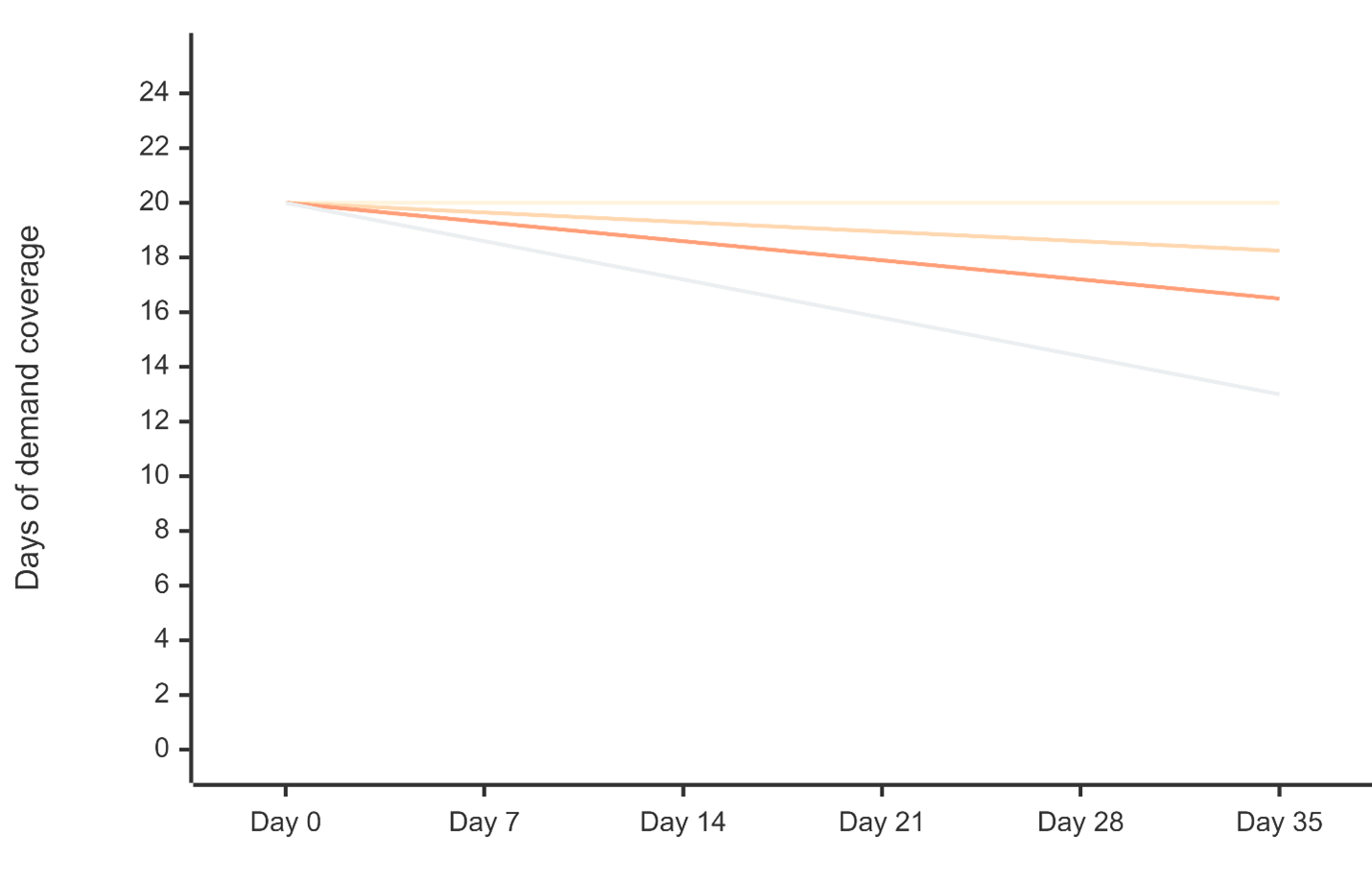
Link to local trigger thresholds: under a sustained 20% net deficit from a 20-day starting buffer, inventory coverage crosses 7 days after roughly 65 days. Under a sustained 10% deficit, threshold crossing shifts beyond 100 days. Shorter timelines emerge when starting buffers sit closer to 7–10 days or when localized logistics disruptions create uneven distribution, even with adequate national totals. [50]
Uncertainty handling: unknown dominates. Local plan thresholds indicate how officials define “serious” at the city or provincial level, but they do not reveal national inventory totals. [50]
Impacts, scenarios, risks, and mitigation options
Domestic impacts inside China
Price stabilization and enforcement remain central tools. NDRC’s domestic pricing notice reflects a “cap” retail model with compliance enforcement and explicit direction to major state firms to maintain stable supply and distribution. [29]
Wholesale price behavior already signals stress and opportunistic stocking. Reuters reports wholesale diesel rising 13.5% between February 28 and March 4 (JLC data) and ex-plant gasoline rising 11% week-on-week in postings by a Shandong independent refiner. Such behavior aligns with early-stage “expected tightness” dynamics, even when end-user demand changes little. [1]
Supply assurance messaging from major state firms during the “Two Sessions” period signals a priority for protecting politically sensitive demand centers, especially Beijing and its surrounding supply chains, with an emphasis on logistics coordination and stable refined product supply. [52]
Rationing triggers are likely to follow local emergency-plan logic: visible station outages sustained for days, plus inventory cover falling toward 7/5/3-day bands, increase the probability of formal limits. Shenzhen Guangming’s plan explicitly ties the highest emergency tier to widespread restrictions and an inventory cover of nearly 3 days. Hunan’s plan ties high-level warnings to inventory below 3–2 days and to large declines in daily inflows. [50]
Global impacts
Regional product markets tighten when China reduces exports. Reuters explicitly links lower Chinese exports to tighter Asian fuel supply and higher refining margins, with diesel processing margins near $49/bbl and jet cracks above $55/bbl at the time of reporting. [53]
Freight and insurance costs surge under a shipping freeze. Reuters reports VLCC Middle East–to–China charter costs rising above $450,000/day after hostilities began, while war-risk costs rose sharply and shipowners held vessels at anchor. [6]
Supply substitution pressures rise immediately. Reuters reports that Asian refiners are seeking replacement barrels outside the Gulf, and that operational disruptions occurred when prompt replacement cargoes failed to arrive. [54]
Geopolitical context and escalation logic
Energy-route dependence remains structurally high. IEA estimates that nearly 15 mb/d of crude and about 5 mb/d of oil products moved via the Strait in 2025, and that only 3.5–5.5 mb/d of crude export capacity exists for bypass routes via Saudi and UAE pipelines under certain conditions. Constraint: Bypass capacity does not cover full volumes. [55]
Analyst and bank commentary sets time-based escalation thresholds. A Reuters compilation quotes a Macquarie strategist stating markets handle a 1–2 week shutdown more easily, while impacts escalate rapidly after week three and further after week four; J.P. Morgan analysis ties prolonged closure to forced production shut-ins for Iraq and Kuwait within days due to storage constraints; UBS links prolonged disruption and infrastructure strikes to potential oil price moves above $100. [56]
OPEC+ response remains constrained by the distribution of spare capacity and shipping feasibility. Reuters reports a modest agreed output increase beginning in April, while core uncertainty remains access to shipping lanes rather than just upstream supply decisions. [57]
Scenario outcomes with probabilities and impacts
Subjective probabilities reflect open-source signals as of March 5, 2026, grounded in the observed attack tempo, vessel hesitancy, insurance stress, and public de-escalation messaging.
| Scenario | Probability | Operational description | Domestic China impact | Global market impact | Main indicators |
| Rapid partial normalization | 45% | Attacks taper; AIS transits rebound materially within ~1–2 weeks; export guidance remains temporary and targeted. | Export pause supports stable domestic product supply; limited need for formal rationing outside localized disruptions [58] | Refining margins ease from peaks; freight and war-risk premia decline from extremes [59] | JMIC traffic recovery; fewer vessel incidents; insurance pricing falls [60] |
| Prolonged disruption | 35% | Transits stay heavily suppressed for ~2–4 weeks; “dark” transits rise; run cuts expand | Export pause offsets part of refinery losses; local shortages emerge where distribution pinches; tighter enforcement and priority allocations rise [61] | Sustained high cracks and freight; substitution pulls barrels from the Atlantic Basin and sanctioned flows; tighter Asian product balance [62] | Continued vessel hits; anchor queues persist; refinery force majeure spreads [63] |
| Extended disruption with infrastructure damage | 20% | Disruption exceeds a month; repeated strikes hit terminals/refineries; storage constraints force upstream shut-ins. | Provincial-level rationing becomes plausible under local-plan thresholds; emergency stock releases and tight controls follow [64] | Oil above $100 more likely; severe freight and insurance strain; global shortages emerge rapidly, given limited bypass capacity [65] | Confirmed prolonged LNG or crude facility outages; production shut-ins accelerate [66] |
Flowchart of the disruption mechanism
Mechanism links: JMIC and Reuters reporting confirm attack-driven risk and vessel clustering; Reuters reporting confirms run cuts and export-policy guidance under supply pressure. [67]

Risk assessment: likely timelines for domestic restrictions
A short disruption (roughly ≤2 weeks) aligns with analyst views that markets absorb a brief shutdown more easily, especially when policy reduces exports and maintains domestic supply. Under that path, formal rationing remains unlikely outside localized logistics constraints, though wholesale price spikes and surveillance intensify. [68]
A 2–4 week disruption raises the probability of localized restrictions at high-demand nodes if refinery run cuts broaden and import replacement lags. Local plans show that authorities escalate rapidly when station outages persist for multiple days and when inventory coverage nears a 7-day band. [69]
A month-plus disruption pushes risk toward broader restrictions and organized rationing, with inventories falling to 5–3 days in multiple cities or provinces, especially if distribution constraints create uneven availability despite national stock buffers. Local plans explicitly treat widespread limits plus 3-day coverage as the most severe tier. [50]
Mitigation options and policy responses
Policy options for China: – Expand refined product export controls through quota management and administrative guidance, while maintaining exemptions for international aviation and bonded bunkering, where necessary to meet external commitments. [1]
– Release crude or product stocks in a targeted manner to support coastal refinery feed and to stabilize inland distribution, consistent with a broader strategic stockpiling posture described in China’s oil and gas planning and analyst estimates of large reserves. [70]
– Strengthen domestic logistics and allocation priorities for essential services, aligned with emergency-plan governance structures that coordinate commerce, transport, and emergency offices. [50]
– Tighten price-policy enforcement and anti-hoarding measures through existing mechanisms and reporting channels, consistent with NDRC’s price-policy enforcement language. [71]
Mitigation options for major importers in Asia: – Activate strategic stock release protocols early, before freight and insurance bottlenecks worsen, using IEA-style oil security logic for chokepoint disruptions and limited bypass capacity. [72]
– Secure alternative supply chains for refined products and crude outside the Gulf, acknowledging higher freight and different crude slates, and plan for short-term refinery optimization for non-Gulf crudes. [73]
– Coordinate naval deconfliction, convoy, or escort concepts only after a realistic assessment of force requirements; shipping-industry experts publicly questioned the feasibility of protecting all tankers under broad threat conditions. [74]
Explicit uncertainties and assumptions
Public records do not show a published written order from the National Development and Reform Commission[75] directing a fuel export shutdown; Reuters and Bloomberg-style reporting rely on unnamed sources describing guidance, and official briefings deny knowledge. [26]
National gasoline and diesel inventory levels lack official public disclosure suitable for a precise national “days-of-supply” series; modeling therefore uses local emergency-plan definitions for what officials treat as severe and uses standardized deficit-share arithmetic for depletion curves. [50]
AIS-based traffic estimates undercount “dark” transits when vessels stop broadcasting; Argus explicitly warns that safety-driven AIS silence can bias counts upward from observed values, but multiple sources still converge on a large drop in movements. [76]
[1] [26] [53] [58] https://www.reuters.com/business/energy/china-urges-refiners-suspend-fuel-exports-amid-mideast-conflict-sources-say-2026-03-05/
[2] [5] [24] [76] https://www.argusmedia.com/en/news-and-insights/latest-market-news/2795597-hormuz-ship-traffic-down-94pc-since-iran-conflict-began
[3] [10] [17] [20] https://www.mfa.gov.cn/wjdt_674879/fyrbt_674889/202603/t20260305_11869312.shtml
https://www.mfa.gov.cn/wjdt_674879/fyrbt_674889/202603/t20260305_11869312.shtml
[4] [13] [15] [19] [21] [22] [23] [33] [34] [60] [67] https://www.ukmto.org/-/media/ukmto/products/update-002—001—jmic-advisory-note-28_feb_2026_final.pdf
https://www.ukmto.org/-/media/ukmto/products/update-002—001—jmic-advisory-note-28_feb_2026_final.pdf
[6] [12] [35] [59] [73] https://www.reuters.com/markets/commodities/charting-widening-impact-iran-crisis-energy-markets-2026-03-05/
[7] [62] https://www.reuters.com/business/energy/asia-refining-margins-rocket-highest-nearly-4-years-hormuz-supply-disruption-2026-03-05/
[8] [16] [51] [61] https://www.reuters.com/business/energy/chinese-refiners-begin-run-cuts-iran-war-tightens-oil-supply-2026-03-03/
[9] [25] [54] [63] [74] https://www.reuters.com/business/energy/hormuz-shutdown-worsens-after-us-hits-iranian-warship-tankers-stranded-fifth-day-2026-03-04/
[11] https://www.ukmto.org/-/media/ukmto/products/jmic-advisory-note-update_01_01_mar_2026.pdf?rev=23972d78c966469992955635ade7a80d
[14] [27] https://www.mfa.gov.cn/wjdt_674879/fyrbt_674889/202603/t20260303_11867941.shtml
https://www.mfa.gov.cn/wjdt_674879/fyrbt_674889/202603/t20260303_11867941.shtml
[18] [55] https://www.iea.org/about/oil-security-and-emergency-response/strait-of-hormuz
https://www.iea.org/about/oil-security-and-emergency-response/strait-of-hormuz
[28] https://www.fmprc.gov.cn/eng./xw/fyrbt/lxjzh/202603/t20260304_11868733.html
https://www.fmprc.gov.cn/eng./xw/fyrbt/lxjzh/202603/t20260304_11868733.html
[29] [71] https://www.ndrc.gov.cn/xwdt/xwfb/202602/t20260224_1403852.html
https://www.ndrc.gov.cn/xwdt/xwfb/202602/t20260224_1403852.html
[30] [52] https://www.cpnn.com.cn/news/nyqy/202603/t20260304_1869805.html
https://www.cpnn.com.cn/news/nyqy/202603/t20260304_1869805.html
[31] https://www.sohu.com/a/991998087_121118719
https://www.sohu.com/a/991998087_121118719
[32] [41] https://www.stats.gov.cn/xxgk/sjfb/zxfb2020/202601/t20260119_1962322.html
https://www.stats.gov.cn/xxgk/sjfb/zxfb2020/202601/t20260119_1962322.html
[36] https://www.reuters.com/world/middle-east/london-marine-insurers-still-offering-middle-east-cover-war-risk-rates-rise-2026-03-04/
[37] https://www.rbc.ru/business/05/03/2026/69a916139a7947f843e870e9
https://www.rbc.ru/business/05/03/2026/69a916139a7947f843e870e9
[38] https://www.asriran.com/fa/amp/news/1146761
https://www.asriran.com/fa/amp/news/1146761
[39] https://ok.ru/group/53666832253080/topic/157973385915800
https://ok.ru/group/53666832253080/topic/157973385915800
[40] https://www.aparat.com/v/cdx9n14
https://www.aparat.com/v/cdx9n14
[42] [70] https://www.reuters.com/business/energy/china-targets-steady-oil-output-more-gas-stockpiling-five-year-plan-2026-03-05/
[43] https://www.reuters.com/business/energy/china-adding-11-new-oil-reserve-sites-2025-2026-2025-10-07/
https://www.reuters.com/business/energy/china-adding-11-new-oil-reserve-sites-2025-2026-2025-10-07/
[44] https://www.reuters.com/business/energy/china-asks-state-firms-add-60-mln-barrels-oil-reserves-vortexa-sources-say-2024-07-04/
[45] https://www.bakerinstitute.org/sites/default/files/2024-06/Tes-Collins-Energy-Stockpiling-062024_0.pdf
[46] https://www.iea.org/reports/oil-market-report-february-2026
https://www.iea.org/reports/oil-market-report-february-2026
[47] https://www.oxfordenergy.org/wpcms/wp-content/uploads/2026/02/Comment-The-drivers-of-Chinas-crude-buying-binge.pdf
[48] [50] [64] [69] [75] https://www.szgm.gov.cn/gmswj/attachment/1/1655/1655636/12523988.pdf
https://www.szgm.gov.cn/gmswj/attachment/1/1655/1655636/12523988.pdf
[49] https://www.hunan.gov.cn/xxgk/wjk/szfbgt/201509/t20150915_4825464.html
https://www.hunan.gov.cn/xxgk/wjk/szfbgt/201509/t20150915_4825464.html
[56] [68] https://www.reuters.com/business/energy/oil-prices-expected-stay-high-days-all-eyes-strait-hormuz-flows-2026-03-02/
[57] https://www.reuters.com/business/energy/opec-debates-oil-output-boost-us-war-iran-disrupts-shipments-2026-03-01/
[65] https://www.reuters.com/business/energy/ubs-raises-average-brent-price-forecasts-first-quarter-full-year-2026-2026-03-04/
[66] https://www.reuters.com/business/energy/hormuz-shutdown-could-force-iraq-kuwait-curb-oil-output-within-days-jp-morgan-2026-03-04/
[72] https://www.iea.org/topics/the-middle-east-and-global-energy-markets
ship-tracking-based/topics/the-middle-east-and-global-energy-markets


