

Futures is … Oil prices – gas at $5 a gallon – Global inflation
The war began in the morning. It was a clear morning on February 28, 2026, and the sun hit the water of the Persian Gulf with a sharp, white light. Then the missiles came. The United States and Israel launched a coordinated strike they called Operation Epic Fury and Operation Roaring Lion. They hit targets across Iran. They hit missile silos and command centers and airfields. They wanted to break the regime. They wanted to end the nuclear threat forever. Iran did not break. It struck back. It struck the neighbors and the oil and the ships. It struck with everything it had left.
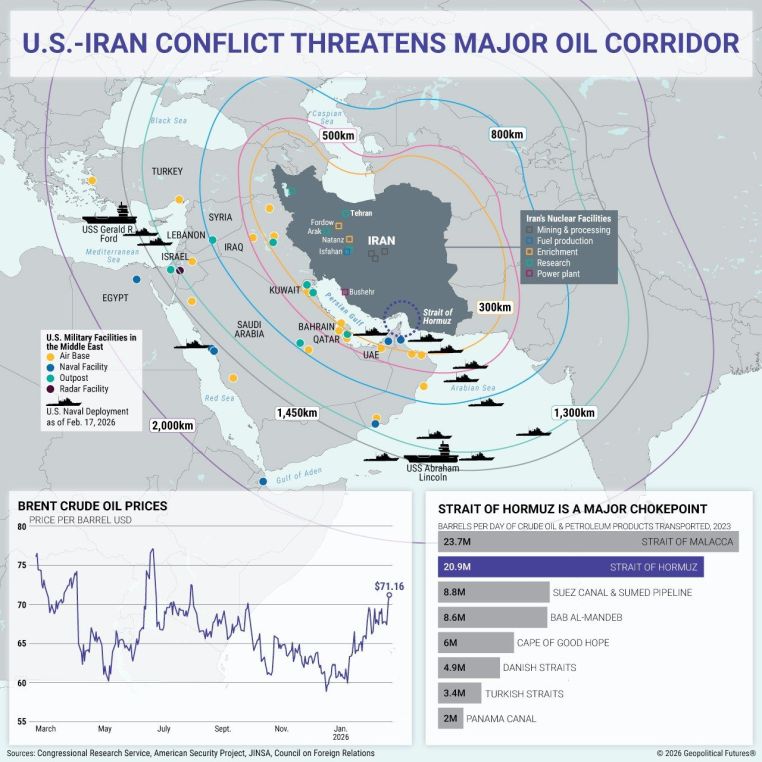
The First Salvos and the Collapse of Diplomacy
Negotiations in Switzerland and Oman failed only days before. The diplomats talked in rooms with high ceilings and cold air but they found no common ground. Iran refused to stop enriching uranium. It refused to limit its missiles. President Donald Trump spoke to the world from the White House. He said the time for talk ended. He said the United States military began major combat operations to eliminate an imminent threat. He told the Iranian people to seize their destiny and rise against their leaders.
Israeli pilots flew their jets into the heart of Iran. They hit hundreds of targets in coordination with American wings. They targeted the Intelligence Ministry in Tehran. Witnesses heard three large explosions. Smoke rose over the city. The air defense systems thudded in the night. In the south, the war grew ugly. A strike hit a girls’ school in Lamerd. The local governor said eighty-five people died there. Iran used these deaths to fuel its rage. It turned its eyes toward the oil-rich states of the Gulf.
The Status of the Region
- Iran closed its airspace and conducted major combat operations.
- Israel declared a state of emergency and closed its sky to civilian planes.
- The UAE intercepted missiles over Abu Dhabi and Dubai and one person died.
- Bahrain saw the US Fifth Fleet headquarters take a hit.
- Kuwait lost its international airport and an air base.
- Qatar reported explosions near Al Udeid and shot down waves of missiles.
- Jordan took down forty-nine drones and missiles over its territory.
The Iranian response was a wall of fire. The Revolutionary Guard Corps (IRGC) fired hundreds of missiles. They did not just aim for the ships. They aimed for the countries that host the Americans. They hit Bahrain, Kuwait, Qatar, Jordan, and the United Arab Emirates. They turned the region into a single, vast battlefield.
The Siege of the Strait of Hormuz
The IRGC issued a warning over the maritime radio bands. They spoke clearly. They said the Strait of Hormuz was effectively closed. They told every vessel to stay away. They said the waters were no longer safe because of American and Israeli aggression. This was the move the world feared for fifty years. The Strait is the throat of the world. One-fifth of the world’s oil passes through this narrow neck of water every day.
Approximately 20 million barrels of crude oil and refined products move through it every twenty-four hours.
- Sixteen to twenty million barrels of oil flow through the neck every day.
- The world gets twenty-five percent of its petroleum there.
- The ships carry the gas from Qatar through the channel.
- Eighty-four percent of the oil goes to the markets in Asia.
The closure was not just a statement. It was a physical reality. Iran used sea mines and GPS interference to choke the channel. They sent fast boats to harass the tankers. The US Navy told commercial ships it could not guarantee their safety anywhere in the Persian Gulf. Tankers stopped. Seven hundred and fifty vessels were in the area when the war began. Some turned back toward the Indian Ocean. Others dropped anchor and waited for a protection that did not come.
The War on the Rigs
Iran targeted the infrastructure of the earth. In Abu Dhabi, drones and missiles struck the heart of the oil industry. A photo showed an oil rig on the water. Black smoke poured from it. The smoke rose high into the grey sky. It was a rig near Abu Dhabi. Iran targeted the rig to hit the wealth of the Emirates. The strike hit a fuel depot in the Mussafah neighborhood owned by the Abu Dhabi National Oil Co. Tankers exploded. Three workers died.
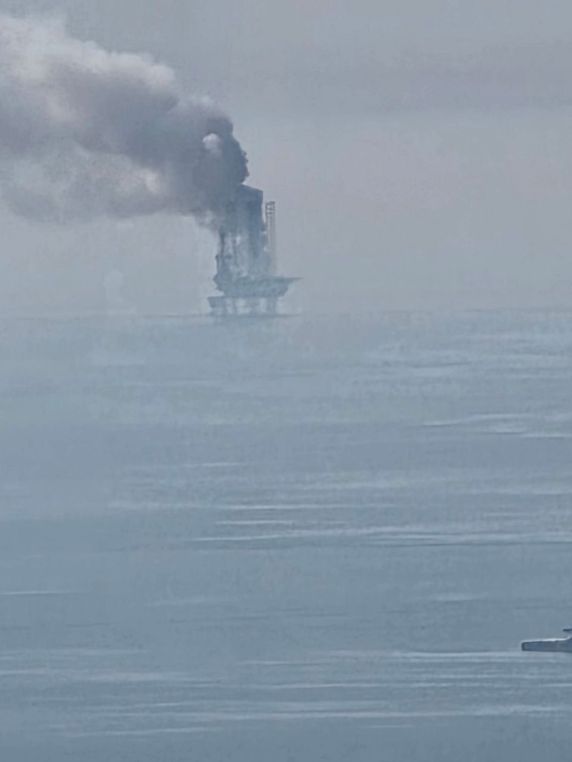
The message was clear. If Iran cannot export its oil, no one in the Gulf will export theirs. The IRGC understands that the rigs are vulnerable. They are stationary targets in a lonely sea. They are the symbols of the domestic transformations that Saudi Arabia and the UAE have bet their futures on. By hitting the rigs, Iran hits the bank accounts of its enemies.
The damage spread across the region. Israel’s Energy Ministry ordered the Greek firm Energean to stop production at the Karish gas field. They also shut down the Leviathan field. A refinery in Haifa closed several units. In Iran, the Kharg Island terminal suffered an explosion. This is Iran’s primary export hub. The war was destroying the very thing the combatants needed to pay for it.
The Strike on Naval Assets and Allied Bases
The US Navy’s 5th Fleet in Bahrain felt the weight of the Iranian retaliation. A missile hit the service center at the base. Plumes of smoke rose over the harbor. Automated warnings told the sailors to seek hardened shelter. The Navy already reduced its staff to mission-critical levels but the base remained a target.
In Kuwait, the war arrived at the Ali Al-Salem air base. Shrapnel from Iranian strikes injured three troops. A drone hit the main international airport and hurt workers there. In Qatar, the sky over Al Udeid air base filled with the sound of explosions. This base holds thousands of American troops. It is the hub of American air power in the region. Iran fired waves of missiles to saturate the defenses.
## The Inventory of the Guard
- Iran held two thousand long-range ballistic missiles.
- The Guard kept two thousand short-range ballistic missiles.
- They owned thousands of cruise missiles and drones.
- The Guard fired three hundred missiles in the first twelve hours of the war.
The Houthis in Yemen joined the fight. They are the allies of Tehran. They vowed to attack ships in the Red Sea and hit Israel again. They have the power to close the southern door to the Suez Canal. If the Strait of Hormuz is the throat, the Red Sea is the lung. The world cannot breathe if both are closed.
The Surge in Oil Prices and Global Costs
The price of oil does not wait for the smoke to clear. It moves on the expectation of pain. Before the first missile fired on Saturday, the price already hit a six-month high. Brent crude traded near seventy-three dollars a barrel in London. It rose nineteen percent since the start of the year.
- Seventy-three dollar oil matches two dollar and ninety-eight cent gas.
- Eighty dollar oil pushes gas past three dollars and shipping rates begin to rise.
- Ninety-one dollar oil increases the cost of tankers and food prices show a moderate impact.
- One hundred and thirty dollar oil sends gas to five dollars and supertankers cost two hundred thousand dollars a day.
- This blockade causes the energy index to surge by twelve percent and food costs jump while inflation begins to boom.
- One hundred and fifty dollar oil creates an inflationary fire across the globe.
The surge in prices hit the shipping industry immediately. The cost to hire a supertanker reached two hundred thousand dollars a day. Insurers raised their rates or canceled policies for the Gulf. The war premium was no longer a few dollars. It was the entire price.
The Inflationary Fire
The rising price of oil is the wind that fans the fire of inflation. In the beginning of 2026, oil was cheap. It was sixty dollars a barrel in January. It was a disinflationary force. It kept the cost of goods low. By mid-February, that changed. The price rose to seventy dollars and then seventy-three.
This represents a fifteen percent increase in a few short weeks. If the price stays high, it will drive up headline inflation across the world. It removes the driver that kept prices down in 2025. Every product moved by truck or ship or plane becomes more expensive. Food becomes more expensive. Electricity becomes more expensive.
Investors saw the inflation coming. They sold their stocks and bought gold. Gold is the safe harbor when the world is on fire. The price of gold climbed toward five thousand dollars an ounce. The major stock indexes in New York all opened in the red. The markets do not believe in a cheap victory. They believe in a long and costly war.
The current conflict in the Persian Gulf has immediately transformed the global economic outlook, shifting energy markets from a surplus-driven “bearish” state to a high-volatility “war premium” environment. Based on the image of the oil rig on fire near Abu Dhabi and the targeting of regional infrastructure like the Mussafah fuel depot, analysts have verified that the geopolitical risk premium is now a physical reality, pushing Brent crude to a seven-month high of $72.48–$73.00 per barrel.
Strategic Foresight Metrics
Gasoline and Logistics: Current U.S. gasoline prices average $2.98 per gallon but are projected to pass $3.00 by Monday.[1] In scenarios involving a partial or total blockade of the Strait of Hormuz, these prices are expected to reach $5.00 and $6.00 respectively, aligned with Brent crude spikes to $130–$150 per barrel.
Shipping and Insurance: Maritime War Risk Premiums have surged from a baseline of 0.01% to as much as 1.0% of a vessel’s value, adding roughly $500,000 to the weekly cost of a single supertanker. Overall shipping rates have reached six-year highs, with supertanker costs nearing $200,000 per day.
Inflation Outlook
While 2026 began with headline inflation near 2.4%, the energy index—which surged 12% in January alone—is now a pro-inflationary driver. Forecasts for late 2026 have been revised upward to a “fever” of 3.5% or higher.
Food and Agflation
Disruption in the Strait of Hormuz threatens 32% of the world’s urea trade (fertilizer) and 50% of seaborne sulphur trade. This supply shock is expected to trigger “agflation,” as food production costs rise alongside a projected 3.1% annual increase in food prices.

Strategic Responses and the Pipeline Gamble
The Gulf states are not without options but the options are limited. Saudi Arabia and the UAE spent years building pipelines to bypass the Strait of Hormuz. Saudi Arabia has the East-West Crude Oil Pipeline. It runs from the oil fields in the East to the Red Sea port of Yanbu. It can carry seven million barrels a day. The UAE has a pipeline to Fujairah on the Gulf of Oman. It can carry nearly two million barrels a day.
The Capacity of the Bypasses
- The Saudi East-West Pipeline carries seven million barrels.
- The UAE Fujairah Pipeline carries nearly two million barrels.
- The bypasses move three million barrels on a good day.
- These routes cannot replace the Strait.
OPEC+ scheduled an emergency meeting for Sunday. They will discuss increasing production to make up for the lost Iranian oil and the disruption of the Strait. Saudi Arabia already began to flood the market in February. They shipped 7.3 million barrels a day. They wanted to build a buffer. But you cannot buffer against a total stoppage of the world’s most important waterway.
The Geography of Pain
The impact of the war follows the tankers. It flows east. Asia takes the most oil and gas from the Persian Gulf. China, India, Japan, and South Korea take nearly seventy percent of the exports. China is the most vulnerable. They take ninety percent of Iran’s oil. They are the world’s largest importer of hydrocarbons. If the Strait stays closed, the Chinese economy will shudder.
The United States is less exposed than it was in the 1970s. It imports only about half a million barrels a day from the Gulf. But the price of oil is a global price. When the price of Brent rises in London, the price of gas rises in Ohio. The national average for gas in the US was two dollars and ninety-eight cents on Saturday. Analysts expect it to pass three dollars by Monday and go much higher if the war continues.
The Long Road and the Shadow of History
The war in 2026 feels like the wars of the past. In 1988, during Operation Praying Mantis, the US Navy destroyed Iranian oil platforms and decimated their fleet. Then, as now, Iran responded by attacking civilian tankers and rigs. But the scale of the 2026 war is much larger. Iran has thousands of missiles now. It has a shadow fleet of tankers to move its own oil past sanctions.
The strategic initiative now lies with Tehran. They will decide if they want to fight a total war or if they want to survive. The United States and Israel want to remove the regime but regimes do not go quietly into the night. They take the world with them if they can.
Summary and the Future Outlook
The war of February 2026 changed the economic landscape of the decade. The impact is not a temporary spike. It is a fundamental shift in risk.
- Energy Security. The myth of a safe Strait of Hormuz is dead. Countries will spend billions to find new ways to move oil or new ways to live without it.
- Global Inflation. The inflationary surge will last for years. Even if the war ends tomorrow, the damage to the rigs and the terminals will take months to repair.
- The New Map of Power. The US and Israel showed they can strike anywhere in Iran, but Iran showed it can strike the world’s economy.
- Market Volatility. The price of oil will stay high until the Strait is reopened and the mines are cleared. This will lead to slower global growth and higher interest rates.
The sun went down on the first day of the war. The fire on the rig near Abu Dhabi was still burning. The smoke was black against the stars. The world waited for the morning to see if the price of life would go up again. It usually does. The oil is the blood of the world, and when the world bleeds, everyone pays the price.


Comments on “The Crude Breach – #Trump’s #Persian Gulf War – #Gas prices #skyrocket – #Economic Impact”
Comments are closed.