

The intelligence landscape of the United States in the 2025–2026 period is characterized by a profound and escalating bifurcation. On one side stands a newly emboldened executive branch, which has aggressively remilitarized the bureaucracy under the banner of the “Department of War,” reinforcing traditional structures of secrecy, compartmentalization, and “lethality.” On the other side exists a chaotic but rapidly coalescing coalition of legislative oversight bodies, high-level whistleblowers, and international actors pushing for the “disclosure” of non-human intelligence (NHI) presence and technology. This report provides an exhaustive review of this conflict, analyzing the rumors of NHI activity on U.S. military installations, the structural allegations concerning Unacknowledged Special Access Programs (USAPs) such as “Immaculate Constellation,” and the broader strategic implications of this struggle for national security and public trust.
The geopolitical and domestic environment of early 2026 serves as the crucible for these developments. The return of President Donald J. Trump to the executive office has signaled a departure from the “institutional silence” that characterized previous administrations’ handling of Unidentified Anomalous Phenomena (UAP). However, this departure has not manifested as a simple march toward transparency. Instead, it has appeared as a complex power struggle where the very definitions of “defense,” “war,” and “alien” are being rewritten. The “early summer” 2026 window has become a focal point for this tension, with various stakeholders anticipating—or dreading—a disclosure event that could fundamentally alter the American social contract.1
This analysis posits that the “rumors” currently circulating regarding NHI are not merely disparate stories but symptoms of a structural fissure in the U.S. national security state. The conflicting narratives—one of a “multi-decade crash retrieval program” described by whistleblowers, and the other of “circular reporting” and “no empirical evidence” described by the All-domain Anomaly Resolution Office (AARO)—can no longer be reconciled. One narrative describes a hidden, illegal bureaucracy managing off-world technology; the other describes a sociological feedback loop of mythology. The resolution of this conflict in 2026 will determine whether the United States moves toward a new era of transparency or retreats into a hardened shell of wartime secrecy.
The “Department of War” and the Remilitarization of the Narrative
Central to the 2026 strategic posture is the radical rebranding of the Department of Defense (DoD). On September 5, 2025, President Trump signed Executive Order 14347, authorizing the use of “Department of War” as a secondary but official title for the agency.2 This executive action, the 200th of his term, was not merely a cosmetic nod to history but a deliberate signal of intent. The White House Fact Sheet accompanying the order explicitly stated that the name “Department of War” conveys a “stronger message of readiness and resolve” compared to “Department of Defense,” which emphasizes only defensive capabilities.2
Defense Secretary Pete Hegseth, authorized by the order to use the title “Secretary of War,” articulated the philosophy behind this shift: “We changed the name after World War II… and we haven’t won a major war since.” He emphasized a return to “maximum lethality” and “violent effect,” rejecting “tepid legality”.4 This shift in nomenclature has profound implications for UAP transparency. The “War Department” ethos invokes the total secrecy protocols of the Manhattan Project era, potentially justifying stricter compartmentalization of “exotic” technologies under the guise of war readiness rather than mere defense. It signals to adversaries—and perhaps to domestic oversight bodies—that the department is moving to a wartime footing, where information control is a primary weapon.
Furthermore, the cost of this rebranding, estimated by the Congressional Budget Office (CBO) to range from $10 million for a modest implementation to $125 million for a broad rollout, indicates the administration’s commitment to this symbolic restructuring.3 This investment in “readiness” branding complicates the UAP narrative. If the military is posturing for “war,” the testing of advanced, unconventional platforms—whether domestic or reverse-engineered—becomes a matter of supreme national survival, potentially shielding such programs from congressional inquiry under the highest levels of classification.
The Legislative Counter-Maneuver: The UAP Transparency Act
While the executive branch hardens its perimeter, the legislative branch has launched its most aggressive transparency offensive to date. The UAP Transparency Act (H.R. 1187), introduced in February 2025 by Representative Tim Burchett, represents a direct challenge to the executive’s information monopoly.5 The bill’s mandate is sweeping: it requires the President to direct the head of each federal department or agency to declassify “all documents, reports, and other records” relating to UAP within 270 days of enactment.6
The statutory language of H.R. 1187 is precise. It defines UAP not just as airborne objects, but includes “submerged objects or devices” and transmedium objects that transition between space and the atmosphere.5 This broad definition aims to capture the full spectrum of anomalous activity reported by whistleblowers, closing loopholes that agencies might use to withhold data on “underwater” or “orbital” anomalies. The bill further mandates that these declassified records be made available on a publicly accessible website, ensuring direct citizen access rather than filtered release through intelligence gatekeepers.6
Simultaneously, the Fiscal Year 2026 National Defense Authorization Act (NDAA) has introduced stringent new oversight mechanisms. It requires AARO to brief Congress on the “procedures and protocols” of UAP intercepts, explicitly targeting the “overclassification” of data.1 This legislative pincer movement—demanding mass declassification on one hand and granular operational details on the other—has set the stage for a constitutional stress test. The refusal of access at Eglin Air Force Base to a congressional delegation 1 serves as a precursor to this conflict, illustrating that the “rumors” of NHI are now functioning as a wedge issue, forcing a determination of who ultimately controls the U.S. security apparatus: the elected representatives or the “Department of War.”
The escalating tension between these two forces—the Executive’s move toward secrecy and the Legislature’s push for transparency—defines the timeline of the 2023–2026 period. This sequence of events, beginning with the confrontation at Eglin and culminating in the introduction of the Transparency Act and the Department of War rebranding, illustrates a diverging trajectory where each side escalates its efforts to control the narrative. The legislative branch introduces mandates like the FY2026 NDAA to force disclosure, while the executive branch counters with orders like EO 14347 that reinforce the military’s autonomous authority.
Chapter 1: The “Immaculate Constellation” Architecture
The most significant and structurally detailed allegation in the 2025–2026 period concerns a program identified as “Immaculate Constellation.” Unlike generic rumors of “crash retrieval,” this allegation describes a specific bureaucratic architecture designed to manage the flow of intelligence within the executive branch, effectively insulating UAP data from standard oversight channels.
1.1 Structural Function as a “Parent” USAP
Whistleblower reports entered into the congressional record describe “Immaculate Constellation” not merely as a research project, but as a “parent” Unacknowledged Special Access Program (USAP).8 Its primary function appears to be the quarantine of data. The program allegedly acts as a central node for consolidating observations from a wide array of military assets, including both “tasked” (directed collection) and “untasked” (incidental collection) platforms.9
The distinction between “tasked” and “untasked” is critical. “Tasked” platforms are sensors specifically directed to look at a target, while “untasked” platforms are general surveillance assets (like radar nets or satellite relays) that happen to capture anomalies. By ingesting data from both streams, “Immaculate Constellation” effectively vacuums up evidence of UAP activity from across the entire Military Intelligence Enterprise (MIE).1
Crucially, the program is described as a mechanism for compartmentalization. Once data is ingested by Immaculate Constellation, it is removed from the broader intelligence circulation. This architecture explains a persistent anomaly in UAP reporting: why so many high-level intelligence analysts, base commanders, and even AARO investigators find “no evidence” in their systems. The evidence is siphoned off before it reaches the repositories they have access to.1 This creates a “sanitized” intelligence picture for the majority of the defense establishment, while a high-fidelity, “unfiltered” picture is retained solely within the USAP.

1.2 Intelligence Holdings and Methodology
The intelligence holdings attributed to “Immaculate Constellation” are reported to be of a significantly higher fidelity than the “fuzzy” videos typically released to the public. Whistleblowers claim the program possesses high-quality Imagery Intelligence (IMINT) and Measurement and Signature Intelligence (MASINT).10 This includes data gathered using:
- Infrared (IR) and Forward-Looking Infrared (FLIR): Capable of detecting heat signatures and propulsion effluents (or the lack thereof).
- Full Motion Video (FMV): Providing kinematic data that allows for the calculation of velocity and acceleration.
- Still Photography: High-resolution images taken from military platforms.11
The report detailed to Congress describes specific incidents captured in this database, including “orbs surrounding and forcing an F-22 out of its patrol area” and a “small orange/red sphere rapidly descending… directly above the flight deck of a CVN aircraft carrier”.10 Such reports, if verified, constitute clear evidence of flight safety hazards and potential hostility, contradicting the “benign” assessment often given in unclassified summaries.
1.3 The Official Denial and the “Word Game” Hypothesis
In response to these allegations, the Department of War has issued a categorical denial. Spokesperson Sue Gough stated, “The Department of Defense has no record, present or historical, of any type of SAP called ‘IMMACULATE CONSTELLATION'”.12 While this appears definitive, intelligence analysts accustomed to the nuances of classification language note the potential for ambiguity.
The specific phrasing—”no record… of any type of SAP called…”—leaves open several possibilities for what analysts term “word games” or “bureaucratic legerdemain” 13:
- Renaming: The program may have been renamed prior to the denial.
- Authority Shift: The program might operate under Title 50 (covert action/intelligence) authority rather than Title 10 (armed forces) authority, placing it outside the DoD’s records search parameters.
- Nickname vs. Designator: “Immaculate Constellation” might be a colloquial nickname or a sub-compartment name rather than the official program designator found in the SAP control registries.
This denial strategy creates a “catch-22” for oversight: investigators request records by a specific name, the agency truthfully denies finding records under that specific name, and the program continues to operate under a different administrative label.
Chapter 2: The Battle for the Bases – Intelligence Review of Key Installations
The conflict over UAP transparency has manifested physically at specific U.S. military installations. These sites have become focal points for rumors, whistleblower testimony, and direct congressional confrontation, each representing a different facet of the alleged NHI enterprise.
2.1 Eglin Air Force Base: The Oversight Flashpoint
Eglin Air Force Base in the Florida Panhandle has emerged as the epicenter of the oversight conflict. The tension here is not merely about a sighting, but about the authority of Congress to investigate military operations. The friction began with a reported UAP encounter in January 2023, where military pilots engaged with an anomalous object.1
When a congressional delegation consisting of Representatives Anna Paulina Luna, Tim Burchett, and Matt Gaetz visited the base to investigate, they were met with what they described as “arrogance” and obstruction. They alleged that the base commander, Brigadier General Jeffrey Geraghty, blocked them from speaking with the primary witnesses and denied them access to sensor data.1 This confrontation escalated the narrative from “unidentified objects” to “illegal concealment.”
While AARO subsequently resolved the Eglin sighting as a “commercial lighting balloon,” this explanation was publicly ridiculed by the lawmakers. They cited the pilots’ description of the object—a “rounded cone” with an engine-like structure capable of maneuvers inconsistent with a balloon—as evidence that the official explanation was a fabrication designed to dismiss the inquiry.1 The Eglin episode has thus cemented the base’s reputation in the disclosure community as a site where “testing” covers for the study of exotic technologies, and where the “Department of War” exerts its autonomy against legislative oversight.
2.2 Vandenberg Space Force Base: The “Red Square” Incursions
Vandenberg Space Force Base in California provides a different intelligence signal: that of persistent, bold incursions by NHI craft interested in U.S. strategic capabilities. The primary source for these allegations is former military police officer Jeffrey Nuccetelli, whose testimony has been central to the 2025–2026 review.1
Nuccetelli detailed an incident from October 2003, widely referred to as the “Vandenberg Red Square.” According to his testimony, three Boeing contractors reported a massive object—”the size of a football field”—hovering silently over a launch site. The object was described as a matte-black, rectangular craft that glowed red, hovered for 45 seconds, and then accelerated at “impossible speed”.1
The “Red Square” incident is significant because it involves “range fouling” of a nuclear-capable launch facility. The 2025 documentary The Age of Disclosure highlighted this case to argue that NHI are not merely observing but actively probing U.S. nuclear readiness.1 Unlike the “lighting balloon” at Eglin, the Vandenberg reports describe a craft of immense size and performance that defies conventional explanation, suggesting a technological gap that the U.S. military is desperate to hide or emulate.
2.3 Patuxent River Naval Air Station: The Logistics of Recovery
While Eglin and Vandenberg are associated with operations and sightings, Patuxent River Naval Air Station (NAS) in Maryland is linked to the logistics of recovery. Investigative journalists Jeremy Corbell and George Knapp have reported on the existence of a specific facility at “Pax River”—allegedly costing $10 million—constructed explicitly to house and analyze recovered UAP materials.1
This rumor is critical because it moves the narrative from “ephemeral sightings” to “physical inventory.” If such a facility exists, it implies a steady stream of recovered materials necessitating specialized storage protocols—likely involving biological containment or radiation shielding. The “Pax River” allegation aligns with the “Immaculate Constellation” framework, serving as a physical node in the quarantine architecture where hardware is exploited away from the prying eyes of standard naval logistics.
2.4 Wright-Patterson Air Force Base: The Biological Connection
Wright-Patterson Air Force Base (WPAFB) in Ohio has long been the “holy grail” of UAP lore, dating back to the Roswell incident. In the 2025–2026 period, this reputation was reinforced by new testimony linking the base to the 1996 Varginha incident in Brazil.
During a January 2026 press conference, witnesses and investigators alleged that the U.S. military orchestrated a clandestine retrieval operation to transport “non-human biologics” from Brazil to WPAFB.1 The narrative includes detailed claims of U.S. Air Force C-17 transport flights and the death of a Brazilian officer from an “unknown bacteria” following physical contact with the entity.1
This specific rumor cluster highlights the “biological hazard” aspect of NHI recovery. The allegation that WPAFB serves as the central repository for biological entities suggests that the “Department of War” views NHI not just as a technological resource but as a biological subject (or threat) requiring the highest levels of bio-containment—a mission profile that fits the base’s historical capabilities.
Chapter 3: The Semantic Fog – “Alien” vs. “Alien”
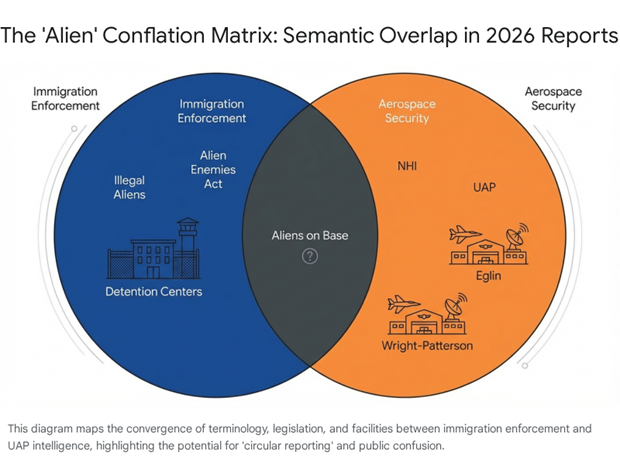
A unique and disorienting feature of the 2026 intelligence landscape is the collision of language. The term “alien,” used for decades in UAP circles to denote “extraterrestrial,” has been aggressively reclaimed by the administrative state for immigration enforcement. This conflation creates a “gray zone” that complicates intelligence analysis and fuels public confusion.
3.1 The Administrative Conflation
Under the Trump administration’s second term, the enforcement of the Alien Enemies Act of 1798 and the Laken Riley Act has led to mass administrative actions. Thousands of “criminal illegal aliens” are being processed and detained, often at facilities auxiliary to or located on military installations.1 Official Department of Homeland Security (DHS) briefings and Department of War documents frequently refer to the movement, housing, and processing of “aliens”.1
Simultaneously, the disclosure movement utilizes the terms “alien,” “non-human intelligence,” and “non-human biologics” to describe UAP occupants. This semantic proximity allows for a form of “plausible deniability” or “circular camouflage.”
3.2 Operational Masking
This overlap provides a cover for covert operations. If an intelligence analyst or a civilian observer hears of “aliens” being transported to Wright-Patterson or Eglin, the report can be easily dismissed or explained away as part of the immigration enforcement mission. The movement of biological containment units, secure convoys, and heightened security protocols—indicators of NHI transport—are indistinguishable from the logistics of moving high-risk human detainees.1
This “semantic fog” serves the interests of secrecy. It creates a high-noise environment where genuine signals of NHI activity are lost amidst the administrative data of border enforcement. For the intelligence community, distinguishing between the “Alien Enemies Act” detainee and the “Non-Human Biologic” specimen requires a meticulous parsing of context, facility type, and security clearance levels that most public observers lack.
Chapter 4: The Official Counter-Narrative – AARO’s Historical Record
Against the tide of rumors and whistleblower claims, the All-domain Anomaly Resolution Office (AARO) stands as the citadel of official skepticism. In its Historical Record Report Volume 2, released in the 2025–2026 timeframe, AARO maintains a steadfast conclusion: there is no verifiable evidence of extraterrestrial technology, and the rumors of secret programs are the result of a sociological phenomenon known as “circular reporting.”
4.1 The “Circular Reporting” Hypothesis
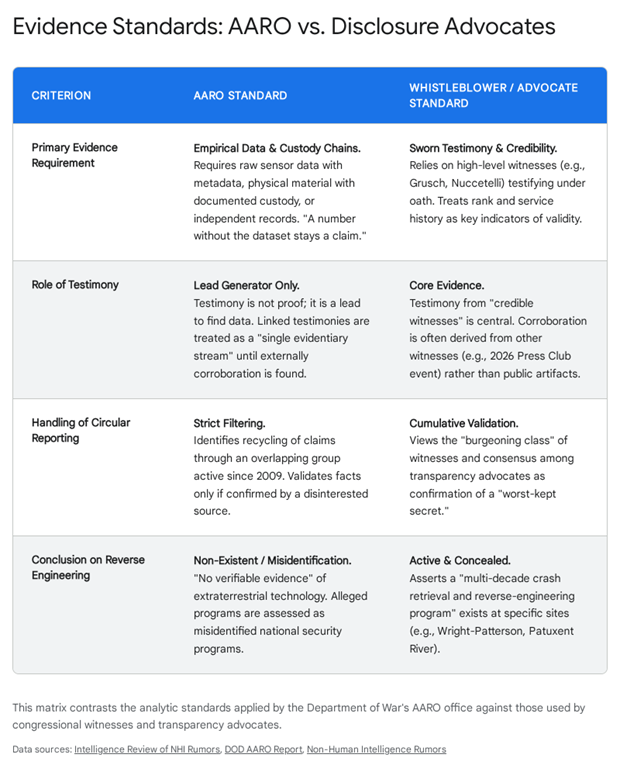
AARO’s central analytical thesis is that the “multi-decade crash recovery” narrative is a self-reinforcing myth. The office explicitly states that the belief in reverse-engineering programs results “in large part” from “circular reporting from a group of individuals… despite the lack of any evidence”.1
This mechanism works as an echo chamber: a small, consistent group of individuals (often referred to as “UAP influencers” or “insiders”) has repeated the same claims to each other, to journalists, and to junior officials for decades. When these claims are retold by “new” witnesses, they are often just regurgitations of the original, unverified rumors rather than independent corroboration. AARO notes that many modern claims trace back to a “consistent group of individuals” active since at least 2009.1
4.2 Evidence Standards: The Epistemological Divide
The conflict between AARO and the disclosure movement is fundamentally a conflict of evidence standards. AARO applies a strict scientific and intelligence tradecraft standard that rejects testimony as proof.
- AARO’s Standard: Requires empirical, reproducible data (raw sensor files, physical material) with a documented chain of custody. A “lead” from a witness is meaningless without the hardware to back it up.1
- Whistleblower Standard: Often relies on “linked testimony clusters.” In this model, credibility is derived from the security clearance of the witness and the corroboration of other witnesses. If three people with Top Secret clearance say they saw a craft, the disclosure movement treats this as evidence; AARO treats it as “hearsay” or “misidentification”.1
This divergence explains why the two sides talk past each other. AARO can truthfully report “no evidence” because they have not been given the keys to the “Immaculate Constellation” warehouse (or because they define the warehouse as nonexistent). Whistleblowers truthfully report “convincing evidence” because they have spoken to the people who built the warehouse.
4.3 Technical Explanations for Anomalies
AARO’s report also provides technical explanations for the “observables” that fascinate the public. It attributes many kinematic anomalies—such as extreme acceleration or “transmedium” travel—to sensor artifacts. Phenomena like “range ambiguity,” “track coasting,” “multi-path reflections,” and “timestamp drift” can create the illusion of impossible speed on radar screens.1 By framing these as “sensor failure modes” rather than “alien technology,” AARO attempts to demystify the data and ground the discussion in conventional physics and engineering limitations.
Chapter 5: International Divergence – The Global Disclosure Front
While the U.S. remains locked in an internal bureaucratic struggle, international actors are pursuing disclosure through different mechanisms, creating a fractured global narrative.
5.1 Canada: The Sky Canada Project
In June 2025, the Office of the Chief Science Advisor of Canada released the final report of the Sky Canada Project.19 This report represents a “scientific transparency” model that contrasts sharply with the U.S. “security containment” model.
- Findings: The report estimates that Canadians report between 600 and 1,000 UAP sightings annually, but only 10% are ever reported to authorities.19
- Philosophy: Unlike the U.S. focus on “threats” and “dominance,” the Canadian approach emphasizes “citizen science.” It recommends de-stigmatizing reporting for civil aviation (pilots, air traffic controllers) and releasing data to the public to foster scientific inquiry.19 This approach implicitly rejects the U.S. premise that UAP data is inherently sensitive national security information.
5.2 Brazil: The Varginha Revival
Brazil continues to be a “leak” in the global secrecy dam. The January 20, 2026, press conference at the National Press Club in Washington, D.C., brought the 1996 Varginha incident back to the forefront.1 The testimony of Dr. Italo Venturelli regarding a “telepathic entity” and the alleged U.S. involvement in retrieving the biological evidence internationalizes the issue. By presenting witnesses outside U.S. jurisdiction, the disclosure movement bypasses U.S. classification walls. If Brazil were to release definitive forensic data, the U.S. policy of ambiguity would face an external shock it could not control.
Chapter 6: The Socio-Economic Horizon – Ontological Shock and Market Adaptation
A critical, often overlooked dimension of the 2026 review is the financial and psychological preparation for disclosure. The concept of “Ontological Shock”—the collapse of a worldview—has moved from philosophical debates to financial risk assessment.
6.1 The “Ontological Shock” Thesis
Former Bank of England analyst Helen McCaw has introduced a sobering economic analysis of disclosure. She argues that the confirmation of a technologically superior NHI would invalidate current asset pricing models, triggering a “catastrophic credit crunch”.1
- The Mechanism: If an NHI possesses “free energy” or advanced manufacturing capabilities (as implied by the lack of propulsion on UAP craft), the valuation of traditional energy companies, utilities, and raw materials could collapse overnight. The “future cash flows” of an oil company are worth zero in a world with zero-point energy.1
- Systemic Risk: This sudden repricing would lead to bank failures and a global financial crisis as confidence in the human-centric economic hierarchy evaporates.
6.2 Market Response: The UFOD ETF
The financial market has responded to this risk with the launch of the Tuttle Capital UFO Disclosure ETF (Ticker: UFOD) in February 2026.22 This fund actively invests in companies likely to benefit from the disclosure and reverse-engineering of NHI technology, such as aerospace and defense contractors.25
- Significance: The existence of such a product validates the “disclosure trade” as a legitimate investment thesis. It signals that UAP speculation has migrated from fringe forums to the trading desks of Wall Street, where “risk” is something to be hedged, not ridiculed.
- Sector Impact: The fund’s strategy highlights the bifurcation of the economy: energy sectors face obsolescence risks, while aerospace and defense sectors are positioned for a reverse-engineering windfall.26
Chapter 7: Future Scenarios and Cones of Plausibility
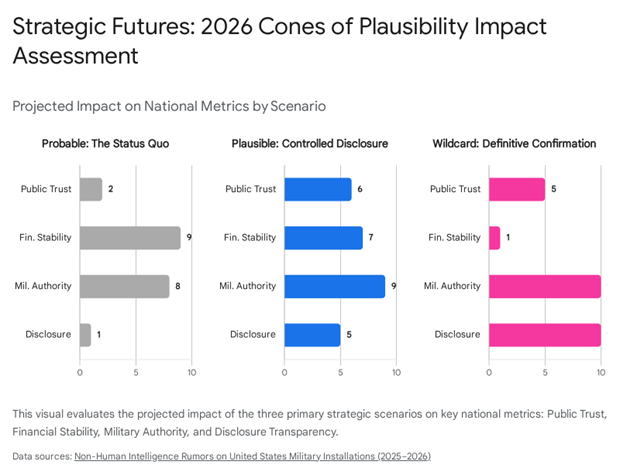
Looking ahead to the remainder of 2026, the intelligence review identifies three “Cones of Plausibility” that define the potential trajectories of the NHI issue.1
7.1 Scenario 1: The Status Quo (Probable)
In this scenario, AARO’s skepticism prevails. No “smoking gun” is released, and the “Immaculate Constellation” allegations are denied or buried in bureaucratic renaming. Institutional inertia prevents any radical disclosure, and public trust in the “Department of War” continues to erode, fueling a permanent sub-culture of conspiracy.
7.2 Scenario 2: Controlled Disclosure (Plausible)
The Trump administration utilizes the “Department of War” rebranding to frame UAP as a “threat” requiring expanded military powers. A partial declassification of “Immaculate Constellation” data occurs—perhaps verifying the 4,100g acceleration or the existence of “unknown actors”—but without admitting to biological recovery.1 This validates the need for increased defense spending and the militarization of space while keeping the core secrets of reverse-engineering intact.
7.3 Scenario 3: Definitive Confirmation (Wildcard)
A “catastrophic leak,” undeniable mass sighting, or international release (e.g., from Brazil) forces the President’s hand. The release of biological or physical evidence triggers the “Ontological Shock” predicted by McCaw. The “Department of War” moves to a full wartime footing to secure the narrative and the technology, potentially suspending normal civil oversight in the name of planetary security.
The “rumors” of NHI on U.S. military installations in 2026 are not merely disparate stories; they are the manifest symptoms of a government at war with itself. The “Department of War” seeks to consolidate control over exotic technologies under the guise of readiness, while the “UAP Transparency Act” seeks to democratize that knowledge. The resolution of this conflict will likely not come from a single document but from the collision of these opposing forces—legislative, executive, financial, and international—in the summer of 2026. Whether the result is a new enlightenment or a new dark age of secrecy remains the defining question of the era.
Works cited
- Non-Human Intelligence Rumors on United States Military Installations (2025–2026).docx
- Trump Renames DOD to Department of War > U.S. Department of …, accessed February 8, 2026, https://www.war.gov/News/News-Stories/Article/Article/4295826/trump-renames-dod-to-department-of-war/
- The Costs of Using the Name “Department of War” – Congressional Budget Office, accessed February 8, 2026, https://www.cbo.gov/system/files/2026-01/61942-DoD-Name-Change.pdf
- President Renames DoD to Department of War, accessed February 8, 2026, https://www.ngaus.org/newsroom/president-renames-dod-department-war
- R.1187 – 119th Congress (2025-2026): UAP Transparency Act, accessed February 8, 2026, https://www.congress.gov/bill/119th-congress/house-bill/1187
- Text – H.R.1187 – 119th Congress (2025-2026): UAP Transparency Act, accessed February 8, 2026, https://www.congress.gov/bill/119th-congress/house-bill/1187/text
- UFOD Stock Quote | Price Chart | Volume Chart (Tuttle Capital Ufo…) – Market Chameleon, accessed February 8, 2026, https://marketchameleon.com/Overview/UFOD/Summary/
- IMMACULATE CONSTELLATION program – Congress.gov, accessed February 8, 2026, https://www.congress.gov/118/meeting/house/117721/documents/HHRG-118-GO12-20241113-SD003.pdf
- The United States Department Of Defense And The Intelligence Community Are Withholding Information About Anomalous Phenomena From Congress – Document Repository, accessed February 8, 2026, https://docs.house.gov/meetings/GO/GO12/20241113/117721/HHRG-118-GO12-Wstate-ShellenbergerM-20241113.pdf
- UNIDENTIFIED ANOMALOUS PHENOMENA: EXPOSING THE TRUTH | Congress.gov, accessed February 8, 2026, https://www.congress.gov/event/118th-congress/house-event/LC73681/text
- The United States Department Of Defense And The Intelligence Community Are Withholding Information About Anomalous Phenomena From Congress – Document Repository, accessed February 8, 2026, https://www.congress.gov/118/meeting/house/117721/witnesses/HHRG-118-GO12-Wstate-ShellenbergerM-20241113.pdf
- DF-2025-00021-Immaculate-Constellation-descrp-from-UNCLASS-Press-22-Oct-2024.pdf – ODNI, accessed February 8, 2026, https://www.dni.gov/files/documents/FOIA/DF-2025-00021-Immaculate-Constellation-descrp-from-UNCLASS-Press-22-Oct-2024.pdf
- Unidentified flying object – Wikipedia, accessed February 8, 2026, https://en.wikipedia.org/wiki/Unidentified_flying_object
- Hellfire Missile Strikes UFO – The Church of God International, accessed February 8, 2026, https://www.cgi.org/news-and-events/2025/11/21/hellfire-missile-strikes-ufo
- In New Doc ‘The Age of Disclosure,’ Military Servicemen Expose More Details About UFOs at Vandenberg – The Santa Barbara Independent, accessed February 8, 2026, https://www.independent.com/2025/12/28/in-new-doc-the-age-of-disclosure-military-servicemen-expose-more-details-about-ufos-at-vandenberg/
- WEAPONIZED with Jeremy Corbell & George Knapp – Apple Podcasts, accessed February 8, 2026, https://podcasts.apple.com/us/podcast/weaponized-with-jeremy-corbell-george-knapp/id1664299388?l=pt-BR
- 726-727. LIVE STREAM Varginha UFO Crash & Witnesses | Podcast …, accessed February 8, 2026, https://www.everand.com/podcast/986162152/726-727-LIVE-STREAM-Varginha-UFO-Crash-Witnesses-We-apologize-in-advance-for-any-audio-issues-during-the-livestream-as-this-is-a-live-press-event
- DOD Report Discounts Sightings of Extraterrestrial Technology – Department of War, accessed February 8, 2026, https://www.defense.gov/News/News-Stories/Article/Article/3701297/dod-report-discounts-sightings-of-extraterrestrial-technology/
- Management of Public Reporting of Unidentified Aerial Phenomena …, accessed February 8, 2026, https://science.gc.ca/site/science/en/office-chief-science-advisor/sky-canada-project/management-public-reporting-unidentified-aerial-phenomena-canada
- Beyond the Human – Podcast, accessed February 8, 2026, https://podcasts.apple.com/us/podcast/beyond-the-human/id1823027687
- Unknown unknowns – Freetrade, accessed February 8, 2026, https://freetrade.io/news/unknown-unknowns
- UFOD Stock Fund Price and Chart — CBOE:UFOD – TradingView, accessed February 8, 2026, https://www.tradingview.com/symbols/CBOE-UFOD/
- MEMY – ETF Opportunities Trust | News – OTC Markets, accessed February 8, 2026, https://www.otcmarkets.com/stock/MEMY/news/As-Ex-Bank-of-England-Analyst-Warns-of-Ontological-Shock-from-Alien-Disclosure-New-ETF-Targets-Potential-UFO-Tech-Benefi?e&id=3400373
- Tuttle Capital UFO Disclosure ETF, accessed February 8, 2026, https://www.cboe.com/us/equities/listings/listed_products/symbols/UFOD/
- accessed February 8, 2026, https://www.sec.gov/Archives/edgar/data/1771146/000199937125013186/ufod-485apos_091225.htm
- Space ETFs vs. Aerospace & Defense ETFs: View From Above – ETF Trends, accessed February 8, 2026, https://www.etftrends.com/space-etfs-vs-aerospace-defense-etfs-view-above/
- Tuttle Capital to launch UFO-focused ETF targeting ‘alien technology’ inspired companies, accessed February 8, 2026, https://seekingalpha.com/news/4411321-tuttle-capital-to-launch-ufo-focused-etf-targeting-alien-technology-inspired-companies
General Adversary Briefs – Treadstone 71
