


A COUNTERINTEL ASSESSMENT OF THE AUGUST 12 DISCLOSURES
The August 12 Paradigm Shift
Geopolitical dynamics experienced a fundamental restructuring on August 12, 2025. Alnur Mussayev, the former Chairman of the National Security Committee of Kazakhstan, issued a declaration that dismantled previous understandings of the relationship between the Russian Federation and Donald J. Trump. The former spy chief did not offer mere conjecture. Mussayev stated definitively that Russian President Vladimir Putin possesses a comprehensive kompromat file on the former American president. He described a dossier of such depth and severity that it functions not merely as a tool for embarrassment but as an instrument of total control.
Mussayev characterizes the file as extensive and meticulously documented. The materials allegedly include financial records that trace illicit transactions connected to accounts owned by Trump or clearly affiliated with his name. Such records would ostensibly expose money laundering operations or sanctions violations. The dossier also reportedly contains sworn statements from operatives who directly participated in the kompromat operations. These individuals stand ready to provide witness testimony confirming the authenticity of the material and the intent behind its collection.
The most volatile element of the disclosure concerns the existence of audio and video recordings. Mussayev alleges that these recordings document sexual crimes against minors and acts of violence against women. He asserts that the Kremlin has held this material for years. The Russian Federal Security Service, or FSB, purportedly leaks fragments of this kompromat deliberately. The agency does not aim to destroy Trump publicly but to exert pressure on him.
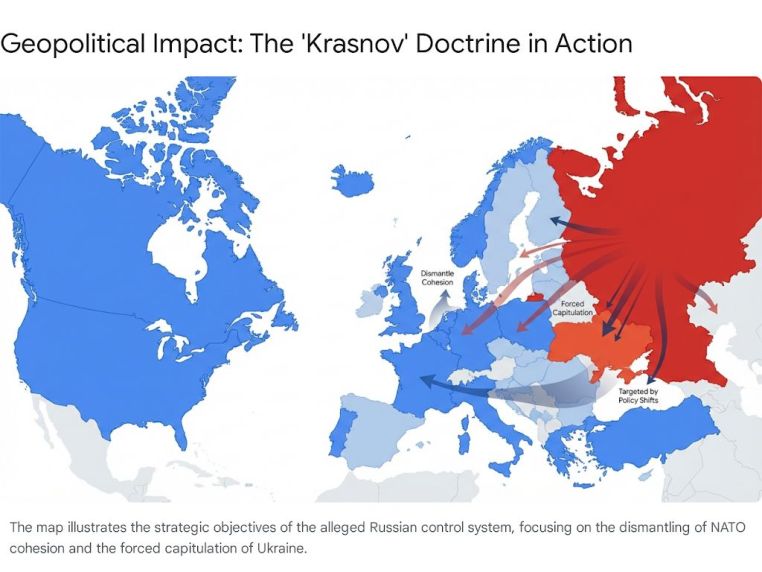
Strategic alignment with Russian geopolitical interests serves as the ultimate goal of these leaks. Objectives include undermining the cohesion of the North Atlantic Treaty Organization, destabilizing the European Union, and pressuring Ukraine into surrendering its sovereignty. The kompromat exists to guide the asset rather than to ruin him. Mussayev describes the mechanism as a calibrated pressure system. The FSB releases just enough information to remind Trump who holds the leash whenever he hesitates or veers from Russia’s interests. The perceived political chaos surrounding Trump is effectively a matter of design. Vladimir Putin serves as the sole beneficiary of that design.
Mussayev further asserts that Trump worked systematically to prevent any United States investigation into his criminal exposure. The former president allegedly turned American institutions into instruments of personal protection. Congress, the Department of Justice, the Federal Bureau of Investigation, intelligence agencies, and even immigration enforcement bodies now answer to a single man in Mussayev’s view. That man answers to Moscow.
The timing of the release coincides with a surge in activity from decentralized intelligence communities, specifically the “Fellas” or the North Atlantic Fella Organization. These groups have amplified the “Krasnov” narrative across social media platforms in Russia and its satellite states. The intersection of a high-level intelligence defector’s testimony with a grassroots information warfare campaign marks a new phase in the global conflict between authoritarianism and Western democracy.
The 1987 Recruitment and the Legend of Danila Krasnov
Understanding the August 12 allegations requires a deep examination of the historical context Mussayev provides. He unrolls a forty-year intelligence legend that begins long before Trump entered formal politics. The narrative centers on the year 1987 and the leadership of Phillip Bobkov, the First Deputy Chairman of the KGB.
The Architect
Phillip Bobkov and the Fifth Directorate
Phillip Bobkov stood as a titan within the Soviet security apparatus. He directed the Fifth Directorate, which handled ideological counterintelligence. His purview included the suppression of internal dissent and the cultivation of foreign influencers who could destabilize Western societies from within. Mussayev alleges that Bobkov personally oversaw the recruitment of Donald Trump.
The KGB identified Trump as a target of immense potential during this period. He possessed a psychological profile that Soviet handlers termed a “narcissistic goldmine.” The target exhibited an insatiable need for flattery, a crude obsession with wealth, and a shallow understanding of history. Such traits made him uniquely vulnerable to cultivation. He was not a reluctant pawn. Mussayev describes him as an enthusiastic asset who shared information freely and circulated eagerly among America’s elite.
The Moscow Visit and the Birth of “Krasnov”
Donald Trump traveled to Moscow in 1987 ostensibly to explore the construction of a luxury hotel. The KGB arranged the trip through Intourist, the state travel agency that functioned as a subsidiary of the intelligence services. Operatives likely utilized this visit to assess his vulnerabilities and establish the initial hooks of control.
Mussayev claims that a large group of top intelligence and counterintelligence officers prepared and executed the recruitment operation. They attributed the pseudonym “Krasnov” to their new asset. KGB employees controlling Trump’s operational activities affectionately called him “Danila Krasnov” among themselves. The use of a codename signifies a formalization of the relationship. It moves the target from a “person of interest” to an operational asset with a dedicated file and handling protocols.
The immediate return on this intelligence investment appeared shortly after Trump returned to the United States. He purchased full-page advertisements in major American newspapers attacking U.S. foreign policy. The ads argued that America should stop paying to defend other nations, a sentiment that perfectly echoed Moscow’s desire for U.S. retrenchment. The KGB views such actions as “active measures”—influence operations designed to shape public opinion and political outcomes in adversary nations.
Motyl notes that other former KGB officers, including Yuri Shvets and Sergei Zhyrnov, have corroborated elements of this timeline. Shvets served as a major in the KGB First Chief Directorate and has long maintained that Trump was cultivated as a “special unofficial contact.” The convergence of these accounts strengthens the historical validity of Mussayev’s claims.
The Transition
From Soviet Asset to Russian Dependent
The collapse of the Soviet Union in 1991 did not sever the relationship between “Krasnov” and his handlers. The SVR and FSB inherited the assets of the KGB. The 1990s proved a difficult decade for Trump as his financial empire crumbled under the weight of bad debts and failed casinos. Western banks retreated from lending to him.
Mussayev writes that the real Trump emerged after the collapse of the USSR. The suave operative of the 1980s gave way to a bloated, bottom-shelf version described as greedy, crude, and addicted to wealth and spectacle. The FSB had to intervene to maintain the asset’s viability. The agency engaged in “complex operational combinations” and incurred “huge financial costs” to prop him up.
These operational combinations likely involved the funneling of Russian capital into Trump’s real estate projects. The flow of illicit funds served a dual purpose. It rescued the asset from insolvency and deepened the leverage Moscow held over him. Financial dependence created a bond far stronger than ideological alignment. The “Krasnov” file expanded during this period to include comprehensive records of these illicit transactions, forming the first layer of the control system Mussayev describes.
The Anatomy of the Kompromat
The specific allegations regarding the content of the kompromat file distinguish the August 12 disclosure from all previous reporting. Mussayev moves beyond general claims of financial impropriety to describe a dossier of specific, documented capital crimes.
The Financial Archive
The financial component of the file reportedly documents the precise mechanisms of money laundering. The FSB possesses the wire transfer records, the incorporation papers of shell companies, and the internal communications that link Trump to Russian organized crime syndicates. These documents do not rely on interpretation. They serve as primary evidence of felonies that carry significant prison sentences in multiple jurisdictions.
The leverage here functions through legal jeopardy. Exposure would result in the immediate seizure of assets and the likely incarceration of the asset and his family members involved in the business. The FSB uses this layer of the file to ensure the asset maintains his financial and political viability by adhering to Moscow’s directives.
The Witness Vault
Mussayev introduces a critical new element with the claim of sworn statements from operatives. Intelligence agencies typically compartmentalize operations to prevent any single individual from knowing the full scope. The FSB apparently violated this protocol or deliberately curated a group of witnesses to strengthen the file.
These operatives participated directly in the kompromat operations. They set the traps, managed the recording devices, and facilitated the scenarios. Their testimony provides the necessary corroboration to authenticate the physical evidence. A video might be dismissed as a “deep fake” in the era of artificial intelligence. A video supported by the sworn testimony of the person who filmed it becomes irrefutable evidence in a court of law or the court of public opinion.
The Tapes of Violence
The most disturbing allegation involves the audio and video documentation of sexual crimes against minors and acts of violence against women. Mussayev asserts that the Kremlin has possessed this material for years. The escalation from consensual but embarrassing sexual acts to violent criminal behavior represents a quantum leap in the power of the kompromat.
Sexual violence against minors constitutes a crime that no society tolerates. The revelation of such material would result in total social annihilation and life imprisonment. The fear of this specific exposure likely overrides all other considerations for the asset. It explains the total subservience observed in Trump’s behavior toward Putin. The asset knows that the Kremlin holds the power to end his life as a free man at any moment.
Mussayev claims the victims were likely silenced or were individuals from marginalized populations whose disappearance could be managed by the security services. The FSB does not solve these crimes. It preserves them. The agency ensures the evidence survives while the witnesses vanish or remain silent under threat.
The Calibrated Pressure System
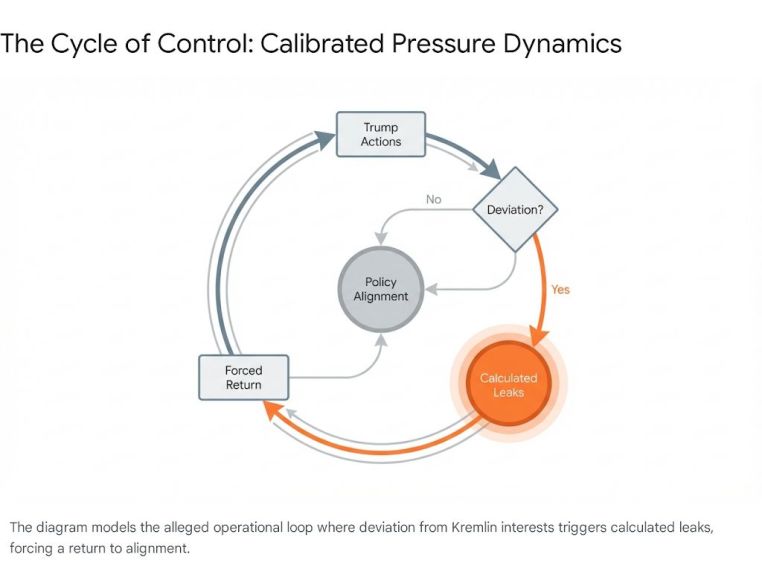
Mussayev challenges the Western perception of the Trump-Russia relationship as chaotic or opportunistic. He posits a highly structured system of control designated as a “calibrated pressure system.” The FSB manages the asset through a feedback loop of compliance and coercion.
The Mechanism of Leaks
The leak of kompromat fragments serves as a disciplinary measure. The FSB releases specific details or rumors when Trump hesitates to execute a directive or when political pressure in the United States forces him to adopt a tougher stance against Russia. These leaks act as warning shots. They remind the asset of the devastation that awaits if the full file is released.
Mussayev argues that this design explains the erratic nature of Trump’s presidency and subsequent political career. The sudden reversals in policy, the inexplicable praise for Putin, and the attacks on allied leaders are not the result of a disordered mind. They are the rational responses of a man operating under extreme duress. The asset navigates a narrow path between the demands of his American constituents and the existential threats issued by his Russian handlers.
Strategic Objectives
NATO, EU, and Ukraine
The ultimate purpose of the control system is geopolitical. Mussayev identifies three primary objectives that the “Krasnov” operation seeks to achieve. The first is the undermining of NATO. The alliance represents the greatest threat to Russian power projection. Trump’s consistent questioning of Article 5 and his demands for withdrawal serve Moscow’s long-term goal of dismantling the security architecture of Europe.
The second objective is the destabilization of the European Union. Russia views a unified Europe as a formidable economic and political rival. The asset is directed to support Euro-skeptic movements, applaud Brexit-style exits, and create trade friction that weakens the trans-Atlantic bond.
The third and most urgent objective is pressuring Ukraine into surrender. The 2025 context places this goal at the forefront. Mussayev claims the kompromat ensures Trump remains aligned with Russian interests regarding the war. This implies the withholding of military aid, the diplomatic isolation of Kyiv, and the legitimization of Russian territorial conquests. The “peace deals” proposed by the asset are, in reality, terms of capitulation dictated by the Kremlin.
Institutional Capture and the Erosion of Rule of Law
The August 12 statement contains a profound indictment of the American state. Mussayev asserts that the asset has successfully captured the institutions designed to protect the republic. Trump turned the machinery of government into a personal protection racket that ultimately serves Moscow.
The Purge of the Watchdogs
The capture mechanism involves the systematic removal of independent civil servants and their replacement with loyalists. The Department of Justice and the FBI serve as the primary targets. The asset worked to ensure that no investigation into his criminal exposure could proceed. Mussayev views the firing of directors, the harassment of agents, and the politicization of intelligence assessments as part of a coordinated effort to blind the state.
The prompt mentions that Trump turned even immigration enforcement into an instrument of protection. This likely refers to the use of border agencies to harass political opponents or to facilitate the movement of individuals useful to the operation. The entire security apparatus is reoriented to focus inward on protecting the leader rather than outward on defending the nation.
The Transnational Chain of Command
Mussayev describes a scenario where American institutions answer to a single man, and that man answers to Moscow. This creates a direct line of influence from the Kremlin to the DOJ. Decisions regarding prosecutions, classifications, and intelligence sharing are made based on their impact on the “Krasnov” file.
The implications for national security are catastrophic. Intelligence sharing with allies becomes impossible if the Commander-in-Chief is a compromised asset. The “Five Eyes” alliance and other partnerships rely on trust that the U.S. executive is free from foreign control. The Mussayev allegations suggest that this trust is misplaced and that the U.S. government has been penetrated at the highest level.
The Source and the Digital Battlefield
The credibility of the allegations rests heavily on the credibility of Alnur Mussayev. His background places him at the center of the post-Soviet intelligence world. As the former head of the KNB, he inherited the files and the institutional memory of the KGB in Kazakhstan. He interacted with the same circle of security elites who run the modern Russian state.
The Exile and the Whistleblower
Mussayev operates from exile in Austria. He fled Kazakhstan after a conflict with the Nazarbayev family, specifically accusing the government of widespread corruption. His life in exile has been marked by violence, including attempted kidnappings and assassination plots. These experiences validate his status as a genuine defector who poses a threat to the established order in the former Soviet sphere.
His decision to speak on August 12, 2025, represents a significant escalation. He is not merely leaking rumors. He is burning his own bridges and potentially endangering his life to expose the “Krasnov” operation. Mussayev frames this act as unrolling a 40-year intelligence legend. He acts as a historian of the shadow world who refuses to let the truth remain buried in the archives.
The Role of #Fellas and NAFO
The user query highlights the role of the “#Fellas” in disseminating Mussayev’s claims. The North Atlantic Fella Organization is a decentralized internet collective dedicated to countering Russian disinformation. The group uses humor, memes, and open-source intelligence to disrupt Kremlin narratives.
The involvement of NAFO suggests that Mussayev’s statement found fertile ground in the digital ecosystem. The “Fellas” likely played a crucial role in amplifying the allegations across social media and the dark web. They serve as a force multiplier for the whistleblower. The decentralized nature of this network makes it difficult for Russian censors to suppress the information. The viral spread of the “Krasnov” story demonstrates the power of civil society in the age of hybrid warfare.
Mussayev’s claims circulated on the dark net and deep web, indicating that raw materials or more detailed dossiers might be moving through encrypted channels. The prompt suggests that the “buzz” on social media was fueled by these leaks. The “Fellas” act as the bridge between the dark corners of the internet and the mainstream public discourse.
Theoretical Implications of the Mussayev Doctrine
The Mussayev allegations require a reassessment of several core concepts in counterintelligence and geopolitical theory. The “Krasnov” case serves as a master class in the long game of intelligence operations.
The Evolution of the Asset
The transformation of Trump from an “enthusiastic asset” to a “controlled asset” illustrates the lifecycle of recruitment. The initial phase relied on flattery and ideological alignment. The KGB exploited his narcissism. The middle phase relied on financial dependency. The FSB exploited his bankruptcy. The final phase relies on coercive control. The Kremlin exploits his criminality.
This evolution mirrors the broader trajectory of post-Soviet Russia. The state moved from ideological competition to oligarchic capitalism and finally to a mafia state structure. The asset’s journey parallels the handler’s journey. Trump is the perfect avatar for the Russian state because he was molded by the same forces that created modern Russia.
The Failure of Western Counterintelligence
The existence of the “Krasnov” operation for forty years represents a catastrophic failure of Western counterintelligence. The FBI and the CIA failed to detect or neutralize the threat posed by Trump’s recruitment. They allowed a compromised individual to ascend to the presidency.
Several factors contributed to this failure. The West largely ignored the threat of Russian intelligence in the 1990s and early 2000s, believing the Cold War was over. The focus shifted to counterterrorism. The intelligence agencies also lacked the legal and political tools to investigate a major political figure. The “Krasnov” operation exploited the seams in the American system. It used the freedoms of an open society to subvert that society from within.
Strategic Outlook and Recommendations
The August 12 disclosures create a strategic imperative for the United States and its allies. The continued presence of a compromised asset in the American political system poses an existential threat to the West.
The Need for Independent Investigation
The institutions of justice must reclaim their independence. A special prosecutor with broad powers must be appointed to investigate the Mussayev allegations. This investigation must have access to the classified files of the intelligence community and the authority to subpoena the financial records mentioned by Mussayev.
The investigation must also focus on the “witness vault.” Investigators should attempt to locate and interview the operatives mentioned by Mussayev. The verification of even one witness statement would validate the entire dossier.
The Response of the Alliance
NATO and the EU must prepare for a future where the United States is an unreliable partner. European nations need to accelerate their efforts to achieve strategic autonomy. They must develop their own intelligence capabilities and defense industries to deter Russian aggression without American support.
The alliance must also engage in a more aggressive information war. The Mussayev revelations provide a powerful weapon against the Kremlin. Western governments should declassify their own intelligence regarding the “Krasnov” operation to corroborate Mussayev’s claims. Sunlight serves as the best disinfectant for kompromat.
The End of the Legend
The unrolling of the “Krasnov” legend by Alnur Mussayev offers a chance to break the cycle of control. The power of kompromat lies in secrecy. The exposure of the file’s existence and its contents diminishes its coercive value. If the public knows the worst, the threat of revelation loses its sting.
The American people must confront the reality that their political system has been compromised. The “Krasnov” file is not a partisan issue. It is a national security emergency. The resolution of this crisis requires a unified effort to purge the influence of foreign intelligence from the halls of power. The timeline of Trump’s cultivation—from the 1987 Moscow visit to the 2025 crisis—stands as a warning of what happens when a democracy sleeps while its adversaries plot.
The “Fellas” and the digital resistance have fired the first shots in this new phase of the war. They have brought the truth out of the shadows. The responsibility now lies with the institutions of the free world to act on that truth before the design of the Kremlin reaches its final, destructive conclusion.