


#Constitutional #Subversion
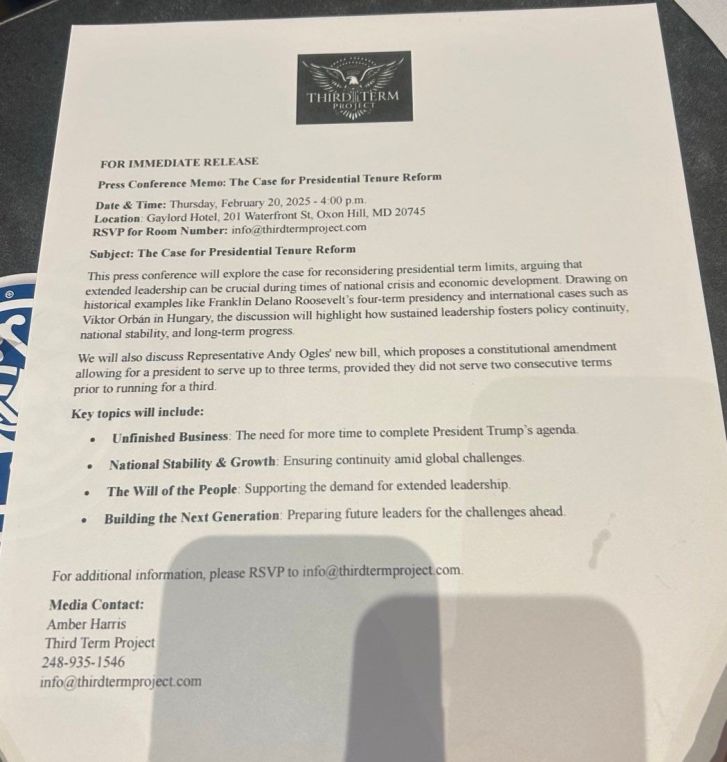
FOR IMMEDIATE RELEASE
Press Conference Memo: The Case for Presidential Tenure Reform
Date & Time: Thursday, February 20, 2025-4:00p.m.
Location: Gaylord Hotel, 201 Waterfront St. Oxon Hill, MD 20745
RSVP for Room Number: info@thirdtermproject.com
Subject: The Case for Presidential Tenure Reform
Θ
This press conference will explore the case for reconsidering presidential term limits, arguing that extended leadership can be crucial during times of national crisis and economic development. Drawing on historical examples like Franklin Delano Roosevelt’s four-term presidency and international cases such as Viktor Orbán in Hungary, the discussion will highlight how sustained leadership fosters policy continuity. national stability, and long-term progress.
We will also discuss Representative Andy Ogles’ new bill, which proposes a constitutional amendment allowing for a president to serve up to three terms, provided they did not serve two consecutive terms prior to running for a third.
Key topics will include:
Unfinished Business. The need for more time to complete President Trump’s agenda.
National Stability & Growth: Ensuring continuity amid global challenges.
The Will of the People: Supporting the demand for extended leadership.
Building the Next Generation: Preparing future leaders for the challenges ahead.
For additional information, please RSVP to info@thirdtermproject.com.
Media Contact:
Amber Harris
Third Term Project
248-935-1546
info@thirdtermproject.com
The so-called “Third Term Project” exposes an overt attempt to dismantle constitutional guardrails through propaganda cloaked in patriotic language. A leaked CPAC press memo for February 20, 2025, reveals a press conference titled “The Case for Presidential Tenure Reform.” Behind the sterile phrase lies a political movement seeking to normalize the idea of extending presidential tenure for Donald Trump, positioning “unfinished business” and “continuity” as moral imperatives rather than naked power grabs. The memo promotes Representative Andrew Ogles’ constitutional amendment proposal, which would allow a president to serve three terms so long as the terms are not consecutive. The choice of CPAC—the American right’s ideological trade fair—as the venue signals deliberate mainstreaming. The brand itself, “Third Term Project,” removes plausible deniability.
The legal and historical context renders the proposal untenable. The Twenty-Second Amendment, ratified in 1951, codifies the two-term limit as a direct response to Franklin D. Roosevelt’s four victories. It reflects a collective decision to prevent any individual from monopolizing executive power, no matter their popularity. The amendment process required by Article V of the Constitution imposes near-impossible hurdles: two-thirds approval in both chambers of Congress and ratification by thirty-eight states. No present political coalition, even among Trump’s allies, approaches that threshold. The attempt therefore functions not as a viable legal initiative but as a strategic normalization campaign—a rhetorical demolition of limits through repetition and media performance.
The CPAC memo’s talking points read like an authoritarian catechism. “Unfinished business” implies that one leader alone embodies national destiny, a claim incompatible with republican succession. “National stability and growth” becomes the slogan of regimes that equate personal tenure with order. “The will of the people” is deployed as emotional leverage to overwrite the will of the people already expressed through constitutional amendment. Invoking Roosevelt ignores that his unprecedented tenure prompted the very constraint the project now seeks to undo. Citing Viktor Orbán as an exemplar is no accident; Hungary’s gradual descent into illiberalism under prolonged rule provides the model. Extended tenure there produced media capture, politicized courts, and electoral manipulation—all under the banner of “stability.”
Every autocrat begins with a legal fig leaf. Russia’s 2020 “term reset,” China’s 2018 removal of limits, and Venezuela’s 2009 referendum all followed identical logic: continuity in crisis, progress through permanence, leadership as destiny. Each produced institutional decay and public disempowerment. The “Third Term Project” situates itself within that lineage. Its argument mirrors the early propaganda of personalist systems: soften the audience with appeals to unity, invoke emergency or unfinished work, and redefine legality as loyalty. The risk extends beyond amendment failure. Even unsuccessful pushes erode norms by teaching supporters that constitutional barriers are flexible if their leader is exceptional enough.
Intelligence analysis shows clear indicators of intent, capability, and opportunity. Intent centers on extending Trump’s eligibility and consolidating his narrative of indispensability. Capability remains legally weak but rhetorically potent; no amendment will pass, yet the propaganda value lies in agitation. Opportunity arises from the fragmented information environment in which spectacle substitutes for governance. Each conference, press release, and interview shifts the Overton window toward permanent leadership framed as patriotic necessity.
Counterarguments demolish the project’s logic. Continuity in crisis comes from resilient institutions, not singular rulers. The will of the people is not reinterpreted through cults of personality but reaffirmed through elections constrained by law. Roosevelt’s precedent is not license for repetition but the historical warning that created the two-term rule. Orbán’s Hungary, often praised by the same faction, shows that “stability” under one man produces stagnation, censorship, and corruption.
The broader danger lies in the normalization of personal rule. Every repetition of “unfinished business” anesthetizes public instinct against authoritarian drift. As voters grow accustomed to hearing constitutional revision framed as common sense, democratic erosion proceeds without the shock of illegality. Legal impossibility does not prevent cultural acclimation. The campaign’s immediate function is psychological: to turn an absurdity into a talking point, then into an option.
Defending against this requires precision and light, not slogans. Legal experts and civic institutions must foreground the text of the Twenty-Second Amendment in every rebuttal. Journalists must translate euphemism into plain English: “continuity” means entrenchment; “unfinished business” means permanent office; “the will of the people” means rewriting the people’s law for one man. Comparative examples from Hungary, Russia, and China should accompany each discussion to reveal the trajectory such reasoning follows. State officials and secretaries of state must publicly reaffirm term-limit enforcement before misinformation metastasizes into procedural confusion during elections.
The “Third Term Project” operates as a test balloon for constitutional subversion. It weaponizes nostalgia and grievance to prepare the public for autocracy through democratic language. Beneath its polished rhetoric lies a single principle: that one man’s continuation outweighs the republic’s rotation. The nation has faced this temptation before and answered with amendment, not surrender. Power ends by design; permanence belongs to the Constitution, not the person who holds it.


You must be logged in to post a comment.