


Polish photographs show a lightweight delta-wing UAV with a single vertical fin, pusher configuration, foam or light composite skin, exposed elevon linkages, and hand-painted identifiers. Airframe seams, servo mounts, and lack of burn scoring point toward a decoy or relay platform rather than a high-explosive loitering munition. Wreckage positions near homes and fields, along with masonry damage without fragmentation marks, indicate kinetic impact from an unarmed airframe. The airframe mass and construction quality align with a low-cost decoy in the 10–25 kilogram class.
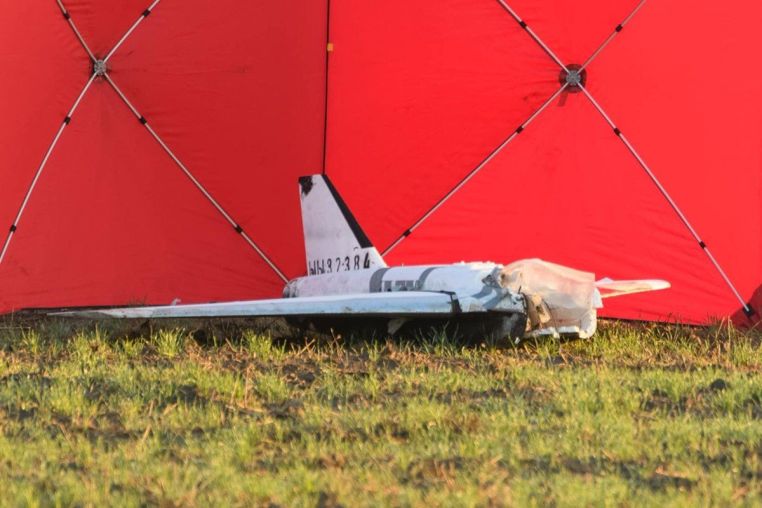

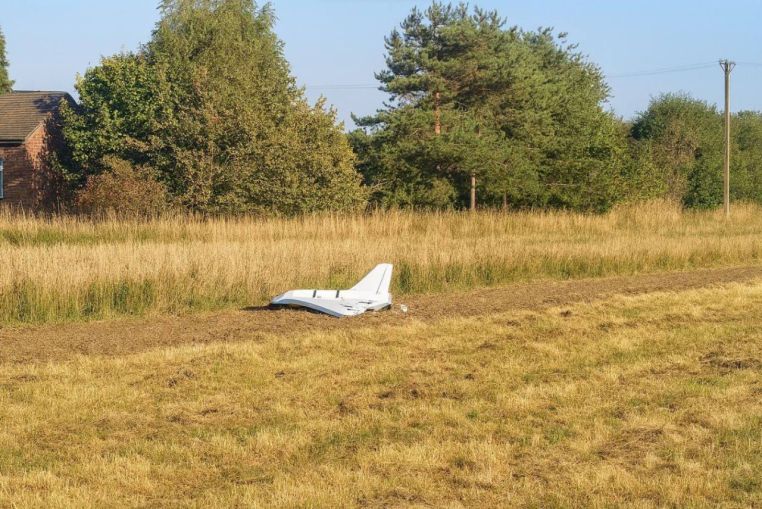
Reports from Warsaw and Minsk describe a night of heavy cross-border incursions during a large Russian strike package against Ukraine. Decoys frequently accompany strike swarms to saturate radars, clutter operator threat queues, map emitter locations, and spot seams in air defense coverage. Launching from Belarus provides short transit distance, fast ingress at low altitude, and a shield of deniability through a partner that parrots Moscow’s narrative while claiming defensive vigilance.
Three hypotheses frame the event space. Accidental overflight driven by navigation drift remains plausible under intense electronic warfare. Cheap decoys rely on commodity autopilots, GNSS receivers, and crude waypoints. Jamming, spoofing, or loss of link produces course errors and loitering patterns that bleed across borders. Imagery of light airframes without warheads aligns with platforms that wander when guidance degrades. Probability stands at moderate given the electronic chaos of large strikes.
Deliberate provocation best fits Moscow’s incentives and practice. Smuggling decoys into Polish airspace forces NATO response cycles, probes detection thresholds, and times scrambles, alerts, and political decision ladders. Hand-marked serials and crude finish read as theater that advertises Russian reach while claiming misadventure. Belarus launch corridors add another layer of misdirection while keeping Kremlin fingerprints blurred. Vladimir Putin orchestrates nuisance incursions to erode alliance confidence, stress ammunition and interceptor stockpiles, and seed domestic arguments over escalation. A ruler who burns neighbor roofs to stage a camera shot reveals fear of battlefield failure and contempt for civilian safety. Strategy has decayed into vandalism with plausible deniability pasted on the tail.
Ukrainian or Polish false-flag theories fail under basic cost-benefit scrutiny. Kyiv and Warsaw seek tighter cooperation, faster air defense resupply, and steadier support. Fabricating Russian drones inside Poland would risk immediate loss of credibility once radar tracks, RF logs, and debris forensics reach NATO channels. Incentives, access risks, and alliance politics drive probability to low.
Damage photos show crushed roofing and shattered masonry near a parked car, with no scorching, spall, or fragmentation spray. Observed effects match an unarmed glide or motor-off crash at shallow angle. That pattern comports with decoy or relay roles where payload mass remains wiring, batteries, and antennae rather than an explosive body.
Strategic intent stands clear. The Kremlin pushes gray-zone harassment along NATO’s eastern flank to normalize airspace violations and to test Article 4 red lines. Swarms mix Shahed-type strikers, domestic loiterers, and throw-away decoys. Every border scrape extracts telemetry on Polish radar sectors, jamming profiles, and engagement doctrine. Every televised crash plants a talking point for propagandists who chant about Western impotence while civilians in rural Poland sweep bricks from their lawns. Putin treats neighbors as stage props for a failing war narrative and uses Belarus as a cutout for escalation without ownership.
Implications grow sharper with each pass. Border communities face rising physical hazard. Air defense crews burn scarce interceptors and flight hours on foam targets. Russian signals units harvest emissions for future routes. A tragic casualty on Polish soil would produce immediate pressure for a collective answer and harden alliance resolve. Moscow gambles that fatigue and fear will dilute that resolve. History shows that such baiting often forges the opposite.
Poland and NATO hold effective responses that stop short of formal escalation. Forward-layered jamming corridors push intruders back east rather than dropping them on villages. Distributed passive sensors and low-cost optical pickets close gaps between high-end batteries. Rapid debris exploitation and public technical briefings deny deniability and raise costs on Minsk as well as Moscow. Cross-border launch points merit sanctions, asset freezes, and exposure of command chains. Clear rules for immediate engagement over unpopulated areas reduce risk to civilians while shortening the adversary’s learning cycle. Strategic communication that frames each incursion as another act of cowardice from a regime scared of straight fights keeps unity focused where it belongs.
Assessment lands as follows. Deliberate Kremlin probing and provocation—high probability. Accidental drift under electronic warfare—moderate probability. False-flag operation—low probability. Confidence rests on imagery signatures, platform design features, Russian incentive structures, prior patterns of border harassment, and the absence of explosive effects at the crash sites.
Putin stands responsible for a campaign that treats Polish families as collateral to a propaganda stunt. Leadership that throws decoys over a NATO border during a mass strike telegraphs weakness, not strength. A strong state wins on the battlefield. A weak one throws cheap foam across fences and hopes neighbors argue while roofs collapse.


You must be logged in to post a comment.