


#Putin’s Alaska “peace” demand as reported reflects a coordinated pressure strategy that carries hallmarks of collusion, coercive bargaining, and transactional greed rather than genuine conflict resolution. The requirement for Ukraine to abandon the remainder of Donetsk still under its control would nullify more than a decade of layered fortifications. It would gift Russia an 85 km uncontested advance to the west, bypassing the attritional cost of breaching established defenses. That corridor would create a staging area ideal for follow-on offensives toward Kharkiv and Dnipropetrovsk, two cities of high strategic and economic value, without the need to overcome any prepared positions. In military terms, the “peace” offer is an operational trap disguised as diplomacy.
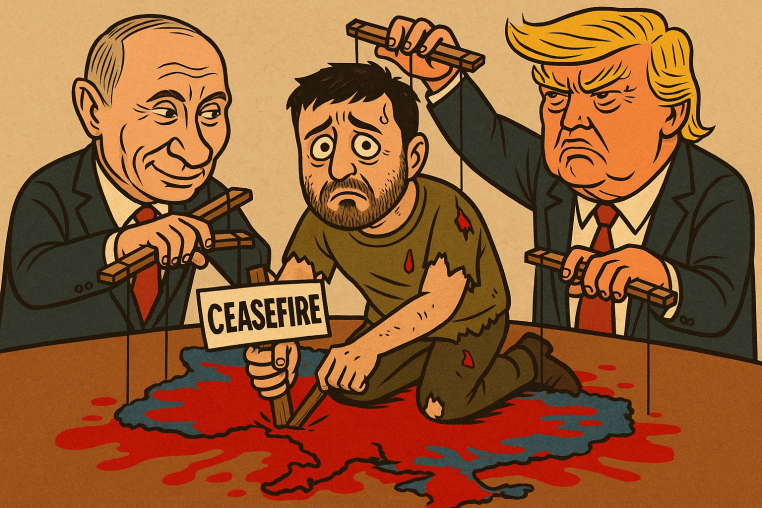
The absence of reciprocal guarantees in Putin’s proposal indicates calculated asymmetry. Ukraine would be surrendering strategic depth and security buffers in exchange for nothing beyond a fragile, time-limited ceasefire. Russia retains the option to resume offensive operations at a moment of its choosing. Such a deal mirrors mafia-style strong-arming, where the dominant actor offers temporary restraint in return for irreversible concessions, knowing the counterparty will be weaker in every subsequent negotiation. The staged sequencing—first extracting Ukrainian withdrawal, then moving to a “final deal” negotiated directly between Putin and Trump—adds a collusion vector. It bypasses Ukraine’s agency, reframes the war as a U.S.-Russia bilateral dispute, and positions Trump as an enforcer for Moscow’s terms.
The design anticipates Ukrainian refusal. That refusal becomes an engineered pretext for Russia to accuse Kyiv of prolonging hostilities. Putin would then pressure Trump to cut U.S. arms shipments entirely, stripping Ukraine of its most important military lifeline. This two-step plan aligns with the Krasnov-era tradition of Moscow using controlled intermediaries and show negotiations to split allies, weaken coalitions, and force capitulation without overtly escalating to full-scale combat. It also echoes post-Soviet criminal-political hybrids, where demands are framed as “offers” but backed by the implicit threat of ruin if refused.
Greed manifests here as well, though not only in territorial ambition. Control over the remaining Donetsk territories and a launchpad toward Ukraine’s economic heartland grants Russia access to industry, logistics hubs, and potential leverage over future trade corridors. Such gains would be achieved at minimal battlefield cost, maximizing return on minimal risk. The proposed terms reveal no interest in stability—only in exploiting perceived political fractures in Washington, shaping the narrative through Trump, and reconfiguring the balance of power in Russia’s favor before Ukraine’s Western support structure can recover. In short, the construct is less a peace plan than a pre-scripted defeat mechanism.


You must be logged in to post a comment.