


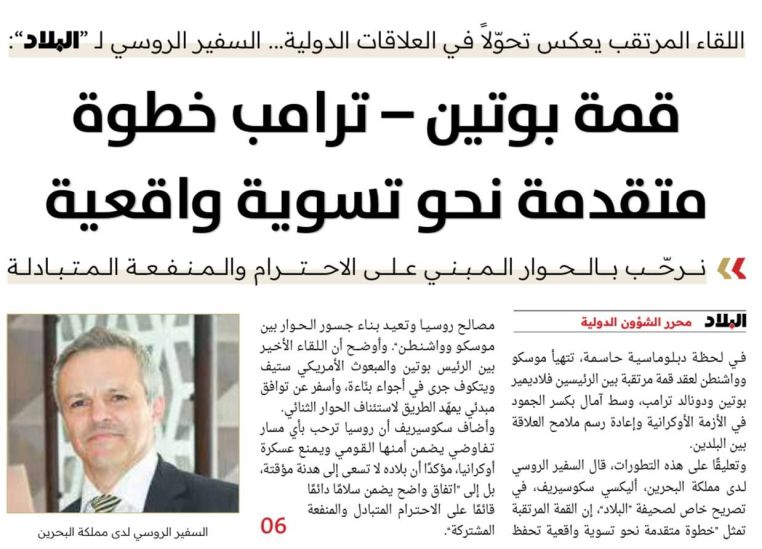
The Russian Ambassador to Bahrain frames the August 6 meeting between President Putin and U S Special Envoy S. Witkoff as a constructive breakthrough toward a pragmatic settlement process. The message projects openness to a Putin–Trump summit and conditional Ukrainian involvement while embedding a cognitive narrative that reframes Russia as a reasonable, security-conscious negotiator seeking mutual respect and benefits.
High confidence in the interview content based on direct sourcing from Al-Bilad. Moderate confidence in forecasted narrative trajectories based on historical Kremlin diplomatic framing and past summit-related information operations.
Narrative architecture — how the interview frames events
The ambassador casts the Moscow talks as businesslike, mutually satisfying, and strategically significant for breaking the freeze in U S–Russia relations. Agreement “in principle” on a presidential summit is presented as proof of a shift from confrontation toward mutual respect. The narrative anchors on three elements:
1. restored direct leader-level dialogue,
2. Russian insistence on security guarantees as the foundation for any settlement, and
3. Portrayal of Moscow as ready to negotiate but unwilling to accept demands framed as unilateral concessions.
Cognitive warfare dimensions — signals, framing, and target audiences
The interview works to erode adversarial perceptions in multiple audiences. Domestically, it signals diplomatic competence and readiness to engage Washington on equal footing, reinforcing an image of Russia as a major power dictating conditions. For international and Gulf audiences, it presents Moscow as a rational actor promoting stability, especially by choosing Bahrain’s press to project moderation into Arab political discourse. Toward U S political circles, it embeds the notion that Russia and the United States share interests in de-escalation that could bypass Ukraine’s direct involvement, thereby nudging debate toward great-power bargaining over regional agency.
Language choices—“mutually beneficial,” “respectful,” “sustainable”—act as moral high-ground markers. Positioning the summit as a “positive signal” primes audiences to view any U S acceptance as reasonable, while any refusal becomes evidence of intransigence.
Influence manipulation — embedded strategic objectives
The piece sidesteps contentious facts about the war’s conduct and instead narrows the focus to “security interests” and the “realities” on the ground—code for acceptance of territorial changes. The ambassador’s conditional openness to Ukrainian participation reframes Kyiv as a peripheral actor whose inclusion depends on Russian-defined prerequisites. This works to normalize the idea of settlement without Ukraine as a full partner, softening resistance among third-party states and reinforcing Kremlin narratives that the conflict’s resolution rests with Washington and Moscow alone.
The stress on preventing “further militarization” and avoiding the creation of an “Anti-Russia” recycles established Kremlin threat frames that justify coercive control over Ukraine’s political and defense posture.
Disinformation risk indicators — message engineering
The interview does not present verifiable concessions or evidence of substantive progress. Assertions of “real steps forward” rest solely on agreement to plan another meeting. By omitting concrete terms, the piece allows flexible reinterpretation later. The selective framing—casting all confrontation as a product of past U S policy—aligns with prior Kremlin rhetorical patterns that deflect responsibility while claiming constructive intent.
Impact forecast — short- to mid-term narrative effects
In the near term, expect Russian state media and sympathetic international outlets to amplify the “summit breakthrough” framing, using it to project momentum toward peace on Russian terms. This could drive wedge narratives in U S domestic politics, especially if the summit is tied to a Trump-led diplomacy storyline. In Gulf and non-aligned states, the interview’s moderate tone could reinforce perceptions of Russia as a pragmatic counterbalance to U S policy.
Over the next six to twelve months, if the summit materializes, Russian messaging will likely present it as validation of Russia’s great-power status and its ability to bypass sanctions pressure through strategic dialogue. If it stalls, the Kremlin can repurpose the narrative to blame Washington for rejecting constructive engagement.
Strategic foresight — three horizon scenarios
Horizon 1: Pre-summit amplification (0–3 months)
Narratives about “historic opportunity” proliferate in Russian and partner media. Indicators include op-eds in Arabic-language outlets echoing the ambassador’s framing and selective leaks about potential summit venues.
Horizon 2: Summit as leverage (3–9 months)
If held, the event is framed as resetting relations, with selective portrayal of agreements as victories for mutual respect. If cancelled, narratives pivot to depict the U S as sabotaging peace.
Horizon 3: Embedding new baselines (9–18 months)
Long-term Kremlin messaging uses the summit episode—whether realized or not—to normalize exclusion of Ukraine from decisive talks, establishing precedent for future conflict settlements shaped by great-power bargaining.
APA references
Al-Bilad. (2025, August 9). لقاء المرتقب يعكس تحولاً في العلاقات الدولية… السفير الروسي لـ “البلاد”: قمة بوتين – ترامب خطوة متقدمة نحو تسوية واقعية. https://www.albiladpress.com/amp/article/930628.html


You must be logged in to post a comment.