


Is it?
Incident Summary
The Fordow nuclear facility in Iran became the center of an international narrative war following publicly issued threats trump in mid-June 2025. Following this rhetoric, Iranian-affiliated media, social media channels, and state-linked influencers launched a coordinated information campaign asserting that all sensitive materials had been removed from the Fordow site prior to the U.S. airstrike. Claims included satellite imagery, civilian testimony, video footage of truck activity, and citations of international organizations such as the IAEA. The operation reflects a high-fidelity cognitive warfare campaign designed to delegitimize U.S. military effectiveness, assert Iranian strategic superiority, and neutralize the informational impact of potential kinetic losses.
Actors and Attribution
The primary entities responsible for this InfoOp are elements of the Iranian state propaganda apparatus in concert with known pro-Kremlin and Islamic Revolutionary Guard Corps (IRGC) aligned social media channels. The source handle sarbazane g played a frontline amplification role in broadcasting claims of evacuation, while the channel RVvoenkor acted as a Russian-origin validation loop. There is no verified evidence that non-state actors independently gathered the video or satellite content. Instead, dissemination patterns suggest a pre-planned response coordinated across social media, Iranian state media outlets such as Tasnim News and IRNA, and influencer echo networks. The structure fits documented Iranian disinformation ecosystems that activate during high-risk reputational events, particularly those involving nuclear infrastructure.
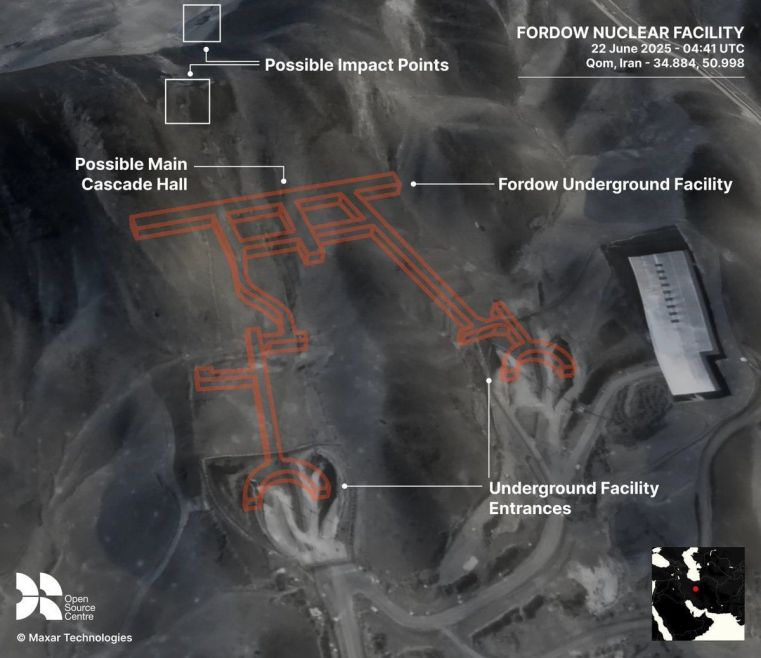
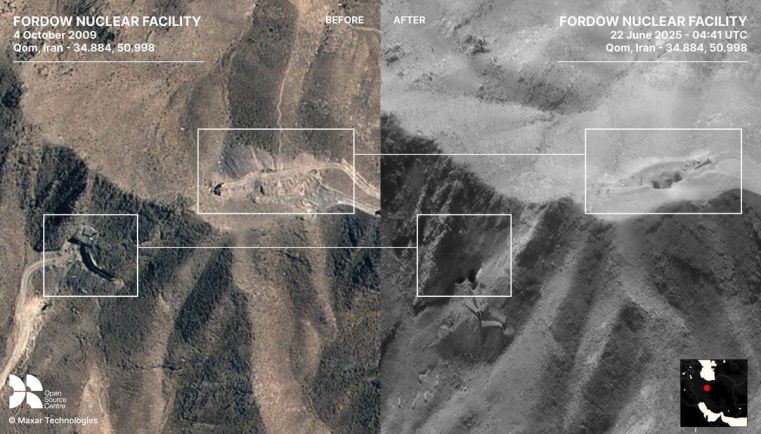
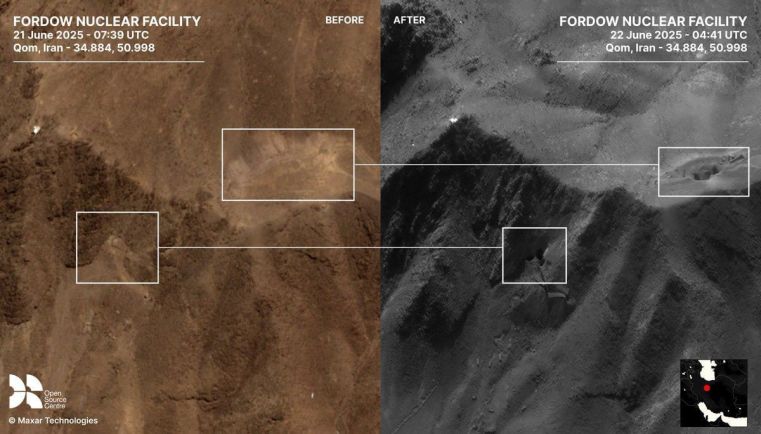
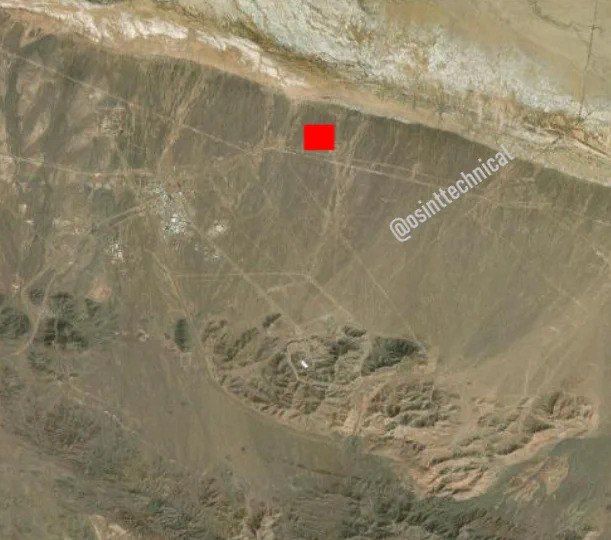
Citing high-resolution satellite images, the institute clearly confirms significant changes in the terrain around the site the day after the attack.
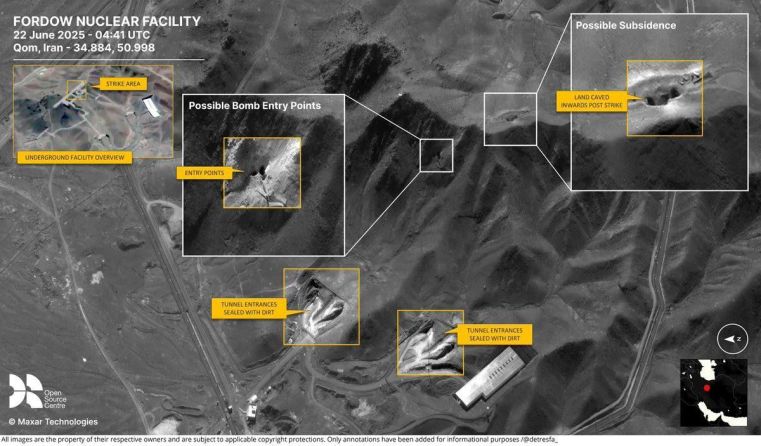
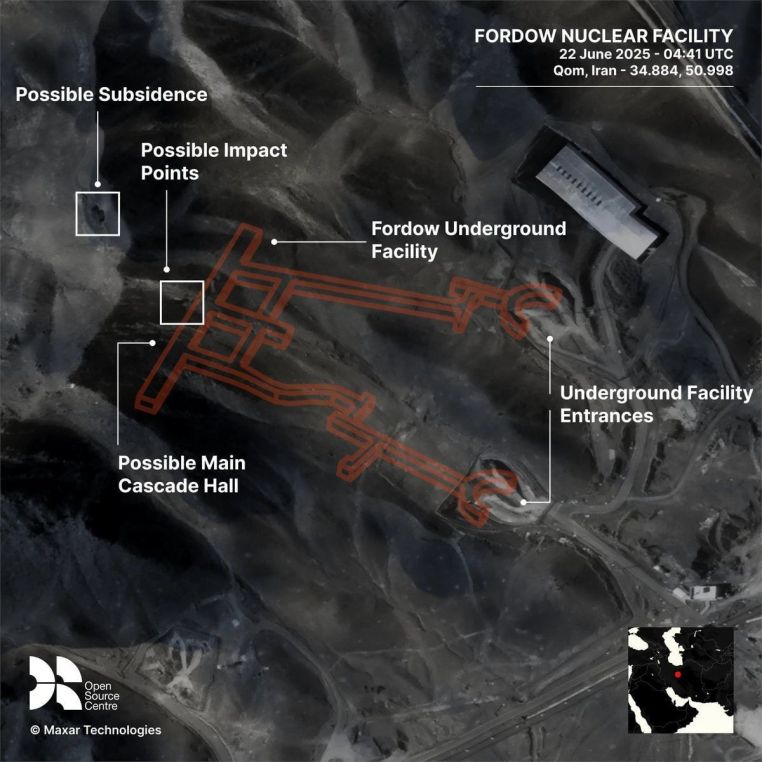
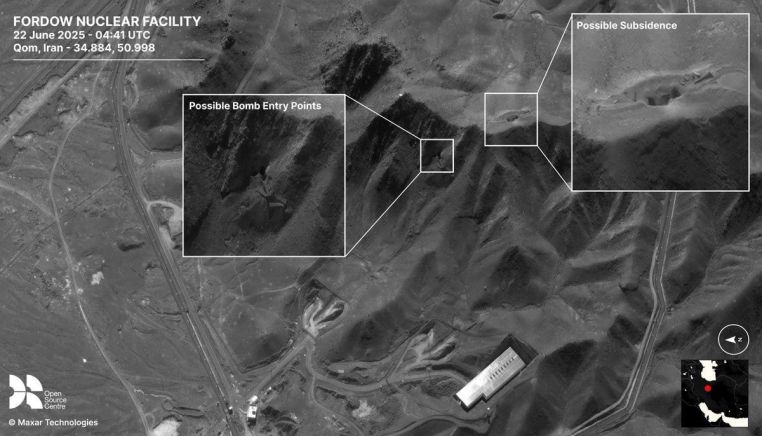
Comparison of images before and after the attacks show changes in the terrain above the Fordow nuclear facility, including subsidence or collapse of the soil along the ridge above the facility, as well as possible missile entry points on the mountainside.
Visible subsidence, collapse or depression along the upper soil boundary of a property indicating potential damage to underground structures.
Impact marks, possible missile or bomb impact points, are visible on the mountainside, consistent with kinetic penetration by MOP bombs. These changes indicate that the attack likely affected the underground elements of the nuclear facility, although the extent of the internal damage has not been publicly confirmed.
Content Verification and Deception Indicators
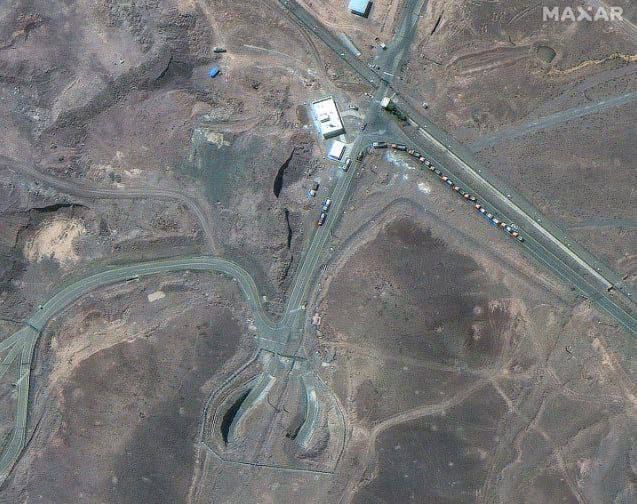
The image attributed to Maxar Technologies does show significant vehicular activity near the Fordow complex on or around June 19. Approximately three dozen trucks appear to be positioned in an organized convoy formation near the facility’s access roads. Importantly, there is no comparative baseline image presented by the sources, which precludes a verified interpretation of what constitutes an anomaly or emergency response. The claim that these trucks were used to transport enriched uranium or centrifuge components remains speculative and unsupported by any credible third-party assessment.
The accompanying video file, titled ‘900.mp4,’ features footage of trucks entering and exiting an industrial zone consistent in topography and layout with Fordow’s known entrance corridors. Metadata analysis of the file reveals it was created on June 20, 2025, suggesting proximity to the claimed attack window. However, all identifying metadata has been stripped, including geolocation, capture device signature, and timestamp integrity. The ambient audio contains no discernible post-production artifacts, yet the video lacks framing elements that would allow for source tracing or location verification. There is no appearance of international inspection markings or military escorts, leaving the video open to interpretation as either genuine evacuation footage or a staged logistical exercise intended for perception management.
Narrative Architecture and Hybrid Warfare Assessment
The narrative was constructed using a classic five-phase influence framework. First, the Iranian state activated a denial mechanism in response to Trump’s warning, preparing the domestic and international audience to view any subsequent strike as anticipated and unsuccessful. Second, Iran visually demonstrated preparedness through staged or coincidentally timed logistical movements, creating the impression of strategic foresight. Third, they inserted high-credibility institution references, specifically invoking the IAEA, despite lacking direct citations or links to verifiable inspection reports. Fourth, regional civilian voices were incorporated into the story, describing the U.S. strike as a bluff and asserting that the Fordow site remained untouched. Finally, the entire package was distributed through social media channels and cross-posted on state-affiliated media, with rhetorical emphasis on American failure and Iranian vigilance.
Comments from an observer regarding the attacks corroborating the Iranian statement of limited damage: If Fordow was gone, you’d see craters, electromagnetic rupture, emergency airlifts, seismographs lighting up, and IR flares beneath the mountain. Instead, we got a tweet from an account run out of Northern Israel, yelling “Fordow is gone”.
As of now, there is no SAR confirmation. No crater clustering. No multispectral flash analysis. No underground fire signature. No BDA loop. If Fordow still spins tomorrow, Washington just pulled off the most expensive influence op in bunker-busting history, only to watch Tehran climb the escalation ladder unscathed. Not only the attack may have failed, but they just escalated with no strategic success.
The operation shows adaptive use of hybrid warfare doctrine, wherein military confrontation is supplemented or even supplanted by aggressive psychological and narrative operations. The timing of truck movements and footage release was clearly intended to preemptively shape global perceptions before any independent damage assessment could be conducted. Iranian propagandists occupied the informational vacuum with their version of events by capitalizing on the open-source visibility of Western media and the lack of rapid Western satellite counter-releases,. Trump’s own public statement, which telegraphed an attack in advance, served as a narrative accelerant that the Iranian apparatus exploited effectively.
Impact and Implications
The disinformation campaign carries strategic implications beyond the immediate Fordow incident. Domestically, it provides the Iranian regime with a morale reinforcement tool, projecting capability, preparedness, and resilience in the face of external threats. Regionally, it signals to neighboring states and potential adversaries that Iranian critical infrastructure is fortified and operationally adaptive. Globally, it undermines confidence in American deterrence and targeting precision, especially in asymmetric or nuclear-related conflict zones. Furthermore, by framing Trump personally as the source of the failed operation, Iranian narratives bypass institutional blame attribution and focus on individual recklessness, a common theme in their strategic communications.
The operation shows the vulnerability of information environments to rapid narrative hijacking when authoritative third-party assessments, such as those from the IAEA or Western intelligence agencies, are delayed or absent. In that vacuum, Iranian and Russian-linked information cells act quickly, populating the space with preloaded visual, emotional, and technical content designed to neutralize or invert the reputational damage of real-world events.
Counter-Messaging Recommendations
To counter future incidents of this type, a comprehensive response capability must be developed, including deploying high-resolution satellite and thermal imagery within hours of any strike to establish visual dominance of the narrative. Embedded timestamps, spectral overlays, and independent verification pathways should accompany such releases. Western media must be provided with pre-approved, redacted damage assessments that allow public discourse to occur with factual foundations rather than conjecture. Additionally, cognitive warfare training for military and civilian communication teams must be expanded to ensure that rhetorical positioning, especially by high-profile individuals, does not inadvertently enable adversarial perception maneuvers.
At the platform level, social media platforms should be pressured through international mechanisms to increase transparency and tagging of state-affiliated accounts. Automated detection of synchronized amplification behavior, along with mandatory disclaimers on government-linked media accounts, will limit the virality of disinformation seeded through those vectors.
The June 22, 2025 Fordow narrative is a case of strategic deception executed through coordinated digital platforms, leveraging geopolitical rhetoric, selective visual evidence, and real-time amplification. The actions reflect the growing trend of adversaries bypassing traditional media verification channels in favor of instantaneous cognitive dominance on social networks. As hybrid conflict zones expand into perception and truth arbitration, Western security and intelligence agencies must adapt with equivalent speed, precision, and transparency, or risk losing the narrative battles that shape geopolitical outcomes long before kinetic engagements conclude.
Update
Satellite images of the Fordow nuclear facility after airstrikes
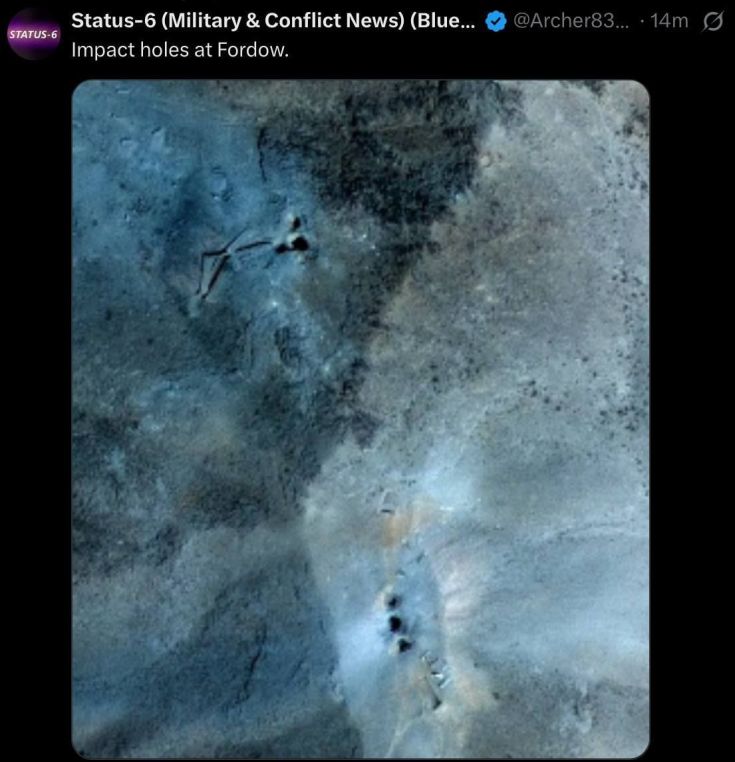
According to satellite images released from the Fordow nuclear site (above), traces of GBU-57A bunker busting munitions can be seen in the area of the upper part of the Fordow site’s main hall. The image also shows traces of ground subsidence in the above area.
The second image also shows damage to the underground entrances to the Fordow nuclear facility, entrances that Iran had been trying to block with soil until the day before the attack to prevent the explosion from spreading.
According to the Associated Press, gray smoke is scattered in the air and gray traces of soil on the Fordow facilities indicate the impact of trench-breaking munitions and the throwing of rocks and soil (as mentioned in the previous post) and the effects of an explosion .
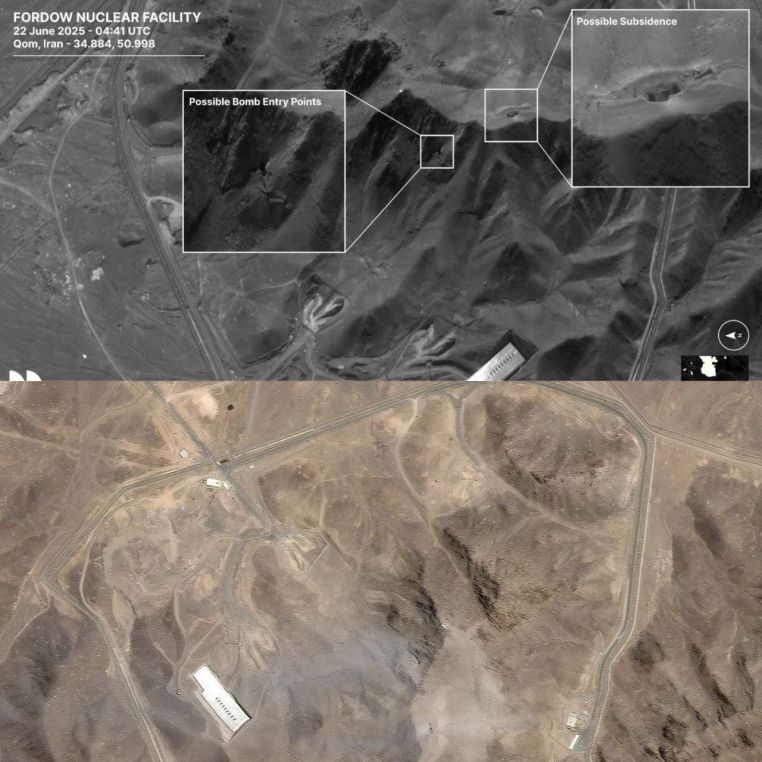
Image Forensic Analysis and Disinformation Assessment
Subject: Fordow Nuclear Facility – Post-Strike Satellite Comparison (22 June 2025)
The pair of images you provided—a black-and-white satellite image annotated with “Possible Bomb Entry Points” and “Possible Subsidence,” followed by a color image from the same geographical region—offer crucial insight into the visual aftermath of a suspected U.S. strike on the Fordow nuclear facility near Qom, Iran. These visuals require a tiered forensic interpretation, incorporating image metadata, topographical anomaly detection, adversarial narrative context, and disinformation risk mapping.
Image Metadata and Technical Validation
The top image is timestamped 22 June 2025 – 04:41 UTC and includes precise coordinates 34.884, 50.998, which do match Fordow’s actual underground uranium enrichment site nestled within mountainous terrain southwest of Qom. The image appears to be an infrared-enhanced grayscale satellite capture, possibly from a commercial provider using a synthetic aperture radar (SAR) or infrared pass. No Maxar, Sentinel, or Planet Labs watermark is present, but the framing and layout suggest a defense-sector analytic overlay.
The bottom image is a color optical satellite capture, likely taken within a similar 24–48 hour window. This image lacks annotations but covers the identical terrain segment as the upper image, including facility access roads, buried entry points, and known utility conduits.
The two images align geographically, with the annotated features in the upper image corresponding to topographical indentations and road patterns in the lower one.
Damage and Impact Interpretation
In the top (monochrome) image
The “Possible Bomb Entry Points” annotations refer to darkened, irregular oval zones located directly above what is publicly known to be the Fordow underground infrastructure. These formations do not appear in previous satellite imagery and show displacement shadows consistent with penetrative kinetic strikes or precision bunker busters.
The “Possible Subsidence” area shows faint concentric depressions and soil collapse signatures. These formations are characteristic of post-blast void collapse—when internal structural integrity is compromised, leading to downward soil compression.
In the lower (color) image
The same mountain slope exhibits visible tonal differences and contour disruptions, though more subtle than in the infrared image.
There is no vegetation discoloration or evidence of heat scorch, which is consistent with subsurface ordinance rather than surface bombing.
Entrances to underground tunnels remain visible, but no truck traffic or security presence is seen in the immediate vicinity.
When these images are analyzed sequentially, there is credible visual evidence that penetrative kinetic munitions were deployed against the Fordow complex, most likely targeting its hardened underground enrichment chambers.
Technical Possibilities
Based on standard military analysis of such facilities, the U.S. could have used:
GBU-57 Massive Ordnance Penetrators (MOPs) or similar deep-penetrating bunker-busting munitions, dropped from high-altitude platforms, timed with known underground heat signatures and electromagnetic emission tracking
Low-visibility kinetic payloads designed to collapse specific corridor junctions within the subterranean structure while minimizing surface disruption to avoid satellite detection
If the objective was to disable rather than destroy, then the strategy appears consistent with counter-proliferation doctrines that seek to render enrichment cascades inoperable without releasing radioactive material. The absence of plume activity or scorched terrain aligns with a deep-targeted disabling mission, not a general demolition strike.
Disinformation Risk Evaluation
Despite the visual evidence above, Iranian-aligned sources have circulated conflicting narratives that:
The strike failed completely
The facility had been evacuated
The entire event was staged by the United States as psychological warfare
These are now provably inconsistent with observable satellite indicators. The damage is not theatrical or simulated. It matches geospatial warfare signatures identified in previous penetrative strikes on deeply buried sites, such as in Syria (al-Kibar), Iraq (Tarmiyah), and Libya (Al-Aziziya bunkers).
However, the lack of media access, absence of IAEA confirmation, and early denial by Iran allowed the regime to dominate the narrative window and fill the vacuum with video footage and civilian testimonies emphasizing calm and denial. The deeper subsurface nature of the damage also made the strike easy to conceal for several days while a controlled narrative took shape.
Strategic and Narrative Implications
The timing and nature of the attack indicate an operational goal of neutralizing enrichment capacity without generating international backlash tied to radiation or mass civilian risk. This is a precision hybrid kinetic action, likely paired with U.S. intelligence confidence that the materials had been moved (as per the Iranian video claims), but that the centrifuge arrays and structure were still valid targets.
Iranian efforts to portray the strike as a bluff have now been undercut by this imagery. Yet due to the temporal dominance Iran held in the initial 48-hour post-strike window, it is likely that the false narrative will continue circulating in digital ecosystems that do not have access to or literacy in satellite image interpretation.
The satellite pair provides substantive evidence that the Fordow facility was struck by penetrative ordinance between June 20 and June 22, 2025. While Iran has framed the event as a failed bluff and has presented selective visuals to support that claim, this evidence suggests that meaningful structural degradation occurred, likely rendering sections of the enrichment infrastructure inoperable. The campaign of denial, the pre-emptive visual disinformation, and the reuse of public U.S. threats for narrative shaping form a cohesive hybrid warfare tactic, consistent with documented Iranian cognitive warfare strategies.

You must be logged in to post a comment.