



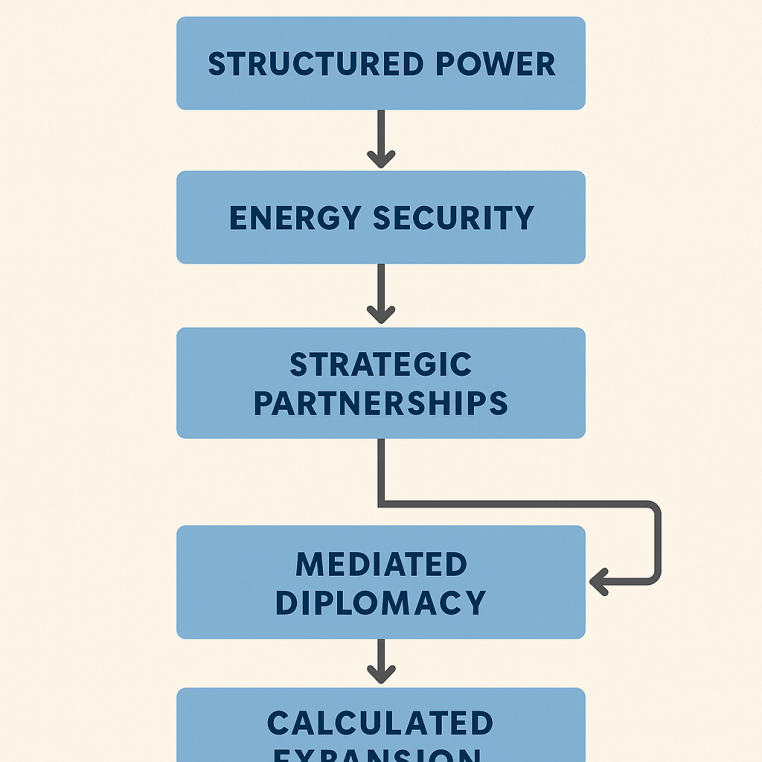
China does not wander into conflict. It enters through opportunity, stabilizes with investment, and expands through calculated neutrality. In the vacuum left by U.S. retreat, China’s presence in the Middle East has shifted from observer to operator—quiet, methodical, and increasingly consequential.
For decades, Beijing remained peripheral in Middle Eastern politics. But economic growth turned oil flows into national imperatives. Rising industrial demand, coupled with maritime choke points, drew Chinese planners toward energy corridors that stretch from Tehran to Djibouti. Today, China’s interest in the Middle East does not mirror imperial strategy. It replaces it with something more transactional.
Economic charts from the IMF, presented in the original study, show China overtaking the U.S. in purchasing power parity. But raw output tells only part of the story. China’s expansion hinges on uninterrupted access to energy and diversified supply routes. More than half of China’s crude oil imports already originate from the region. That dependency turns Middle Eastern security into a Chinese problem. It does not mean military intervention—it means embedding influence through ports, pipelines, and production deals.
Rather than entering with hard power, China builds its leverage through trade agreements, high-level visits, and special loan packages. Chinese investment in Egypt’s infrastructure exceeds $10 billion. In Iran, it remains the largest buyer of crude oil despite sanctions, while quietly modernizing Iran’s nuclear infrastructure. In Saudi Arabia and the UAE, China has moved beyond oil procurement into military exercises, telecom ventures, and logistics bases. These investments are not favors. They are hedges—insulating Chinese supply chains from the volatility of regional politics.
Beijing’s language avoids confrontation. Officials present China as a mediator, not a challenger. It offers platforms for dialogue, particularly in Syria, Yemen, and Palestine, while rejecting U.S.-style regime change. Chinese diplomacy wraps itself in non-interventionist rhetoric, but that does not mean detachment. In reality, China aligns itself with stability where it serves its energy and trade interests, while maintaining close contact with conflicting parties.
This strategy—described in the paper as “mediated engagement”—allows China to expand without projecting overt force. It avoids military entanglement but supports security outcomes that preserve its commercial routes. Even where its partners include rivals—such as Israel and Iran—it splits diplomatic identity from transactional necessity. This compartmentalized diplomacy may appear contradictory, but it works. China trades with all sides while taking no side.
The Belt and Road Initiative amplified this logic. In 2016, China committed $63 billion in Arab economic development. Joint infrastructure, energy hubs, and telecom build-outs now stretch from Haifa to Hormuz. Chinese firms construct the ports, fund the roads, and run the data. Soft power, in this configuration, is steel and silicon.
Critics argue that China’s absence of ideology makes its strategy reactive, not strategic. But that misses the point. Strategy is not a declaration—it is a pattern. In the Middle East, China’s pattern is clear. Reduce exposure. Increase partnerships. Avoid war. Sustain supply. Expand quietly.
Unlike the U.S., China does not build alliances to contain enemies. It builds systems to extend access. Those systems—economic, logistical, and informational—create dependence on Beijing without the baggage of military intervention. In doing so, it positions itself as indispensable to all and threatening to none.
The Middle East is not China’s endgame. But it is the testing ground for a new foreign policy model—one that replaces force with finance, ideology with infrastructure. In this model, the map is not drawn with borders but with bandwidth. The winner is not the loudest actor but the most embedded one.
You must be logged in to post a comment.