


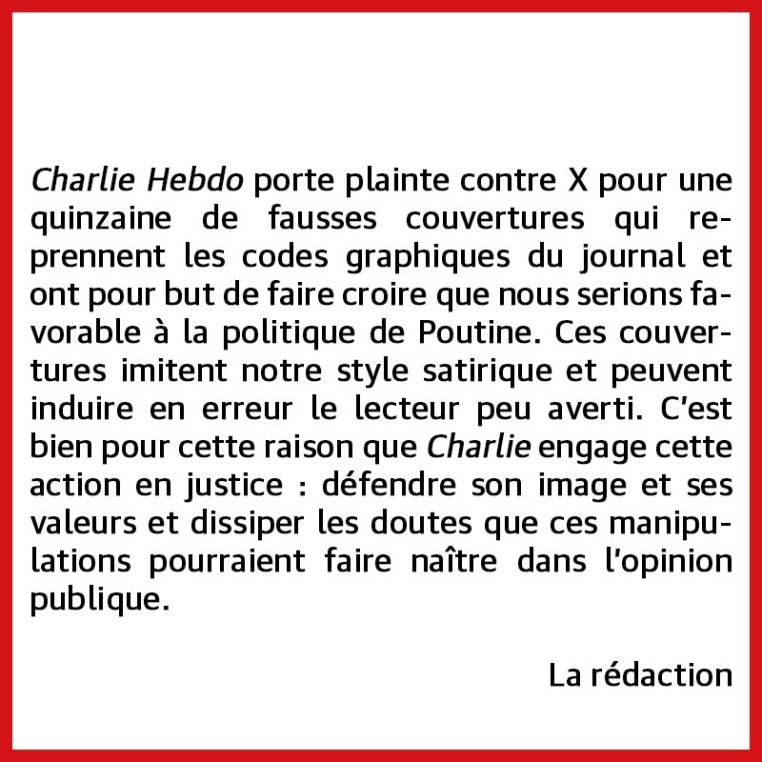
The lawsuit filed by Charlie Hebdo against the social media platform X brings to light a calculated disinformation campaign involving the creation and distribution of fake magazine covers. These forgeries falsely portray the satirical French publication as supportive of pro-Kremlin narratives, especially those mocking Ukrainian President Volodymyr Zelensky and discrediting Western support for Ukraine. Over the past two years, at least 15 counterfeit covers have circulated on platforms like Telegram and X, reflecting a pattern of manipulation designed to erode public trust and distort perceptions of the publication’s editorial stance.
The content of the forgeries exhibits clear propagandistic intent. They consistently denigrate Ukraine, ridicule European and French backing of Zelensky, and in some cases, perpetuate personal smears—such as spreading long-debunked rumors about Brigitte Macron’s gender identity. Such themes are not coincidental; they align closely with known disinformation strategies that aim to amplify societal divisions, delegitimize political leadership, and undermine institutional credibility in target countries.
Charlie Hebdo’s editorial board emphasized that these fakes appear to be part of a coordinated campaign, questioning whether they were commissioned at the highest levels of the Russian state. The publication’s legal complaint seeks to identify those responsible for producing and disseminating these forgeries, arguing that their creation appears to be industrial in scale. This characterization suggests a systematic effort, potentially involving networks of bots, fake accounts, and possibly AI-generated imagery, all of which contribute to the illusion of legitimacy and widespread acceptance.
The wider context further substantiates this concern. The independent fact-checking initiative Verified has identified more than 70 fake covers mimicking various satirical magazines, with approximately one-third of them attributed to Charlie Hebdo. The overwhelming focus on mocking Ukraine and Western figures indicates a broader strategy of media impersonation and narrative laundering. This method of forgery exploits the authority and recognizability of established media outlets to lend credibility to disinformation.
This campaign illustrates the use of satire as a vector for manipulation, inverting the very tools of critique and free expression to serve authoritarian narratives. By faking the voice of a known critic, propagandists aim not just to deceive, but to confuse audiences, blur the line between real and fake, and ultimately dilute the power of authentic dissent. The legal steps taken by Charlie Hebdo may mark a turning point in how such impersonation campaigns are challenged, particularly on digital platforms that have become conduits for geopolitical manipulation.
The broader implications are significant. If left unchecked, this type of narrative falsification threatens to corrode trust in both media and democratic processes. It also underscores the need for stronger content verification mechanisms and more aggressive efforts to trace the origins of digital forgeries. As disinformation actors grow increasingly sophisticated, the line between satire and subversion becomes a critical battlefield in the information war.

You must be logged in to post a comment.