

This statement, attributed to Donald J. Trump on his social media platform, is a classic case study in cognitive dissonance, narcissistic displacement, and projection, woven together into a profoundly dangerous piece of narrative distortion. Though cloaked in the language of condemnation, the post reveals a deeply fractured worldview that enables aggression, erases accountability, and indulges in revisionist mythology—all in service of preserving the ego of the speaker.
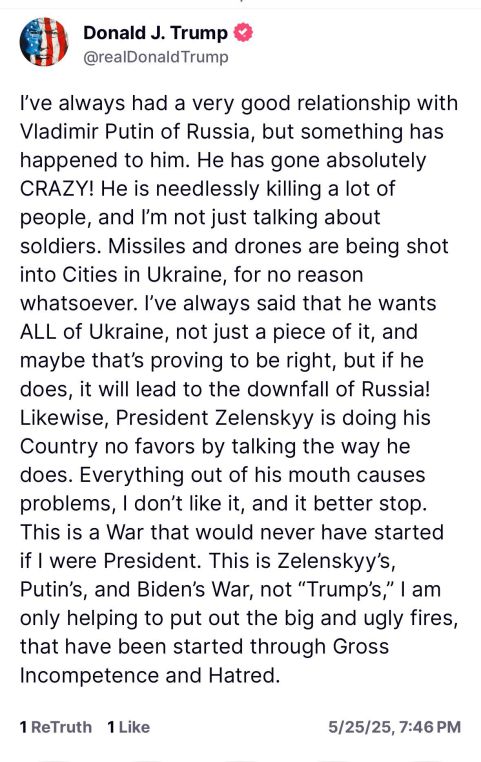
Let’s begin with the central premise: Trump claims he had a “very good relationship” with Vladimir Putin, but that something has now “happened” to the Russian leader. This assertion implies a false rupture, as if Putin’s capacity for barbarism is some newly emergent trait. The subtext is simple: Trump attempts to divorce himself from Putin’s actions, as if to say, he was fine when I liked him. It’s the geopolitical equivalent of “he changed after the wedding,” except the “wedding” here involved years of undermining NATO, parroting Kremlin propaganda, and never once holding Putin accountable for anything—including the 2014 annexation of Crimea, assassinations on foreign soil, and cyberattacks on U.S. institutions.
Trump’s claim that Putin is now “needlessly killing people” in Ukraine, and that “he wants all of Ukraine,” is not new intelligence—it’s stale realization dressed up as revelation. Analysts, NATO partners, and Ukraine itself have been warning of Putin’s maximalist goals for years. Trump is not enlightening anyone; he’s attempting a sleight-of-hand—acting like the arsonist who returns to the scene of the fire and declares, “wow, look at this mess!”
Then comes the narcissistic pivot: “This is Zelenskyy’s, Putin’s, and Biden’s war, not Trump’s.” This is a textbook display of ego-protective projection. By invoking everyone else’s name—Zelenskyy, Putin, Biden—he distances himself from the consequences of his own rhetoric and policy legacies, which helped embolden Russia and fracture U.S. alliances. In doing so, he attempts to recast himself not as a former head of state with immense responsibility, but as some prophetic bystander heroically trying to douse the flames. This is delusional self-mythologizing in full bloom.
The line “everything out of [Zelenskyy’s] mouth causes problems” is not just incorrect—it is a veiled threat and a grotesque moral inversion. It implies that the Ukrainian president, whose country is under brutal attack, is somehow provoking violence by defending his nation and seeking international support. This is psychological manipulation in the language of abuser logic: “If you weren’t talking so much, you wouldn’t be getting hurt.”
And then, as always, the refrain: “This war never would have started if I were president.” This is not analysis—it is megalomania. Trump is positioning himself as a singular force of peace whose mere presence would have canceled out decades of Russian imperial ambition. In reality, his policies—weakening NATO unity, praising autocrats, undermining Ukrainian aid—contributed directly to the conditions that enabled Putin’s full-scale invasion.
Psychologically, this post exhibits a familiar cluster of traits:
Grandiosity: the belief that only he could have prevented a world war.
Externalization of blame: attributing all failures to others—Biden, Zelenskyy, even Putin now.
Detachment from consequence: an unwillingness to acknowledge how past actions led to present realities.
Dehumanization by deflection: refusing to center Ukrainian suffering, and instead focusing on how it reflects on him.
This is not a neutral commentary. It is a disordered, self-serving, and corrosive narrative designed to whitewash history and recast the perpetrator (Putin) as a fallen friend, the victim (Zelenskyy) as an agitator, and the absentee enabler (Trump) as a misunderstood peacemaker.
The post should be read not as a statement of foreign policy, but as a symptom of authoritarian narcissism—dangerous in content, delusional in tone, and perfectly calibrated for internal destabilization. It demands not rebuttal, but dissection—and rejection as both strategic disinformation and personal pathology cloaked in the guise of statesmanship.

You must be logged in to post a comment.