


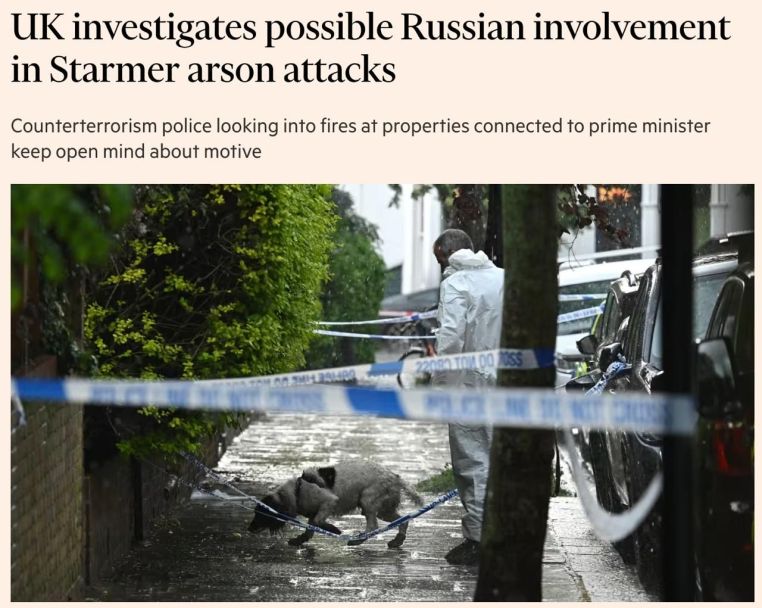
The image presents a headline from the Financial Times stating that UK authorities are investigating possible Russian involvement in arson attacks linked to Prime Minister Keir Starmer. It reports that counterterrorism police are keeping an open mind about the motive but are exploring whether actors in Russia may have been involved. This legitimate and carefully worded article is being manipulated and inverted by the Russian Telegram channel RVvoenkor, which falsely attributes a different headline and narrative to the same source. According to the Telegram post, British authorities are supposedly investigating whether Ukrainians carried out the attacks on Starmer’s property under Kremlin direction. The post claims that three Ukrainians were detained and suggests a connection to Russia through recruitment, but this framing distorts the original facts and misleads the audience.
This Telegram post is a clear example of a Russian disinformation operation designed to obscure potential Kremlin involvement by introducing false Ukrainian culpability. It misattributes a fabricated headline to the Financial Times, a known technique used to create the illusion of credibility by piggybacking on respected Western journalism. The language used—phrases such as “British officials say” and “may have recruited”—employs classic weasel wording to spread speculative claims without providing evidence. This kind of ambiguous phrasing allows the narrative to seed doubt while maintaining plausible deniability.
The core manipulation lies in the inversion of narrative. Where the original article reports that British authorities are looking into possible Russian involvement, the Russian channel turns this on its head and promotes the idea that the real perpetrators are Ukrainians being manipulated by Russia. This narrative inversion not only diverts attention away from Moscow’s known use of hybrid warfare tactics but also attempts to destabilize the relationship between the UK and Ukraine at a time of strategic cooperation.
The choice to use Telegram—specifically RVvoenkor, a channel closely aligned with Russian military influence operations—further reinforces the disinformation objective. RVvoenkor is known for blending partial truths with misleading context, crafting posts that mimic journalistic tone while pushing Kremlin-aligned propaganda. By invoking Ukrainian actors in a possible act of domestic terror against a high-level UK political figure, the message seeks to sow confusion, shift blame, and manipulate public perception.
This tactic reflects a broader strategy of hybrid warfare outlined in intelligence frameworks developed by cyber intelligence expert Jeffrey S. Bardin. Bardin’s assessments detail how Russian operations often employ narrative camouflage, third-party proxies, and cognitive warfare to disrupt political institutions and mask state involvement. Disinformation campaigns of this nature are not designed to prove a coherent alternate reality but to fracture trust, overwhelm the public with contradictory signals, and discredit any emerging evidence of Russian culpability.
In this case, the image clearly shows that UK authorities are not blaming Ukraine, and no credible source has confirmed the arrest of Ukrainians in connection to the case. By fabricating such claims and pushing them through Telegram, the Russian narrative attempts to exploit the information vacuum around an ongoing investigation. It is essential to treat this message as a disinformation artifact that should be flagged, cataloged for analysis, and monitored for further propagation across platforms like VKontakte, WeChat, and other fringe ecosystems where Kremlin narratives mutate and spread.


You must be logged in to post a comment.