


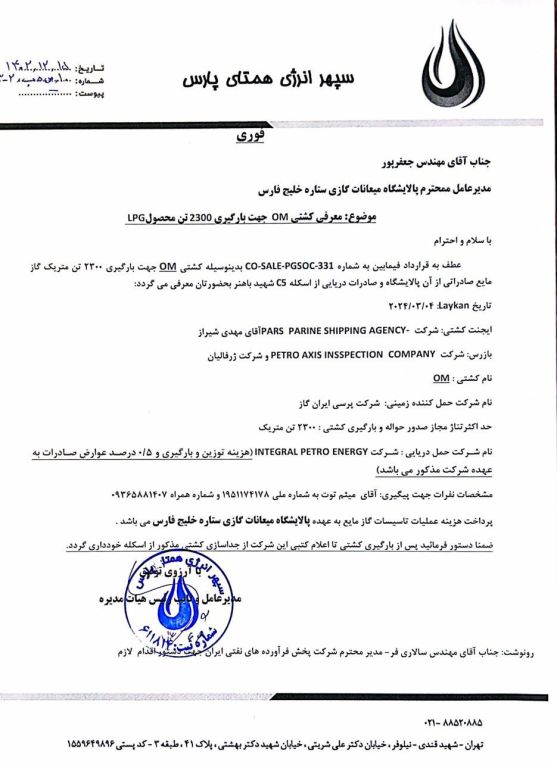
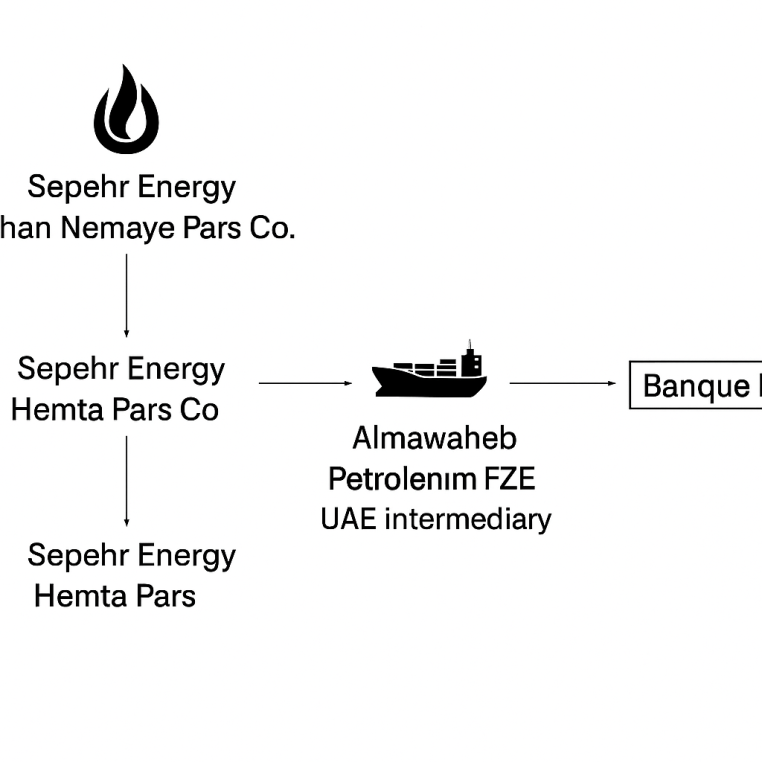
The documents in the images show a coordinated financial laundering and export scheme operated by the IRGC and its proxies using front companies like Sepehr Energy Jahan Nemaye Pars Co. and Sepehr Energy Hemta Pars. These entities, under direct or indirect military command, control billions in petroleum revenue through shell companies and offshore facilitators. The profits fund asymmetric warfare, foreign militia operations, and regime protection activities rather than public welfare, infrastructure, or healthcare in Iran.
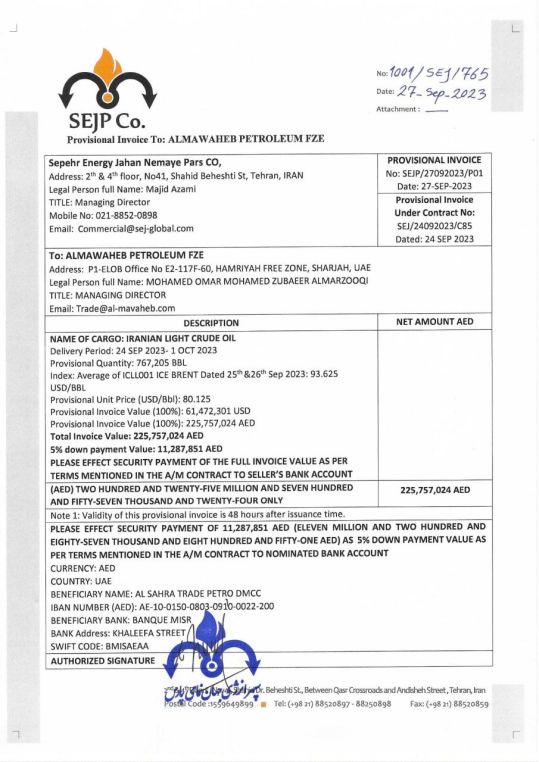
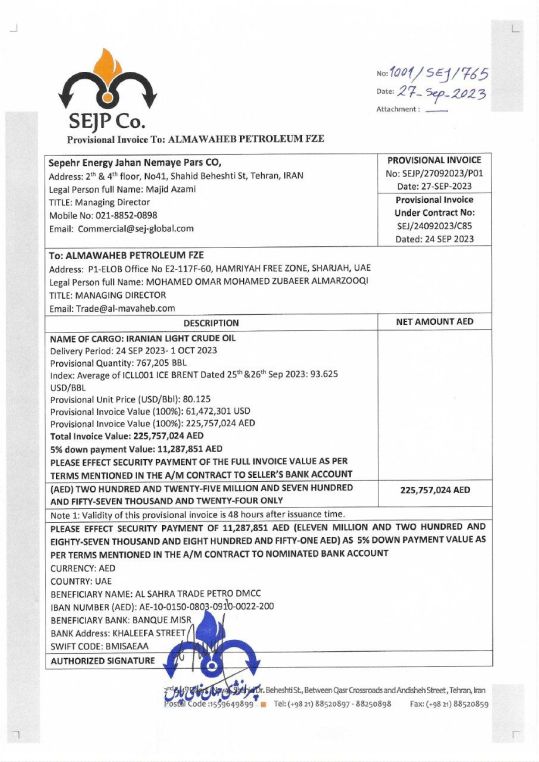
The first document is a provisional invoice for the sale of 767,205 barrels of Iranian light crude oil to Almawaheb Petroleum FZE, based in Sharjah’s Hamriyah Free Zone. The listed sale price is over $61 million USD, converted to over 225 million AED. The seller, Sepehr Energy Jahan Nemaye Pars Co., headquartered on Shahid Beheshti Street in Tehran, is led by Majid Azami. A 5% down payment is requested to be wired to an Emirati bank account registered to Al Sahra Trade Petro DMCC, with the bank being Banque Misr and the IBAN pointing to the UAE.
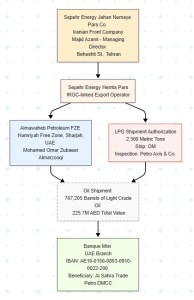
The Iranian method reflects a financial concealment system involving shell companies in Dubai’s free zones, a known hub for Iranian sanctions evasion. The invoice also specifies a delivery window from 24 September to 1 October 2023. The listed average price index (93.625 USD/BBL) and unit price (80.125 USD/BBL) match Brent benchmarks but offer no transparency on transport, vessel identity, or buyer-side end use. Almawaheb Petroleum, listed with a UAE commercial office, has no public-facing trading activity in major petrochemical indexes, and its managing director Mohamed Omar Zubaeer Almarzooqi may be acting as a cutout or intermediary for non-transparent transactions.
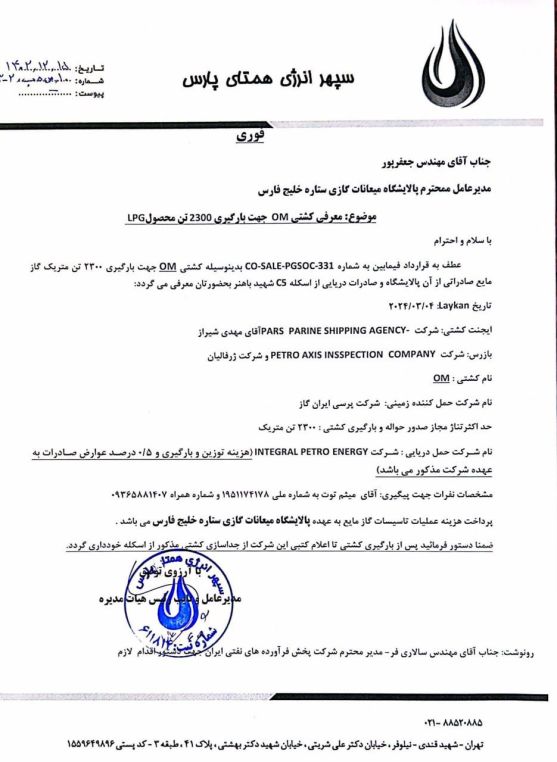
The second document, written in Persian, reveals the operational logistics of a 2,300-metric-ton LPG shipment conducted by Sepehr Energy Hemta Pars. It includes the nomination of the vessel OM to load liquefied gas under contract CO-SALE-PGSOC-331. The transaction references C5 condensate shipments, indicating Star of the Persian Gulf refinery output. The letter names agents, shipping inspectors, and the transit facilitator, Integral Petro Energy. The shipping agency is listed as Pars Shipping, and inspection services are performed by Petro Axis and a company named Zanjanian.
The document confirms that the shipper, Parsian Gas Company, has authorization to issue permits and ship 2,300 metric tons, and outlines a commission of 0.5% for fees related to shipping and export clearance. Bank information is provided, including full national ID and registry data of the parties involved. The end recipient of revenue is not the Iranian state treasury, nor any health or education agency, but commercial military intermediaries.
The documents corroborate that Sepehr Energy functions as a smuggling and capital flight apparatus. It operates in parallel to national infrastructure, siphoning off revenues generated from natural resources. Billions of dollars are lost to this process annually, none of which support the Iranian public. The regime’s claim that sanctions damage public services is contradicted by these invoices, which show that public welfare suffers not due to sanctions, but due to internal state corruption, monopolization of the energy sector by the IRGC, and intentional redirection of national assets toward proxy warfare.
By using layers of proxies—foreign-registered front companies, untraceable offshore accounts, and opaque contracts signed through intermediaries—Iran’s regime masks the origin, end use, and beneficiary trail of its oil exports. Almawaheb Petroleum FZE is one of many such entities, likely with no employees or infrastructure beyond registration. The presence of Banque Misr as the listed bank further allows Tehran to work through sympathetic or weak regulatory jurisdictions that fail to flag suspicious financial flows.
The Iranian people are excluded from this financial ecosystem. Infrastructure crumbles, schools lack basic funding, and medical systems remain under-equipped while the regime collects foreign cash to finance Hezbollah, Iraqi PMF groups, Houthis, and Syria’s Assad regime. These documents confirm the diversion of Iranian national resources for illicit geopolitical influence, reinforcing decades of systemic corruption that denies the population their rightful share of prosperity.


You must be logged in to post a comment.