


The National Liberation Army (ELN) is designated as a terrorist organization by multiple governments, including the United States, the European Union, and Colombia itself. The group, founded in 1964, has been involved in a long-running insurgency against the Colombian state. ELN operates through guerrilla warfare, armed attacks, kidnappings, extortion, and bombings, often targeting infrastructure, security forces, and political figures.
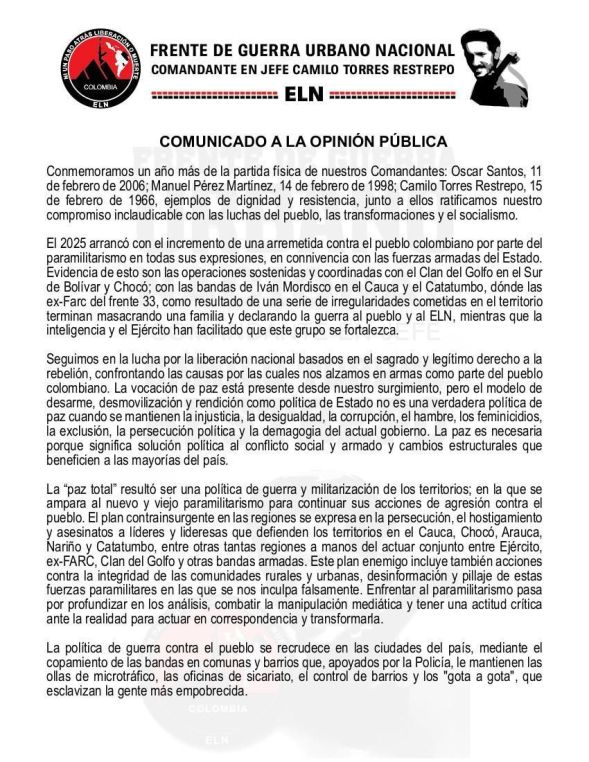
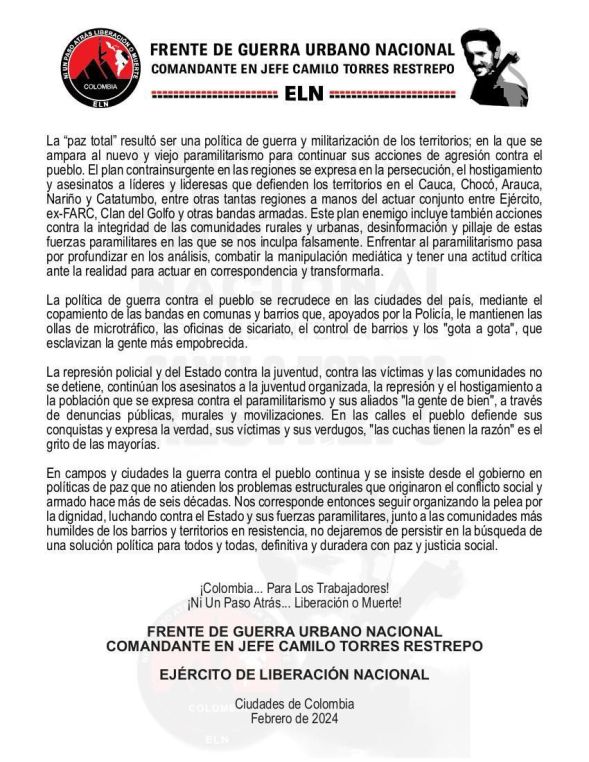
The statement from the National Urban War Front of the ELN reflects the group’s ideological position and its continued justification for armed struggle. The message denounces the Colombian government’s Total Peace policy, framing it as a front for militarization and repression. The ELN claims that state forces collude with paramilitary groups, drug traffickers, and former FARC dissidents to suppress opposition movements, particularly in regions with strong indigenous and rural resistance.
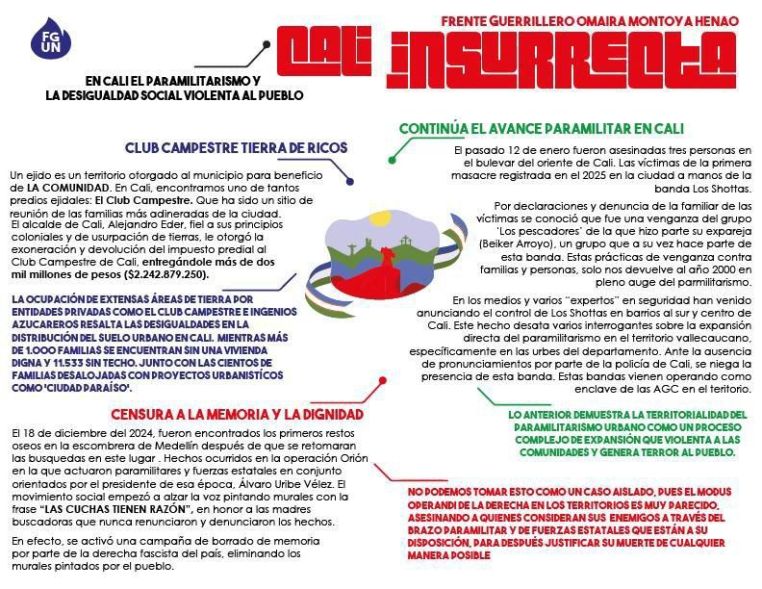
The document highlights ELN’s urban warfare focus, a significant shift from its historical rural operations. The mention of Cali, Chocó, Arauca, Nariño, and Catatumbo as key conflict zones suggests that the group is expanding influence in urban centers, likely leveraging criminal networks, youth radicalization, and economic discontent to recruit fighters. The Omaira Montoya Henao Urban Guerrilla Front is specifically referenced, reinforcing ELN’s attempt to establish a permanent urban insurgency.
Accusations against paramilitary expansion and state complicity align with ELN’s long-standing narrative that the Colombian government protects right-wing armed groups. The reference to “Los Shottas” and “Los Pescadores” indicates that the ELN considers local criminal organizations as extensions of paramilitary power, reinforcing their view that urban violence stems from state-backed repression rather than independent criminality.
The section on land inequality in Cali, particularly regarding the Club Campestre and sugarcane monopolies, suggests a targeted messaging effort to radicalize disenfranchised urban and rural communities. ELN is attempting to connect economic inequality, land ownership disputes, and security concerns into a broader revolutionary narrative, likely to justify continued armed actions.
The explicit threats against the government, paramilitaries, and economic elites indicate that ELN intends to escalate operations in both rural and urban settings. The call for mobilization, denunciation, and resistance signals a potential increase in attacks, assassinations, infrastructure sabotage, and mass protests in the coming months.
The ELN’s rhetoric is consistent with left-wing insurgent movements that mix Marxist-Leninist ideology with nationalist and populist messaging, positioning themselves as defenders of the marginalized. The persistence of ELN as an armed group, despite multiple peace negotiations, shows that it remains committed to a military strategy over political compromise.
Assessment:
ELN remains highly active despite ongoing peace talks.
Urban warfare strategy is evolving, integrating criminal elements and radicalized youth.
Targeting of landowners, corporations, and state security forces will likely escalate.
Propaganda efforts are increasing, attempting to link social inequality with armed resistance.
Government responses, including military operations and counterinsurgency measures, will likely intensify, leading to further violence.
ELN’s continued operations indicate that Colombia’s armed conflict is far from resolved. If peace negotiations do not address the underlying grievances ELN exploits, the group will likely persist in armed struggle, adapting tactics to sustain its insurgency.



You must be logged in to post a comment.