

The Iranian government directive provides a highly structured approach to controlling student activity, information flow, and ideological compliance within university settings.
Strategic Objectives and Influence Operations
The document primarily aims to prevent university campuses from becoming centers of dissent, particularly following the protests under the Women, Life, Freedom movement. The measures outlined reflect a preemptive crackdown on student and faculty activism, disguised as security and discipline initiatives. The Iranian government leverages universities as ideological training grounds rather than centers for independent thought, reinforcing strict obedience to the Supreme Leader and the Islamic system.
The Provincial Supply Council’s resolutions mandate extensive surveillance, disciplinary actions, infiltration, and cyber control, demonstrating the government’s approach to countering perceived threats from academia. The framework here aligns with counterintelligence, psychological operations, and suppression tactics aimed at preemptively neutralizing dissent. The directive also reveals a strong intent to manipulate student and faculty behavior using psychological pressure, institutionalized fear, and infiltration tactics.
Indicators of Cyber and Cognitive Warfare
Several elements in the document highlight a coordinated cyber and cognitive warfare effort against students and faculty:
1. Mass Surveillance & Cyber Monitoring (1-4, 13-1)
Universities must install CCTV cameras and issue smart control cards, ensuring real-time tracking of students and faculty.
The Ministry of Intelligence is directly responsible for CCTV data, indicating central government oversight over all university movements.
The mention of “monitoring virtual channels and identifying administrators” suggests direct cyber operations targeting Telegram, Instagram, and other online communication tools used by students to organize protests.
2. Online Infiltration & Suppression of Digital Dissent (13-1, 14-1)
Student leaders are identified and either coerced, threatened, or arrested based on their online activity.
A clear intent to control narratives and suppress independent media outlets in academic institutions.
Any non-aligned digital content is marked for removal, and intelligence agencies intervene directly.
3. Psychological and Ideological Warfare (22-1, 23-1, 27-1)
The “Jihad Explanation Team” is tasked with ideological enforcement, which is a soft influence strategy to control academic thought.
“Free Thought Chair and Free Tribune” initiatives serve as controlled opposition measures, allowing only regime-approved discourse.
System officials will be permanently embedded in universities, ensuring an environment of constant ideological reinforcement.
Infiltration and Suppression Strategies
The document outlines multiple infiltration techniques for ideological control:
1. Security Oversight Committees (2-1)
Universities must create internal surveillance committees comprising university presidents, the Supreme Leader’s representatives, student and professor mobilization units.
These committees function as institutional informant networks, with broad authority to monitor, report, and suppress dissent.
2. Targeting Faculty for Ideological Compliance (18-1, 19-1, 20-1)
Professors deemed “problematic” are to be monitored, warned, or removed.
Immediate disciplinary action for faculty who dissent, forcing an environment of self-censorship.
Selection of professors must be “reformed,” ensuring only those loyal to the regime remain in academic positions.
3. Suppressing Student Unrest (12-1, 15-1, 16-1)
Any unauthorized student gathering triggers immediate intervention by intelligence and security forces.
Disciplinary committees escalate actions from warnings to parental involvement and severe punitive measures.
The government attempts to create a culture of intimidation by proactively identifying and neutralizing student leaders.
4. Dismantling Student Unions (11-1, 10-1)
Non-aligned organizations are targeted for pressure, justification campaigns, or outright closure.
Trade unions engaged in political activities face immediate dissolution.
The regime ensures only state-controlled student bodies remain operational.
Oppression and Suppression Indicators
The measures taken illustrate a pre-emptive authoritarian control model, preventing protests before they can materialize:
1. Tightening Control Over Women (21-1, 25-1)
Universities are required to enforce hijab laws strictly.
Girls’ dormitories receive special monitoring for ideological and behavioral compliance.
Gender segregation in student activities is reinforced under the guise of cultural oversight.
2. Manipulation of Youth & Indoctrination (22-1, 24-1, 26-1)
The “Jihad Explanation Team” is a systematic indoctrination initiative, replacing protests with regime-approved propaganda.
The recruitment of pro-regime individuals into universities ensures long-term control over student bodies.
3. Crackdown on Expression (6-1, 7-1)
Any “bipolar situations” (student-faculty conflicts) are to be neutralized immediately, preventing open debate.
Psychological suppression tactics include mandatory counseling for students with “behavioral disorders”, ensuring anyone with dissenting views is psychiatrically labeled.
Implications and Strategic Assessment
Iran’s strategy of preemptive suppression is not just limited to universities. The framework outlined here mirrors the broader state security apparatus, which has long relied on a blend of surveillance, infiltration, and ideological reinforcement to maintain control. The detailed focus on university spaces indicates that the Iranian government sees student activism as one of the most serious internal threats to its power.
Key Takeaways
1. Universities in Iran are being transformed into high-surveillance, government-controlled environments, stripping them of academic freedom and dissent.
2. Cyber and cognitive warfare tactics are actively deployed to prevent anti-regime sentiments from spreading within academic spaces.
3. Iran is institutionalizing suppression by embedding intelligence networks into all levels of university life, from faculty to student organizations.
4. Psychological pressure and ideological indoctrination remain central, with targeted efforts to eliminate any opposition from students or professors.
5. Women are a specific target for increased surveillance, behavioral control, and suppression, reflecting broader gender-based repression in Iran.
The directive is a clear roadmap for authoritarian control, utilizing mass surveillance, ideological warfare, and suppression tactics to neutralize any potential threats from academic institutions. The Iranian intelligence services are deeply embedded in this process, ensuring systematic suppression of intellectual dissent while preserving the Islamic Republic’s monopoly over information, ideology, and power.
In the name of God
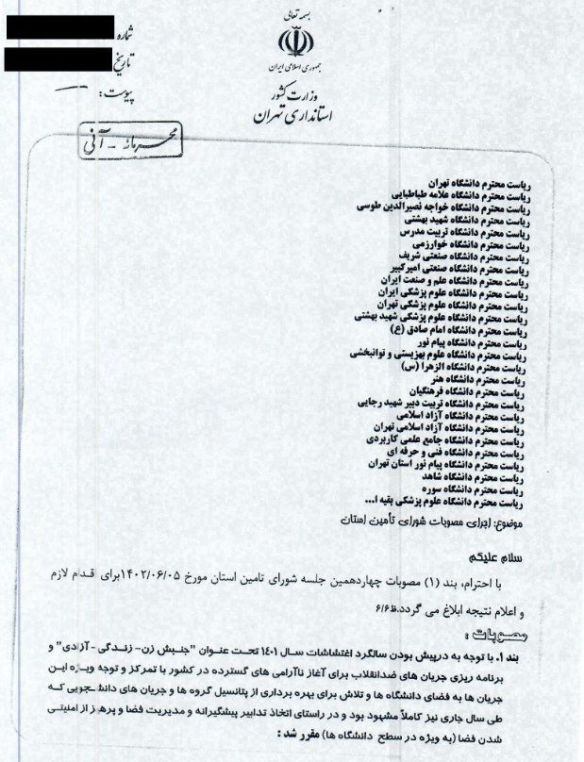
Islamic Republic of Iran
Ministry of Interior
Tehran Governorate
Number
Date
Attachment:
Jermaneh-I
The Honorable President of the University of Tehran
The Honorable President of Allameh Tabatabaei University
The Honorable President of Khajeh Nasir al-Din Tusi University The Honorable President of Shahid Beheshti University
The Honorable President of Tarbiat Modares University
The Honorable President of Kharazmi University
The Honorable President of Sharif University of Technology
The Honorable President of Amir Kabir University of Technology
The Honorable President of Iran University of Science and Technology
The Honorable President of Iran University of Medical Sciences
The Honorable President of Tehran University of Medical Sciences
The Honorable President of Shahid Beheshti University of Medical Sciences
The Honorable President of Imam Sadegh (AS) University
The Honorable President of Payam Noor University The Honorable President of the University of Welfare and Rehabilitation Sciences The Honorable President of Alzahra University (SA) The Honorable President of the University of Arts The Honorable President of Farhangian University The Honorable President of Shahid Rajaee Teacher Training University The Honorable President of Islamic Azad University
The Honorable President of Islamic Azad University Tehran The Honorable President of Comprehensive University of Applied Sciences
The Honorable President of Technical and Vocational University The Honorable President of Payam Noor University Tehran Province
The Honorable Dean of Shahed University
The Honorable Dean of Sourah University
The Honorable Dean of Baqiyat University of Medical Sciences …..
Subject: Implementation of the resolutions of the Provincial Supply Council
Peace be upon you
With respect to paragraph (1) of the resolutions of the 14th session of the Provincial Supply Council dated 1402/06/05 for necessary action
and announcement of the result, it is hereby announced. 6165
Approvals:
Paragraph 1. Considering the upcoming anniversary of the 1401 riots under the title of the Women’s Life-Freedom Movement and the planning of counter-revolutionary movements to start widespread unrest in the country, with special focus and attention of these movements on the university space and efforts to exploit the potential of student groups and movements, which was also clearly evident during this year, and in line with adopting preventive measures and managing the space and avoiding the security of the space, especially at the university level, it was decided
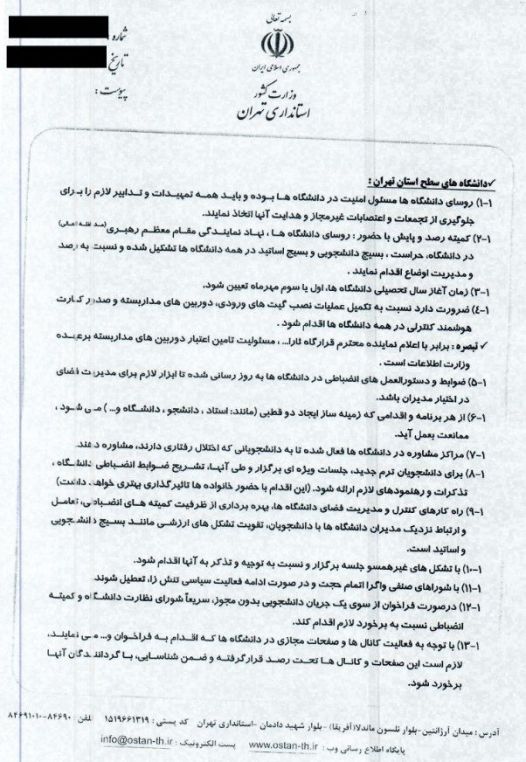
Tehran Province Universities
(1-1) University presidents are responsible for security in universities and must take all necessary measures and precautions to prevent and guide unauthorized gatherings and strikes.
(2-1) A monitoring and surveillance committee with the presence of university presidents, the Supreme Leader’s representative body (May God protect him) in the university, student mobilization, and professor mobilization will be formed in all universities and will monitor and manage the situation.
(31) The start of the academic year of universities should be set for October 1 or 2.
(1-4) It is necessary to complete the installation of CCTV camera entrance gates and issue smart control cards in all universities.
Note: According to the announcement of the respected representative of the Thara headquarters…, the responsibility for securing the accreditation of CCTV cameras lies with the Ministry of Intelligence.
5-1) Disciplinary rules and regulations in universities have been updated so that managers have the necessary tools for managing the space.
6-1) Any program or action that creates a bipolar situation (such as between a professor, a university student, etc.) should be prevented.
(7-1) Counseling centers should be activated in universities to provide counseling to students with behavioral disorders.
(81) Special meetings should be held for new semester students, during which the university’s disciplinary regulations, reminders, and necessary guidelines should be explained. This measure will be more effective with the presence of families.
(9-1) Strategies for controlling and managing the university environment include utilizing the capacity of disciplinary committees, interacting and communicating closely with university administrators and students, and strengthening value-based organizations such as the Student Mobilization and professors.
(10-1) Meetings should be held with non-aligned organizations and taking steps to justify and warn them.
11-1) End the argument with divergent trade union councils and close them if they continue to engage in political activities that cause tension.
12-1) In the event of a call from a student group without permission, the University Supervisory Council and Disciplinary Committee shall immediately take the necessary action.
13-1) Considering the activity of virtual channels and pages in universities that make calls and…, it is necessary to monitor these pages and channels and identify and deal with their administrators.
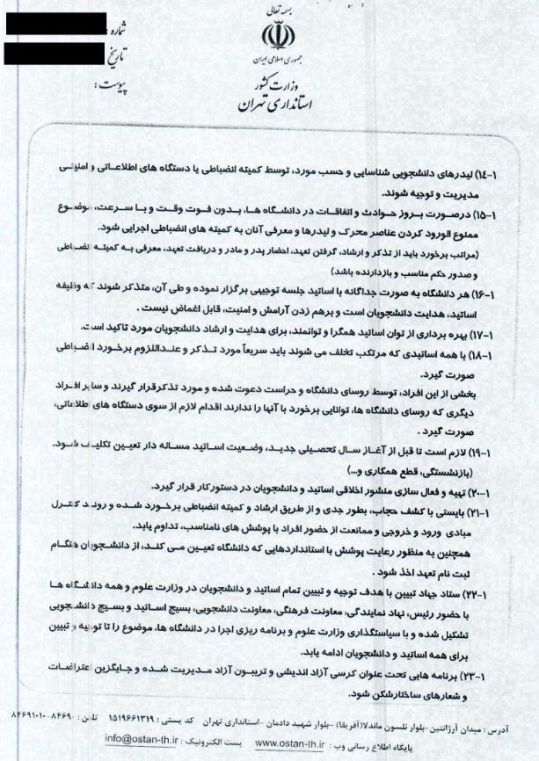
1-14) Student leaders should be identified and, as the case may be, managed and justified by the disciplinary committee or intelligence and security agencies.
(15-1) In the event of incidents and events in universities, the issue of prohibiting the entry of inciting elements and leaders and introducing them to the disciplinary committees should be implemented without delay and with speed.
The level of treatment should range from warning and guidance to the obligation to summon parents and receiving an obligation to introduce them to the disciplinary committee and issuing an appropriate and deterrent sentence.
(16-1) Each university should hold a separate briefing session with professors, during which they should be reminded that the duty of professors is to guide students and that disturbing peace and security cannot be tolerated.
(171) It is emphasized to utilize the power of convergent and capable professors to guide and enlighten students.
18-1) All professors who commit violations should be immediately warned and, if necessary, dealt with disciplinary action.
Some of these people should be invited and warned by the university presidents and security, and other people who are not able to deal with the university presidents should be taken necessary action by the intelligence agencies.
19-1) It is necessary to determine the status of problematic professors before the start of the new academic year and to eliminate them. Retirement, termination of cooperation, etc.
(2001) Preparing and activating a code of ethics for professors and students should be on the agenda.
(211) The uncovering of the hijab should be dealt with seriously through the guidance and disciplinary committee, and the control of entry and exit points and the prevention of the presence of people with inappropriate clothing should be continued.
Also, in order to comply with the standards set by the university, a commitment should be taken from the student at the time of registration.
22-1) The Jihad Explanation Team has been formed with the aim of justifying and explaining to all professors and students in the Ministry of Science and all universities, with the presence of the head of the representative body of the Cultural Deputy, the Student Deputy, the Professor Mobilization and the Student Mobilization, and with the policy-making of the Ministry of Science and the implementation planning in universities, the issue will continue to be explained and explained to all professors and students.
23-1) Programs under the title of Free Thought Chair and Free Tribune will be managed and replaced with destructive protests and slogans.
Mohsen Naibi
Deputy Security Officer and Secretary of the Provincial Security Council
Address: Argentina Square – Nelson Mandela (Africa) Boulevard, Shahid Dadman Boulevard, Tehran Governorate Postal Code: 1519661319 Phone: 1469101084690
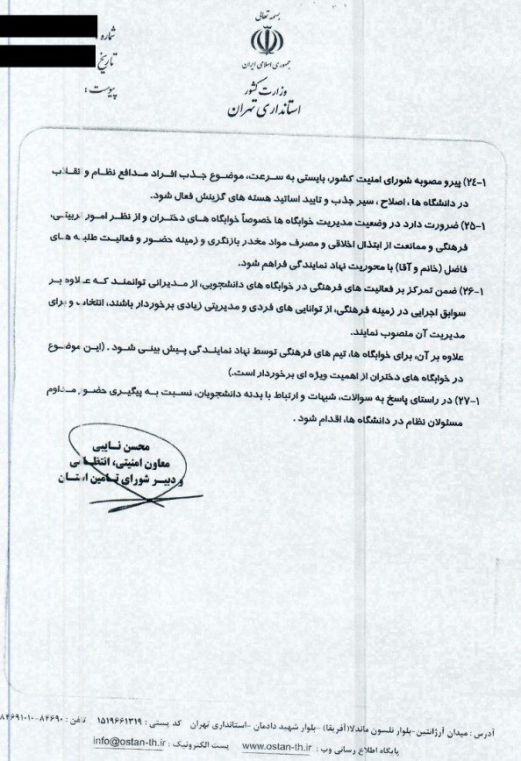
(1-24) Following the resolution of the National Security Council, the issue of recruiting people who defend the system and revolution in universities, reforming the recruitment process and approving professors of the selection centers should be activated immediately.
25-1) It is necessary to review the management of dormitories, especially girls’ dormitories, in terms of cultural education and prevention of moral vulgarity and drug use, and to provide opportunities for the presence and activity of excellent students (male and female), centered on the representative institution.
26-1) While focusing on cultural activities in student dormitories, capable managers who, in addition to their administrative records in the cultural field, have great personal and managerial abilities should be selected and appointed to manage them.
In addition, cultural teams should be provided for the dormitories by the representative institution. This issue is of particular importance in girls’ dormitories.
27-1 In order to answer questions of suspicions and communicate with the student body, action should be taken to follow up on the continuous presence of system officials in universities.
Mohsen Naibi
Deputy Chief of Security and Secretary of the Provincial Security Council
Address: Argentina Square – Nelson Mandela Boulevard (Africa) Shahid Dadman Boulevard Tehran Governorate Postal Code: 1519661319 Phone: 1469101084690
info@ostan-th.ir
Website


You must be logged in to post a comment.