


Hello, I was a prisoner in the A-F ward of Isfahan. I found the picture of this prison on Google. The path is along the road next to the gardens and dirt. The prison is in the Dolat Abad area of Isfahan, around the taxi rank. Find the Isfahan Correctional Center on Google Earth. You can see two buildings in the shape of a plus. One is pink brick and the other is yellow brick. Both are circular in the middle with a fence that was a ventilation hole. It has several floors underground. I will send you its picture.
There is also a center in Najaf Abad, Isfahan. Address: Find it on Google Earth.
Najaf Abad, Basij Square, towards Daneshgah 1 Boulevard (opposite the Fadak gas station information), there is the IRGC Intelligence Center and the Najaf Abad Intelligence Office. There are alleys on both sides of the buildings (north and south of the buildings). All the houses in the alley have underground access to the IRGC center, and there are secret team houses and torture centers.
The satellite image below shows a layout of multiple detention facilities in Isfahan, Iran, including a military prison, an intelligence detention center, and a juvenile correctional facility. The surrounding environment consists of open land and agricultural fields, which provide natural barriers and limited visibility. The facility’s proximity to major roads such as Foroudgan Boulevard suggests ease of access for security forces while maintaining a degree of isolation from dense urban areas.
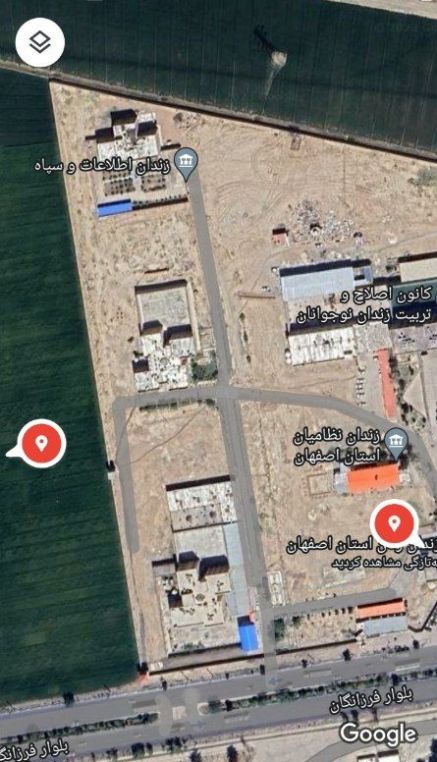
The presence of the “Zendan Etelaat va Sepah” (Prison of Intelligence and IRGC) indicates that the site functions as more than a standard penitentiary. IRGC-run facilities are often associated with detentions related to national security, espionage, political prisoners, and cases involving foreign intelligence operations. The structural layout, including multiple buildings with confined spaces and underground sections, suggests reinforced security measures designed to prevent unauthorized access or escape.
The circular structures with central openings resemble ventilation shafts, which could indicate underground detention cells or interrogation chambers. Such designs are often found in high-security prisons that require controlled airflow for subterranean sections. The existence of underground floors aligns with reports of concealed detention areas used for high-profile prisoners or sensitive interrogations.
The Najaf Abad location, identified as housing an IRGC Intelligence Center and an Intelligence Office, strengthens the assessment that these sites are linked to Iran’s broader security infrastructure. The surrounding residential areas with underground access to the IRGC facility raise questions about covert operations, unofficial detention centers, or interrogation rooms hidden within civilian areas. Such arrangements suggest a deliberate effort to maintain plausible deniability while enabling rapid transfer and containment of detainees.

The geographic positioning and reported underground connections between private residences and the IRGC complex imply a network designed for secrecy and operational efficiency. Safe houses linked to intelligence operations often function as staging points for covert activities, making them ideal for detaining high-value prisoners without attracting public scrutiny.
Analyzing structural modifications of Isfahan’s detention facilities over time, alongside detainee testimonies and satellite imagery, offers a comprehensive understanding of their evolution and function. Isfahan Central Prison, also known as Dastgerd Prison, has a history marked by significant events and changes. Notably, during the 1988 executions of Iranian political prisoners, at least 230 confirmed executions occurred within its walls. In 2013, six prisoners attempted an escape by digging a 23-meter tunnel, highlighting both the prison’s security challenges and the lengths to which inmates would go to escape. Reports indicate that the prison has been overcrowded, holding more inmates than its intended capacity. In 2020, the United States imposed sanctions on Isfahan Central Prison due to alleged human rights abuses, including extrajudicial killings and arbitrary detention. Plans have been announced to replace the current facility with a new prison located outside the city, aiming to address overcrowding and other systemic issues.
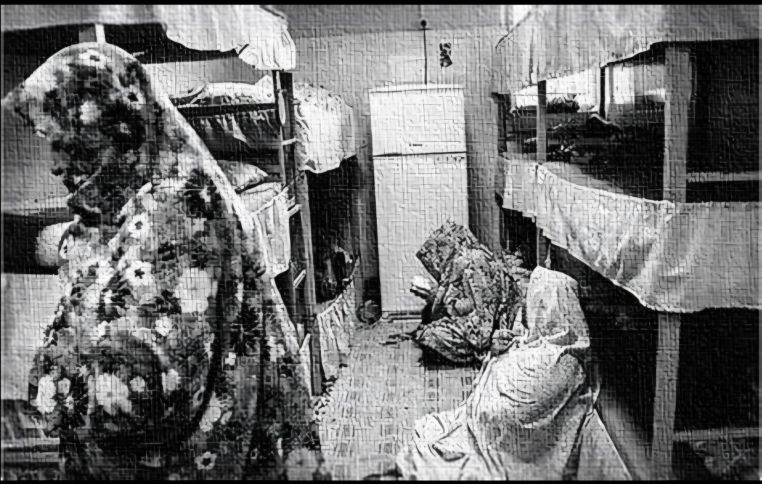
Detainee testimonies provide personal insights into the conditions within these facilities. Reports from Dolatabad Women’s Prison in Isfahan describe harsh conditions leading some prisoners to contemplate suicide. Issues such as poor food quality, inadequate medical care, and psychological abuse have been highlighted. Additionally, accounts from various Iranian prisons detail systemic issues, including abuse and neglect, which exacerbate the suffering of inmates.
Satellite imagery analysis can reveal structural changes over time, such as expansions, new construction, or modifications to existing buildings. Comparing historical and current images may show the development of additional facilities, changes in security perimeters, or the construction of new access routes. These physical changes can indicate shifts in the prison’s capacity, security measures, or functional priorities.
Mapping the movement of personnel and logistical support infrastructure, such as supply routes and secondary access points, can uncover additional layers of security operations within Isfahan’s intelligence and prison system. Understanding these logistical networks provides insight into the operational capabilities and priorities of the institutions involved.


You must be logged in to post a comment.