


A satellite system that helps the Russians guide missiles
The Russian Global Navigation Satellite System (GLONASS) awas created as an alternative to the American GPS. With its help, the occupiers can direct missiles, drones and artillery on Ukrainian territories. We reveal the chain of enterprises involved in the work of GLONASS and key persons.

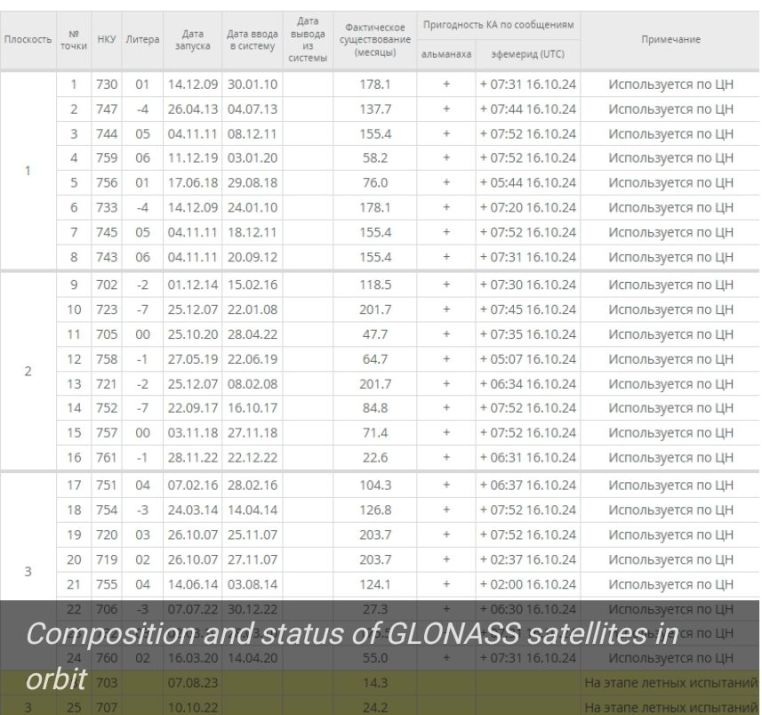

The system described is the Global Navigation Satellite System (GLONASS), operated by the Information and Analytical Center for Coordinate-Time and Navigation Support under TsNIIMash, a subsidiary of Roscosmos. GLONASS is a satellite-based navigation system developed by Russia, functioning as an alternative to GPS, with global coverage and applications in civilian and military sectors.
The satellite constellation’s status report dated December 7, 2024, details the operational history and technical attributes of active satellites. Each satellite is identified by its spacecraft number, position within an orbital plane, and unique frequency allocation. Key parameters include launch dates, commissioning dates, and operational status. For instance, Satellite 730, designated Cosmos 2456, launched on December 14, 2009, entered service on January 30, 2010, and remains operational. Other satellites follow a similar structure, with variations in their commissioning and orbital assignments. Frequency allocations for satellites range from -7 to +6, distributed across three orbital planes to optimize signal integrity and minimize interference.
Recent operational updates highlight both past and planned activities. Past events include maintenance interruptions and system reactivations, as seen in Satellite 706, which underwent maintenance from November 6, 2024, between 17:42 and 20:40 MSK, with user recommendations to update the satellite almanac. Another instance involves Satellite 747, which resumed operations on November 26, 2024, after system integration.
The system provides additional resources, including real-time satellite ephemeris, hourly and daily monitoring reports, technical specifications, and geographic visibility calculations. Navigation standards and ionospheric data support enhanced positional accuracy. The infrastructure includes mechanisms for GNSS characteristic validation and an FTP archive containing normative documents and experimental data.
System development aligns with Roscosmos objectives, ensuring operational reliability through regular monitoring, maintenance, and technological enhancements. The GLONASS infrastructure continues to support navigation applications in diverse fields, adhering to international standards while maintaining resilience through robust control and validation mechanisms.
GLONASS, Russia’s satellite navigation system, represents a multifaceted platform with applications in civilian navigation, military operations, and potential intelligence activities. Below is a comprehensive analysis of its capabilities, functions, control facilities, support infrastructure, and potential use in espionage activities.
Capabilities and Functions
GLONASS offers global positioning, navigation, and timing (PNT) services, comparable to GPS. It ensures real-time positioning with accuracy levels of 2.8–7.38 meters for civilian applications and higher precision for military users. The system operates with 24 active satellites divided into three orbital planes, each with eight satellites, ensuring global coverage and redundancy.
In the civilian domain, GLONASS supports transportation, agriculture, disaster management, and urban planning. In the military domain, it provides secure navigation for Russian armed forces, supports precision-guided munitions, and ensures resilience against electronic warfare through encrypted communication and anti-jamming technologies.
Spy and Intelligence Actions
GLONASS holds potential for intelligence operations. By integrating satellite data with other intelligence platforms, it can track the movement of military assets, monitor adversarial activities, and provide geospatial intelligence (GEOINT). Russia’s integration of GLONASS with drone systems and reconnaissance satellites enhances its capability to conduct surveillance, monitor borders, and collect data on adversaries in real time.
The system can also serve as a platform for electronic warfare, leveraging its encrypted military frequencies to coordinate cyber and electronic warfare operations. Potential exists for covert data collection, leveraging location-based services to gather intelligence on users interacting with GLONASS-enabled devices.
Control Facilities
The GLONASS system operates under centralized control through key facilities managed by Roscosmos and the Ministry of Defense. The primary operational hub is the Center for Coordination, Navigation, and Timing Support at TsNIIMash, Moscow Region. This facility manages satellite operations, monitors system health, and coordinates technical maintenance. The GLONASS Control Center (ЦУС ГЛОНАСС) tracks satellite positions, plans orbital adjustments, and oversees ground-segment operations.
Secondary control facilities include ground monitoring stations located across Russia and allied territories, ensuring global signal coverage and redundancy. These stations track satellite signals, assess performance, and relay commands from the central facility.
Support Teams and Infrastructure
GLONASS employs multidisciplinary teams comprising satellite engineers, navigation specialists, military operators, and software developers. These teams ensure continuous system updates, hardware maintenance, and alignment with international navigation standards. Support structures include satellite assembly plants, like the Information Satellite Systems (ISS) Reshetnev Company in Krasnoyarsk, responsible for satellite manufacturing and integration.
In addition to the operational teams, GLONASS leverages academic institutions and research centers for technological advancements, including navigation algorithms, signal encryption, and anti-jamming capabilities. Partnerships with civilian industries expand GLONASS applications in smartphones, vehicles, and autonomous systems.
Physical Locations
Key GLONASS facilities include the primary Control Center near Moscow, secondary tracking stations across Russia, and several international monitoring facilities in allied countries like Belarus, Kazakhstan, and India. The satellite assembly occurs at ISS Reshetnev in Siberia. Ground support extends to remote locations like the Arctic and Russian Far East to maximize geographic signal coverage.
Resilience and Redundancy
GLONASS employs a robust system design to mitigate risks from signal disruption, cyberattacks, or physical damage to satellites. Redundancy in satellite placement ensures uninterrupted service, while ground stations provide real-time monitoring to detect and resolve anomalies. Military-grade encryption and anti-jamming technologies protect the system from adversarial interference.
Conclusion
GLONASS is not merely a navigation system but a strategic asset supporting Russia’s geopolitical and military objectives. Its dual-use design enables civilian applications while providing the Russian military with secure, resilient navigation capabilities. Integrated with other intelligence platforms, it acts as a force multiplier for surveillance, reconnaissance, and electronic warfare. The infrastructure’s centralized control and broad geographic spread demonstrate its importance to Russia’s defense strategy and technological aspirations. The system remains under continuous development to enhance precision, security, and integration with modern warfare and civilian technologies.
Strategic Importance
GLONASS plays a critical role in Russia’s geopolitical strategy. Beyond its civilian and military uses, it underpins Russia’s efforts to maintain technological sovereignty and reduce reliance on foreign systems like GPS. This aligns with broader national security goals and bolsters Russia’s ability to operate independently in contested or adversarial environments. Its integration with the Eurasian Economic Union (EAEU) and collaborations with countries like China, India, and Iran showcase its utility as a soft-power tool.
Economic and Technological Leverage
The system contributes to Russia’s economic initiatives, enabling precision agriculture, transportation logistics, and infrastructure development. It supports industries such as autonomous vehicles, maritime navigation, and aviation. The commercialization of GLONASS-enabled devices generates revenue, with state-backed incentives encouraging adoption in domestic markets and among allied nations.
Dual-Use Technologies
GLONASS satellites host payloads that may serve non-navigation purposes. These include potential reconnaissance equipment, secure communication systems, and sensors for environmental or military intelligence. Dual-use technology allows GLONASS to integrate with reconnaissance satellites, drones, and advanced weapons systems for real-time targeting and intelligence dissemination.
Cybersecurity Implications
As a critical infrastructure system, GLONASS incorporates advanced cybersecurity measures to safeguard against cyberattacks. Its reliance on encrypted military frequencies and proprietary technologies reduces vulnerability. However, its centralization within Russian-controlled networks raises questions about its use in offensive cyber operations, such as spoofing or jamming GPS signals of adversaries.
International Deployment and Expansion
Russia has established GLONASS ground stations in several allied countries, such as Brazil, India, and South Africa, under bilateral agreements. These stations extend the system’s global reach and strengthen ties with strategic partners. Russia also seeks to expand GLONASS adoption in Africa, Latin America, and the Middle East, providing subsidized infrastructure to increase influence in these regions.
Integration with Military Platforms
GLONASS seamlessly integrates with advanced Russian military platforms, including ballistic missiles, hypersonic weapons, and unmanned aerial vehicles (UAVs). This enhances the accuracy of weapons systems and improves situational awareness for command and control operations. Its compatibility with Russia’s C4ISR (Command, Control, Communications, Computers, Intelligence, Surveillance, and Reconnaissance) framework ensures real-time coordination during complex operations.
Monitoring and Control Architecture
Ground-based infrastructure supports precise monitoring of satellite orbits and health. Facilities such as the Plesetsk Cosmodrome handle satellite launches, while the Baikonur Cosmodrome provides additional capacity for orbital deployments. Tracking stations in Siberia, the Far East, and beyond relay data to control centers. These stations operate as a cohesive network, ensuring uninterrupted system functionality.
Research and Development
Russia invests heavily in R&D for GLONASS upgrades, focusing on next-generation satellites with improved performance metrics. This includes efforts to increase signal accuracy, enhance anti-spoofing capabilities, and integrate quantum communication technologies. These advancements aim to secure GLONASS’s position as a cutting-edge navigation system capable of countering adversarial technological developments.
Environmental Monitoring
GLONASS satellites host payloads for environmental observation, aiding in disaster management, climate research, and resource exploration. These capabilities support civilian government functions while also providing intelligence for strategic resource allocation in contested regions like the Arctic.
Strategic Dependencies
GLONASS infrastructure creates dependencies among user nations, strengthening Russia’s influence over allies and partners. This interdependence limits the geopolitical maneuverability of countries adopting GLONASS while creating a long-term strategic advantage for Russia.
Future Directions
Russia’s plans for GLONASS include transitioning to third-generation satellites with longer lifespans, greater precision, and enhanced resilience. The integration of artificial intelligence and machine learning into ground-based monitoring systems is also being explored to optimize operations and detect anomalies in real time. Expanding global partnerships and ground station networks remains a priority to further entrench GLONASS as a competitor to GPS, Galileo, and BeiDou systems.
Space Warfare Readiness
GLONASS is a crucial asset in Russia’s preparation for space-based conflicts. It serves as a resilient navigation backbone in anti-satellite (ASAT) warfare scenarios. GLONASS satellites are designed with redundancy and shielding to withstand kinetic or electronic disruptions, ensuring operational continuity in contested environments.
Precision Targeting for Strategic Weapons
The system plays a pivotal role in enhancing the accuracy of Russia’s strategic weapons. For intercontinental ballistic missiles (ICBMs) and hypersonic glide vehicles like the Avangard, GLONASS provides precision guidance throughout their flight trajectory. This reduces the reliance on inertial navigation systems alone, significantly increasing targeting accuracy.
Arctic and Polar Operations
GLONASS is uniquely optimized for Arctic navigation, providing critical coverage in high-latitude regions where GPS signals degrade. This capability supports Russia’s strategic interests in the Arctic, including resource exploitation, military deployments, and maritime navigation through the Northern Sea Route.
Integration with Civil Infrastructure
The system underpins Russia’s critical infrastructure, including energy grids, transportation networks, and emergency services. GLONASS-enabled timing synchronization is crucial for operations in rail systems, power plants, and communication networks, ensuring efficiency and security.
Espionage and Counterintelligence Applications
GLONASS may support clandestine operations by enabling real-time tracking of individuals, assets, or vehicles equipped with GLONASS-compatible devices. This can be leveraged for surveillance, counterintelligence, or covert action against adversaries or dissidents within Russia or abroad.
Hybrid Warfare Support
In hybrid warfare scenarios, GLONASS serves as a force multiplier for non-linear operations. Its integration with cyber, electronic warfare, and psychological operations enhances Russia’s ability to conduct coordinated attacks that disrupt adversary operations while masking attribution.
Autonomous Systems Development
GLONASS forms a foundational element in Russia’s development of autonomous systems, including military drones, robotic ground vehicles, and naval vessels. The system ensures these platforms can operate with high precision and reliability in GPS-denied environments.
Space Cooperation with Strategic Partners
Russia uses GLONASS as a diplomatic tool to deepen ties with strategic partners. Collaborative agreements for GLONASS ground stations and technology sharing create mutual dependencies, strengthening alliances with countries like China, India, and Iran. These partnerships also facilitate joint projects in satellite development and space exploration.
Disaster Response and Crisis Management
GLONASS supports Russia’s disaster response framework by providing accurate geolocation data for search and rescue operations, evacuation planning, and infrastructure assessment during natural disasters. Its rapid deployment capabilities enhance coordination between military and civilian authorities in emergencies.
Regional Influence in Navigation Standards
Through GLONASS, Russia promotes an alternative global navigation standard to challenge Western dominance in PNT systems. By integrating GLONASS into regional organizations and frameworks, Russia undermines the monopoly of GPS while fostering dependence on Russian technology.
Satellite Health and Longevity Programs
Continuous monitoring ensures satellite performance is optimized and extended beyond planned lifespans. Maintenance strategies include orbit adjustments, software updates, and predictive analytics to preempt failures. Russia has prioritized extending the lifespan of older satellites while deploying newer models.
Advanced Signal Capabilities
GLONASS incorporates modernized signal structures, such as the L3 and L5 bands, to improve multipath resistance and compatibility with other global navigation satellite systems. These enhancements aim to maintain competitive parity with GPS and Galileo.
Economic and Security Linkages
Russia ties GLONASS adoption to economic and security agreements. For example, trade partnerships and arms deals often include stipulations for GLONASS integration into defense systems, creating long-term dependencies that strengthen Russia’s geopolitical leverage.
Training and Skill Development
Roscosmos and affiliated organizations maintain extensive training programs to develop expertise in satellite navigation, control systems, and advanced analytics. These programs ensure a steady pipeline of talent capable of operating and innovating within the GLONASS infrastructure.
Role in Electronic Countermeasures
GLONASS aids in detecting and countering electronic warfare threats. Ground and space-based sensors monitor signal integrity, allowing rapid response to jamming or spoofing attempts. This capability is crucial for maintaining operational reliability in contested electromagnetic environments.
Future Integration with Quantum Technologies
Russia is exploring the integration of quantum communication and quantum clocks into GLONASS satellites. These advancements aim to enhance signal accuracy, improve encryption, and provide resilience against cyber threats.
Enhanced Role in Maritime and Aerospace Defense
The system is integral to Russia’s maritime and aerospace defense strategy, supporting the navigation and targeting systems of warships, submarines, and aircraft. Its ability to operate in GPS-denied environments strengthens Russia’s defensive and offensive posture in strategic regions like the Black Sea and the Pacific.
Research on Next-Generation Constellations
Russia is actively researching fourth-generation GLONASS satellites, which will feature higher accuracy, greater signal stability, and expanded frequency bands. These advancements aim to position GLONASS as a leader in the global navigation system market for both civilian and military applications.

You must be logged in to post a comment.