


The conflict in the northern Hama countryside reflects dynamic, localized shifts in control, underscoring the intensity of the broader strategic struggle between the Syrian Arab Army (SAA) and Hay’at Tahrir al-Sham (HTS). The recent developments highlight the fluidity of the frontlines, characterized by aggressive offensives and counteroffensives by both parties.
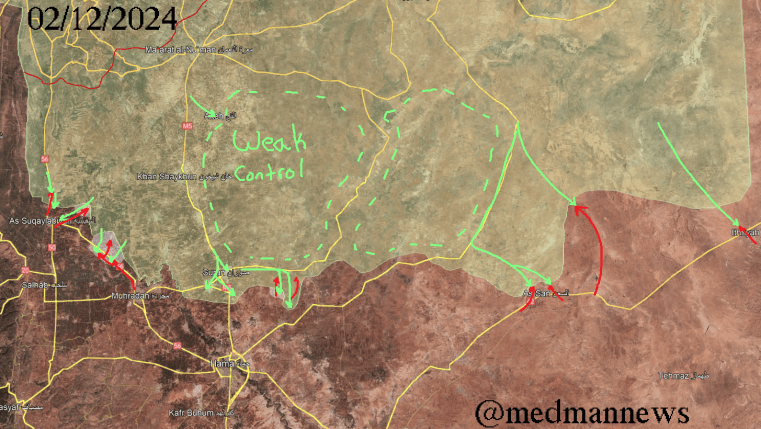
Qalaat al-Mudiq and Southern Advances
The SAA’s attempt to gain a foothold in Qalaat al-Mudiq faced robust resistance from HTS forces. The repulsion of the SAA’s advance resulted in continued clashes south of the city. This suggests that Qalaat al-Mudiq serves as a critical stronghold for HTS due to its proximity to strategic supply routes and its defensive advantages.
Suqaylabiyah-Muhradah Highway
HTS’s offensive targeting the Suqaylabiyah-Muhradah highway highlights their efforts to disrupt SAA logistics and isolate key urban centers. In response, the SAA launched counterattacks on Jalameh and Tel Malah. The ambiguity surrounding control over these towns underscores contested gains and the challenges of maintaining territorial stability along critical routes.
Eastern Sector
HTS demonstrated significant momentum by retaking Suran, Tayyibat al-Imam, and Maardes. These advances reversed much of the SAA’s progress from the prior day, suggesting HTS has regrouped and is capable of quickly exploiting vulnerabilities in SAA lines.
The loss of these towns may compromise the SAA’s ability to project power further into HTS-controlled territories, reinforcing the need for the SAA to stabilize its eastern front.
Kawkab and Adjacent Areas
SAA efforts to advance near Kawkab at Muraywid, Abu Mansaf, and Mubattan faced fierce HTS counterattacks, which resulted in the loss of most of these positions. The unclear status of Muraywid suggests ongoing skirmishes or contested control. HTS’s recapture of Madbaah underscores their tactical capacity to regain lost ground swiftly.
Southeast Idlib Consolidation
HTS’s movement into Alteh indicates a strategic focus on consolidating positions in southeast Idlib. The action likely aims to secure staging areas for future offensives and strengthen defenses against potential SAA incursions into Idlib province.
Strategic Implications
HTS’s Tactical Adaptability
The rapid counterattacks and subsequent territorial gains demonstrate HTS’s operational flexibility and effective use of reinforcements. Their ability to reclaim lost ground within a short timeframe disrupts SAA plans for sustained offensives.
SAA’s Overextension
The SAA appears to face difficulties in maintaining consistent territorial control across multiple sectors. The failure to secure gains in both western and eastern fronts may reflect overextension of resources or inadequate preparation for counteroffensives.
Contested Highways
Control over major highways remains pivotal for both logistical support and strategic mobility. The unresolved status of towns along the Suqaylabiyah-Muhradah highway represents a critical bottleneck for both sides.
Idlib as a Staging Ground
HTS’s consolidation in southeast Idlib highlights the province’s importance as a command and logistics hub. This positioning facilitates sustained operations in Hama and other contested areas.
Status of Key Highways Continuous updates on control over the Suqaylabiyah-Muhradah highway and surrounding towns will offer insights into shifting operational priorities.
HTS Expansion in Idlib
Observing HTS activities in southeast Idlib, particularly in Alteh, could signal preparation for larger offensives.
SAA Reinforcement Patterns Analysis of SAA troop movements and supply chain vulnerabilities will clarify their capacity for sustained engagement in the region.
The situation remains highly volatile, with the balance of power hinging on effective coordination, resource allocation, and the ability of either side to exploit battlefield opportunities.


You must be logged in to post a comment.