


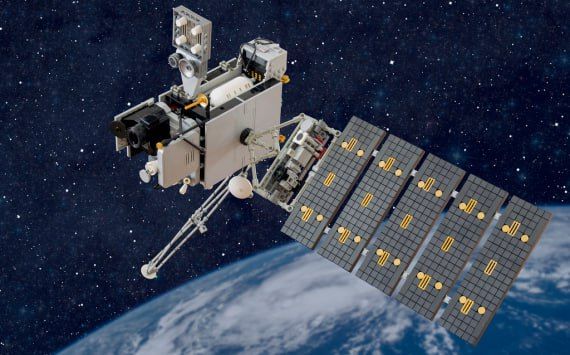
The multifunctional radar satellite shown in the image is the “Obzor-R,” a Russian observation satellite developed by the Progress Rocket and Space Center (RSC), which operates under Roscosmos. This satellite is scheduled for launch in early 2025, delayed from its previously reported late 2024 launch window. The “Obzor-R” serves as part of Russia’s space-based radar reconnaissance program, employing Synthetic Aperture Radar (SAR) for high-resolution imaging capabilities.
The satellite will conduct all-weather, day-and-night Earth observation, providing detailed imaging for various applications such as environmental monitoring, resource management, and military surveillance. It will enhance Russia’s ability to gather geospatial intelligence, improve maritime situational awareness, monitor infrastructure, and assess potential natural disasters.
Potential threats posed by the “Obzor-R” satellite include its dual-use nature, as it supports both civilian and military applications. This could raise concerns about increased Russian surveillance capabilities, particularly in contested regions or along borders. Given its SAR technology, the “Obzor-R” can penetrate clouds, smoke, and even some vegetation, making it capable of monitoring hidden or camouflaged targets, which amplifies its intelligence-gathering effectiveness. The satellite’s deployment also contributes to Russia’s broader strategy of achieving greater autonomy in space-based reconnaissance, reducing reliance on other nations’ space assets.
The launch of “Obzor-R” aligns with Russia’s broader strategy of expanding its space-based capabilities, particularly in response to international sanctions limiting access to Western technology. By enhancing its radar satellite constellation, Russia seeks to strengthen both its military intelligence and domestic security capabilities, impacting regional security dynamics and increasing the potential for geopolitical tensions.


You must be logged in to post a comment.