

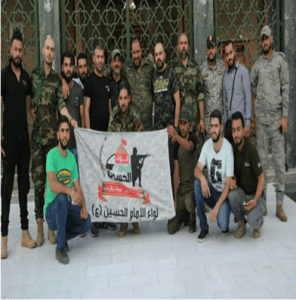
Iranian forces have been deployed in the form of “Imam Hussein Brigade” to fight with Israel in southern Lebanon
A spokesman for the Israeli Ministry of Defense says that the “Imam Hussein” brigade includes Iranian militiamen who have reached southern Lebanon from Iraq and Syria.
“Imam Hossein” army is one of the armies under the Quds Force of the Islamic Revolutionary Guard Corps, active in Syria. who has gone to Lebanon to help Hezbollah
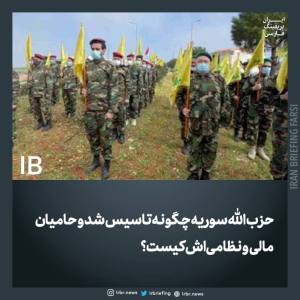
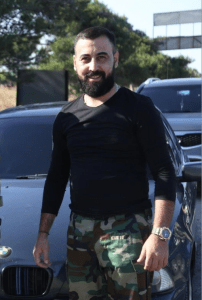
This army consists of 5,000 military forces and is equipped with all kinds of drones and rockets. Its commander is a Lebanese-born Zulfiqar Hanawi. Israeli army reports indicate that the Imam Hussein Brigade was carrying out hostile activity against Israel, including weapons smuggling. Particular focus was placed on the commander of this brigade, called Zulfiqar Hanawi, 42, a Lebanese affiliated with Hezbollah, who led a military division that was fighting in Aleppo in 2013.
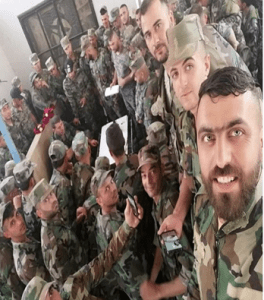
Imam Hossein Army is the name of a special force and one of the proxy forces of the Islamic Revolutionary Guard Corps, and under the direct control of the Quds Army; This force was established in 2016 by the former commander of the Quds Force, martyred Hajj Qassem Soleimani; This special force includes thousands of fighters of different nationalities who are capable of carrying out attacks against the United States of America in Syria and Israel; These forces are directly funded by the 4th Syrian Army.
According to the recently published information, Imam Hussein’s army or Hezbollah of Syria was placed by #قاسم_سلیمانی_تروریست as a subset of the Syrian army, and the purpose of this work was to stabilize the influence of the IRGC’s Quds terrorist force in Syria.
This report emphasizes that for this reason, the Iranian regime is forced to finance an important part of the Syrian army in order to finance this division.
According to this report, the joint trip of Bashar Assad, the butcher of the Syrian people, Qassem Soleimani and Mohammad Jaafar Qasir, nicknamed Haj Fadi, from the Hezbollah forces and responsible for transferring money from Iran to Lebanon and Syria, was carried out in March 2017 to provide the budget for Hezbollah in Lebanon and part of the Syrian army.

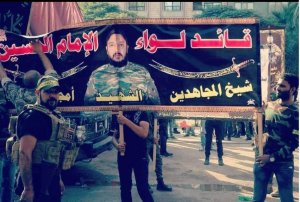
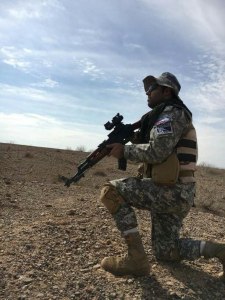
January 2019 – Missile fired from Syria into Israel:
On Sunday, January 20, 2019, an Iranian-made medium-range surface-to-surface missile was fired from Syria at the Golan.
June 2019 – Rocket fire from Syria into Israel:
On June 1, 2019, two missiles that were fired at Mount Hermon in the Golan Heights from the Quneitra region of Syria were located. In close proximity to one of Israel’s military installations on Mount Hermon, one rocket landed in Israeli territory, and the other one landed in Syrian territory.
August 2019 – Attempted launch of UAVs at Israel:
On Saturday, August 24, 2019, Israeli warplanes attacked a site near Damascus from which they were preparing to launch drones at Israel.
October 2021 – Attack on the American base in Al-Tanf:
On Wednesday, October 20, 2021, five unmanned aerial vehicles (UAVs) carried out an airstrike against the American facility in Al-Tanf, carrying the following message from Iran to the US and Israel: “No more patience, and the attack will be equal to an attack.”
The American base was attacked after an CBW airstrike in the Palmyra area a week earlier, on Thursday, October 14, 2021.
Appendix C – Interviews with senior commanders of the Al-Imam Hussein Brigade:
The following is a transcript of an interview with Abu Ali Assad (see https://www.aymennjawad.org/22526/), commander of the “death squad” within the Al-Imam Hussein Brigade (April 20, 2019):
Interviewer: First, when was the Al-Imam Hussein Brigade established and what exactly was its source? Were its commanders originally part of the Abu al-Fadel al-Abbas Brigade?
Abu Ali: Dear Sir, the Al-Imam Hussein Brigade was established by Martyr Sheikh Amjad Al-Bahadali. There is no connection to the Abu al-Fadel Brigade, but they are all our brothers.
Interviewer: Did Sheikh Amjad al-Bahadali, may God have mercy on him, lived in Syria before the crisis?
Abu Ali: That’s right
Interviewer: In which areas did the brigade fight and how many martyrs did it lose?
Abu Ali: We fought in Mu’tamiya, Maliha, Dariya, Darkabia, Khan al-Sheikh, Wadi Barada, Qabwan, Harsta, Hajar al-Aswad, Yarmouk, Daraa, and Idlib. We fought in several areas in eastern and western Ghouta. In every area, we sacrificed dead and wounded.
Interviewer: Is the exact number of Martyrs known?
Abu Ali: I estimate about 40 shaheeds, including commanders.
Interviewer: Did the Islamic resistance, Hezbollah, and its Iranian friends help you with armaments, training, and finances?
Abu Ali: Everyone provided assistance, but in the Al-Imam Hussein Brigade we were supported mainly from the Syrian leadership, the Fourth Division.
Interviewer: When was the brigade attached to the Fourth Division? And what exactly does this mean?
Abu Ali: Since 2012, a group has been established within the brigade and armed by the Fourth Division, after which all the brigade operatives worked with the division.
Interviewer: Yes, that is, salaries, armaments and training are currently from the Fourth Division.
Abu Ali: That’s right.
Interviewer: When exactly was the Death Battalion established?
Abu Ali: 2013. The Death Battalion was established under the auspices of the brigade.
Interviewer: And is it considered the Syrian arm of the brigade?
Abu Ali: Exactly 100 percent.
Interviewer: Are the fighters Syrians from many areas and ethnicities?
Abu Ali: That’s right
Interviewer: Whoever joins the Death Brigade and serves it is considered a flagship service?
Abu Ali: Yes, most of the young people who join are considered servants of the flag.
Interviewer: That means they enlisted on the basis that serving in a battalion is like serving the flag.
Abu Ali: No, only after the decision of the commander of the Fourth Division was this decision implemented.
Interviewer: How do you assess the situation in Syria today in general?
Abu Ali: Excellent
Interviewer: But why hasn’t the liberation of Idlib started yet?
Abu Ali: There may be alternative options from a military campaign, but in the end Idlib will be liberated in any way.
Following is a transcript of an interview with Firas al-Mahdawi (see https://www.aymennjawad.org/22697), senior commander of the Al-Imam Hussein Brigade (May 17, 2019):
Interviewer: Were you with the Abu Fadel al-Abbas Brigades at first?
Feras al-Mahdawi: “I am one of the Hezbollah network. The Abu Fadel Brigade is the first name of the party. I acted as part of a fighting group under Hezbollah in 2013. In the southern sector, Al-Sham, Deraa, Quneitra and Suwayda.
Interviewer: Okay, so at first you worked with Hezbollah
Feras al-Mahdawi: That’s right.
Interviewer: Did you then join the Al-Imam Hussein Brigade?
Feras al-Mahdawi: Yes. Then I joined my Iraqi brothers in the brigade. I was [in the past] with the Lebanese Hezbollah and also worked in securing the Sayyida Zaynab temple.
Interviewer: Does this [Temple Security] belong to the Fourth Division, for example?
Feras al-Mahdawi: No, it belongs to Hezbollah. [It was] before the brigade (Al-Imam Hussein). I continued working during 2015 between fighting and securing the Sayyida Zaynab Temple. Then I joined the Imam (Hussein) Brigade.
Interviewer: Did you fight outside Damascus?
Feras al-Mahdawi: I fought in the suburbs of Hisham and in several provinces.
Interviewer: And you also worked with Army of Hope? (In Arabic, Al-Jaysh al-Muamel, the Islamic resistance force in Iraq, and Sham, an Iraqi Shiite army established to fight in Syria and Iraq against the Islamic State).
Feras al-Mahdawi: I worked with them a little, while it was being established.
Interviewer: Did you fight in Iraq as part of this army?
Feras al-Mahdawi: I didn’t get into battles with them. My work is mainly in Syria. I am a resident of the area. I went on certain visits. The force was in Syria, and many were sent from Iraq to fight in Syria. But there were many men and commanders left.
Interviewer: Yes. I learned that some brothers who live in Syria joined them in Syria. Then they left.
Feras al-Mahdawi: Exactly.
Interviewer: Did they return to the local Iraqi brigades?
Feras al-Mahdawi: This brigade did not last as long as the other brigades in Syria, such as Al-Nujaba or the Imam Ali Brigades.
Interviewer: So, you returned to the Al-Imam Hussein Brigade and to this day you work with the brigade?
Feras al-Mahdawi: Yes.
Interviewer: How do you assess the situation in Syria today?
Feras al-Mahdawi: Praise God, thanks to the determination of the heroes and those who believe in Syria, the situation is very good. We are ready to face any aggression against Syria. Our goal was to defend the land and protect the holy places, whether Muslim or Christian.
Interviewer: Why did you choose to join the Al-Imam Hussein Brigade?
Feras al-Mahdawi: It is a well-known brigade with the best Iraqi youth and is mixed with the youth of Syria and its brigades affiliated with the Syrian Arab army, with my love and appreciation for Hezbollah.
Interviewer: Yes, and everything belongs to the Fourth Division? Weapons, and salaries, etc.?
Feras al-Mahdawi: Yes. All funding from the fourth division.
Interviewer: Did the Syrian state offer you Syrian citizenship in recognition of your sacrifice?
Feras al-Mahdawi: We didn’t fight for citizenship or money. Our goal is to defend our people in Syria and its land from any occupier. Iraqi citizenship is enough for me. I’m proud of it and I’m proud of my second homeland, Syria.


You must be logged in to post a comment.