Since 2013, the Great Chinese Golden Shield has been technically managed by the China Cyberspace Administration (CAC), which is “the organization in charge of translating the doctrine and policy of the CCP into technical specifications.” But not only….
One recent CAC project has been a campaign to “hit hard” bloggers and streamers who post unauthorized content. China’s Cyberspace Administration has vowed to use internet censors to stop “rumour-spreading” by citizen journalists and “win the ideological struggle on the internet while ensuring national and political security.”
Bead games in Chinese. China’s big cyber brother has been playing cat and mouse with Chinese netizens for two and a half decades. And it looks like he’s winning
The Great Firewall (防火长城), which appeared in the PRC in 1997, serves as an obstacle to ideological and political heresy, including in terms of the most sensitive, “territorial” topic in relations between Russia and China. About how dangerous thoughts and news are censored in the Celestial Empire, Heartland talked to Nikolai Kuznetsov, an incognito expert competent in these matters.
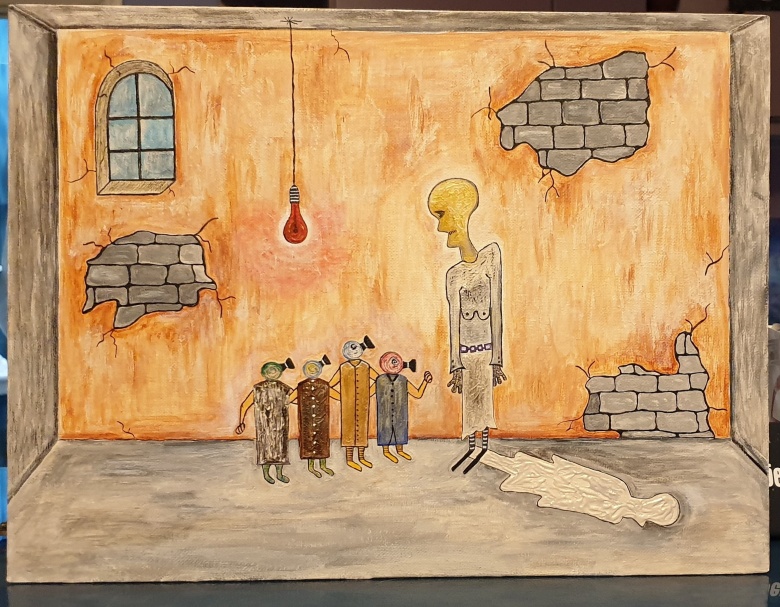
Grant Misakyan Magister. 2022
Image courtesy of the artist
Since 2013, the firewall has been technically managed by the Cyberspace Administration of China (CAC), which, to quote Wikipedia , is “the organization responsible for translating the doctrine and policies of the Chinese Communist Party into technical specifications.” Can it be formulated like this?
– Could be so.
— I read a curious report the other day about a campaign launched in China a month ago to “strike hard” against bloggers and streamers who post unauthorized content. China’s Cyberspace Administration has vowed to use internet censors to stop “rumour-spreading” by citizen journalists and “win the ideological struggle on the internet while ensuring national and political security.” What do you say about this?
“Actually, cyber-censorship in China is such a dynamic phenomenon. Of course, there are some specific topics that have been banned for a very long time – these are the Dalai Lama, the Falun Gong sect and, somewhat later, the issue of Xinjiang in terms of the oppression of the Uyghurs. China denies this, although there is abundant evidence that “re-education” camps did exist.
Or do they still exist?
– Maybe.
How China blocked Putin’s article
— Here, it seems to me, one can also add disgraced politicians and dissidents, for example, the former general secretaries of the party of the 80s Hu Yaobang and Zhao Ziyang, the “Chinese Sakharov” Wei Jingsheng. Official references can be found on them in the Chinese blogosphere, but it is forbidden to post any posts.
– Agree. In addition to this rather narrow set of topics, which has been banned for a very long time, the rest, in principle, is regulated very situationally. Of course, when censorship was carried out manually, that is, in fact, there were moderators, hundreds of thousands of specially trained people who moderated Internet content, then, of course, a lot was subjective and depended on the personal opinion of the Internet Cerberus. Later, when censorship began to be carried out by keywords, by semantic analysis, on the one hand, as it might seem, it became more precise, that is, it was subject to some specific standards of forbidden keywords. On the other hand, like any automated system, it was not flexible, did not perceive the context, so there were often even curiosities.
— For example?
– The most famous of them is when an article by Russian President Vladimir Putin in the American magazine The National Interest was blocked in China. However, later, after appropriate appeals from the Russian embassy to the PRC, this oversight was corrected. Now it often happens that such articles and such content are subjected to censorship, which is not that, in principle, outside the law in China, but in this particular situation, as the authorities considered, should not be actively distributed, or, if in principle it can, then the initiative here must belong to official sources, that is, authorized media or Chinese state and official structures.