


Integrated Strategic Foresight and Threat Assessment
Early 2026 produced a convergence of military redeployments, economic shocks, and signaling behavior that reshaped deterrence calculations across the Taiwan Strait. PLA air and naval operations increased around Taiwan during a period when American forces shifted toward the Middle East. Taiwan’s defense ministry reported twenty-six PLA aircraft and seven naval vessels operating around the island during a single twenty-four hour reporting window. The activity marked the largest concentration in weeks and followed a two-week reduction in aerial activity.
Regional developments unfolded simultaneously. Washington ordered an amphibious assault ship and thousands of Marines from the Indo-Pacific toward the Persian Gulf. Discussions about redeploying Patriot and THAAD missile defense systems from South Korea toward the Middle East appeared in open reporting. Rising oil prices near one hundred dollars per barrel added economic pressure across global markets while the conflict in the Persian Gulf disrupted energy flows.
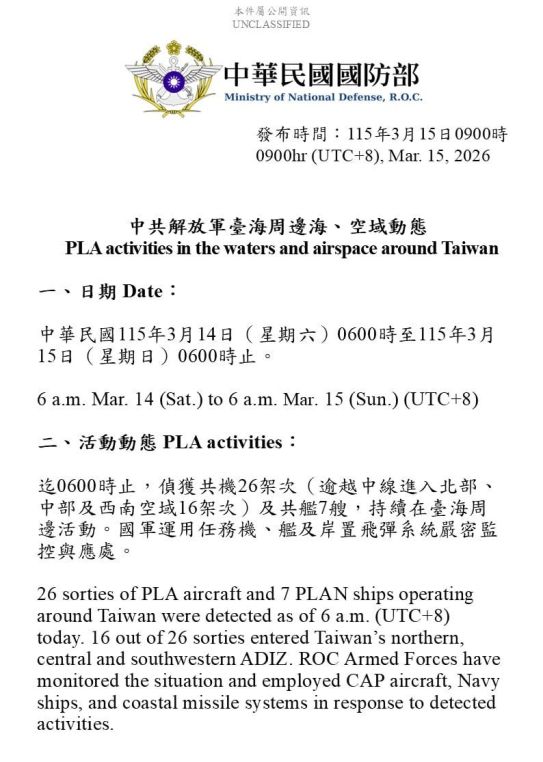
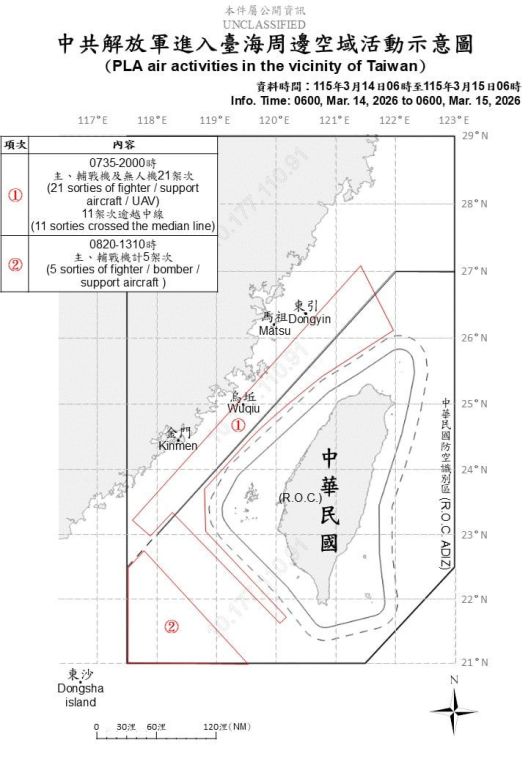
Beijing observed the same signals. Strategic timing in Chinese doctrine often aligns operational pressure with perceived adversary distraction. Military activity around Taiwan therefore warrants evaluation through multiple analytic frameworks rather than a single linear explanation.
Project Omega May 25-29 Prague
Operational Tempo and Momentum Reversal
Momentum-Reversal Analysis detects shifts that reveal concealed decision cycles. PLA activity displayed a clear pattern.
Late February showed a sudden decline in aircraft incursions near Taiwan. Reports recorded multiple days without significant PLA aircraft presence across the median line. Analysts initially interpreted the lull as routine fluctuation tied to domestic political meetings in Beijing.
Mid-March ended that lull abruptly. Twenty-six aircraft sorties and multiple naval vessels appeared around Taiwan almost immediately after confirmation that American amphibious forces departed the Pacific theater.
Operational pauses followed by sudden resumption often indicate recalibration rather than de-escalation. Command structures observe adversary movement, re-assess risk tolerance, then resume pressure under new strategic conditions. Chinese planners likely evaluated three variables during the lull.
American force diversion toward the Middle East
Taiwan arms procurement timelines
Global economic turbulence tied to energy disruption. Reactivation of PLA air patrols after those signals aligns with a monitoring phase followed by renewed coercive pressure.
Adversarial Cognitive Simulation of Beijing
Adversarial Cognitive Simulation reconstructs how decision makers interpret the environment.
Chinese leadership views reunification with Taiwan as an irreversible historical objective. Internal messaging frequently describes the process as inevitable rather than optional. Military planners therefore search for windows that lower the risk of foreign intervention.
American engagement in the Persian Gulf offers such a window. Redeployment of amphibious forces and missile defense assets signals competing priorities inside U.S. strategic planning. Chinese observers may interpret those moves as temporary weakening of Indo-Pacific deterrence.
Taiwan’s rapid defense modernization introduces another pressure point. Legislative approval for roughly nine billion dollars in U.S. weapons packages includes systems such as HIMARS rocket artillery and M109A7 self-propelled howitzers. Delivery delays and contract expiration deadlines create incentives for Beijing to act before those systems integrate into Taiwanese operational planning.
Perceived time pressure often shapes authoritarian decision cycles. Beijing may believe current conditions represent a narrowing opportunity before Taiwan’s defense network becomes significantly stronger.
Causal Density of the Emerging Crisis
Causal Density Mapping examines interacting drivers rather than isolated events. Four interconnected systems define the present escalation environment.
Military posture shifts
Economic shocks tied to energy markets
Technological dependency centered on semiconductor production
Political pressure inside major powers
American military resources currently divide between the Middle East and Indo-Pacific theaters. Missile defense interceptors, amphibious forces, and naval escorts represent finite assets. Consumption of high-end interceptors during Middle Eastern operations increases strain on existing stockpiles.
Energy disruption compounds the situation. Iranian activity around the Strait of Hormuz produced oil prices approaching one hundred dollars per barrel. Elevated energy costs affect naval logistics, transportation networks, and domestic political tolerance for prolonged conflict.
Semiconductor dependency adds a structural vulnerability. Taiwan produces more than ninety percent of the world’s most advanced chips. Global manufacturing sectors rely on those chips for artificial intelligence systems, consumer electronics, automotive control units, and defense electronics.
Economic modeling suggests that a large disruption in Taiwanese semiconductor production could trigger cascading effects across technology markets and financial systems.
Adaptive Threat Calibration
Adaptive Threat Calibration measures threat escalation dynamically.
Early February assessments classified Taiwan Strait tensions as routine gray-zone pressure. The March surge in PLA activity combined with American redeployments demands reassessment.
Current ATCRI evaluation places Taiwan within the highest tier of strategic risk indicators. Semiconductor dependency magnifies potential consequences of even limited disruption. Studies estimate that significant disruption to Taiwanese chip production could increase global logic chip prices dramatically while damaging industrial output in multiple countries.
Financial exposure further amplifies risk. Technology firms reliant on advanced semiconductors represent a large share of equity market capitalization. Supply interruption would therefore propagate rapidly through financial systems.
Perception Gap and Miscalculation Risk
Perception Discrepancy Analysis identifies divergence between belief and reality. Chinese strategists likely perceive American forces as stretched across multiple crises. Missile defense redeployments and naval movements toward the Persian Gulf reinforce that perception.
American military capacity, however, remains substantial despite operational strain. Long-range strike capability, carrier aviation, and allied support networks continue to provide significant deterrent power.
Miscalculation becomes dangerous when perception diverges from reality. Chinese planners who assume severe American weakness could authorize actions that trigger a far larger response than anticipated.
History offers many examples of conflicts sparked by misjudged adversary resolve.
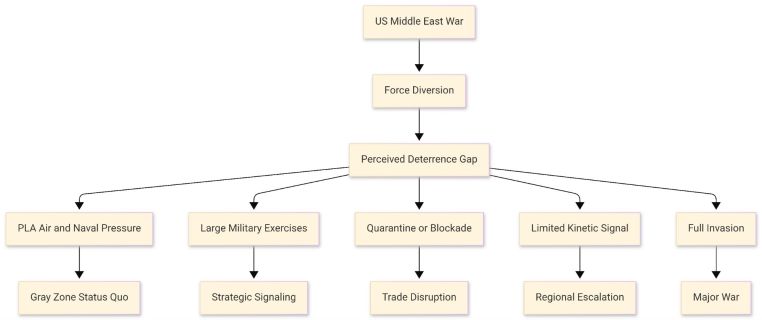
Escalation Pathways
Multiple escalation trajectories remain plausible during the next several months.
Routine gray-zone coercion remains the most probable path. Air patrols, naval presence, and psychological pressure allow Beijing to maintain strategic leverage without crossing kinetic thresholds.
Expanded military exercises form the second path. Large-scale drills involving missile launches and maritime exclusion zones would signal readiness while avoiding immediate combat.
Maritime quarantine operations represent a third pathway. Coast guard inspections and selective shipping interference could disrupt Taiwanese trade without launching an invasion.
Limited kinetic signaling presents a fourth possibility. Missile launches near Taiwanese waters or strikes against small offshore islands would serve as warning demonstrations.
Full amphibious invasion remains the least likely short-term scenario. Large-scale amphibious operations require logistical mobilization that open sources have not yet observed.
Strategic Foresight Cones
Strategic foresight analysis identifies three plausible future trajectories.
Baseline trajectory
Persistent gray-zone pressure continues. PLA aircraft and naval patrols sustain a steady presence designed to exhaust Taiwanese defenses and test political reactions.
Plausible escalation trajectory
Chinese forces implement a partial maritime quarantine while citing legal enforcement of sovereignty claims. Inspection of cargo vessels begins near the Taiwan Strait while PLA naval forces enforce exclusion zones.
Wildcard trajectory
Economic panic linked to semiconductor disruption pushes major powers toward emergency negotiations. Diplomatic talks attempt to stabilize chip supply chains in exchange for political concessions regarding Taiwan’s status.
Wrap up
Convergence of military diversion, economic turbulence, and technological dependency creates a rare geopolitical alignment. American engagement in the Middle East reduces visible military presence in the Indo-Pacific while global markets remain sensitive to energy shocks.
PLA activity around Taiwan increased precisely during that period of strategic distraction. Evidence does not confirm imminent invasion. Evidence does confirm opportunistic pressure designed to probe deterrence boundaries.
Global semiconductor dependency ensures that any disruption in the Taiwan Strait would produce cascading economic consequences far beyond the immediate military theater.
Strategic stability now depends less on raw military power and more on perception management.
Misinterpretation of adversary resolve remains the most dangerous variable in the present crisis.
The strange part of geopolitics shows up here. War sometimes begins not because leaders seek it, but because they believe the other side will not fight back.


You must be logged in to post a comment.