


Anatomy of a Fabricated Mandate
Political historians often characterize the history of regime change in the Middle East as a recurring pathology in which exile movements mistake the hospitality of Western capitals for a genuine domestic mandate. The 2003 invasion of Iraq serves as the modern archetype of this strategic failure. In that instance, Ahmad Chalabi persuaded Western powers that a grateful populace would greet liberators with sweets and flowers, only for the ensuing chaos to expose the vast chasm between diaspora fantasy and domestic reality. The early weeks of 2026 have seen a similar dynamic unfold as Iran faces an unprecedented wave of domestic unrest known as the “Janus Uprising.” Scrutiny of the strategic relevance of Reza Pahlavi II, the former Crown Prince, has intensified and has prompted a comparative analysis with the Chalabi archetype. The Report titled “The Architecture of Failure” identifies a psychological and strategic condition termed “Exile Narcissism” and defines it as a state where the subject’s self-delusion regarding their own popular support becomes an exploitable asset for the very regimes they seek to topple. A deeper forensic analysis reveals critical gaps in this initial framework. These gaps concern the mechanisms of diplomatic reach, the industrial engineering of media influence, and the profound disconnect between diaspora rhetoric and the “Neither Shah nor Clergy” sentiment that flourished during the 2026 Iranian uprising.
Forensic intelligence analysis of the events of January 2026 confirms that this condition has metastasized beyond mere delusion into a quantifiable security vulnerability. Data indicates that the “Pahlavi Mandate” is not merely an exaggeration of popularity but a construct of industrial-scale digital manufacturing. Evidence suggests the Islamic Revolutionary Guard Corps (IRGC) likely tolerates or even facilitates this construct to fracture the genuine opposition. The emergence of the “Neither Shah nor Clergy” slogan in the streets of Tehran and Rasht during the bloodiest days of the crackdown offers the most stinging rebuttal to the restorationist narrative. Pahlavi’s “Rise Iran” campaign generated millions of impressions on Western social media servers while hospital morgues in Iran recorded over 30,000 deaths in forty-eight hours. The population met this slaughter not with Pahlavi’s promised leadership but with his remote calls for rooftop chanting.
The following assessment dismantles the Pahlavi-Chalabi paradigm through four distinct vectors. These include the algorithmic manufacturing of consent, the symbiotic financial architecture of the “Zanjani Network” that underpins the regime’s survival, the diplomatic estrangement from Western capitals, and the profound rejection of centralist authority by Iran’s ethnic periphery.
The Hollow Army and the Industrial Manufacturing of Consent
The central pillar of Reza Pahlavi’s claim to leadership lies in an alleged tidal wave of popular support. Proponents point to millions of online engagements and signatures on the “Rise Iran” campaign as irrefutable evidence of a mandate. Intelligence analysis of the Treadstone 71 forensic audit exposes these metrics as the product of a sophisticated cyber-influence operation that bears the hallmarks of state-level engineering rather than organic human organization.
The Algorithm of Deception
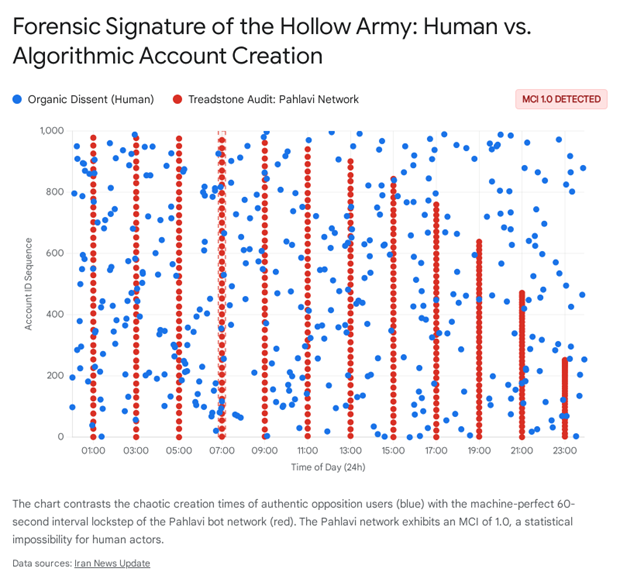
Digital forensics applied to the “Rise Iran” campaign and Pahlavi’s social media ecosystem exposes a “Hollow Army” operating with mechanical precision. Organic human behavior on social networks follows a chaotic distribution known as “jitter,” where real users sleep, eat, and hesitate. The network supporting Pahlavi lacks these human traits.
The Metronome Coherence Index (MCI) measures the timing consistency of account creation and engagement. A score of 0.0 represents chaos or human behavior, while 1.0 represents perfect machine synchronization. The audit of 356,941 Pahlavi-aligned accounts returned an MCI of 1.0.1. These accounts were created at exact sixty-second intervals and formed a “perfect grid” of digital infantry. The system generated streaks of over 1,200 consecutive accounts on peak operation days in June 2025 without a single deviation from the sixty-second rhythm.1 Such precision is impossible for human operators and indicates the use of high-latency botnets designed to overwhelm social media algorithms.
Stylometric Collapse and the Scripted Voice
The content of the support reveals a “Stylometric Entropy Collapse” beyond the timing of account creation. Human language is complex and unpredictable, and typically registers a lexical entropy score above 0.7. The comments and posts flooding Pahlavi’s channels during engagement bursts registered an entropy score below 0.35.1. The “voice” of this movement is procedural rather than expressive.
Over 55 percent of comments across platforms were exact string duplicates, while another 23 percent qualified as “near duplicates” that differed only by a single emoji or punctuation mark.1 The linguistic fingerprints include shared unique typos such as the phrase “We king again Iran” appearing across thousands of ostensibly independent accounts simultaneously.1 This “collision” of errors confirms a single operator or script source rather than a decentralized movement of millions.
The “Rise Iran” signature campaign further corroborated this artificiality. Data showed near-perfect autocorrelation of 0.976, alongside unnatural vertical stacking, which identifies signatures injected by a script rather than organic human participation.1 The forensic investigation utilized NFKC Unicode Normalization to standardize characters and Homoglyph Sanitization to detect lookalike symbols because bots often hide behind Cyrillic or Greek characters to evade filters.1
The Trojan Horse Symbiosis with the Regime
The investigation describes a “Grand Inquisitor” strategy in which regime-controlled assets seed specific slogans, such as #ThisIsTheFinalBattle. The Pahlavi bot network automatically detects these trends and mass-amplifies them to create an illusion of viral momentum. The Islamic Republic then points to this bot-driven activity as proof that the opposition is “foreign-backed” and “inauthentic” and thus validates their repression of genuine domestic dissent.1 Pahlavi serves as the perfect foil for the Islamic Republic in this “Architecture of Failure.” He becomes a scarecrow that allows the regime to frame the conflict as a choice between “Stability” and “Monarchist Restoration,” effectively erasing the democratic and republican alternative that the majority of Iranians actually seek.
Vector Two- The Zanjani Network and the Financial Grey Zone
The financial substrate of the Iranian conflict is defined by the “Zanjani Network,” while bots manipulate the digital sphere. Understanding the failure of the exile opposition requires analyzing the financial ecosystem that sustains the regime they seek to topple. The Pahlavi critique often ignores the complexity of the regime’s survival mechanisms and assumes that sanctions alone will induce collapse.
The Zedcex-IRGC Nexus
The 2026 Crypto Crime Report by TRM Labs identifies the UK-registered exchanges Zedcex and Zedxion as critical nodes in the IRGC’s sanctions evasion network.2 These entities present a veneer of legitimate corporate registration but function as a “stablecoin clearing hub” for the Revolutionary Guards. These platforms moved approximately USD 1 billion in IRGC-linked funds between 2023 and 2025 by utilizing the TRON blockchain for its speed and low transaction costs.4
The connection to Babak Morteza Zanjani is explicit. Zanjani is the notorious “sanctions-evasion financier” who previously faced a death sentence for embezzlement before his release in 2024. He was a director of Zedxion until days before Zedcex was incorporated with the same address and control structure.2 The significance of this network lies in its integration with the domestic Iranian economy. Funds routed through this offshore infrastructure interact directly with local exchanges like Nobitex, creating a “blurred operational environment” where retail users and terror financiers coexist on the same rails.3
Table 1 illustrates the scale of the financial flows facilitated by the Zanjani network for the IRGC. The sharp increase in 2024 highlights the regime’s growing reliance on this channel during periods of intense geopolitical pressure.
| Year | Total IRGC-Linked Volume (USD) | Share of Total Exchange Activity |
| 2023 | $23.7 Million | 60% |
| 2024 | $619.1 Million | 87% |
| 2025 | $410.4 Million | 48% |
Source- TRM Labs 2026 Crypto Crime Report 5
The Strategic Blind Spot
The existence of this network highlights a critical gap in the Pahlavi-Chalabi paradigm. Chalabi’s failure was political, but Pahlavi’s failure is also forensic. The opposition focuses on rhetorical delegitimization, while the regime constructs a robust, blockchain-based parallel financial system. The “Zanjani Network” demonstrates that the regime has adapted to “strategic submission” mandates by becoming a “sovereign criminal enterprise.”
The “symbiotic relationship” hinted at in the Treadstone 71 audit suggests that the same “White SIM” infrastructure that enables bots to operate may also facilitate crypto-mining and trading activities that sustain the Zanjani network. The regime has effectively captured the digital battlefield and uses it to both fund its repression and manipulate its opposition.
Vector Three- The Janus Uprising and the Rejecting Periphery
The actual test of any exile movement is its resonance with the domestic population. The January 2026 uprising provides the empirical data needed to evaluate Pahlavi’s standing and is dubbed the “Janus Uprising” for its dual rejection of past and present dictatorships. The slogan “Neither Shah nor Clergy” has become the defining chant on the streets and signals the maturation of the Iranian protest movement beyond the binaries offered by the diaspora.6
The Geography of Rejection
Data from the GAMAAN “Political Preferences in 2024” report dismantles the myth of nationwide monarchist support. Pahlavi enjoys 42 percent support in his ancestral stronghold of Gilan, but his appeal collapses in the critical ethnic peripheries.7 Support for the monarchy plummets to 15 percent in Kurdistan and sits at 17 percent in West Azerbaijan.7 These regions have borne the brunt of the regime’s brutality and overwhelmingly favor a federal and secular republic.
Table 2 breaks down the regional disparities in support for the monarchy and reveals a sharp divide between the central Persian provinces and the ethnic periphery.
| Region | Support for Reza Pahlavi / Monarchy | Dominant Political Preference |
| Gilan | 42% (Highest National) | Monarchy |
| Alborz | 40% | Monarchy |
| East Azerbaijan | 20% | Secular Republic / Federalism |
| West Azerbaijan | 17% | Federal Republic |
| Kurdistan | 15% (Lowest National) | Federal Republic |
Source- GAMAAN Analytical Report 2025 7
The “National-Centric Fear” in these regions is palpable. The memory of Pahlavi-era suppression and the enforced homogenization of language and culture remains a potent political force. Pahlavi’s supporters in the diaspora actively alienate the very populations currently leading the fight against the IRGC when they attack federalist sentiments as “separatism.” Narges Mohammadi, the Nobel laureate imprisoned in Tehran, has trenchantly described the Pahlavist movement as “the opposition against the opposition” and notes that their toxic online behavior fractures the unity required to challenge the state.8
The Rasht Massacre and the Disconnect
The disconnect between the exile leadership and the street reached its nadir during the “Rasht Market Massacre” in January 2026. Security forces slaughtered civilians trapped in a bazaar as part of a crackdown that killed over 30,000 people in 48 hours.9 Reza Pahlavi issued calls for “rooftop chants” during this same period.10 The juxtaposition of industrial-scale slaughter with performative and low-risk resistance tactics exposed a “strategic architecture” entirely unsuited for the reality of the conflict.
Dr. Amir Parasta’s hospital data reveals 30,304 deaths on January 8 and 9 alone and underscores the severity of the violence.11 The regime deployed heavy machine guns and foreign mercenaries to create a kill zone that no amount of hashtag activism could breach. Pahlavi’s failure to provide logistical support or communications infrastructure, such as Starlink, or a strike fund for workers, rendered his leadership symbolic at best and negligent at worst.12
Table 3 juxtaposes the digital activity of the Pahlavi campaign with the physical reality on the ground during the peak of the violence.
| Date Range (Jan 2026) | “Rise Iran” Campaign Activity | Physical Reality in Iran |
| Jan 6-7 | “Millions” of impressions; trending hashtags. | Protests intensify; Internet blackouts begin. |
| January 8 | Calls for rooftop chanting; Twitter spaces are active. | Massacre begins. Hospitals record ~15,000 deaths. |
| January 9 | Botnet engagement peaks; “Victory” slogans trending. | Massacre peaks. 18-wheelers used for corpses. Total deaths- 30,304. |
| January 10 | Continued digital amplification. | Morgues are overwhelmed; a 400-hour blackout consolidates. |
Source- Comparison of Treadstone 71 Audit 1 and Time Magazine/Dr. Parasta Data 9
Vector Four- The Diplomatic Vacuum and the Chalabi Test
The final component of the “Architecture of Failure” is the exile leadership’s inability to secure genuine international backing. Ahmad Chalabi initially succeeded because he embedded himself in the Pentagon’s strategic planning. Reza Pahlavi remains on the periphery of power despite decades of residence in the United States.
The Trump Assessment
President Donald Trump’s assessment of Pahlavi in January 2026 was devastatingly dismissive when he stated, “He seems very nice… but I don’t know whether or not his country would accept his leadership. “.13 This comment reflects a shift in U.S. policy from active regime change to “strategic submission” via economic pressure. The White House views Pahlavi not as a partner but as a “nice” irrelevance. The refusal to commit to a post-regime roadmap indicates that Washington has learned the lessons of 2003, even if the Iranian opposition has not.
The Missing Strategic Architecture
The Cost of Delusion
The “Exile Narcissism” identified in the initial Report is not merely a psychological quirk but a structural flaw that the Islamic Republic has weaponized. The regime ensures that the only visible alternative to its rule is one that large swathes of the population will never accept by inflating Pahlavi’s support through botnets and allowing him to monopolize the opposition narrative.
The Pahlavi-Chalabi paradigm holds true but with a tragic twist. Chalabi’s failure led to a war that destroyed a country. Pahlavi’s failure is helping to preserve one of the world’s most repressive dictatorships. The “Neither Shah nor Clergy” sentiment is not apathy but a desperate demand for a third way—a democratic and secular republic that neither the regime nor the exile elite is willing to offer. The architecture of failure will remain the only structure standing in Tehran until the opposition dismantles its “Hollow Army” and builds a coalition rooted in the reality of Iran’s diverse and devastated society.
Works cited
- The Anatomy of a Mirage- Treadstone 71 Forensic Audit Exposes …, accessed February 8, 2026, https-//irannewsupdate.com/news/general/the-anatomy-of-a-mirage-treadstone-71-forensic-audit-exposes-the-industrial-scale-manufacturing-of-reza-pahlavis-digital-support/
- In 2024 UK crypto firm moves $619.1 million on behalf of the Islamic Revolutionary Guard Corps (IRGC) – Comsure, accessed February 8, 2026, https-//www.comsuregroup.com/news/in-2024-uk-crypto-firm-moves-6191-million-on-behalf-of-the-islamic-revolutionary-guard-corps-irgc/
- OFAC Sanctions Zedcex and Zedxion in First-ever Designation of an IRGC-linked Digital Asset Exchange – TRM Labs, accessed February 8, 2026, https-//www.trmlabs.com/resources/blog/ofac-sanctions-zedcex-and-zedxion-in-first-ever-designation-of-an-irgc-linked-digital-asset-exchange
- 2026 Crypto Crime Report – Illicit Crypto Trends & Typologies | TRM …, accessed February 8, 2026, https-//www.trmlabs.com/reports-and-whitepapers/2026-crypto-crime-report
- How Two UK-registered Companies Moved Over a Billion in …, accessed February 8, 2026, https-//www.trmlabs.com/resources/blog/how-two-uk-registered-companies-moved-over-a-billion-in-stablecoins-for-the-irgc
- Iran’s protest chants- From reformist appeals to calls for monarchy | Iran International, accessed February 8, 2026, https-//www.iranintl.com/en/202601052740
- Analytical Report on “Iranians’ Political Preferences in 2024 …, accessed February 8, 2026, https-//gamaan.org/2025/08/20/analytical-report-on-iranians-political-preferences-in-2024/
- Iranians Are Protesting. Reza Pahlavi Can’t Save Them – Time Magazine, accessed February 8, 2026, https-//time.com/7344936/iran-protest-reza-pahlavi-ayatollah/
- More Than 30000 Killed in Iran, Say Senior Officials – Time Magazine, accessed February 8, 2026, https-//time.com/7357635/more-than-30000-killed-in-iran-say-senior-officials/
- How Trump Reset the Opposition’s Conversation About Iran’s Future – Middle East Forum, accessed February 8, 2026, https-//www.meforum.org/mef-observer/how-trump-reset-the-oppositions-conversation-about-irans-future
- Iran Protest Death Toll Could Top 30,000 – Genocide Watch, accessed February 8, 2026, https-//www.genocidewatch.com/single-post/iran-protest-death-toll-could-top-30-000
- The Debt We Owe the Dead – Middle East Forum, accessed February 8, 2026, https-//www.meforum.org/mef-reports/the-debt-we-owe-the-dead
- Trump Casts Doubt on Iran’s Exiled Heir as U.S. Keeps Distance from Regime Change, accessed February 8, 2026, https-//moderndiplomacy.eu/2026/01/15/trump-casts-doubt-on-irans-exiled-heir-as-u-s-keeps-distance-from-regime-change/


You must be logged in to post a comment.