


The author, Angel Gomez, argues that the memory of the 1953 CIA coup (Operation TPAJAX) haunts current US-Iran relations. Gomez posits that while proof of current US involvement in Iranian protests is lacking, the historical precedent creates a valid suspicion. The text highlights US capabilities for covert influence (cyber, financial, narrative) but distinguishes capability from intent. It references Dan Kovalik’s book The Plot to Attack Iran to suggest a pattern of US provocation. The core thesis is that the truth of today’s events might not be known until 2089, mirroring the 64-year delay in declassifying TPAJAX files.
Critical Analysis of the Historical Anchor
Relying on 1953 to explain 2025 constitutes a failure of imagination and analysis. The author falls into the trap of historical determinism. Operation TPAJAX occurred in a specific Cold War context. Applying that template to the modern digital age ignores the agency of the Iranian people. The “Ghost of 1953” narrative serves the current regime in Tehran more than it enlightens the observer. The Mullahs use this history to delegitimize organic dissent. Blaming the “Foreign Hand” remains the oldest trick in the autocrat’s playbook.
Cognitive Warfare and the “Plausible Deniability” Trap
Gomez discusses “plausible deniability” as a US tool, yet fails to see how the concept works in reverse. The Iranian regime uses the plausibility of US interference to deny the reality of internal rot. The argument creates a “Reflexive Control” loop. Western analysts, afraid of repeating history, hesitate to support legitimate freedom movements. The fear of being called an imperialist paralyzes the moral compass.
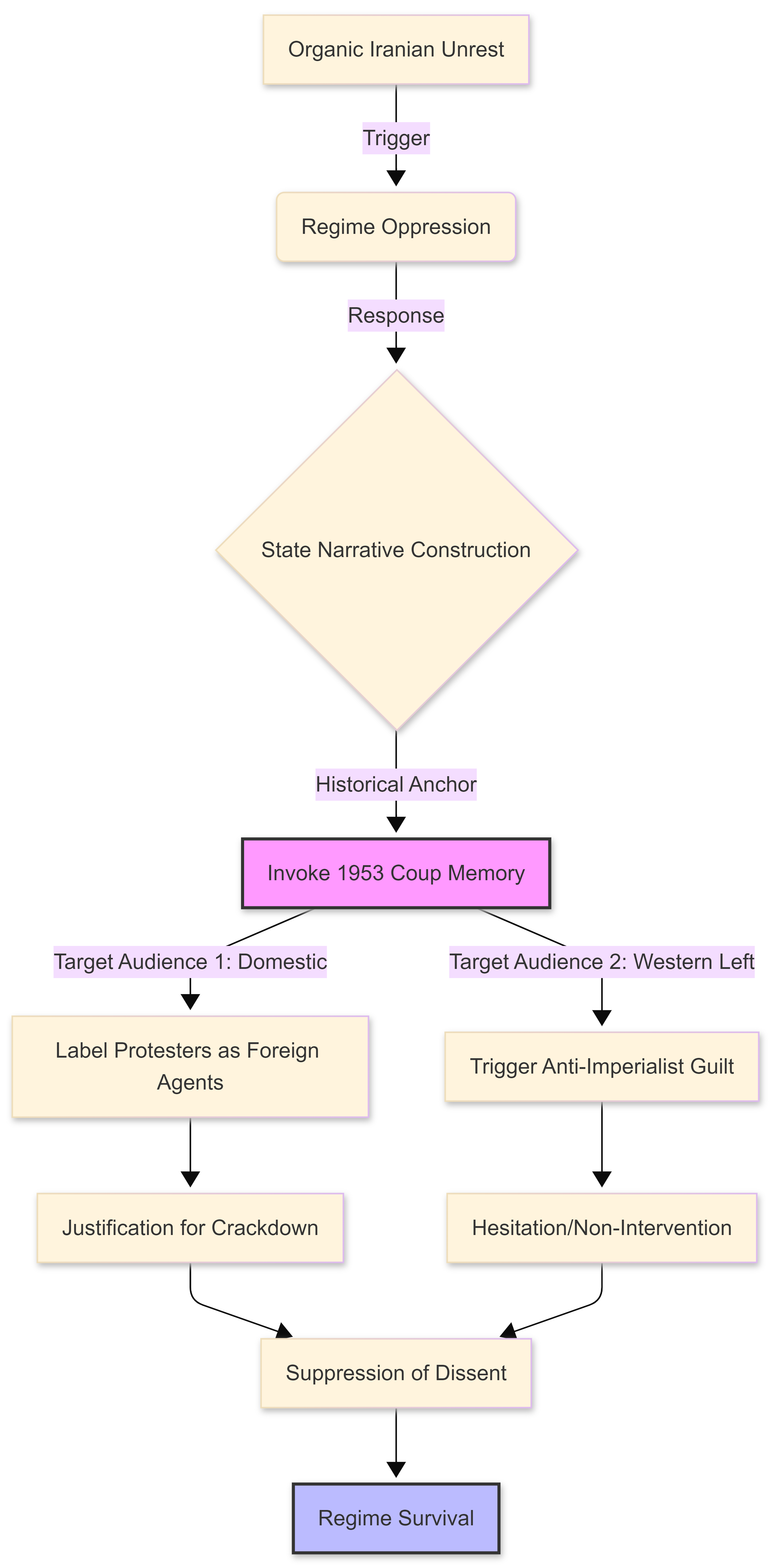
Visualizing the Cycle of Dissent and Blame
The following chart demonstrates how the “1953 Narrative” neutralizes external criticism and internal dissent.

Forensic Linguistics and Stylometrics
The text uses phrases like “cloaked in democracy rhetoric” and “asymmetry of language.” These choices reveal a specific bias. The author equates US support for Israel with terrorism while contextualizing Hezbollah as “resistance.” Such semantic inversion signals a clear ideological stance. The use of “whispers” and “ghosts” attempts to emotionalize the intelligence analysis. Intelligence deals in hard data, not spectral metaphors. The reliance on Dan Kovalik, a known critic of US foreign policy, further narrows the analytic aperture. It creates an echo chamber rather than a balanced assessment.
Adaptive Intelligence Lifecycle Assessment
The “wait until 2089” argument represents analytic defeatism. Intelligence professionals do not wait for declassification. We analyze the noise now. Pattern analysis of current protests shows distinct differences from 1953. The demographics, the digital coordination, and the slogans (“Death to the Dictator”) originate from the streets, not a CIA safehouse. Attributing the courage of Iranian women and youth to a foreign intelligence agency insults their agency. It reduces them to pawns in a great power game they are actively trying to exit.
Gomez’s article serves as a warning, but not the one intended. The piece illustrates how historical trauma can be weaponized to paralyze modern analysis. The Cultural Nexus framework demands we look at the Iranian people’s current reality, not just the US archives. Focusing solely on what the CIA might be doing obscures what the Iranian regime is doing. The true intelligence failure lies in ignoring the obvious to hunt for the covert. The ghosts of the past should not dictate the future of the living.